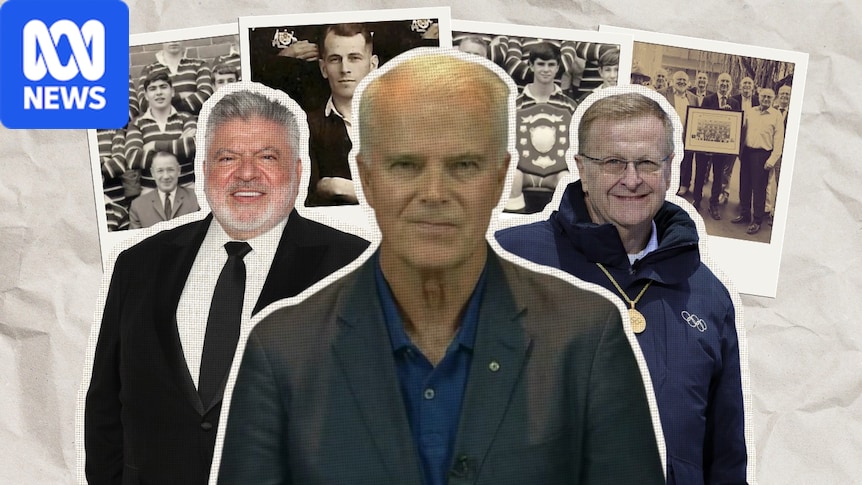

It’s not easy for Gordon Bray to name his favourite memory from a lifetime involved with rugby union.
Regarded as one of international rugby’s greatest broadcasters, Bray called almost 400 Test matches, including a host of significant moments in the Wallabies’ storied history.
World Cup victories, the 1984 Grand Slam, series wins over the All Blacks, and British and Irish Lions … Bray was behind the microphone for so many of Australian rugby’s milestone achievements.
His service to the game and sport broadcasting was recognised in 2005 when he was made a Member of the Order of Australia in the Queen’s Birthday Honours list.
Gordon Bray called rugby during his broadcast career with the ABC, and the Seven and 10 networks. (ABC)
But aside from Bray’s commentary work, there’s one event from his rugby journey he considers to be among his most treasured memories.
Bray was scrum half in the 1965 Homebush Boys High first XV when they won the prestigious NSW-wide knockout competition, the Waratah Shield.
“I think that Waratah Shield victory is right up there with any rugby experience I’ve been involved with,” Bray tells ABC Sport.
Bray isn’t the only member of Homebush’s 1965 first XV who proudly remembers the tense 8-3 win over Oakhill College in the Waratah Shield final.
Packing down in the second row that day was John Symond, later to become one of Australia’s best-known businessmen when he founded Aussie Home Loans.
“The Waratah Shield was definitely the highlight of my whole school experience, that’s for sure,” Symond recalls.
“It just stands out as the pinnacle of my schooling.”
The official team photo of the 1965 Homebush Boys High first XV. (Gordon Bray)
Partnering Bray in the halves was another of the first XV’s stars, Greg Bell.
A first-grade player for the respective Western Suburbs rugby and cricket clubs in Sydney after leaving school, Bell enjoyed several highlights in his sporting career.
But the Waratah Shield win is among the most cherished.
“It meant a hell of a lot,” says Bell, casting his mind back 61 years.
Bell scored the winning try in the final, a moment he’s often recounted to his children.
“That win is a story we heard many times over the years,” Bell’s daughter Mel says with fondness.
Capturing the first XV’s performances as the team’s photographer was John Coates, who would become International Olympic Committee (IOC) vice-president and Australia’s most influential sporting administrator.
Bray considers Coates as much a part of the Waratah Shield triumph as any of the players who took the field.
For Coates, being around the first XV was an experience he reflects upon with affection.
“They were my heroes,” says Coates, who was Australian Olympic Committee (AOC) president from 1990-2022.
The 1965 Homebush Boys High first XV returned to the school in 2025. (Facebook: Homebush Boys High)
To mark the 60th anniversary of the Waratah Shield win, Coates, Bray, Symond, Bell and other members of the first XV returned to their old school in Sydney’s west as guests of honour last year.
They’re now in their late 70s, but the bonds of friendship have survived the test of time, and the emotion of the victory remains as strong as ever.
“I can still feel it today,” Bray says with pride.
‘Our own little dynasty’
Jack ‘Pug’ Mason was brief and to the point.
Speaking to a select group of year-nine rugby players in 1964, the Homebush Boys High first XV coach let them know they were on his radar.
“He (Mason) picked out five of us and said, ‘You’re going to be playing in the firsts next year,'” remembers Bray, who was a supremely talented scrum half.
“There were five boys from year 10 in the 1965 team, and the rest were doing their leaving certificate.”
Mason’s decision to mix rookies with experienced campaigners was the perfect recipe for winning the Waratah Shield, which was the high-water mark in Homebush’s rugby history.
But the school was already a dominant force in the sport before its crowning achievement.
Ex-students Arthur Summons (a dual international) and Geoffrey Vaughan represented the Wallabies and played three Tests together in 1958, which was a rare achievement for a public school.
Geoffrey Vaughan (fourth from right in back row) and Arthur Summons (right in front row) before the Wallabies’ 1958 Test against England at Twickenham. (Getty Images)
As the NSW Combined High Schools Sports Association (CHS) reorganised sport into fixed zones at the beginning of the 1960s, Homebush continued to make its presence felt in rugby.
The school had a stranglehold on the North-West Metropolitan CHS zone, winning eight straight first-grade premierships between 1961-68.
Bray’s elder brother John was 1963 first XV captain, guiding his team through an undefeated run in the zone, which was arguably the CHS’s strongest.
Gordon Bray remembers Homebush’s zone matches with fondness. (Getty Images: Cameron Spencer)
“It was a very fierce rugby zone,” Bray says.
“Our main rivals were Epping Boys High and Normanhurst Boys High.
“They were laden with talented players, and we always had ding-dong battles but managed to still win our zone premiership.
“We were forging our own little dynasty out there at Homebush in the western suburbs.”
CHS rugby enjoyed a golden era in the 1960s, with almost 70 public schools involved in the game by the end of the decade, and Homebush was one of the powerhouses.
Homebush players regularly appeared in the CHS first XV, which proved more than competitive against their rivals from NSW’s hallowed private school competitions in the annual representative matches.
Highlights of these fixtures for the CHS first XV included a convincing 42-0 defeat of Combined Associated Schools in 1966 and a 28-3 triumph over the Athletic Association of the Great Public Schools in 1968.
The CHS and CAS first XVs pictured playing each other in the 1960s. (Mitchell Library/State Library of NSW/Tourism Australia)
It wasn’t uncommon for CHS schools to offer both rugby union and league, and Homebush was no different.
But there’s no doubt about which code was the school’s top priority.
“The school had a fantastic rugby culture,” Bray says.
“We did have rugby league at the school, but rugby union was very much the number one football code.”
Homebush’s fearsome record in rugby didn’t go unnoticed.
It helped convince a talented forward at St Patrick’s College Strathfield to ask his parents if he could switch schools.
All roads lead to Homebush
It’s fair to say John Symond didn’t take the direct route to Homebush Boys High.
“My parents had fruit shops,” Symond explains.
“They used to build up a little fruit shop, sell it and get a few bob.
“My older brother, sister and me would hop on the back of an old fruit truck and go to another suburb and so on.
“That is why I went to 11 schools.”
John Symond played in the second row for the 1965 Homebush Boys High first XV. (Getty Images: Brendon Thorne)
Before starting at Homebush, which was the 11th school, Symond attended St Patrick’s for two terms after his family made a mid-year move from Queensland to Sydney.
They had a business in Strathfield, so it made sense for Symond to be enrolled at St Patrick’s, which was a Christian Brothers school.
Symond, however, had other ideas.
“The reason I switched to Homebush for my last two years of high school was I was playing sub-district rugby and half of the team all went to Homebush,” he says.
“I got my parents to agree for me to switch to this great school I told them about.”
Homebush Boys High has paid tribute to John Symond’s first XV career. (Facebook: Homebush Boys High)
There was one detail, though, Symond chose to leave out when he spoke with his parents.
“I didn’t mention anything about playing rugby, but that was the reason I went,” Symond says with a chuckle.
Symond played third grade after arriving at Homebush, before graduating to the first XV in his final year of school.
Like Bray, he would be one of several fresh faces in 1965, while the first XV would also welcome a recruit to their off-field staff.
‘Such a good organiser’
When John Coates was drafted into service as the first XV’s photographer, Bray gave his close friend a firm instruction.
“The condition was I had to capture his dive pass,” Coates says.
His work behind the lens was ultimately given the seal of approval.
“He managed to get a couple of good shots,” Bray cheekily says.
Gordon Bray performing the perfect dive pass for Homebush. (Supplied)
Coates was in the same school year as Bray and excelled at rowing as a coxswain.
He would captain Homebush Boys High’s rowing squad and earn a school blue.
Coates didn’t play rugby but relished being involved with the first XV.
“I was not a footballer,” Coates says.
“I had a congenital hip issue, and I had to stop playing as it was too dangerous.
“Because I couldn’t play, they were the people I liked to mix with.”
Sport meant everything to Coates, and Homebush was the ideal setting to cultivate his passion.
“We had a lot of fun with sport,” Coates says.
“It’s what you went to school for.”
Bray shared Coates’s love of sport, but occasionally the pair got up to some old-fashioned mischief.
“My only problem with Gordon was he was one of those who led me on the punt at a young age,” Coates says with a laugh.
“We’d nick off from school and get out to Canterbury or Randwick (racecourses). We had a lot of fun.”
John Coates has been involved with the Olympic movement for much of his professional life. (Reuters: Denis Balibouse)
Both knew when it was time to be serious, however, with Coates ultimately given added responsibilities as the first XV’s “de facto manager”.
But Bray still had an influence on some of Coates’s tasks when he began his expanded role.
“Gordon proposed that I select the best-and-fairest award,” Coates says.
“Of course, Gordon would win that every week.
“Somehow, Gordon had me consulting or being a team selector as well, which was just as crazy.”
The managerial experience held Coates in good stead when he continued his involvement with rowing after school.
His professionalism and attention to detail were among the reasons he quickly rose to become Australia’s rowing section manager at the 1976 Montreal Olympics, aged just 26.
It was the start of Coates’s remarkable career with the Olympic movement.
John Coates was Australia’s chef de mission at six consecutive Olympics. (Reuters)
Among a multitude of appointments, he served as IOC vice-president (2013-17 and 2020-2024) and a member of its executive board (2009-12), and was Australia’s chef de mission at six Olympics (1988-2008).
During his tenure as AOC president, Coates played a significant role in Australia’s revival on the Olympic medal tally.
“In the final two years at Homebush, he (Coates) was involved in managing the first XV as he was such a good organiser,” Bray says.
“You could see Coatesy was one step ahead. He has been our pre-eminent sporting administrator.
“It all began at Homebush.”
Authority and charisma
Jack Mason’s players didn’t feel they needed to ask their coach how he got the nickname ‘Pug’.
“He looked as though he had been in the boxing ring with his flattened nose,” Bray says with the utmost respect.
Homebush’s first XV coach Jack Mason (centre of back row). (Supplied)
Mason began at Homebush as a physical education teacher in 1951 following postings in Dubbo, Mudgee, Parkes, North Strathfield and Ashfield.
He eventually became first XV coach and sports master, the latter being a fitting appointment given his family’s athletic pursuits.
Their proudest sporting achievement came when daughter Michele won silver in the women’s high jump at the 1964 Tokyo Olympics.
Mason wasn’t afraid to enforce discipline at Homebush, although first XV players conveniently escaped punishment.
“I remember with PE classes, he would lock up the change rooms and be the last into the gymnasium,” Bray says.
“All hell would be breaking loose before he got there.
“He’d arrive, and suddenly everyone would be like, ‘Oh God, he’s here,’ and he would start reprimanding students.
“To anyone in the first XV he would say, ‘You’re OK.'”
Jack Mason’s daughter Michele won an Olympic silver medal as a high jumper. (Getty Images)
As a rugby coach, tactics weren’t Mason’s strong suit.
“He wasn’t a real strategist, but he really believed in us,” Bray says.
“He had authority as a coach, but it was more his charisma that had an effect.”
Greg Bell also noted Mason wasn’t a master tactician, although he couldn’t fault his effort.
“He put everything he had into it,” says Bell, who first played under Mason in 1964.
“He was as conscientious as anyone could be.”
Symond still speaks glowingly of Mason, who he felt had genuine care for his players.
“He was terrific,” Symond says.
“He was quite dedicated to our team. He took a real strong interest in us. He was so involved.”
Mason may have lacked tactical acumen, but he had an ace up his sleeve.
Late in the 1965 season, ‘Pug’ called upon a friend who lived near the school.
That friend’s name?
George Thomas Bryan Palmer.
Homebush’s ‘secret weapon’
Bryan Palmer, as he was more commonly known, served as a Wallabies coach during the 1960s.
He also happened to be one of Australian rugby’s most enigmatic characters.
“A phenomenon of nature,” respected Sydney Morning Herald rugby journalist Phil Wilkins wrote of Palmer in 1967.
“Rugby crusader, psychologist by instinct, bombastic, dogmatic … interesting,” Wilkins continued.
“A legend in his lifetime.”
Bryan Palmer was one of Australian rugby’s more colourful characters. (Classic Wallabies)
Born in 1899, Palmer made his mark on Australian rugby as a player and coach.
He was selected for the famous 1927/28 Waratahs tour of Great Britain, Ireland, France and North America but withdrew because his wife was expecting their first child.
When their son was born, he was named Bryan Rugby Palmer.
In 1931, Palmer was included in Australia’s squad for its New Zealand tour but didn’t play a Test after suffering blood poisoning.
Bryan Palmer (with the ball) pictured coaching a rugby team in the 1950s. (UNSW Archives)
Fortuitously, he gained his first experience in supervising players after replacing tour manager Tom Davis, who had to return to Australia.
There were numerous coaching appointments in the following decades, including more than one stint in charge of the Wallabies.
Palmer coached NSW with success, recording a stunning 12-11 win over the All Blacks in 1962 and a 21-9 defeat of Ireland in 1967.
The Sydney Morning Herald’s headline describing NSW’s win over the All Blacks in 1962. (Supplied)
His coaching philosophy was built around demanding commitment from players, both on and off the field.
Hyperbole was frequently used to illustrate his point.
“Nobody’s going to get my permission to miss training unless he is dying in his bed,” Palmer bluntly told Wilkins when profiled in the Herald.
In 1965, Palmer wasn’t called upon by Mason to help at Homebush until the Waratah Shield semifinals.
“He was the one who sat us down and worked out what we were to do and where,” Greg Bell says.
Bray describes Palmer as the first XV’s “secret weapon”.
“He would get us in a huddle and start talking with that gravelly voice, but he wouldn’t look at us,” Bray says.
“He sort of looked at the horizon. He’d look beyond us. We were just spellbound, just riding every word.
“When he actually made eye contact with you, you felt a really strong personal connection.
“We all bought into it. It was a little bit eerie but very inspiring.
“We couldn’t believe just how lucky we were.”
Preseason preparations
Before Palmer came on board, the first XV gathered at their home ground, Airey Park, to prepare for the 1965 season.
They knew there were massive shoes to fill.
Bill Laing (left), Greg Bell, Peter Countouris and Nigel Morgan (right) at the first XV’s 2025 reunion. (Facebook: Homebush Boys High)
Homebush had won four straight North-West Metropolitan zone premierships in the top grade by this stage, losing only two matches in the competition during the previous three seasons.
Jack Mason also had a hole to plug in terms of team personnel.
The star of the 1964 first XV was captain Tony Ford, rated by revered CHS coach Bill Toft at the time as the best schoolboy fullback he had seen in more than a decade.
On the CHS tour of New Zealand that same year, Ford was given the nickname ‘Boots’ by none other than the legendary All Blacks fullback at the time, Don Clarke, due to his prodigious talent as a goal kicker.
Clarke was known as ‘The Boot’ for the same reason.
Ford, who would later play first grade for the Western Suburbs rugby league club, was going to be hard to replace.
An excerpt about Tony Ford from a 1969 edition of The Rugby League News. (Rugby League News)
But Mason believed he’d found a worthy candidate: Dave Hassall.
“Dave was a big, sturdy fullback,” Bray says of Hassall, who was also adept at rugby league and cricket.
“He was a goal kicker with a massive boot. A brilliant sportsman.”
Along with Bray, Hassall was one of the year-nine students Mason had identified in 1964 as first XV prospects for the following season.
Bruce Shipton (winger), Frank Gardner (centre) and Warren Piggott (utility forward) were the other three.
The squad could still rely on experience, with third-year veteran and loose forward Peter Countouris named captain, and fly half Bell appointed his deputy.
Among other players returning was mobile “line-out specialist” Warwick Hincksman, who towered over the opposition at 6’3″ tall.
“There was no (preseason) camp or anything like that,” Bray says.
“We just rolled up at training. After school, you’d go down to Airey Park, and Jack would do a lot of talking and stand on the sideline and yell at us.”
Premiership defence
If Homebush’s preseason matches were anything to go by, Mason’s bombastic approach to training was having little impact.
Homebush snuck home 3-0 against St Patrick’s College Strathfield, before falling 19-8 to North Sydney Boys High, who were the giants of the CHS North Shore zone.
But once the North-West Metropolitan competition began, Homebush hit its straps.
“We had to find some centres because we were short in the back line,” Bell says.
“So we got a couple of those (Gardner and Dave Sayers), and we improved as we went along.”
Homebush clinched the zone premiership courtesy of an 8-2 win-loss record, with first-round victories over Epping (14-11), Normanhurst (13-9) and Asquith Boys High (23-3) the highlights.
“The Waratah Shield at the start of the season wasn’t a major focus,” Bray says.
“Our zone rivals were our main target.”
With rugby consuming Bray’s life, his studies sometimes took a back seat on Wednesdays when zone matches were played.
As he sat in class ahead of the afternoon kick-off, Bray’s mind easily wandered.
“On match day, school lessons were a really big distraction,” says Bray, laughing at the memory.
“I remember we always had a double economics period before a match.
“The economics teacher would be shaking his head and saying, ‘You’re not listening to a bloody word I’m saying, are you?’.
“Of course, I was thinking about the game and psyching up.”
‘Pretty serious business’
At its participation peak in the late 1990s, the Waratah Shield was contested by more than 150 schools across NSW and the ACT.
The Commonwealth Bank was a naming-rights sponsor for several years, such was the Shield’s prestige.
Open to public and private schools, the Waratah Shield featured an array of talent during its heyday.
The Ella brothers (Matraville High), Michael O’Connor (Phillip College), Brett Papworth (Epping Boys High), Ricky Stuart (St Edmund’s College), George Smith (Cromer High) … the list can easily go on.
Gary Ella (left), Glen Ella, Eddie Jones and Mark Ella (right) won the Waratah Shield twice with Matraville High. (Getty Images: Matt King)
Named in honour of the 1927/28 Waratahs, the competition was first won by Randwick Boys High in 1963, with Hurlstone Agricultural High School triumphing in its second year.
An ‘also-ran’ in its first two Waratah Shield tilts, Homebush started the 1965 campaign with an 11-6 win over Fairfield Boys High.
Punchbowl Boys High was the next opponent in the quarterfinals, with Homebush claiming a 14-9 victory.
“We didn’t know much about Punchbowl,” Bray says.
“We played them at Airey Park, and they were mainly rugby league players.
“Once we won that quarterfinal, we suddenly realised this is pretty serious business.”
With Homebush safely through to the semifinals, it was time for Jack Mason to bring in the cavalry.
Palmer’s words of wisdom
Having orchestrated a win over the All Blacks as NSW coach, Bryan Palmer was over-qualified to be Mason’s assistant.
So the first XV weren’t surprised when Palmer took control of training ahead of the Waratah Shield semifinal against the highly respected Balgowlah Boys High.
“Poor old ‘Pug’ Mason, he got left in the wings with Bryan around,” Bell says.
“He [Palmer] had so much more acumen and knew what he was doing.”
But not all of Palmer’s instructions were based around on-field strategy.
“He told the backs we had to be show ponies and entertainers,” Bray says.
Gordon Bray worked for ABC Sport from 1969 to 1994. (ABC)
“He said, ‘You guys do all the fancy stuff. You have to be immaculately groomed.’
“‘I want Brylcreem in your hair. I want your collar up and starched. I want your shorts white and starched.’
“‘I want white tape on your boots, and you’ve got to be able to see your own reflection in the toes.'”
Palmer also gave the forward pack a series of directives.
“They had to rub dirt on their face, Vaseline around their eyebrows,” Bray says.
“They had to have dishevelled hair.
“They had to look angry, ugly and mean, and scare the living daylights out of the opposition when they lined up against them before the kick-off.”
Palmer’s words of wisdom had the desired effect, as Homebush defeated Balgowlah 11-3 at Airey Park to earn a spot in the final.
John Symond’s second-row partner Wal Krooglik crossed for a try, which was worth three points at the time.
Prop Nigel Morgan and winger Victor Amasoff also scored tries, while Dave Hassall added a conversion.
By now, excitement about Homebush’s chance of winning the Waratah Shield was building at the school.
A year-eight student was even inspired to write the following poem describing the semifinal victory, dedicating the piece to Mason.
Our second rower with pure nerve
Beat the defender with a body swerve.
Passing defenders by and by,
Went near the posts to score a try.
The kick was taken with good flight
And soared inside the left upright.
The opposition soon kicked high
And our prop crashed in to score a try.
The conversion kick this time was missed
But still eight points were on the list.
Their outside centre had some kicks,
But only one between the sticks.
Next our winger went in to score,
To increase the points three further more.
With now the score eleven to three,
We’d won the match quite comfortably.
Next up was the final, with Oakhill College eagerly awaiting Homebush.
A worthy opponent
Based in the north-west Sydney suburb of Castle Hill, Oakhill College was established by the De La Salle Brothers in 1936, the same year Homebush Boys High first opened its doors.
Oakhill’s march to the 1965 final included a 13-11 win against Homebush’s zone adversary Epping and a 14-6 semifinal victory over Fort Street Boys High.
“Oakhill has always been a good rugby school,” Symond says.
“I still see their name pop up every now and then.”
The final was played at Chatswood Oval, which hosted a NSW vs Queensland interstate fixture earlier that year.
More than 1,000 spectators made the trip to Sydney’s Lower North Shore on a late August afternoon, with Homebush principal Kevin Myers and much of the school’s student body coming out to cheer on the first XV.
Contributing to the sense of occasion, Australia’s top referee Roger Vanderfield was appointed to officiate the final.
Roger Vanderfield was a prominent figure in Australian rugby for decades. (Getty Images)
Despite the demands of his role as medical superintendent of Royal North Shore Hospital, Vanderfield regularly found time in his busy day to partake in what he described as his “relaxation”.
Even family holidays were not off limits.
“Dr Roger Vanderfield, regarded as Australia’s leading rugby union referee, will have charge of a non-competition match between Ainslie and Lyneham at Griffith Park at 12:30pm today,” The Canberra Times reported in 1965.
“Dr Vanderfield, who is holidaying with his family at Thredbo, requested a game in Canberra as he wanted to keep in condition.”
Vanderfield refereed more than 1,200 rugby matches, including 13 Tests.
He served as International Rugby Football Board (now World Rugby) chair, among a series of administrative roles.
When Vanderfield died in 2008 at the age of 80, several obituaries and tributes mentioned he was meticulous about his appearance.
He paid particular attention to his hair, which was noted by the Homebush backs ahead of the Waratah Shield final.
“All the backs were lining up to get to the mirror before the game to make sure there was not a hair out of place,” Bray says.
“We were held up for about 10 minutes because of Dr Roger Vanderfield, who had beautifully slickered hair. He was always immaculately groomed.
“He was in front of the mirror for 10 minutes, so it was very frustrating for the backs who could have been stretching and warming up.
“We were all queued up behind him.”
Once their grooming duties were completed, the Homebush players — resplendent in the school colours of maroon, blue and white — joined Vanderfield and Oakhill on the field and the final got underway.
‘War of attrition’
It may be more than 60 years ago, but Bray’s recollection of the final hasn’t diminished.
“It was a very dour match, I remember,” he says.
“It was a real war of attrition.”
On a more light-hearted note, Bray can recall Homebush receiving a helping hand from Symond’s parents, courtesy of their fruit shop.
“They used to supply us with the oranges at half-time and full-time,” Bray says.
“We had plenty of oranges that day.”
Dave Hassall provided Homebush with its early points. (Supplied)
The score was deadlocked at 3-3 during the second half of a titanic affair, with Homebush’s points coming via a Dave Hassall penalty goal.
“Defence just dominated. It was a war,” Bray reflects.
“Our forwards really got stuck in, but Oakhill was a very good side. It was very hard to make breaks.
“We had excellent backs, and we tried all our fancy stuff, even a little bit of kicking in behind the defensive line with little grubber kicks.”
As the final wore on and tension filled the air at Chatswood Oval, it was clear Oakhill wasn’t willing to concede.
If Homebush was to get on top, a moment of inspiration would be needed.
Greg Bell knew what he had to do.
Bell’s brilliance
Athletic ability came naturally to Bell.
“He was an outstanding sportsman, one of the best schoolboy rugby players I saw,” Bray says of his teammate.
“He was quite a nuggety hard-running type. Very aggressive, built like a mini hooker but he was very fast and very skilful, and had a great rugby brain.”
Greg Bell’s sporting exploits as a teenager attracted local newspaper attention. (Supplied)
Aside from rugby, Bell skippered Homebush Boys High’s first XI cricket team to an undefeated zone premiership in 1965, topping the batting statistics with 277 runs at an average of 70.
In baseball, he had played centre field for the NSW under-16 representative team at the national championships.
With the Waratah Shield final on a knife’s edge, Bell seized his moment on the halfway line when he found a gap in Oakhill’s defence.
“There were a couple of times I cut through between the [Oakhill] five-eighth and the inside centre and one of those was the try in the second half,” Bell says.
“I did it in the first half, and they had enough cover defence to tackle me just short of the line.”
According to Bray, Bell’s try was poetry in motion.
“He burst through on halfway and ran around the fullback,” Bray says.
“It was a piece of individual, game-breaking brilliance.”
Greg Bell (right) pictured with first XV teammate Bill Laing (left) and principal Kevin Myers. (Supplied)
Hassall’s conversion made the score 8-3 in Homebush’s favour, but Oakhill refused to give up.
With Bryan Palmer and Jack Mason’s match-day addresses ringing in their ears, Homebush’s players gritted their teeth and fought through exhaustion to seal victory.
“Their speeches at half-time and before the game were so inspiring,” Bray says.
“They said, ‘This is going to go right down to the wire, and you guys have got to roll your sleeves up all the way.’
“‘If you backs have to get down and dirty in the closing stages, do it.’
“We all just defended, tackled everything in sight and just wouldn’t give an inch, so we were able to squeeze home.
“There was a sense of euphoria about what we had achieved.”
As his teammates celebrated, Bell enjoyed a moment to himself inside Homebush’s dressing room.
But he was soon joined by referee Vanderfield.
“Dr Roger Vanderfield walked into the rooms and sat down next to me and said, ‘Do you know how you scored that try?'” Bell recalls.
“I said, ‘Nah. All I remember is putting the ball down.’
“He said, ‘Well, I’ll tell you. You cut through here, and then you stayed outside, and you didn’t try and cut back in as you had done in the first half.’
“He told me all about it.”
After the Waratah win
Homebush Boys High won the Metropolitan North-West premiership in 1966, but its Waratah Shield defence ended in the early rounds following an 11-8 defeat to Hurlstone Agricultural School.
Hurlstone lost the final 20-3 to a Manly Boys High line-up featuring Stephen Knight, who made his Wallabies Test debut against the Springboks three years later.
Gordon Bray is listed among the first XV captains on Homebush’s honour board. (Supplied)
Bray captained Homebush’s 1967 first XV in his final year, leading the team to another zone premiership.
The Waratah Shield proved elusive, however, with Epping defeating Normanhurst 9-6 in the final to claim the first of three straight titles.
Epping’s 1967 captain, Jack Newton, would achieve international sporting fame eight years later when he finished runner-up to Tom Watson at the British Open following a thrilling 18-hole play-off.
Jack Newton (left), pictured with Tom Watson at the 1975 British Open, was a talented junior rugby player. (Getty Images)
A friendly counterpart to Newton on the rugby field, Bray left Homebush amid much praise, with Jack Mason saying he was “close to being the complete halfback.”
His 1965 teammates couldn’t agree more.
“He (Bray) was one of the best players in the team,” Symond says.
“He was a fantastic halfback.”
Mason departed Homebush at the end of 1968, retiring from the service of the NSW Department of Education.
He would exit a winner after guiding the school to its eighth consecutive zone premiership.
Homebush continued producing rugby talent and added two more Wallabies to its honour board, Fili Finau and Rodney Blake.
Rodney Blake played seven Tests for the Wallabies in 2006. (Getty Images: Chris McGrath)
Blake was a member of Homebush’s 2001 first XV, which won the Metropolitan North-West zone premiership and reached the Waratah Shield quarterfinals.
Incidentally, their quarterfinal loss came at the hands of Oakhill College, who triumphed 26-19.
Homebush no longer enters the Waratah Shield, which is staged in a significantly condensed format (compared to its glory days) and was not contested between 2018-21.
But the school has enjoyed success in other sports, while ex-students Mitchell Starc and the late Phillip Hughes made Homebush proud by playing Test cricket for Australia.
CHS rugby — in the 15-a-side format — isn’t as strong as it once was, although the teachers, coaches and players involved aren’t at fault.
Rugby programs need funding and resourcing, and the public schools can’t compete with the financial war chests enjoyed by those in the private system.
An increase in existing support from governing bodies and clubs is crucial.
“It’s got to be a priority going forward,” Bray says.
“It takes money, good coaching and equipment.”
Return to Homebush
In Bray’s words, “10 survivors” from the 1965 first XV returned to Homebush Boys High last November to present the school with a framed photo of the team and speak with students.
Skipper Peter Countouris flew to Australia from his Greek base for the occasion, illustrating how much the Waratah Shield victory meant to the players.
The Homebush old boys regaled current students with stories about the win, as well as their other experiences at the school.
The 1965 Homebush first XV had the chance to catch up 60 years after their triumph. (Supplied.)
For Greg Bell, who was school vice-captain in his final year, there was a touching moment with one of his successors.
“The school vice-captain walked up to me and said, ‘I believe you were the school vice-captain, so I was wondering if I could get a photo with you as this means a lot to us,'” Bell says.
“It really showed the school has a great background.”
John Coates attended the get-together, much to Bray’s pleasure.
“Having John Coates there was very special,” Bray says.
“He was a fantastic support for the team. It was so good to have him there for the reunion.”
Coates says it was a “wonderful experience”, allowing him to reflect on the profound impact Homebush Boys High had on his life.
When IOC officials toured Sydney during the bidding process for the right to host the 2000 Olympics, he made sure to let them know where he did his schooling.
“The Sydney Olympics were basically at Homebush,” Coates says.
“When we were first selling the bid, I used to make a point: ‘This is where I went to school, just up on the hill there.'”
As the Sydney bid team prepared for the final IOC vote, Coates met with Nelson Mandela during a trip to Africa.
Coates proudly spoke of how Homebush was a beacon of multiculturalism.
“I had an hour with Mr Mandela, along with Gough and Margaret Whitlam, in August 1993 before the vote on Sydney [the following month],” he says.
“In Africa, I was able to talk about the diversity of the students at Homebush Boys High. It was a source of great pride to me.”
The reunion gave the ex-players a chance to reminisce about their victory. (Supplied)
John Symond takes delight in recalling his time at the school.
Selected as the 1965 first XV’s most improved player, Symond still thinks back to the lessons he took from rugby into the business world.
“The memory I have of that is just outstanding,” he says.
“I learned the value of being involved in teams and friendship.”
Injury meant Symond could not continue playing rugby after school, while Bray also hung up the boots when his broadcast career intervened.
He joined the ABC as a specialist trainee in 1969, beginning a 25-year career with the organisation.
“It meant my rugby career was over,” says Bray, who also worked for the Seven and 10 networks.
After Bray’s playing days were cut short, calling international rugby provided decades of highlights.
But there’s a moment that will always hold a special place in his heart.
“That Waratah Shield win is one of my most cherished memories,” Bray says.

 By
By