
This is Naked Capitalism fundraising week. 1317 donors have already invested in our efforts to combat corruption and predatory conduct, particularly in the financial realm. Please join us and participate via our donation page, which shows how to give via check, credit card, debit card, PayPal, Clover, or Wise. Read about why we’re doing this fundraiser, what we’ve accomplished in the last year, and our current goal: more original reporting.
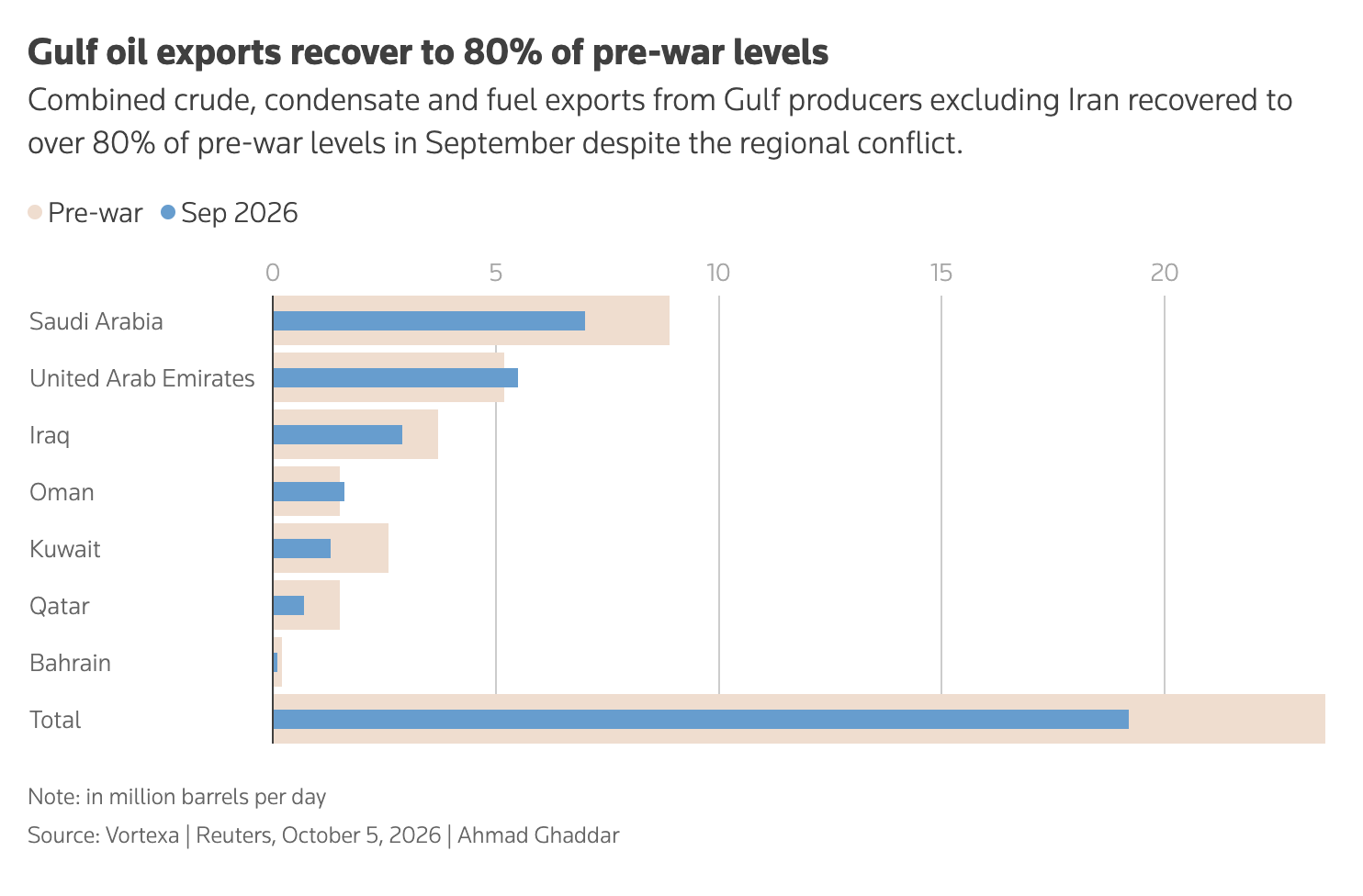
We have some new, directionally consistent assessments on the state of Persian Gulf oil and oil products exports in September. Both Reuters and Standard Chartered contend that in aggregate, they were roughly 80% of prewar levels. As much as that is a marked increase compared to previous months, keep in mind that this still represents an energy starvation diet. Both governments and the private sector have been running down inventories. The US has announced a 40 million barrel Strategic Petroleum Reserve release (which is actually a restatement of earlier drawdown plans). The US has successfully pressured Europeans to tap their diesel reserves. This is not a picture of normalization. And the higher level of Gulf exports do not change that picture. What they do do is slow the trajectory to an intense crunch, as in price hikes, shortages, and/or rationing.
The Reuters and Standard Chartered tallies come up with even higher figures than some careful Twitterati, which was more in 8 to 12 million barrel per day range. However, the high end of the Twitter figures may actually reconcile with the Standard Chartered analysis, which has slightly lower totals than the Reuters account, while still coming up with the 80% of old normal level (that suggests definitions or measurements applied consistently to the two time frames).
Standard Chartered looked at all oil exports, and not just Strait of Hormuz transits, which was the big focus of the debate, and points out that those are indeed down to more like 60% of the old level but that the exporters have been successful in shifting more volume to other routes.
Having said that, I have difficulty understanding the level of Saudi exports presented, which does not seem to reflect much/any impact of damage to the east-west pipeline and the port operations at Yanbu. I assume this analysis will generate further debate and perhaps some criticism.
Note that the Standard Chartered analysis, which a new OilPrice post recaps and we reproduce below, also clearly flags an issue we raised yesterday: that these exports are coming at very high cost. We had quoted a Trita Parsi reaction to a discussion between oil expert Rory Johnson and Michelle Brohard, which Parsi said was consistent with what Iranian officials had told him. I’m returning to this tidbit to feature the conversation, which among other things stressed how the operation was high cost to the US and likely the Gulf States and thus not sustainable.
🛢️ Countries getting crude out of the Strait of Hormuz may be paying Iran a toll for safe passage, possibly 10% to 20% of each cargo, Kpler head of policy and geopolitical risk Michelle Brohard said, specifying it was “just my speculation.”
Brohard said the current setup is “unsustainable,” with costly US Navy escorts as well as a “hefty fee to Iran.” As such, exporters are racing to move “as much as possible, as quickly as possible before the war restarts,” she told energy analyst Rory Johnston.
@Rory_Johnston | Full video on YouTube. Link in reply.
— Drop Site (@DropSiteNews) October 3, 2026
The key points from the Reuters story, Gulf oil flows rise to average 81% of pre-war rate in September, data shows:
Gulf oil flows excluding Iran surged to over 81% of pre-war levels in September, data showed, led by a recovery in Saudi exports despite attacks on the kingdom’s oil infrastructure and escalating Iranian attacks on regional shipping, while Iranian exports fell to zero due to a US blockade…..

Now this is based on Kpler data, which some, including TankerTrackers, have argued is too high. But as we indicated, Iranian sources are not denying that more oil and oil products are getting out. So the debate is about the amount of the increase, and not the fact of an increase.
As we also pointed out yesterday, the kinetic action of late is centered on the effort of the Saudis, with the help of their “internationally recognized government” stooges in Yemen, to retake the territory that Ansar Allah took in its lightening raid on Mocha and the Bab el Mandeb coast, and more recently, cutting the road to Taiz. The Saudis deployed roughly 100 aircraft. But as Robert Pape warned, bombing campaigns do not win wars, and the Saudi army is widely seen as pathetic, and so won’t deliver a meaningful ground forces punch.
Note that there was a meeting in Riyadh of the Mecca Alliance. That pact is solely defensive. The Saudis did elicit some further commitments from Pakistan and Turkiye, but one presumes any role will be limited to shoring up Saudi protection and not participating in Saudi adventurism in Yemen.
Turkiye and Pakistan have agreed to a rapid military deployment under the Mecca defence pact to bolster Saudi Arabia’s security following Houthi threats to Mecca and Medina.
Al Jazeera’s @osamabinjavaid reports. https://t.co/TAxEZ8sSeQ
— Al Jazeera English (@AJEnglish) October 6, 2026
Of course, providing troops for defense would free up forces for operations in Yemen.
Contrasting assessments on the state of the new Saudi campaign in Yemen:
The Saudi offensive is only just beginning.
Today, hundreds of drones, dozens of helicopters and a large combat aviation force were used against Houthi positions, which lost ground in open terrain along the coast.
Anyone expecting the Saudis to act as they did in the Yemeni civil war, where they were defeated, is mistaken. This will be an extremely hard war for the Houthis, who will retaliate against the Saudi and Emirati oil industries.
The central question comes down to two points:
1How far are the Saudi and Emirati industries willing to overlook the economic damage? Yes, the bill will reach the Emirates as well before long, since their proxies are already fully engaged and moving into the front lines.2Inevitably, Iran will have to act more decisively. Once the Saudis and Emiratis are ignoring the damage to their own economies, in a not-so-distant scenario Trump could resume the war and likewise overlook Iranian retaliation against the GCC’s industry.
That is the picture taking shape if the war in Yemen continues to escalate.
A more brutal resumption of Yemen’s civil war will be far more consequential than it was years ago.There is a bet that Iran, in its current economic situation, has limited capacity to finance the Houthis, and that this is therefore a golden opportunity.
The problem is that the Yemenis still hold an arsenal that will certainly last for months of fighting, even with the massive support of Saudi allies.
This conflict will quickly evolve into one fought mainly with drones and 4x4s on the front, with missiles flying from both sides aimed at the economy and logistics.
https://t.co/P6RN2eyQzB
— Patricia Marins (@pati_marins64) October 6, 2026
If you unfollow Al Jazeera and other US-oriented media outlets and follow alternative media instead, you do yourself a favor.
— Seyed Mohammad Marandi (@s_m_marandi) October 6, 2026
By Alex Kimani, a veteran finance writer, investor, engineer and researcher for Safehaven.com. Originally published at OilPrice
- Gulf oil exports rebounded to roughly 16.5 million bpd in September, near pre-war levels, despite only 60% of those barrels crossing Hormuz versus 83% before the war.
- Exporters have adapted through pipelines, bypass ports and extensive ship-to-ship transfers, but the system is more expensive, inefficient and increasingly stretched, with elevated freight and security costs.
- Iran’s ability to choke off regional oil exports has weakened, while its own seaborne crude exports have fallen from around 1.7 million bpd to near zero.
Oil flows through the Middle East have staged an impressive rebound, with export volumes recovering to near pre-war levels even as traffic through the Strait of Hormuz remains well below normal. Standard Chartered estimates crude and condensate exports from the Gulf, excluding Iran and including bypass routes such as Fujairah and the Red Sea, reached roughly 16.5 million barrels per day (bpd) in September, broadly back to pre-war volumes. But only 60% of those barrels crossed the Strait of Hormuz, compared with 83% before the war. Standard Chartered says the numbers show resilience rather than normalization: exporters have found ways to move the oil, but they are doing it less efficiently and at considerably higher cost.
The system has been forced to use more complex workarounds, particularly a vessel-intensive chain of ship-to-ship (STS) transfers. Shuttle tankers are increasingly moving crude through Hormuz before transferring it to larger vessels in the Gulf of Oman, while exporters are also making greater use of pipelines and ports that bypass the strait. The southern route along the Omani coast has become an important route for shuttle vessels moving through Hormuz. Standard Chartered says STS capacity appears saturated, vessel utilization remains inefficient, voyage times have lengthened and both freight and security costs remain elevated.
Saudi Arabia perhaps best illustrates both the success and limits of this adaptation. Following the early-September damage to the East-West pipeline, exports shifted sharply to the east coast. Standard Chartered estimates total Saudi exports rebounded to roughly 6.9 million bpd in September from 2.45 million bpd in August, with 19 VLCCs transiting Hormuz in one week alone. The restart of the East-West pipeline and Yanbu loadings has restored another route to market and reduced the immediate risk of shutting in production, although pipeline throughput remains below nameplate capacity and exposed to further attacks. The workarounds are also expensive, with reports of discounts of up to $9 per barrel on cargoes loaded offshore Oman to compensate for the added logistical costs.
The recovery in physical flows has reduced the probability of the most extreme shortage scenarios and should gradually remove some of the scarcity premium in oil prices. But those barrels are moving at higher cost, with longer voyage times, heavier use of tankers and less spare capacity in the logistics system. Standard Chartered says the improvement is bearish compared with a market pricing a prolonged physical supply loss, but does not justify a return to pre-war risk premiums. Exporters have shown they can move far more crude than many expected, but the system has less room to absorb another major disruption. Hormuz oil flows.pdfPDF
The tactical success of Gulf exporters has also altered regional dynamics. Seaborne crude exports from Iran fell to near zero in September, down from roughly 1.7 million bpd before the war, after the U.S. naval blockade sharply curtailed Tehran’s ability to move crude through Hormuz. Consequently, Iran’s ability to weaponize its chokehold on the Strait of Hormuz is breaking down, though this increases the risk of unpredictable military escalation.
Iran remains defiant and reiterated Sunday that the Strait of Hormuz will remain closed until the United States fulfills seven conditions contained in the June interim agreement. Foreign Minister Abbas Araghchi said separately that Tehran’s latest proposal could lead to the strait reopening within seven days if Washington accepts Iran’s terms.
Tehran has denied reports that it offered international nuclear inspections in exchange for sanctions relief. Araghchi has said Iran hopes Washington will pursue diplomacy, but warned that the country is better prepared than before to respond if the U.S. opts for further military action.



 By
By