
This is Naked Capitalism fundraising week. 1309 donors have already invested in our efforts to combat corruption and predatory conduct, particularly in the financial realm. Please join us and participate via our donation page, which shows how to give via check, credit card, debit card, PayPal, Clover, or Wise. Read about why we’re doing this fundraiser, what we’ve accomplished in the last year, and our current goal: more original reporting.
This time the weakest link could be the Euro Area’s second largest economy.
Just when you thought things could not get worse on the old, creaking continent, it looks like the European Debt Crisis may be back after a 14-year hiatus. And the so-called “periphery” no longer appears to be the main problem.
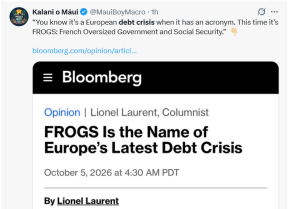
This time, the weakest link could actually be the Euro Area’s second largest economy, France, whose risk premium — the extra interest its government pays over benchmark German Bunds — recently hit its highest level since the first Euro Area debt crisis. Worryingly, the crisis already has an acronym…

France’s 10-year yields have surged in recent months, and are now on the verge of crossing the 5% threshold. To put that in perspective, Italian bond yields at the height of Europe’s first sovereign debt crisis reached a peak of 7.5% on November 11, 2011 before stabilising. Interestingly, Italy’s 10 year bonds are 20 basis points lower than France’s right now, and have been consistently lower for some time.
As the right-hand graphic below shows, French public debt is actually higher than it was during the worst of the COVID-19 virus crisis, when economic activity collapsed during the lockdowns, leading to a massive upsurge in public debt-to-GDP ratios. By contrast, Spain’s debt-to-GDP ratio has almost returned to its pre-COVID level of 97%. Even Italy’s has come down 18 percentage points to a still-ridiculously high 136%.

Admittedly, both Spain and Italy benefitted enormously from the ECB’s sovereign debt buying during its near decade-long QE program. Since the pandemic Spain’s economy has grown much faster than the Euro Area average. For its part, Italy regularly registers primary surpluses — when government revenue exceeds non-interest spending — while France hasn’t registered one since 2001.
Another potential cause for concern is the general provenance of most holders of French debt. As flagged by Eurointelligence, French debt is predominantly held by foreign investors, which makes it particularly vulnerable to sudden capital outflows, higher costs to roll over maturing debt and sudden spikes in government bond yields (as we’re seeing right now):
French debt is predominantly held by foreign investors. According to the Banque de France, 57% of French debt is held by non-residents. Amongst the advanced economies, France has the highest proportion of foreign debt holders. The share is much lower in countries like Spain with 42%, the UK with 32%, Italy with 27% or the US with 23%. The fate of French debt is thus very much in the hands of asset managers outside France. A fact that may not be much appreciated by French political parties.
Of course, none of this means that France’s current debt woes will blossom into a full-fledged debt crisis, though the general global economic backdrop is hardly what you’d call favourable. The UK, for instance, has experienced a couple of near-misses in the bond markets in recent years, most notably with the 2022 UK Gilt Crisis that was triggered by Liz Truss’ “mini-budget”, which caused UK government bond prices to plummet and yields to spike.
That said, it is not just fringe economic commentators who are sounding the alarm about France’s rising debt woes:


A large part of France’s problem is political. Put simply, it has become harder and harder for the Emmanuel Macron’s deeply unpopular government to pass budgets. In its budget proposal for 2027, the government hopes to reduce the deficit to five percent of GDP with €43 billion in spending cuts.
Those proposed measures, which include the freezing of the employment bonus, the civil service pay index and pensions above €1260 as well as a lowering of the 10% tax allowance on pensions, will further crimp the purchasing power of struggling low and middle-income households, which in turn will act as a further brake on France’s slowing economic activity
That assumes, of course, that the budget proposal gets passed in something closely resembling its current form. As Eurointelligence warns, such an outcome should not be taken for granted:
The government does not have a majority and needs to negotiate with opposition parties to pass the budget. In the past two years, these have been extremely painful negotiations and high drama ahead of the deadline in December before an amended version under a new prime minister was then adopted without a vote by using Art 49.3.
This time, such a theatre would coincide with the presidential elections. The stated preference of presidential candidates is that they want to get the 2027 budget out of the way ahead of the elections in April. But their dilemma is that no one can really be the one seen as propping up the centrist government. All opposition parties have their red lines, and there is not enough leeway in the budget to accommodate them all.
Meanwhile, the proposed austerity package has already triggered the time-honoured public response…
Political instability has become a defining feature of Emmanuel Macron’s last term in office. Three French governments have collapsed in less than a year. Barnier and Bayrou’s governments both crumbled over budgetary disputes, and Lecornu resigned after less than a day, but was later reappointed.
What’s more, the budgetary pressures are not limited to the central government, reports Le Parisien:
For several years now, the departments of the Ile-de-France region have been warning about the budgetary difficulties they are facing. Essonne, Yvelines, Seine-et-Marne, Val-de-Marne, Seine-Saint-Denis… Everyone is sounding the alarm.
“The departments of Île-de-France are facing an equation that has become untenable: their revenues, particularly from real estate, are contracting, while the solidarity expenses they have to assume continue to increase,” laments Pierre Bédier, president (DVD) of the Yvelines departmental council and the Association of Île-de-France departments.
Now, as France contemplates life without its extreme centrist (and broadly reviled) president, that instability seems likely to rise. And it’s rising at precisely the worst possible time — when global economic instability is on the rise and interest rates more broadly are surging.
A full-fledged sovereign debt crisis may be a fitting send off for Macron, the former investment banker who waltzed into French politics from the plush hallways of Rothschild & Cie, but it will be a disaster for the French people. As Bloomberg points out, recent polling suggests next year’s presidential election, scheduled for April 18, may come down to a second-round runoff between the far-right front-runner Marine Le Pen and far-left rival Jean-Luc Mélenchon.
For the moment, polls show Le Pen’s National Rally beating both Melenchon’s La France Insoumise and Édouard Philippe centrist Horizons party in the second round. Out of a choice between Melenchon and Le Pen, it is not hard to guess which will be the preferred candidate for France’s financial and business elite, especially with Mélenchon calling to cancel 18% of France’s national debt that is held by the Bank of France.
That may be the only way out of the coming crisis. As Michael Hudson periodically reminds us, “debts that can’t be paid, won’t be paid.” Unsurprisingly, Bank of France chief Emmmanuel Moulin sees things somewhat differently, describing Melenchon’s proposal as “illegal, dangerous and useless.” But he also had this to say about the effects of surging interest rates.

There are still six months to go before France’s elections take place, and a lot can happen in that time — especially in the financial markets. Lest we forget, the world is currently grappling with two regional wars, a worsening energy crisis, mounting stagflationary pressures, a slowly bursting AI bubble, and rising political instability, among other things.
Just yesterday, Spain’s Prime Minister Pedro Sánchez called early elections for mid-November, as economic and political tensions in the Euro Area’s fourth largest economy come to a head. Meanwhile, as Europe’s economy bogs deeper into the mire, the governments of France and Germany have stumbled upon a solution to the continent’s economic ills: a kill switch to cut China out of the EU market. Which is just what Europe’s stagflating economy needs.
Concerns, meanwhile, are inevitably rising about the potential contagion of Europe’s sovereign debt troubles to European banks’ balance sheets. It’s worth recalling that France is home to more TBTF banks — the so-called Global Systemically Important Banks, or G-SIBs — than any other Euro Area economy, with a total of three. From Bloomberg:
The cost of insuring French banks’ bonds against default has jumped above that of other European lenders as concerns about France’s fiscal and political situation spill over into credit markets.
The annual cost of protecting €10 million ($11.2 million) of Societe Generale SA’s bail-in senior debt for five years reached €103,000 on Monday, about €16,500 more than insuring similar debt issued by Deutsche Bank AG, according to data compiled by Bloomberg. As recently as late August, the cost was identical.
The credit-default swap spreads of BNP Paribas SA and Credit Agricole SA are also far above those of major banks in the UK, Germany, Switzerland and Spain, the data show.
The bigger concern is that France’s recent debt woes are merely a harbinger of a much broader debt crisis afflicting economies in the Euro Area as well as in the collective West more broadly, most of which face similar structural and cyclical problems (over-indebtedness, not just in relation to public but also private debt; surging inflation caused by the wars in West Asia and Ukraine; stagnating economies; deindustrialisation; a hollowed-out middle class…).
But what makes Euro Area economies particularly vulnerable, as long-time NC readers are well aware, is that they cannot print their own money or devalue their currency, making them uniquely exposed to self-reinforcing “doom loops” between weak banks and sovereign debt. Indeed, as Brookings’ Robin Brooks notes in a recent substack, the Euro zone sovereign debt crisis never really ended.
It just got papered over by an ECB that’s using German fiscal space to paper over the fact that many Euro zone countries are basically broke. As I argued last year, this approach is doomed to fail. That’s because Europe doesn’t just need to avoid fiscal blowups. It needs to be able to spend money, i.e. it needs fiscal space. The mere avoidance of debt crises doesn’t accomplish that. It just means Europe limps along while resentment builds in Germany. The Euro – in its current form – can’t and won’t survive.
Brooks warns that while the ECB will once again do “whatever it takes” to cap the soaring yields — and this time, it’s going to take a hell of a lot given the size of France’s economy and the respective liabilities of its largest lenders — the usual can-kicking tactic of “grabbing German fiscal space to defray market pressure on [other countries’] public finances” may be running out of road, especially given AfD’s rapid rise as well as Germany’s own economic woes:
The grab for Germany’s fiscal space obviously isn’t politically sustainable, which is why it’s hidden and camouflaged. But the rise of the AfD will shine a light on all this and bring needed change.
What form that change may take is as yet unclear, but it is unlikely to be a smooth, orderly process.


 By
By