
We have discussed the science and art of diet and the science and technology of ultra-processed foods (UPFs) here several times before. The arguments continue, as does the research. On 29 September 2026 McGill University and the McGill Office of Science and Society hosted their annual Trottier Public Science Symposium: Ultra-Processed Foods: Processing the Facts (video). I had been looking forward to this event for several months. It did not disappoint, except for one important matter, discussed at the end. Ashley Gearhardt first addressed the question, “Can Ultra-Processed Foods Be Addictive? A Review of the Science.” She was followed by Kevin D. Hall who spoke on “Ultra-Processed Foods and Body Weight.”
Dietary advice has a long history. Hippocrates (460-370 BCE) of the Hippocratic Oath may have said, “Let thy food by thy medicine.” Luigi Cornaro (1456-1566) recommended 350 grams of food and half a bottle of wine per day (which may have been safer than water). This was probably the first caloric restriction diet. Sylvester Graham (1794-1851) wrote that we should eat a vegetarian diet supplemented with whole grains; good advice that Michael Pollan would approve. William Banting (1796-1978) recommended a diet consisting largely of meat, with no sugar or starch. This foreshadowed the Adkins and Paleo diets. More recently Steven Gundry (a former cardiologist who is all over my YouTube, based on Big Brother’s parsing of my search history) has been telling us that lectins are basically poison. This is true if the lectin is ricin from castor beans, but then only if it is injected (I do not recommend eating a castor bean, though). Other beans that humans eat, not so much. RFKJr recommends beef tallow instead of seed oils as the MAHA pathway to good health. Animal fat is not the dietary devil it has been made out to be, but neither are seed oils, although they are a feedstock for UPFs. Current health influencers range from certifiable quacks to legitimate scientists.
As the medical education establishment has sought to improve nutrition education, various diets and successive dietary guidelines have been discussed as part of my work. Most recently, whether UPFs are bad for our health has been the topic of the day. Chris van Tulleken’s book Ultra-Processed People: The Science Behind Food That Isn’t Food has (2023) has been an excellent source for many who are paying attention. UPFs can be defined as manufactured food-like products made from commodity crop inputs and various industrial additives to improve taste and mouth feel. As Dr. Gearhardt put it, corn (maize) provides the definition of UPFs:
- Unprocessed: Corn, fresh or blanched and then frozen (there is nothing better than Silver Queen picked that morning during the height of summer)
- Minimally processed: Canned corn with some salt added to preserve shelf life (healthy and tasty by itself or with real butter, and in soups)
- Ultra-processed: Nacho Cheese (flavored) Dorito (hyper-palatable industrial food-like product that is fine as a rare treat, if you can avoid eating half the “Party Size” bag)
It is not too difficult to see which of these three are real food and the one that is an industrial product. There is no recipe for a Dorito. The same scheme applies to UPFs primarily made of soy and wheat, which along with corn make up the Big Three of commodity inputs for UPFs. Regarding their addictive properties, UPFs have a history similar to the products of Big Tobacco, which are also ultra-processed. Many of the manufacturers of UPFs were at one time subsidiaries of Big Tobacco. The lineage in all its ramifications is there for all to see.
Of the two speakers at this Trottier Symposium, Dr. Ashley Gearhardt of the University of Michigan was the more convincing. She is an addiction psychologist who has studied UPFs in social, cultural, and medical contexts. What led her to focus on UPFs as addictive was the language used by those who were addicted to UPFs, mostly in the form of what is described as junk food. They spoke of their irresistible cravings and other behaviors that they knew were harmful to their health. If people think UPFs are addictive, are they correct? That is the question, and it is difficult to answer. But Professor Gearhardt’s research, which has been based on the lived experience of real people, and her body of research with her students and colleagues is convincing:
“I do it all the time, but one example is, I went to [name of mall], which is 30 or 40 minutes away from my house just to get a Cinnabon [chuckle] and I got extra sauce on it…If I have other foods in the house…I might have my fruits and vegetable in there but I’ll still go to the store and get Reese’s peanut butter cups and then Doritos and two or three pops” (participant with severe food addiction and very low food security)
This is very believable and straight out of the language of addiction, with its loss of control that can be viewed by some as unreason. There are few completely objective biomarkers for addiction, so the psychology of addiction is the most effective way to approach the problem of the effects of UPFs on so many. Nevertheless, there is also evidence that the “dopamine hit” associated with satisfying motivation and desire is very real but dependent on social context (cf. “likes” from social media in the broader context that is wellnigh inescapable, for adolescents and adults). The Yale Food Addiction Scale (YFAS) developed by Gearhardt and her colleagues, has been used for diagnosis of food addiction since it was introduced in 2009. YFAS Metrics include: loss of control, cravings, inability to cut down despite trying, negative consequences ignored, tolerance (larger “dose” required for satisfaction), withdrawal symptoms including agitation and psychic discomfort.
The manufacture of these “addictive” food-like industrial products by Big Food long predates the definition of UPFs by Carlos Montiero and his colleagues in Brazil (covered here). Michael Moss published Salt Sugar Fat: How the Food Giants Hooked Us in 2013. [1] The foundations of this industrial food technology – not food science – lie in the work of Howard Moskowitz on the bliss point. The bliss point is where the relative amounts of sugar, salt, and fat in a UPF optimize “palatability in the formulation of food products.” Note the key words, “formulation of food products” instead of “preparation of food.” Research has shown that >90% of food products that reach their bliss point are UPFs. No one here is really trying to hide anything. UPFs are meant to be, at a minimum, habit forming. Professor Gearhardt makes a strong case they are meant to be addictive and her research backs this up. The corollary is that if UPFs are addictive, or manufactured with the intention to make them “habit forming,” their use is not a matter of “free choice,” contrary to the Merchants of Doubt who will eventually “die on that hill,” but not before doing more damage.
So, what is to be done? Professor Gearhardt doesn’t mention the Farm Bill in her presentation, but she has it in mind. She recommends correctly that we eat whole foods. But this will be possible only after the federal government subsidizes actual food instead of commodity crops such as corn, wheat, and soy as inputs for animal feed and UPF production. Only then will “healthy eating stand a chance in the grocery store.”
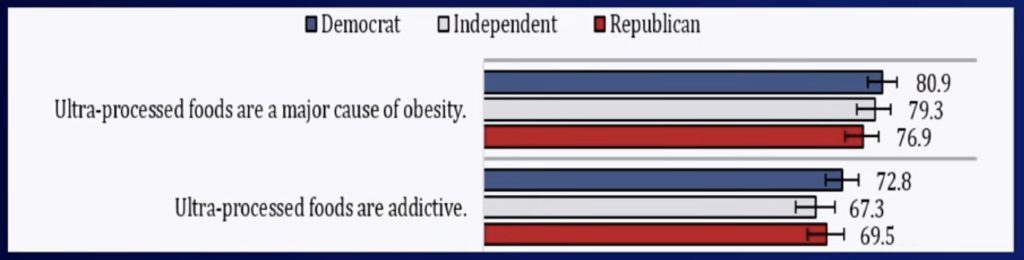
One on the more striking points made in her presentation is that this is imminently possible. As Dr. Gearhardt points out, the evidence that UPFs are destroying the health of many is strong enough to act now, rather than in some future beyond the time horizon when there is “scientific proof” of the harm done by UPFs. The people are also ready for change, as shown by this 2025 poll from one of her laboratory’s papers published in American Journal of Public Health in July 2026 (from her presentation):

About 80% of all Americans (Democrat, Independent, Republican) agree that “Ultra-processed foods are a major cause of obesity.” Moreover, approximately 70% of Americans agree that “Ultra-processed foods are addictive.” These are astonishing numbers. What else do Americans agree on in such large majorities? Yes, the people know, from personal experience: No one can eat only one Nacho Cheese (flavored) Dorito. This is intended by the manufacturer. So, perhaps this result is not a surprise. Long before Dr. Luther Terry directed publication of the Surgeon General’s Study on Smoking and Health in 1964, cigarettes, perhaps the original ultra-processed addictive consumer product, were known colloquially as “coffin nails.” The people knew then, too. And they eventually reacted. This is not a partisan issue. But it is a political issue because we have a Uniparty that is beholden to Big Ag and Big Food in the Era of Citizens United, while caring not for their erstwhile constituents.
Dr. Kevin D. Hall, formerly of the National Institutes of Health, talked about “Ultra-Processed Foods and Body Weight” in the second presentation. He began by making the correct point that being overweight is not necessarily a moral failure, contrary to what many want to believe. Biological regulation of body weight is real and also has a multifactorial genetic component. This idea goes back to early physiologists such as Walter B. Cannon, who wrote The Wisdom of the Body (1932; still useful after all these years as the statement of physiological homeostasis).
Those scolds who argue that an overweight person will inevitably lose weight if calorie intake is less than calorie expenditure ignore basic human biology. While the raw thermodynamics dictates this, it is not that simple. When someone loses weight, his or her appetite will increase to compensate for the weight loss. And this can be stronger than willpower. What people eat also has a large effect on weight regulation (the thermodynamics of metabolism can be complicated and is not path independent, as in the bomb calorimeter that measures the calories in a food sample by measuring the heat released during combustion). The nature of UPFs is at the very center of this argument.
Dr. Hall and his research group’s seminal publication showing that given the choice of comparable diets rich in UPFs or consisting only of whole foods, people on the UPF diet consumed 500 more calories per day than when they were on the whole food diet. Naturally they gained weight (discussed here previously). Subsequent research demonstrated that a simple dopamine response is probably not responsible in all situations for the “allure” of UPFs. This means that something else is going on. This result is also why Kevin Hall left the National Institutes of Health. When the research was published, he learned that he was forbidden to talk about his results because the study “did not match RFKJr’s ideas about ultra-processed foods.” So much for the science of MAHA over priorities of the Current Administration priorities.
Hall’s recent research has addressed what mediates the power of UPFs. These factors are energy density and hyper-palatability. This has been studied in a trial (unpublished) using four separate diets, as described below:

In my layman’s terms, the first diet is essentially the typical whole food diet that an average, non-foodie American would have to work hard to achieve. The second is a typical American diet that consists of UPFs manufactured to be energy dense with components optimized to their bliss point for hyper-palatability. Number three is a UPF diet with manufactured high energy density but lacking hyper-palatability. The fourth diet is a low energy density UPF diet that tastes bad and has poor “mouth feel.” This latter would seem to defeat the purpose of UPFs in the first place.
The results are consistent with the earlier study showing that people on UPF diets consume more calories and gain weight:

The minimally processed “whole food” diet (MPF ll, blue) showed the lowest energy intake, while the UPF diet with high energy density and hyper-palatability (UPF hh, red) showing the highest intake. The UPF high energy density but low palatability diet (UPF hl, purple) was not much different than the “traditional” UPF diet. The “lousy” UPF diet (UPF ll, green) showed about the same energy intake as the whole food diet. These results demonstrate that the food technologists who use the bliss point as their lodestar were correct: If we heavily market manufactured food that is energy dense and hyper-palatable, people will happily eat more of it, especially if it is perceived to be cheap and convenient. Corporate profits without responsibility for outcomes will ensue.
The weight changes observed were as expected. People who consumed the turbocharged UPF diet (red) gained the most weight. The whole food diet (green) led to weight loss:

This trial is powerful enough to support these claims. However, the broader take-home message is this is a complicated problem and that further research is necessary. Dr. Hall does address the problems with our food system in the United States. For example, we grow entirely too much “food” in the form of industrially “farmed” corn, soy, and wheat. This amounts to 15,000 calories per person per day. Much of this is used as animal feed in CAFOs, which are profitable but immoral and inhumane, and production of biodiesel and ethanol as a gasoline additive. The latter makes sense only in Iowa/Corn Belt politics, courtesy of Senator Chuck Grassley (R-IA, b. 1933). The remainder is used to manufacture UPFs. But even then, according to the available data only one-third of these products is eaten.
This is an insane environmental disaster. So, what do we do? Dr. Ashley Gearhardt’s answer is that we should reboot our food system to produce healthy food while addressing the pathological consequences of UPFs while we must. As she notes in the discussion period, she grew up on a farm that did not actually grow food. In my view, she is correct. Both speakers support the idea that UPFs are connected to the obesity epidemic that has been ongoing for fifty years. Gary Taubes and others have placed the blame for the obesity epidemic on processed sugar that was used to replace fat calories when the traditional American diet, pre-1970s, was demonized because in included fat and cholesterol (discussed here). UPFs undoubtedly contributed to this catastrophe. Teasing out which component is the most damaging is futile. We just need to go back to eating real food. Our diet and our health will be fine if we eat “real food, not too much, mostly plants,” in the words of Michael Pollan. Non-industrial meat can also have an honorable place in a whole-food diet. A sensible Farm Bill that subsidized real food instead of industrial commodity crops would make this possible.
Finally, Dr. Kevin Hall’s conclusion was astonishing to me. Instead of advocating going back to the future, in a sense, and producing and eating whole foods while making this possible by using the Farm Bill to publicly subsidize the necessary agricultural revolution, he finished abruptly with an advert for what he labeled Obesity Pharmacotherapy in the form of tirzepatide, a GLP-1 receptor agonist also known as Mounjaro and Zepbound. Yes, GLP-1 receptor agonists work by altering the physiological equilibrium between diet and weight. But they do so as a workaround rather than as a solution to a profound problem that has been caused by bad politics. Is this a sustainable solution to our problem with the Great American Food System? Or is it something else?
It is no accident that in my view Dr. Ashley Gearhardt of the University of Michigan, with essentially no disclosures to make, got the better of the argument than Dr. Kevin D. Hall, formerly Integrative Physiology Section Chief in the National Institute of Diabetes & Digestive & Kidney Diseases, National Institutes of Health. Dr. Hall is now:
Senior Director, Clinical Scientist,Translational Sciences and Clinical Development, Research and Early Development, Cardiovascular, Renal, and Metabolism, AstraZeneca Pharmaceuticals
and
Eddie Goldenberg Research Chair of Canada in Nutrition and Metabolic Health, University of Ottawa
Good for him, but which is it? To be both at the same time seems to be a contradiction. My first post at Naked Capitalism was a review/discussion of The Illusion of Evidence-Based Medicine: Exposing the Crisis of Credibility in Clinical Research. We all need to remember that the primary question when assessing evidence-based medicine (EBM) is, “Whose evidence, for what purpose?” This assessment is best made by reading the Acknowledgments of a published paper, even before reading the Abstract. Always.
Having said that, it remains best to stay out of the center aisles of the grocery store to the extent you can, as recommended by Marion Nestle in What to Eat Now. Bon appétit!
Note
[1] I have tried to get this and other similar books added to the mandatory medical student reading list, to no avail so far, but this will happen eventually. The biochemistry of nutrition will not stick forever, but the politics of Big Ag and Big Food will stick if we let them get away with it.



 By
By