

I interviewed Sam about her regular habit of sharing “3 good things” from her days on her personal social media feed.
EP: You often post “3 good things” on your personal socials along with photos. How long have you been doing this, and has your reason for still doing it changed since you started?
SB: I started six years ago in November. November is gratitude month, and it’s also my least favourite month of the year, so I figured it couldn’t hurt to look around and find things to be grateful for.
I’m not sure exactly when I started doing it year-round, maybe two or three years ago? I liked it so much I didn’t want to stop when November was over.
Why do I keep it up? I like the way it makes me feel. But also, and I notice this more these days, the practice itself trains me to start looking around for good things.
EP: This tracks with something I heard on a recent podcast about negativity bias. We’re wired to overfocus on the bad (to the point where we overlook the good), but intentionally practising the positive can help us rebalance. The researcher called it gain-framing, seeing experiences through a positive lens or treating setbacks as opportunities to learn. Does that match your practice?
SB: Yes, that definitely matches my experience. I do a bit of only good things and a bit of reframing. I’ve got a close family member in the hospital. Not good. But good that they’re getting the excellent medical care they need.

I also share bad news. I’m one of those academics, for example, who posts about rejections. It’s not just good news. Junior scholars need to see that rejection is part of the process. I also share when I stop doing things, so it doesn’t always look like I’m doing more new things without stopping others.
EP: The podcast researcher talked about the value of sharing positive experiences with others, which reinforce them and connect us to others through that sharing. Do you think about how others receive your posts? How do you feel sharing them?
SB: I do worry sometimes that people think it’s all good things all the time, but there’s a lot of bad at work that I can’t share on social media for a whole host of reasons. Ditto bad personal news, which often involves other people, and sometimes it’s their story to tell, not mine. Sometimes I find it hard to get the valence right.
EP: It sounds like you are aware of thr bad, but it’s not always shareable. So that’s another reason why you just choose to focus on the good. And maybe that you don’t want the terrible to stop your from seeing the good?
SB: I find that seeing the good helps me understand what we’re struggling for, why it all matters. The world is a beautiful place.
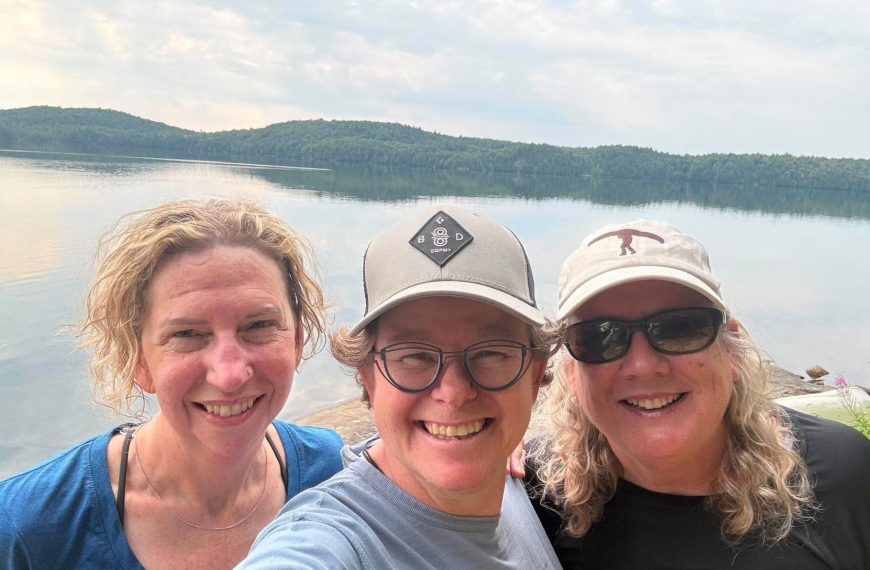
We were canoe camping this past weekend and I loved the light on the water, the sounds of the birds, watching a hummingbird on the flowers, swimming with loons, basking on warm rocks after swimming in a cold lake, the taste of hot tea and cookies, swaying in a hammock and napping. So many good things.
EP: How would you recommend that others try out sharing “3 good things,” and what to do on the days when thry feel negativity bias creeping in?
SB: To be honest, I’ve skipped 3 or 4 days over the years where things were too bleak to do it. I think that’s okay. That’s life.
I keep a Google doc on my phone, called Three Good Things, for myself. But I also share on social media for the habit and the accountability. For a time I thought about starting a blog just focused on tracking workouts and sharing good things. You could do that too.
Listen to “Stepping Out of the Shadows” from Hidden Brain, hosted by Shankar Vedantam, with psychologist Alison Ledgerwood (University of California Davis).,who explores negativity bias, the deeply human tendency to hold on to what went wrong and overlook what went right. In the episode, Ledgerwood unpacks why our minds are drawn to losses and threats, and what can be done to rebalance our attention.
Related
Discover more from FIT IS A FEMINIST ISSUE
Subscribe to get the latest posts sent to your email.

Published by

 By
By