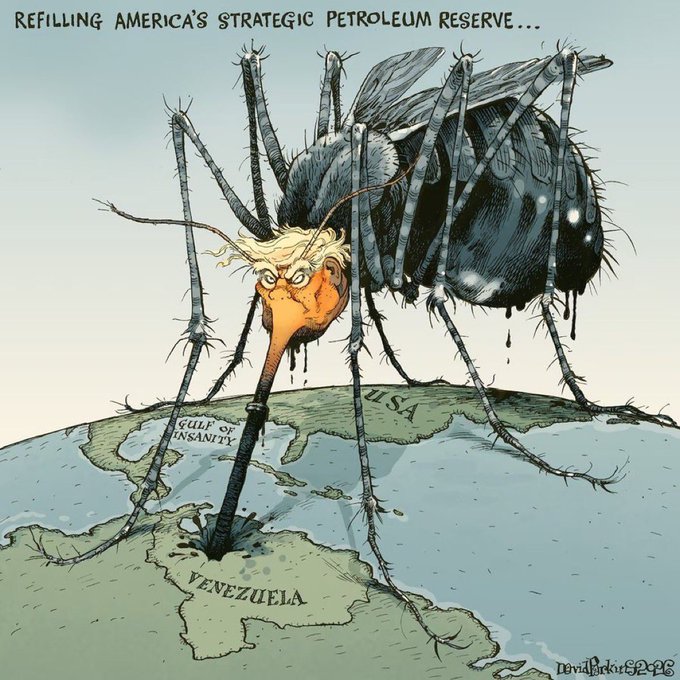

Smoke and mirrors on a Trumpian scale.
Remember the Cartel of the Suns and Tren del Aragua? You know, those two Venezuelan “drug cartels” that were designated by President Trump as foreign terrorist organisations in mid-November 2025. In the case of the Cartel of the Suns, it appears only to have existed in the creative minds of CIA and DEA agents.
That didn’t stop Washington from repeatedly claiming that President Nicolás Maduro was the make-believe cartel’s ring leader. Of course, the US government provided no evidence to back up those claims — because there was no such evidence. Indeed, for the sake of Maduro’s “updated” indictment, the Dept. of Justice quietly admitted that the cartel wasn’t real.
By then, of course, the foreign terrorist organisation designation had done the trick. Both of the “cartels” had dominated the news cycle as media outlets obediently banged the drums for another US military adventure. Small speed boats in the Caribbean and Eastern Pacific, including fishing vessels, suddenly became targets for US air strikes, and still are.
Then, on January 3, the US launched its attack. After Maduro’s abduction, almost all references to the Cartel de los Soles were removed from the indictment filed against Maduro after his imprisonment in New York. All talk of Venezuela being a vital conduit for the global narcotics trade vanished from the political and media discourse almost as quickly as it had appeared.
Job done.
Then, this Wednesday (Sept 16) Trump removed Venezuela from the US’ list of countries that are failing to comply with their obligations in the fight against drug trafficking — despite the fact that the new Delcy Rodriguez government is led by three of the people most widely accused of running the phantom cartel (Delcy, her brother, Jorge and Diosdado Cabello).
From the Spanish news agency EFE (translation by yours truly):
Trump decided to remove the Caribbean nation from a list that continues to include Afghanistan, Bolivia, Burma and Colombia, according to the ‘Presidential Determination on Major Drug Transit or Major Illicit Drug Producing Countries for Fiscal Year 2027’, published Wednesday by the State Department.
The list includes states that, over the past 12 months, have “demonstrably failed” to comply with their “obligations arising from international agreements to combat drug trafficking”, as well as with the measures required in this area by US law.
The timing of the decision is interesting, coming just a fortnight after the Trump administration signed what many are hailing as a historic oil “deal” with Venezuela’s US-imposed Delcy Rodriguez government. The deal, announced by Trump on August 30, grants a US-led company 100-year concessions over 17 oilfields, which account for more than a fifth of Venezuela’s claimed reserves.
Trump characteristically described the agreement as the “biggest oil deal in world history” while Delcy Rodriguez said it would bring more than $US100 billion of investment to Venezuela. However, neither government has provided clear details about how the arrangement would work or where the new investment would come from. It is also far from clear what role Petroleos de Venezuela (PDVSA), Venezuela’s sanctioned state-owned oil company, will play.
Exxon’s Possible Return
As readers may recall, in the days immediately following Maduro’s abduction Trump invited lots of oil industry executives to the White House and effectively told them, “I want you to invest in Venezuela.” The response he got was far from encouraging. The Exxon Mobil CEO Darren W Woods said that Venezuela, in its current state, was “uninvestable”. The full quote:
We have had our assets seized there twice and so you can imagine to re-enter a third time would require some pretty significant changes from what we’ve historically seen and what is currently the state. Today, it’s uninvestable.
Trump responded initially by threatening to sideline the oil giant from the spoils. Now, roughly nine months later, Exxon apparently wants a piece of the action despite the fact the country’s oil production has already stagnated in recent months at around 1.1 million barrels a day (see table below of production figures for first eight months of 2026).
La producción de Venezuela se ha estancado en los los últimos meses. pic.twitter.com/CT2yGCOBQP
— Francisco J. Monaldi (@fmonaldi) September 17, 2026
From Reuters:
Exxon is negotiating to return to Venezuela and has shown interest in the large Petromonagas heavy oil project in the Orinoco Belt – where the US energy major previously had a stake – as well as in areas in the neighboring Carabobo block, according to people familiar with the matter.
A reentry into Venezuela by Exxon, if finalised, would mark a staggering reversal for the company after it exited the OPEC country nearly two decades ago amid a dispute triggered by the nationalization of its oil projects by the government of former President Hugo Chavez.
ExxonMobil held talks this week with Venezuela’s government about re-entering the country as the Texas oil giant explores whether to follow US rivals back into the home of the world’s largest reserves https://t.co/NO4xyugNPz
— Francisco J. Monaldi (@fmonaldi) September 16, 2026
Another company looking to enter the Venezuelan market is Continental Resources. Founded by Harold Hamm, a billionaire fracking tycoon who was among Trump’s earliest backers in the 2016 election, Continental signed a memorandum of understanding with Venezuela’s state oil company PDVSA to operate and develop the Ayacucho 2 area in the prolific Orinoco, the country’s largest output region. From the FT:
Hamm on Wednesday said his company Continental Resources had signed a memorandum of understanding to develop an oilfield in Venezuela’s prolific Orinoco oil belt in partnership with state-owned Petróleos de Venezuela (PDVSA).
“I think this can also be the energy renaissance that is necessary in Venezuela,” Hamm said at the G20 energy ministers summit in Houston. “We see this becoming the key to really turning it around and perhaps, not only get [back to] where production peaked before, but actually extend that further.”
The deal marks the latest contract signed by a western oil producer to launch operations in Venezuela as Washington exerts increasing control over the sector following the US military’s capture of president Nicolás Maduro in January.
Hamm has been expanding globally. In August, he told the FT that Continental was spearheading a multibillion-dollar drilling campaign in one of the world’s largest shale basins in Argentina.
So, what has changed?
It’s hard to tell given how little information has seeped into the public arena. One thing that is clear is that the $100 billion of investment will not be coming from public coffers — Venezuela’s coffers are bone dry while Trump has insisted that rebuilding Venezuela’s oil industry will not cost US taxpayers a dime.
For their part, the oil majors will be reluctant to inject yet more money into Venezuela, as Tomás Pueyo points out:
For these companies to invest that sort of money, they would need assurances that they will be able to pump oil for decades without their investments being nationalized again.
Which means that this is only going to happen if the US can guarantee the rights of US oil companies in Venezuela for the next few decades.
And that is very big “IF”. So where is the money going to come from? According to the Venezuelan economist Francisco Rodriguez, in a recent interview with Open Democracy, this is where it gets “really interesting and really murky”:
These $100 billion are going to be put out by a Barbados-based company that was created just a few years ago. It’s a company owned by a businessman with not the best reputation in the world. His name is Alejandro Betancourt. He’s best known for getting billions of dollars in no-bid contracts from the Chavez administration to build electrical plants, at least one of which was never completed. And he’s offering to the US a thirty-five percent stake in his company.
So the US Department of War is going to now own thirty-five percent of that company. And it’s also going to have the right to purchase at cost twenty percent of the company’s output. So that’s the deal.
The White House yesterday put out a statement saying that Venezuelan barrels of oil are going to start flowing into US reserves as of November (NC: just in time for the elections!). And basically, President Trump had already said that they were going to replenish the US Strategic Petroleum Reserve (SPR) with oil that was a gift from Venezuela.
That’s the word that President Trump used.
So that means that probably as of today you will have Venezuela sending 40,000 barrels of oil to the US at cost. That’s a loss of about $500 million a year for Venezuela.
The SPR is now at its lowest levels since November 1982. According to Eric Nuttall, lead portfolio manager of the Ninepoint Energy Fund at Ninepoint Partners, the oil market is now in very, very dangerous territory.
However, Venezuelan oil is not going to come to the SPR’s rescue, no matter how many times the claim is parroted by Trump officials, FOX News hosts and MAGA influencers. Venezuelan oil is simply too sour, acidic and sludgy to qualify for the SPR. If it was used, it would clog up the reserve caverns, turning them into giant “tar caves” of umpumpable sludge.

Secondly, there are serious doubts as to whether Venezuela even has 65 billion barrels of oil to spare under its soil. Like many oil-producing nations, it allegedly inflated its claimed level of proven reserves during the 2000s in the absence of new discoveries.
Analysts have also raised the issue of cost, though that issue loses much of its relevance if: (a) the US gets much of its Venezuelan oil at below cost, as Rodríguez suggests; and (b) the market price of oil stays well above the historic dollar average price, which certainly appears to be the case for the foreseeable future.
Trumpy scores another own goal. The all-in economic cost of Venezuelan heavy crude is $70 per barrel compared to the 56 year constant dollar average price of global crude at $71/barrel, less 15% discount for low quality Venezuelan crude or $60 per barrel. That is to say, a… pic.twitter.com/qg9uOBzboT
— David Stockman (@DA_Stockman) August 30, 2026
There’s also the issue of Venezuela’s broken oil infrastructure, as Health Ranger points out:
[T]he 65 billion barrels of oil can’t possibly be tapped without at least A FULL DECADE of infrastructure investment in Venezuela, and at least $100 billion in investment funds, plus you have to find all the experts around the world who know how to do these things and somehow entice them to move to what is effectively a war zone where local resistance groups will be targeting them constantly.
So nope, your gas prices aren’t going to get any better tomorrow. It’s all just smoke and mirrors. As usual.
What is clearly most on Trump’s mind right now are the mid-term elections, notes Rodríguez. But he also warns that the Trump administration’s forcible appropriation of a fifth of Venezuela’s oil reserves is worse than the theft of national assets in post-Soviet Russia:
It smells like Trump essentially said, “I wanna do something about gas prices before the midterm and I wanna claim that I’m getting some of this oil from Venezuela. So I want some of that oil from Venezuela to come in and for me to say that I’m putting it into a strategic reserve, and this is bringing down oil prices. I wanna do that before the midterms. Sign me a deal.”
I think that’s essentially all there is. But from the standpoint of Venezuela, Venezuela has just given away 20% of its reserves to a company owned by a very shady figure.
After the invasion of Iraq when you had the occupation there was a public bidding round for the rights to exploit Iraqi oil. This was a competitive bidding process, it was transmitted through public television, so Iraqis could actually see the bidding taking place in real time.
This process was transparent. This is the complete opposite. This firm is going to get, over the life of the concession, the equivalent of $303 billion (NC: assuming, of course, that the reserves are actually there and the investments are made)
That’s the, that, that is what the private firm gets in profits.
That is what it’s going to get. That is the equivalent of three years of Venezuelan GDP. 65 billion barrels. Venezuela has a huge level of reserves. The Russian privatization program of 1996 was for 20 billion barrels of oil.
This is more than three times the size. And in Russia, which was a steal, which was horrible, there was a free-for-all. That’s what led to the rise of the Russian oligarchs. They at least had the decency to rig an auction. Here, there was no auction. They didn’t even pretend.
It’s important to note that this is not just happening with Venezuela’s oil. In testimony to Congress (see video blow), US Treasury Secretary Scott Bessent said this model of US appropriation of Venezuelan oil applies to “many Venezuelan assets”.
Those assets presumably include natural gas, of which Venezuela holds the largest reserves in Latin America, gold — Venezuela not only sits atop one of the largest undeveloped gold provinces in the Western Hemisphere, with potential in-ground reserves of 7,000 tons to 8,000 tons, but also boasts the largest central bank reserves of gold in Latin America (and we all know just how much the US governments covets that yellow metal) — and rare earth materials.
Rep. Casten: “President Trump said…we’re taking in a lot of money, billions of dollars from Venezuela…He seemed to imply that we, the U.S. people, are taking in money to offset those costs. That would suggest flows to U.S. persons.”
Bessent: “This is one of the largest assets… pic.twitter.com/XlHW6Ex5zr
— Bulwark Clips (@BulwarkClips) September 15, 2026
The gold theft/appropriation was inevitable. US has stolen/appropriated gold reserves in every military conflict and regime change operation since 1999 in Yugoslavia. https://t.co/cUvL4kRYWX
— Kathleen Tyson (@Kathleen_Tyson_) September 18, 2026
When Bessent says “WE are taking in a lot of money, billions of dollars from Venezuela”, it is not entirely clear to whom the “WE” refers: the US government or Trump Inc? My money is on the latter, especially given the unsavoury character of the people and companies involved in these operations, including the Swiss trading house Trafigura, the Dutch multinational energy conglomerate Vitol, Alejandro Betancourt and David Rivera, a former congressman and Marco Rubio’s old housemate, who was convicted in May of acting as an unregistered foreign agent.
The following paragraph, from a must-read twitter thread by leahfiles, nicely sums up the sheer nakedness of Trump 2.0’s imperial gangsterism in Venezuela:
SO, we took a country’s primary revenue stream at gunpoint, routed it through a bank in Qatar, then a Citibank account, handed the sales to two Swiss traders with federal bribery cases, put the Pentagon in business with a man the Justice Department once named in a $1.2 billion PDVSA laundering case, and declared the whole thing immune from American courts by decree. Okay….
Lastly, it is worth keeping mind that Venezuela is only the first country in the Western hemisphere to face the full force of the new wave of US imperial plunder. As The Guardian reports, US mining, shipping, and real estate companies are salivating at the prospect of taking over Cuba’s publicly owned assets and the assets left behind by foreign companies forced out of Cuba by recent US sanctions if/when the government in Havana finally falls.
Corporate colonialism: The US empire is suffocating Cuba with an oil blockade and brutal sanctions, trying to overthrow its revolutionary government.
US corporate vultures are already trying to take control of Cuba’s assets.
Billionaire oligarchs who funded Marco Rubio and… pic.twitter.com/Ldhv1kschI
— Ben Norton (@BenjaminNorton) September 17, 2026
As all this unfolds, one can’t but wonder just how sustainable the US’ new wave of continental plunder is likely to be when all it has to offer the local populace is the opportunity to have their most valuable resources ransacked at gun point. Which is a recipe for widespread resistance which in turn will be met by widescale repression. The US will eventually have to send its own troops into the mixer and they’re unlikely to get a warm welcome.
Many of the region’s countries, including Cuba and Venezuela, boast dense tropical jungles and mountainous terrain that make them at least as inhospitable as Vietnam and as immaculately suited for guerrilla warfare. To paraphrase Health Ranger, the US will still have to entice engineers and other mining experts to move to what will soon become giant war zones where local resistance groups will be targeting them constantly.


 By
By