
Yves here. It seems that some things cannot be said too often. It is frustrating to see some commentators who are often insightful, such as former UAE adviser Steve Hanke, then put his foot in mouth and chew by going on about money supply increases as driving inflation. That was decisively disproven in the early 1980s by monetarist experiments under Reagan and Thatcher. Changes in money supply correlated with no macroeconomic measure. Japan has engaged in massive amounts of what is commonly called money printing for decades, yet remained stuck in borderline deflation.
By Richard Murphy, Emeritus Professor of Accounting Practice at Sheffield University Management School and a director of Tax Research LLP. Originally published at Funding the Future
Does creating more money cause inflation? We are repeatedly told that “money printing” inevitably pushes prices higher. But that claim misunderstands both how modern money works and what actually causes inflation.
Governments create money when they spend. Commercial banks create money when they lend. Both processes happen every working day. If creating money automatically caused inflation, modern economies would be permanently experiencing rapidly rising prices. They aren’t.
In this video, I explain where money actually comes from, why government spending is not inherently inflationary, and why hundreds of billions of pounds of quantitative easing did not produce the inflation its critics predicted.
The crucial constraint on government spending is not money. It is the availability of real resources: people, skills, energy, materials, technology and productive capacity.
Inflation can occur when demand exceeds the economy‘s ability to supply what people want to buy. But much of the inflation experienced in the UK in recent years has instead resulted from external shocks, including energy shortages, war and disruption following Covid.
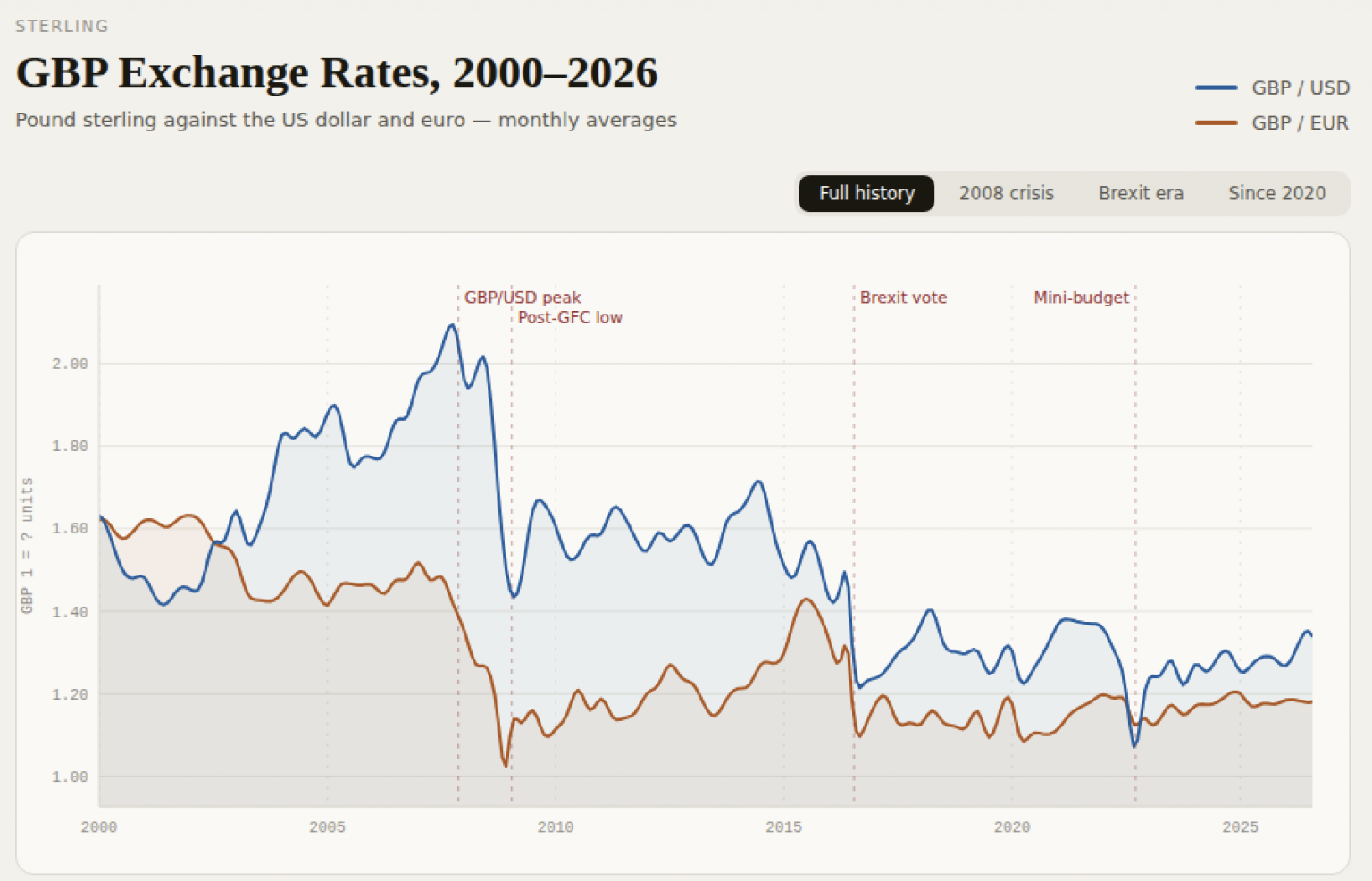
I also look at sterling, Brexit, the financial crisis and Liz Truss to explain why exchange rates cannot simply be understood by looking at the amount of money being created.
Understanding inflation requires understanding the real economy. Money is only part of the story.
The audio version is being released this morning, but it is available here.
This is the transcript:
Does more money cause inflation? Time and again, I am told that what people like to call money printing will cause prices to go up. But the reality is that this is simply not true. Money creation and inflation are not the same thing, and they aren’t even very closely related, if at all. So we do need to understand what this relationship is and when it can cause a problem and when it doesn’t.
This claim assumes that there is somehow a fixed amount of money in the economy, as if we were still on the gold standard. That’s not true. There is no fixed constraint on the amount of money on which our economy in the UK, or that in the USA, or those in Europe might depend. The amount of money in the economy does, in fact, vary every day. The governments of all of those countries create money with their spending, and they cancel it by taxing their population.
Banks also create money. Banks create money by lending, and they cancel it by asking for loans to be repaid. That’s how commercial banks put all their money into circulation. There is no other way by which we end up with having money in circulation but by one of those two routes. The government has to spend, or banks have to lend, and that’s it.
The idea that money creation is then something unusual is just wrong because it does quite literally happen every working day of every year, and it has done so throughout your lifetime.
So, what does that mean? Let’s just talk in detail about what a government does. The government does actually create new money when it spends. I know most people think that governments have to borrow or tax to be able to spend, but that is not true. There is no evidence for that being correct, and in fact, the double-entry bookkeeping to suggest that it’s possible simply does not exist.
The government spends because it has a legal budget, and when it spends, it asks the Bank of England to make a payment on its behalf. Effectively, the Bank of England marks up the government’s overdraft, and I know at the end of the day that they then issue bonds and Treasury bills to sort of balance that equation. But the point is the government spends first. The money comes back in later, and even the mechanics of this process look like that.
So, if money creation always caused inflation, all government spending would be inflationary, but we know that is not true. We had a decade of stable prices, near enough, between 2010 and 2020, and that was despite the fact that the government pumped hundreds of billions of pounds of new money into the economy through the quantitative easing process, QE, as it was commonly called. And let’s be clear: although tax did take some of that money back out of circulation during that period – that is the sole purpose of taxation; it exists to take money out of the economy to control inflation – the government didn’t take all the money that it created out of the economy. It left some of it in use, and that was a good thing.
First of all, that allowed for the very modest rates of inflation we did have, and most of the economists agree that we do need a modest rate of inflation.
And secondly, that allowed for a growing economy.
And thirdly, that allowed for a growing population.
All of those things meant we needed more money, and government spending created that money and left it in use.
So money created by the government cannot by itself explain inflation, because as I’ve just explained, the government does create vast quantities of money. It has a mechanism to manage the system of inflation as a consequence, which is called taxation, and as a result, we don’t get it.
So money creation and inflation are not then intimately related to each other unless we bring all those other variables like quantitative easing, quantitative tightening, taxation, and more into consideration. The link is too tenuous to make it worthwhile worrying about as a result.
And there’s another point to make as well. I did mention that commercial banks do create money, and they do whenever they make a loan. A commercial bank does not lend you the money deposited with it by savers. They can’t do that because that money is owed back to savers. So they can’t pick up a saver’s money without their permission and shovel it to you. That is just not how modern banking can possibly work. There is no mechanism in which that is possible. As a result, and the Bank of England agree that what I’m saying here is exactly right, every mortgage, every overdraft increase, and every single payment on a credit card creates new money at the time a purchase is made.
But bank lending does not automatically cause inflation. Again, creating money is not enough to explain rising prices because we have to repay those loans, and the balance between these two events is the factor which creates the possibility of inflation, but there’s more to it than that as well.
So, what can cause inflation? In essence, there are just two things. One, which is what we have experienced in the last five or so years, is an external price shock. In fact, almost every form of inflation that many of us will have seen during our lifetimes has arisen as a consequence of external price shocks, heading right back to the 1970s when we had an inflation spike created by war in the Middle East to today, when we have rising inflation because of an oil price increase as a result of war in the Middle East. Nothing much changes.
And my point is that these external price shocks, whether caused by war, or COVID reopening, or oil price shortages whether manufactured by war or OPEC, it doesn’t really matter, all of them create external shocks which will give rise to relative price increases, and there’s nothing we in the UK can do about these. We did not cause them. We cannot stop them. They happen. We just have to accommodate them over time, and we cannot adjust our systems to prevent them from happening because they’re beyond our control. In that case, to say that money creation in the UK had anything to do with this inflation is just complete and utter nonsense.
But there is a situation where we can create inflation entirely within the UK economy, and that arises when there’s too much demand in the economy, and that then creates an excess demand for goods and services, which physically can’t be supplied, and the price is therefore bid up. Now, the fact is we haven’t seen inflation of this type for so long that, again, hardly any of us can ever remember it. I can’t really plausibly explain an event like this for over 20 to 30 years. It just hasn’t happened in most people’s living memory.
And spending can only cause inflation when the economy cannot meet demand. What that means is that the economy is operating at full capacity. There is full employment. Everyone is at work. Everything is humming along nicely, and people still want to spend more. That means that resources are scarce and supply might be unable to meet the expanded demand quickly enough, and in that case, demand can push prices upwards. But as I say, this is such a rare phenomenon in the UK economy because we haven’t had full employment for decades and we haven’t seen the economy humming along nicely for so long that we can’t recall it. And so this type of inflation is possible, but in practice very rare. But it is unfortunately what the Bank of England thinks we have all the time, but they’re just wrong.
Spending does not create inflation in most circumstances, and in fact, nor does additional spending, if there are resources available to buy. Take the current economy, for example: we can afford to put labour to work because there’s an ample supply of it, which is sitting unused. We have a lot of unemployed people, especially young people. So we could put those people to work, and we wouldn’t get inflation because there is a resource available to meet the demand. And that might be true of many aspects of our economy because services dominate in the UK economy right now; goods don’t.
So spending need not be inflationary, but the condition is that resources must be available to buy. The government can then employ people who would otherwise be unemployed, and they can put them to work. For example, they could build houses when construction capacity is available. They could be put to work on renewable energy and transport because there is the capacity available to deliver those resources. New money can then result in more economic activity rather than higher prices.
And in fact, spending on investment can actually increase the productive capacity of the economy and, as a consequence, reduce the risk of inflation. And that’s because the greater capacity that is created allows more demand to be met in the future without higher prices. So, better infrastructure does, for example, remove constraints on economic activity whilst renewable energy can increase available resources. So in these situations, money creation can therefore finance investment that actually reduces future inflationary pressure: the exact opposite of the popular narrative.
But what about the value of sterling? That’s the argument I’m always presented with. “Oh, you can say we can create more money, but what about the value of sterling? That will plummet if we create more money.” Well, the answer is, “No, it won’t.” We’ve been operating the system I’m describing here, which is that of modern monetary theory in the UK since 1971, at least. And the reality is that all modern monetary theory describes is the world as it really is: the world of money as it really is.
And in that situation, let’s just look at this chart, which shows what has happened to the value of sterling against the dollar and against the euro, our two main rival currencies during the course of the current century.

Let’s look at the dollar mainly. That’s probably the most important currency in the world. And if we look at that, we can see that the value of the pound rose from 2004 until 2008 because we let the City of London run away with itself, and money poured in as a consequence, and the exchange rate went up. And what happened? The City fell over, and the exchange rate fell. And that was the inevitable consequence. It had nothing to do with money creation. In fact, the quantity of money in the economy went down after 2008, but the exchange rate collapsed. So there was no link in this case between the creation of new money and the fall in the exchange rate. The fall in the exchange rate was because nobody wanted the products of the City of London anymore.
And then we had a period of relative stability created by quantitative easing, and that lasted until 2016. And what happened then? Brexit. At that point, we saw a significant fall in the value of the UK exchange rate because of politics.
In other words, all the changes that we see of great significance in the dollar exchange rate happened because of politics. The rise of the City, the fall of the City, and Brexit.
And what happened in 2022? Another political disaster. What was that? That was Liz Truss. She caused another little dip, which you can see on the chart. And then we’ve stabilised again.
Now, I’m not saying things are absolutely flat in the intervening periods. There will be oscillation. But the point is this fear that because we create money all the time and remove it all the time through taxation or loan repayment, we will be out of control, is nonsense. This is how the money system works.
And so let’s talk about what the real constraints within the economy are. Money is not the constraint. The government can always create it. Banks seem willing to lend it. So we don’t have a shortage of money in the UK economy. That’s not the issue. What we do have are shortages of people, skills, energy and materials, plus the technology to use them, and they are the real constraints. If we don’t have them, we don’t have the productive capacity to absorb demand, and so we can get inflation. And that’s what the government should be concentrating on if it really wants to beat inflation.
A true anti-inflationary policy is one that increases the demand that the economy can absorb. It produces more supply, in other words. That is the vital point I’m trying to make here. Money does not create inflation. A shortage of industrial and production capacity does. That’s the issue we’re facing.
So money creation does not necessarily cause inflation. Spending beyond the economy’s capacity to respond can cause inflation, but the reality is that most of the inflation that we have seen in recent years has been caused by events far beyond our control and has nothing whatsoever to do with our money supply.
So let’s come down to the simple fact that money creation is not the primary cause of any inflation we have suffered this century in the UK, and any claim that money creation causes inflation is then basically wrong because there’s no evidence to support it. The claim ignores the facts and what actually happens in our economy, and the fact that we have got a system that does work reasonably well to manage inflation and which could work so much better if we only understood that interest rates do not control inflation, most especially when it’s created by external shocks, but taxation can. That is the lesson we need to learn.



 By
By