

This post may contain affiliate links. Please read my privacy policy.
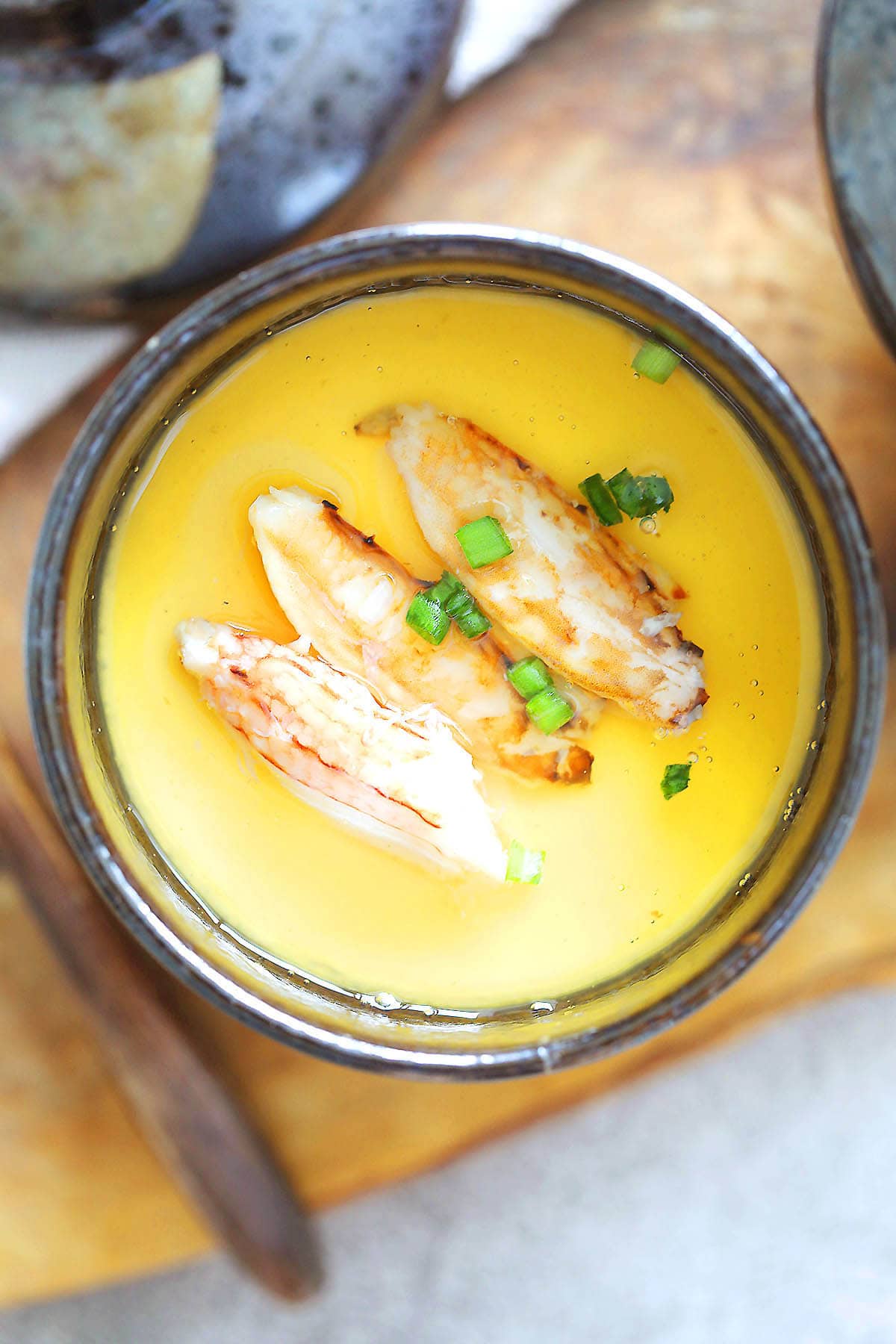
This easy Japanese steamed egg (chawanmushi) recipe combines silky egg custard with tender chicken cubes and crab meat. Topped with a savory homemade Dashi Sauce, it tastes just like the ones you get in Japanese restaurants!

Chawanmushi Recipe
In my last post, I shared my Dashi Sauce, and I promised to use that same savory sauce to top silky Japanese steamed eggs. Here it is! This chawanmushi recipe makes a classic Japanese steamed egg custard, gently steamed in small cups until soft, delicate, and incredibly smooth.
The key to good chawanmushi is getting the right egg-to-liquid ratio and straining the egg mixture before steaming. Straining removes any bits of egg and tiny bubbles, giving you that smooth, restaurant-style texture. I tuck chicken and crab meat into the cups, then finish each one with a spoonful of homemade Dashi Sauce for an extra layer of flavor.
Serve it warm alongside rice or noodle dishes for a comforting Japanese meal. And if you already love my Chinese Steamed Eggs, I think you’ll enjoy this Japanese version too. Both have that soft, silky texture that makes steamed eggs so good.
Sidenote: Traditional chawanmushi can include ingredients such as gingko nuts, kamaboko fish cake, and shiitake mushrooms. For more ideas on what you can use, check out my Easy Swaps and Substitutions section below.
Choosing The Right Cups For Chawanmushi

I recommend using traditional chawanmushi cups if you make this dish often. They are the right size for individual servings, and the lids help protect the delicate custard while steaming. If you don’t have them, there are several good alternatives.
- Traditional Chawanmushi Cups: Look for small ceramic cups with matching lids. They are usually around 6 to 7 ounces (180 to 210 ml), which is a good size for this recipe. The lids also help prevent condensation from dripping onto the custard.
- Ramekins: Small heatproof ramekins are the easiest alternative. Choose ones that hold around 6 ounces (180 ml) for a similar serving size and cooking time.
- Heatproof Glass or Ceramic Bowls: You can also use small heatproof glass or ceramic bowls. Make sure they are suitable for steaming and not too large or deep.
- Covering The Cups: If your cups don’t come with lids, cover them tightly with aluminum foil before steaming. This keeps condensation from collecting on the surface of the custard.
- Individual Cups vs. One Large Bowl: I prefer individual cups because the custard cooks more evenly and they are ready to serve straight from the steamer. You can use one large bowl, but the cooking time will be different.
- Where To Buy Chawanmushi Cups: You can find them at Japanese grocery stores, Asian supermarkets, Japanese kitchenware stores, restaurant supply stores, or online. Search for “chawanmushi cups” or “Japanese steamed egg cups with lids.” Amazon and other online retailers also carry a good selection.
Ingredients You’ll Need

See the recipe card below for all the ingredient details and exact measurements.
Pro Tip #1: Get The Egg-to-Dashi Ratio Right
I use a 2:3 egg-to-dashi ratio by weight, which gives the chawanmushi a soft, silky texture. For this recipe, that’s 2 large eggs (about 3.5 oz/100 g) to ⅔ cup (150 ml) dashi broth. Room temperature eggs are easier to mix with the dashi.
Pro Tip #2: Use Good Dashi
Dashi is the base of this dish and gives the custard its delicate savory flavor. You can use homemade dashi or instant dashi, but for the best flavor, I recommend my Dashi Broth recipe.
Pro Tip #3: Choose Good Mirin
Mirin adds a subtle sweetness and depth of flavor to balance the savory dashi and soy sauce. I recommend Kikkoman Manjo Aji Mirin, Mizkan Honteri, or Eden Foods Mirin, which are good options for Japanese recipes.
Pro Tip #4: Use Chicken Breast
I use boneless, skinless chicken breast cut into small cubes because it cooks quickly and evenly while the custard steams. The mild flavor also works well with the delicate dashi-based custard.
Pro Tip #5: Add Crab Meat
I add crab meat for a touch of natural sweetness and a delicate seafood flavor that pairs well with the savory custard. Reserve some crab meat to use as a topping before serving.
Pro Tip #6: Finish with Dashi Sauce
The dashi sauce adds another layer of savory flavor and moisture, and makes it taste just like the kind you’d get at a Japanese restaurant. It’s optional, but I highly recommend it. Check out my Dashi Sauce for the full recipe.
Easy Substitutions And Swaps
You can easily switch up the fillings depending on what you have on hand. Keep the pieces small so they cook evenly with the egg custard.
- Chicken Thighs: Swap the chicken breast with boneless, skinless chicken thighs. Cut them into small cubes, about ½ inch, so they cook through evenly while steaming.
- Shrimp: Swap the crab meat with shrimp. Peel and devein the shrimp, then cut larger shrimp into small pieces so they cook evenly. Small shrimp can be left whole.
- Ginkgo Nuts: Ginkgo nuts are a traditional addition to Japanese steamed eggs. Use canned or vacuum-packed ginkgo nuts and add a few to each cup.
- Mushrooms: Use thinly sliced fresh shiitake mushrooms, or swap them with shimeji mushrooms. Cut larger mushrooms into smaller pieces so they cook evenly while steaming.
- Kamaboko or Narutomaki: Both are Japanese fish cakes made from white fish paste and are commonly used as a garnish. Kamaboko is usually white with a pink outer edge, while narutomaki is round with a pink or red spiral in the center. Slice thinly and use a few pieces as a topping.
How To Make Japanese Steamed Egg

Drop your chicken cubes and crab meat right at the bottom of each chawanmushi cup, but make sure to hold back a little bit of that crab meat so we can garnish the top later.
Pro Tip: Cut your chicken into tiny, even little cubes. That way, they cook right in the center of the cup without being too heavy and sinking your delicate egg mixture.

Grab a bowl, crack your eggs in there, and beat them up really well. Pour in your Dashi Broth, soy sauce, and mirin, then mix everything together until it is fully combined.
Pro Tip: Mix your eggs and liquids nice and gently. You want to avoid whipping up a bunch of foam, which keeps the mixture smooth and makes it way easier to strain later.

Pour the mixture through a fine-mesh strainer twice. This extra step is worth doing if you want that soft, silky texture.
Pro Tip: Straining it multiple times catches all those pesky stray chalazae and lumps. Trust me, this is the secret step that guarantees a mirror-smooth, totally pore-free custard surface.

Carefully pour your strained egg mixture into the chawanmushi cups, keeping a close eye out to make sure no air bubbles are hanging out on the surface.
Pro Tip: If any tiny surface bubbles pop up after you pour, don’t worry. Just gently tap the cup or pop them with a toothpick to get that flawless finish.

Cover your cups securely and steam them for about 15 minutes, or until the egg mixture is completely set.
Pro Tip: Keep your steamer at a gentle, medium-low simmer. If the water starts boiling too crazy and vigorously, your custard will heat up way too fast and turn all spongy or porous instead of silky.

Spoon that warm Dashi Sauce right over your steamed eggs. Top it off with your reserved crabmeat and some fresh scallions, and serve it up immediately while it is hot.
Frequently Asked Questions
Yes. Just place a heatproof metal ring or a crumpled piece of aluminum foil at the bottom of a wide pot to elevate your cups slightly above the boiling water.
Give the cup a gentle shake. If the edges are set and the center has just a slight jiggle, they are ready to come out of the steamer.
It is best not to do that. Steaming a larger or deeper portion for double the time will overcook the outer edges while leaving the center undercooked. Instead of using bigger cups, stick to standard-sized portions and steam multiple cups at the same time.
Reheating delicate egg custard is tricky because the microwave easily turns it rubbery. It is always best enjoyed fresh out of the steamer.
Keep any leftover cups tightly covered in the refrigerator for up to one day.
This recipe is 148 calories per serving.

What To Serve With This Recipe
For an easy and wholesome Japanese weeknight dinner, I recommend the following recipes:
I hope you enjoy this post as much as I do. If you try my recipe, please leave a comment and consider giving it a 5-star rating. For more easy and delicious recipes, explore my Recipe Index, and stay updated by subscribing to my newsletter and following me on Facebook, Pinterest, and Instagram for new updates.
Other Egg Recipes You Might Like
Prevent your screen from going dark
-
Place the chicken cubes and crab meat in the bottom of each chawanmushi cup, reserving some crabmeat for topping.
-
In a bowl, crack the eggs and beat well. Add the Dashi Broth, soy sauce, and mirin, and mix well to combine.
-
Strain the egg mixture twice through a fine-mesh strainer.
-
Carefully pour the egg mixture into the chawanmushi cups, making sure there are no air bubbles on the surface.
-
Cover the cups and steam for 15 minutes, or until the egg mixture is set.
-
Spoon the Dashi Sauce over the steamed eggs. Garnish with the reserved crabmeat and scallions, and serve immediately.
Serving: 2people, Calories: 148kcal, Carbohydrates: 2g, Protein: 20g, Fat: 6g, Saturated Fat: 2g, Polyunsaturated Fat: 1g, Monounsaturated Fat: 2g, Trans Fat: 0.02g, Cholesterol: 201mg, Sodium: 658mg, Potassium: 344mg, Fiber: 0.03g, Sugar: 1g, Vitamin A: 259IU, Vitamin C: 1mg, Calcium: 57mg, Iron: 1mg
Nutrition information is automatically calculated, so should only be used as an approximation.


 By
By