
[This Iran war post is launching before complete. Please return or refresh this page at 8:00 AM EDT for a final version]
Even with the US and Iran being more in threat display than hot action mode, we seem to be in an ongoing low-level skirmish over tanker transits in and around the Persian Gulf. Mind you, this low level tanker war may be very short lived, as in Trump may soon try to make a showy or big attack.
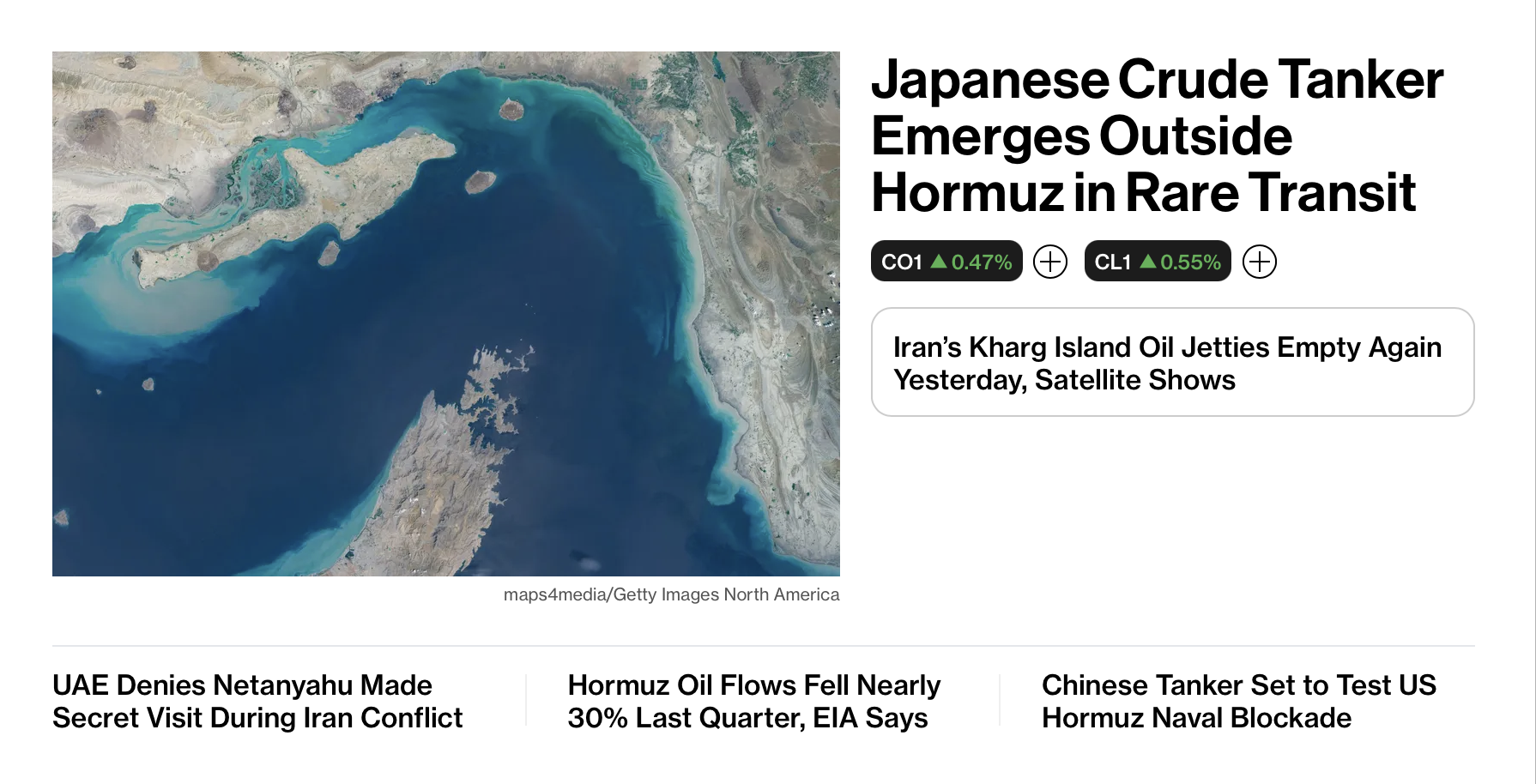
Some ships that had been bottled up in the Gulf are trying to make their way past the US blockade. This image from the Bloomberg landing page is not at the very top; that is all about the Trump-Xi meeting:

A key point that sadly needs repeating: the media fixation on merely exiting the Strait of Hormuz is mislead. Ships that have come from Iranian ports or have gone through the Iran clearing process are subject to US interference. Yes, only a very few have been boarded or attacked, but many more have turned back, presumably after having been challenged by the US Navy.
The Japanese transit is significant. Recall that Japanese officials visited Iran very early in the war (Japan, unlike nearly all US allies, had maintained decent relations with Iran) and had secured an agreement with Iran in March to let Japanese vessels through (see Aljazeera, for instance, in Iran says it will allow Japanese ships to transit the Strait of Hormuz).
However, the Bloomberg story shows that this Japanese vessel did not take the Iran designated route but instead stayed on the Oman side. Even though it is an open question as to whether Iran would have charged this ship a fee, it appears that the operators did not want to be assumed to have done that and then subject to US harassment in the blockade area.
So this confirms my thesis, that even this very lame US blockade is still affecting how ship owners and masters behave.
From Bloomberg:
- A Japanese supertanker, the Eneos Endeavor, has emerged in the Gulf of Oman after last signaling that it was inside the Persian Gulf, indicating a rare transit through the Strait of Hormuz.
- The tanker’s location transmissions show a gap, suggesting the ship sailed through Hormuz without broadcasting its movements, and its draft readings indicate that the vessel is nearly full with cargo.
- Eneos President Tomohide Miyata confirmed the vessel passed through Hormuz and expects the ship to arrive in Japan sometime between the end of May and early June.
A Japanese supertanker has emerged in the Gulf of Oman after last signaling that it was inside the Persian Gulf, indicating a rare, undercover transit through the Strait of Hormuz by a vessel from the Asian country.
The Eneos Endeavor, a very large crude carrier, began transmitting its location north of the Omani capital Muscat late Wednesday, sailing east toward the Arabian Sea, ship-tracking data show. That came after the tanker’s last signal showed that it was in the Persian Gulf, north of Abu Dhabi, on Monday. The gap in its transmissions suggests the ship sailed through Hormuz without broadcasting its movements.

A later Bloomberg story shows that two Indian ship carrying cooking fuel have exited the Strait of Hormuz. One that went through the Iran-approved channel, was from the UAE, even as (see shortly) new information about UAE active aggression against Iran and collaboration with Israel has led to some uproar. I don’t see this as new news per se; the fierceness of UAE opposition to Iran is settled fact.
So why did Iran let a UAE vessel through its toll booth? Iran has agreed to let India-bound cargoes pass. Cooking oil is essential for the population in India, and it may also not be a high value cargo. So this may have been the UAE testing if Iran was willing to hurt the Indian public in a very immediate way (hunger!) to keep strangling the UAE.
From Bloomberg in Two India-Bound LPG Carriers Add to Uptick in Hormuz Transits:
- Two India-bound vessels laden with cooking fuel from the Persian Gulf appear to have transited the Strait of Hormuz, despite continued restrictions from the US and Iran.
- The two passages take the number of large ships carrying oil, fuel and gas that have made it through Hormuz since Sunday to nine.
- A growing number of Persian Gulf exporters are managing to get their cargoes out, with Abu Dhabi National Oil Co. among those that have been shipping fuel on vessels moving through the strait without broadcasting their locations.
Two India-bound vessels laden with cooking fuel from the Persian Gulf appear to have transited the Strait of Hormuz, making them the latest to exit despite continued restrictions from the US and Iran.
One of the liquefied petroleum gas carriers, Symi, emerged in the Gulf of Oman on Thursday after turning off its transponder, with the other — NV Sunshine — went dark just after making it through the strait.

So it looks like Iran not as much in control of the Strait of Hormuz as it maintains it is. Admittedly, unlike the US, Iran has shown considerable ability to adapt how it operates over the course of this war, so it may improve its procedures. The flip side is the Oman side is Omani territorial waters. Iran does not have a good case except “might makes right” for interfering with vessels there. The one exception could be inbound ships, where Iran could legitimately take the position that they might be carrying weapons intended for use against Iran, and Iran needs to inspect the ships to verify otherwise.
Iran has allowed Chinese tankers through the Strait of Hormuz amid the war.
Ship-tracking data shows at least 7 Chinese-linked vessels, including the Yuan Hua Hu (carrying 2M barrels of Iraqi crude), transiting via IRGC routes after being stranded since March. pic.twitter.com/O5PZas5ocb— Sabria Chowdhury Balland 🇺🇸 (@SabriaCBalland) May 13, 2026
‘
But Iran has flexed at least some muscle on the Oman side of the Strait of Hormuz. From the Financial Times in UK navy says vessel seized off UAE coast and heading for Iran:
The UK’s navy said on Thursday that a ship had been seized off the coast of the United Arab Emirates and was heading towards Iranian waters.
The UK Maritime Trade Operations Centre said the vessel was anchored 38 nautical miles north-east of Fujairah, one of the seven emirates that make up the UAE, when it was taken by “unauthorised personnel”. It provided no details about the ship, saying it was investigating the incident.
Presumably more to follow…
On a story from yesterday in Bloomberg, Chinese Tanker Set to Test US Hormuz Naval Blockade, was updated mid-morning EDT yesterday but with no new information about the tanker’s progress. Twitter has no sighting that it got past the US blockade, only one handwave tweet with no backup.
For a bigger picture, Sal Mercognliano’s discussion tries to look at where the fight to assert control over the Strait of Hormuz is going, with some revealing exchanges between Pete Hegseth and Congresscritters on the House and Senate appropriations subcommittees. One needs to filter for Mercogliano’s biases; for instance, he calls Iran an authoritarian regime that does not care for the well-being of its people. He’s also been a strong advocate for the US running convoys through the Strait of Hormuz. It has been revealing to see, as he continued to do here, him come to grips with the limits of US power. For instance, in an earlier segment, he effectively conceded that the US Navy could not solve this problem but then called for the US to clear the Iran coast of all weapons that could mess with ship, which is an extremely tall order.
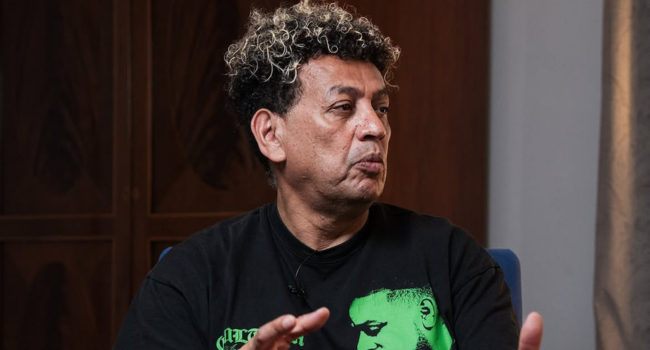
On the critical issue of where this conflict may be going, some important takes from John Mearsheimer on a fresh talk with Daniel Davis:
You will see that Mearsheimer firmly rejects one option I had been unduly hopeful about, that Trump will simply throw up his hands and walk away. However, he now conjures up a fourth alternative: that even though he is clear the US and Iran will not negotiate now, he posits that they will negotiate about the Strait later after economic pain on the US and the world gets to be intolerable. From a mildly cleaned-up machine transcript:
Davis: Do you see any possibility of a genuine negotiated settlement in the near term?
Mearsheimer: No. Excuse me, Danny. No, I don’t. There really four reasons for that. First of all, there are a number of different issues that have to be settled here. Not just the nuclear enrichment issue, , but the whole question of who controls the Strait of Hormuz.what are going to be Iran’s relations with Hezbollah, Hamas uh and the Houthis moving forward and so forth and so on.
They’re just a number of complicated issues that will take time to figure out by themselves.The second is that the Israelis uh will go to great lengths to make sure we don’t have a negotiated settlement.
Third point is there’s zero tolerance, excuse me, zero trust on the Ukrainian, excuse me, on the Iranian side. The Iranians just don’t trust us at all. And uh that makes it very hard in a complicated situation like this to get some sort of agreement.
And then the final point and a point that’s not to be underestimated is that the Trump administration has demonstrated since it’s took office in January 2025 that when it comes to negotiating with adversaries and shutting wars down, it’s the gang that can’t shoot straight….
Davis: then that leaves the other two options are either the walk away theory where President Trump just decides and claims victory and then leaves, picks up our toys, opens the the blockade and leaves and just hope that Iran then uh follows suit and opens up theirs and then the the return to war.
I’m going to get that last one separately. What are the chances do you think that given all of the options here that President Trump does some version of the declare victory and walk away theory?Mearsheimer: I think the chances are about zero. Uh first of all, the national security establishment in uh the United States is addicted to war. It’s deeply committed to policing every inch of the planet. Uh and the idea that we would walk away from the Middle East from the point of view of the American national security establishment is unthinkable.
And then on top of that, you have Israel and the Israel lobby….So, we’re not going away. We’re going to be stuck there forever.
Davis: Well, then that seems to leave one other option unless you see a different one and that is to and certainly there’s many advocates very powerfully so uh in in President Trump’s inner circle as well as in the public sphere of returning to combat operations to finish them off once and for all…Is there another alternative besides those three I’ve enumerated]
Mearsheimer: ….I think uh the chances of us returning to war are small uh and in large part because we can’t win…
I think what’s likely to happen is that you may get some sort of agreement, , on opening the straits or, , some sort of agreement on a few issues temporarily, but what will really matter here is the state of the international economy. I’ve long believed that what happens in terms of the international economy uh will be the decisive factor that will bring President Trump to the negotiating table and force him to make a deal that recognizes the fact that Iran won this war….
Davis: But wouldn’t wouldn’t there the same headwinds against the declare victory and walk away? Wouldn’t those same forces be against any kind of a this a deal like that that he would agree to?
Mearsheimer: No. Not that one, not that set of concerns. The the headwinds would come from the fact that you’re dealing with a lot of complicated issues that have to be resolved. And that means it would just take time to put an agreement together. But I believe that the speed of the agreement would be reasonably fast in large part because we would have such an incentive to shut this one down. I mean, the question you have to ask yourself, Danny, is can we allow this war to go on and on and on from an economic perspective given what it’s doing to the international economy?
I am hardly well positioned to question a top expert like Mearsheimer, but this is the geopolitical version of the economists’ “Assume a can opener.” And one might consider another economist’s saying that we have invoked in connection with this conflict, Herbert Stein’s “If something cannot go on forever, it will stop.”
First, Mearsheimer has described how the Trump team is incapable of conducting negotiations. A theoretical simpler deal does not solve that
Second, Trump added another Zionist stooge, Nick Stewart, to the negotiating team, confirming that Israel will be fully equipped to sabotage any talks.
Third, I don’t see how there is an easier deal to be had. For instance, Iran will insist on the US taking concrete action, like releasing substantial frozen assets, before it gets out of bed. Does a deal with fewer points to haggle over make US concessions like these any more likely?
However (and this is still optimistic, I concede) it is not just the “global economy” that will soon be pressured by shortages. So too will the military. Those who know how the armed services handle supplies can correct me, but for instance, lubricant shortages are already staring in the supposedly-insulated-from-oil-issues US. Paint, plastics, and textiles shortages are coming. Shortages of fuel for ships will mean goods from certain countries or regions, or those with complicates supply chains, may be hard to procure. And that is before the fact, as former Army Ranger Greg Stoker pointed out, US military maintenance is outsourced and generally poorly done. So if the armed services are relying on subcontractors to do work and be responsible for maintaining their own inventories of supplies, part of the US war machine could seize up unexpectedly.
That on top of the piece in the Atlantic by diehard neocon Robert Kagan describing long form that the US had already, and badly, lost the Iran war, may lead to fractures in the national security establishment, which Mearsheimer depicts as unified, that many will come to see an ugly exit as preferable to doing even more damage to the military along with the US economy.
To other updates: I am not as excited as Janta Ka is by confirmation that Israel and the UAE are joined at the hip. And Saudi Crown Prince MBS has regularly been depicted as egging Trump on to keep prosecuting the war against Iran while publicly pretending to be neutral. Nevertheless:
To Iran, this will be seen as even more evidence that the United Arab Emirates has become a base for Mossad just a few nautical miles off its southern coast. If war breaks out again, Iran will feel even more justified in hammering away at Dubai and Abu Dhabi https://t.co/2egUZpDTcL
— Borzou Daragahi 🖊🗒 (@borzou) May 13, 2026
What seems more noteworthy is the clip of Trump with reporters at 9:10. He’s name-calling them with much greater frequency than before.
You’ll see immediately after another short segment (which we featured yesterday) of Trump telling reporters that he did not consider, “not even a little bit,” the costs American were bearing in his failed effort to subdue Iran. As a result, the Wall Street Journal reports, Republicans Want Trump to Focus on Voters’ Economic Concerns:
Republican senators came to the White House on Monday with an urgent message: We must address voters’ concerns about high costs.
Sens. John Kennedy of Louisiana, Eric Schmitt of Missouri and Bernie Moreno of Ohio pressed President Trump to throw his weight behind legislation to ease the cost of homeownership, one of the central issues fueling Americans’ economic anxieties. “The American people are crying out for us to address the cost of living,” Kennedy told reporters later.
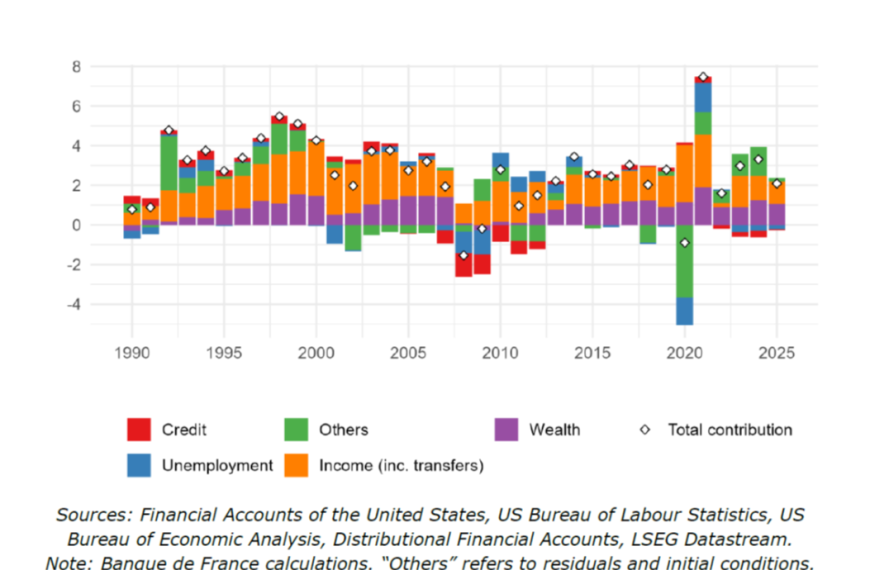
This chart in the story is deadly:

Some informational hygiene: We gave comparatively short shrift to a New York Times article, Intelligence Shows Iran Retains Substantial Missile Capabilities. That was because it seemed more significant as an indicator that insiders were being authorized to leak sensitive information to try to throw a spanner in the war than as bona fide news news about Iran’s capabilities, at least if you were not drinking the official Kool Aid.
However, since Trump’s China trip means we are a bit quiet on the kinetic war front, Simplicius called out a key part, which was the persistence of the US trying to destroy or impede access to Iran’s underground sites, to little effect. Key bits from Another Blow to Pentagon Hype: 90% of Iran’s Missile Sites Remain According to NYT Findings:
The New York Times now finds that 30 out of 33 Iranian missile sites along the Strait of Hormuz are still intact (emphasis original)…
Most alarming to some senior officials is evidence that Iran has restored operational access to 30 of the 33 missile sites it maintains along the Strait of Hormuz, which could threaten American warships and oil tankers transiting the narrow waterway.
The article elaborates that Iran plays a kind of shell-game—which we’ve long outlined here—moving its missile launchers around, popping them in and out of underground launch sites that make them effectively un-targetable by US strikes.
Several anecdotal stories about precisely this have circulated on social media:
NYT goes on to note that Iran has regained access to 90% of its missile storage sites and launch facilities…
It’s clearer than ever that it has been the US that has suffered far greater attrition relative to its own starting stocks than Iran:
In short, our earliest estimates are slowly being proven true: that Iran has taken hardly any damage because it was able to salt everything of worth away and adjust its launch tempo such that a couple dozen undetectable launches per day were able to be carried out from randomized sites without risking the platforms; most of what was hit ended up being decoys or derelict old decommissioned junk. This forced US to play a difficult game of ‘whack-a-mole’ that, given the size of Iran’s territory, is certainly not favorable to the US.


Other tidbits, first on the economic front.
Many including your humble blogger warned that Iran-war-induced high energy prices would not lead to more development to the US due to the expectation that demand destruction would kick in and lower prices. This forecast has become official:
There is no “drill baby drill” despite the price increase.
– The surge in US exports is mainly due to inventory releases
– US rig counts are down 30% YoY
– Average laterals are increasing by 5%SPR release + Axios = lower oil prices = no drilling pic.twitter.com/klIZsFEzTc
— Lukas Ekwueme (@ekwufinance) May 14, 2026
US EMERGENCY OIL STOCKPILE SEES RECORD DRAWDOWN
The U.S. Strategic Petroleum Reserve fell by 8.6 million barrels last week, the largest weekly drop on record, as the Trump administration responds to ongoing energy market stress.
The drawdown surpasses the previous record set…
— *Walter Bloomberg (@DeItaone) May 13, 2026
Indian authorities have asked the US administration to extend the license to purchase oil from Russia, Bloomberg wrote, citing sources.
The US Department of the Treasury’s authorization for the sale, transportation, and unloading of oil and petroleum products of Russian origin… pic.twitter.com/B9kcklCoQc
— Mats Nilsson (@mazzenilsson) May 14, 2026
⚠️ 8 Million acres of hard red wheat will be abandoned in US due to ramification of the war against Iran.
This is the lowest wheat acreage since 1919.
Keep blockading the blockade! pic.twitter.com/ps5GU9GW0R
— Ehsan Safarnejad (@Safarnejad_IR) May 14, 2026
SOMALI PIRATES just hit 4 ships in 11 days. The last time they moved this fast was 2012.
This is not a piracy resurgence. It is a security vacuum filling itself.
Every warship sent to Hormuz is a warship that left the Gulf of Aden. Naval assets concentrate where the crisis is…
— The Red Sea Monitor (@redseamonitor) May 13, 2026
More from DropSite in Somali Pirates Demand $10M Ransom for Oil Tanker Owned by Emirati Company:
Amid ongoing disruptions to maritime shipping in the Middle East due to the closure of the Strait of Hormuz, Somali pirates are demanding a $10 million ransom for the release of an oil tanker recently hijacked off the coast of Yemen, multiple security officials tell Drop Site News.
The oil tanker MT Eureka was sailing with the flag of the West African nation of Togo when it was seized by pirates at 5:00 a.m on May 2 near the port of Qana in Yemen in the Gulf of Aden. The hijacking was the second within a ten-day stretch, following the hijacking of another ship, the HONOUR 25, by pirates on April 22.
Mizrahi throws down a marker:
I see that virtually everybody is still mostly wrong about why Israel is bringing up the made up allegations of mass rape on October 7, and, after 2.5 years, it’s a little frustrating.
So listen carefully:
This is not historical revisionism.
This is not about the Gaza…— Alon Mizrahi (@alon_mizrahi) May 13, 2026
And a small bit of good news:
BREAKING! US court ha suspended the US sanctions against me!
As the judge says: “Protecting the Freedom of speech is always just the public interest”.
Thanks to my daughter and my husband for stepping up to defend me, and everyone who has helped so far.Together we are One. pic.twitter.com/z6L3tb7Esp
— Francesca Albanese, UN Special Rapporteur oPt (@FranceskAlbs) May 13, 2026
Done for today! Nat will be on duty tomorrow, so be nice!



 By
By