

Today’s Iran war post is for once actually a bit thin due to the appearance of quiet. That does not relieve the considerable pressures still growing on the economic front and also on the US’ and Israel’s already-limited ability to keep hitting Iran hard. Even if they could, keep in mind that escalation expert Robert Pape and others have pointed out that punishment campaigns do not work, and the US clearly lacks the means to contest Iran’s source of advantage, control over the Strait of Hormuz.
If there are any late-breaking developments, I will update this post between 7:00 AM EDT and 8:00 AM EDT and flag that in the headline.
Iran is still silent on the US demands proposal. I have not seen anything that supersedes this report:
Iran’s response to the US proposal remains under review with no deadline. Tehran is calling for a phased deal starting with ending regional conflicts and lifting sanctions before nuclear talks, amid ongoing disputes over the Strait of Hormuz.
Al Jazeera’s Resul Serdar reports. pic.twitter.com/GhomjoEBq0
— Al Jazeera English (@AJEnglish) May 9, 2026
If I were Iran, my reply would be to go back to its former position, no response to the substance until the blockade is lifted.
We still haven’t heard about a response from Iran on the US’ peace memo. In the future, one diplomatic source suggested avoiding timelines altogether:
“If the US stops saying, ‘We expect a response in two days,’ they may actually get a response.”
— Caitlin Doornbos (@CaitlinDoornbos) May 9, 2026
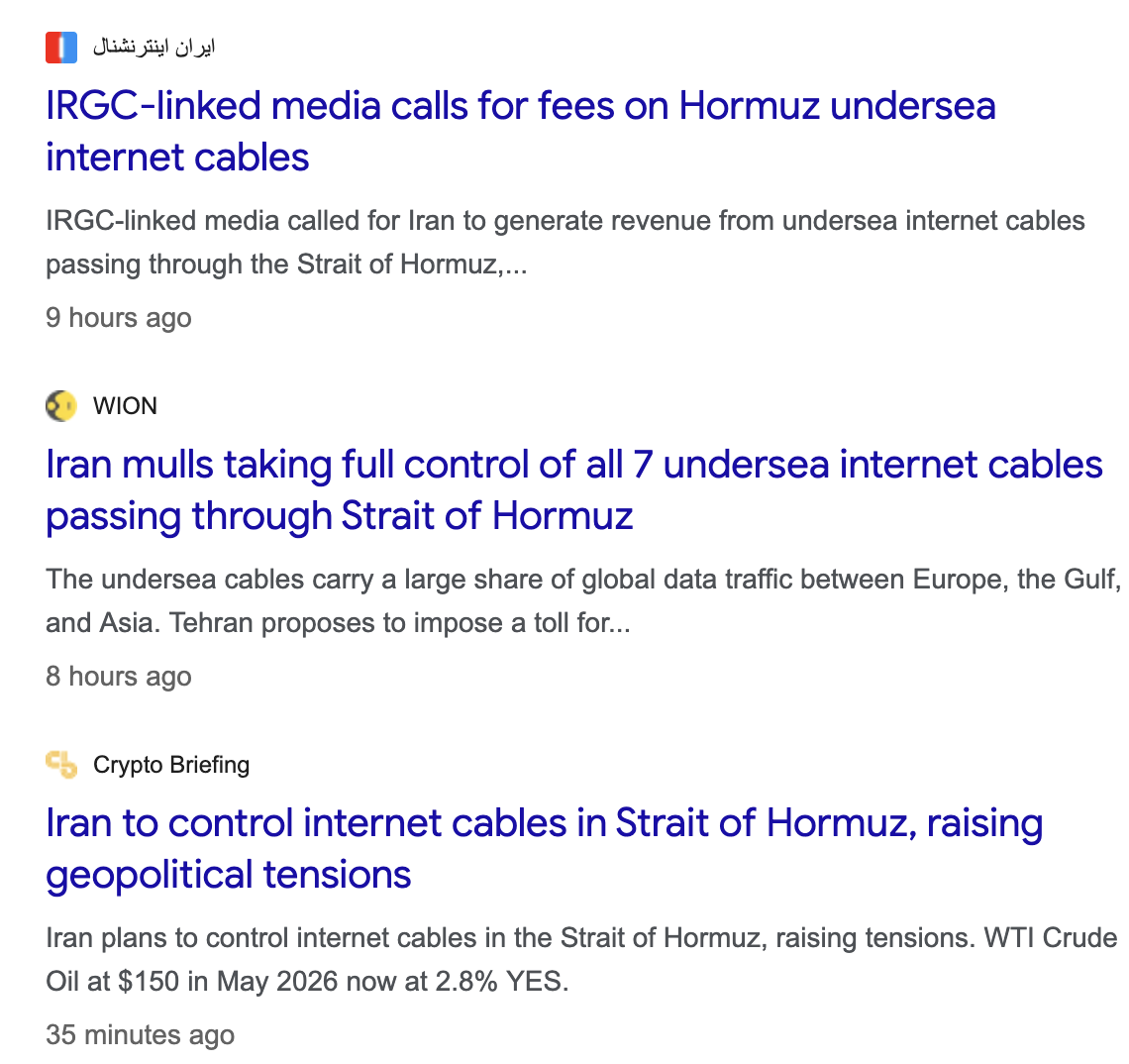
Oddly, neither the Western press nor officials have yet deigned to take notice of Iran’s inclusion of cables under the Persian Gulf as subject to its control. Will Iran tax them in return for leaving them unharmed?
Reader Ann identified a report at Pakistan Observer, Iran moves to place Internet Cables in Hormuz under State Control:
Iranian authorities have reportedly taken major and highly sensitive step involving Hormuz, moving to place undersea internet infrastructure and key maritime traffic under tighter state control.
The state regime started considering undersea internet cables passing through Strait of Hormuz as strategic national asset. These cables, which carry vast volumes of global internet traffic and critical financial data, could soon come under Iranian regulatory authority.
Reports suggest that a newly created authority in the Strait of Hormuz will be responsible for overseeing and managing international submarine communication cables in the region. Under this proposed framework, all such cables would fall under Iranian laws and oversight.
Tehran is reportedly working to grant domestic companies greater technical control over the maintenance and management of these undersea cable systems, further strengthening its influence over digital infrastructure in the region….
This is a fresh Google search on “Iran cables”. Keep in mind that Google very much favors mainstream outlets in its results. The ones shown are the only ones since Iran made its announcement:

Some additional comments:
Companies that have long denied service to Iran due to U.S. sanctions—like AWS, Google Cloud, Oracle Cloud, PayPal, Stripe, Apple Dev, and many global payment networks—now claim to care about internet access in Iran.
— IRIB (Islamic Republic of Iran Broadcasting) (@iribnews_irib) May 9, 2026
Bloomberg’s current lead story focuses on the deteriorating oil situation:

From its text:
- The world has burned through oil inventories at a record speed due to the Iran war, eating into the buffer that protects against supply shocks.
- The rapidly shrinking stockpiles mean the risk of extreme price spikes and shortages is getting closer, leaving governments and industries with fewer options to cushion the impact.
- Global visible oil stocks are already close to their lowest since 2018, with some signs that the drawdown may have slowed slightly in recent days, but the market remains vulnerable to future disruptions.
One has to marvel at the tacit assumption in this summary that oil supplies are a manageable problem ex getting something approaching old normal energy flows through the Strait of Hormuz. In a talk we included in yesterday’s post, commodities expert Jeff Currie said that two years after the Ansar Allah attacks on Red Sea shipping, traffic was only at 75% of prior levels. Currie made clear even if the war were to end soon, it would be a very long time before many shippers were confident that transit through the Strait of Hormuz was safe. Currie’s assessment is consistent with what ship owners and industry expert said to Lloyd’s List and Bloomberg soon after Iran asserted control over the Strait of Hormuz.
From the body of the article:
Morgan Stanley estimates global oil stockpiles dropped by about 4.8 million barrels a day between March 1 and April 25 — far exceeding the previous peak for a quarterly drawdown in data compiled by the International Energy Agency. Crude accounts for almost 60% of the decline, and refined fuels the rest.
Crucially, the system also requires a minimum level of oil, which means that the “operational minimum” is reached long before the inventories actually hit zero, said Natasha Kaneva, JPMorgan Chase & Co.’s head of global commodities research…..
JPMorgan’s Kaneva warns that inventories in the Organisation for Economic Co-operation and Development could reach “operational stress levels” early next month, if the strait doesn’t reopen, and then “operational minimum” floors by September. That’s the point when the world hits the bare minimum amounts of oil needed for pipelines, storage tanks and export terminals to function properly.

Economist and former adviser to the UAE Steve Hanke, in a talk with Lena Petrova, stresses that energy markets are set to hit a cliff as various buffers are depleted, and a big price spike by the end of July if not sooner.
This Aljazeera update gives prominent play to levitating food and energy costs:
If you listen closely, the segment also says, in effect, that the US is hopeful Iran will reply to its proposal. The formulation suggests that Aljazeera is not seeing an Iranian response as a given.
Forbes focuses on the looming jet fuel crunch, in Jet Fuel Shortage In ‘Crisis Mode’—More Flight Cuts And Higher Airfares:
• “It’s not going to be a short-term issue, because it can’t be easily solved,” Matt Smith, director of commodity research at Kpler, the energy data and analytics platform, told Forbes, having likened the jet fuel shortage to a “slow-motion car crash.”
* “We’re going to be in crisis mode,” John Gradek, who teaches aviation risk management at McGill University, told Forbes, noting “the industry has never seen this before, where the actual supply of the product needed to support aviation, that pipeline, is drying up.”
* Europe’s jet fuel inventories are expected to dip below the International Energy Agency’s critical 23-day shortage threshold sometime in June, according to a recent Goldman Sachs research note to investors.
Even local US newscasts are reporting on the damage to local commerce. For those outside the US, the Central Valley is the big growing area in California:
This segment gives an update on the latest Strait of Hormuz to-ing and fro-ing. Iran barks loudly after the latest dust-ups Trump makes the empty threat of restarting Project Freedumb even thought it has widely been reported that the Saudis and Kuwaits put their feet down, denying the US use of airspace and bases (this restriction was apparently limited to this operation; there are Twitter reports that the US is again using these resources).
Note that this segment, toward the end, discusses the UK’s chikenshit capitulation to Trump demands for help with the Strait of Hormuz. It will send the destroyer HMS Dragon to hang out nearby, in case a multinational operation miraculously comes together.
Stasislav Krapivnik talks with Danny Haiphong mainly about the Iran war but also the Victory Day commemoration:
Stas stresses that the US blockade is hopeless, echoing the point Larry Johnson and others have made, that there are far too few ships committed to the task. But the US hitting enough carriers may still succeed in keeping ships from transiting the Strait of Hormuz, although Iranian carriers seem most willing to take their chances.
However, there is still a great deal of debate in the Twitterverse over the significance of the recent exchange of fires in the Gulf and destruction of Iranian tankers. Note it took place in area that Iran had defined as within its zone of control:
The US strikes against the tankers Sevda and Sea Strike III were well past the blockade line set up by the US.
According to @TankerTrackers, the ships were spotted to the east of Bandar-e Jask (the ships are dark on AIS).
The ship location is in red. The area set up by the… pic.twitter.com/blAGYXkQM0
— Sal Mercogliano (WGOW Shipping) 🚢⚓🐪🚒🏴☠️ (@mercoglianos) May 9, 2026
Approximate locations of the 4 vessels disabled by CENTCOM since the initiation of the blockade. https://t.co/ebS42DnIsE pic.twitter.com/pjqMGD6a3D
— The(REAL)IntelFrog (@TheIntelFrogbu) May 9, 2026
🇺🇸🇮🇷 The U.S. reportedly struck tankers near Jask. Satellite shows 4 vessels hit, oil burning on the water, spills spreading 7km out.
80,000 barrels are leaking from Kharg Island (Iran’s main oil terminal) drifting toward UAE, Qatar and Saudi coasts. The Pentagon won’t say if… https://t.co/EXXOcwA4DR pic.twitter.com/6ChSzTKxCA
— Mario Nawfal (@MarioNawfal) May 9, 2026
The US had made new strikes:
Trump continues to escalate against Iran.
Today, three more Iranian oil tankers were hit, very close to the Iranian port of Bandar, practically in front of an IRGC Navy base.
President Trump continues to escalate, apparently trying to force an Iranian reaction that Iran seems… pic.twitter.com/aHOcXZulE4
— Patricia Marins (@pati_marins64) May 9, 2026
Marins and others argue that the US is trying to provoke Iran into sinking a destroyer. Professor Marandi (on Nima) said in the last 24 hours that the Iran shots at the US ships were intended to scare them off.
But what does Iran do now? Is the IRCG debating whether to retaliate directly or indirectly, say by leaning on Ansar Allah to shut down Bab el-Mandib transits? Tell Trump no talks if this crap continues? Is it studying if and how it can simply disable a destroyer by hitting its rudder and/or propellers? The lack of a muscular response is not a great look but the Iranians are patient and skilled at playing multi-layered games.
Keep in mind Iran has even more ways to get oil out via water:
🇮🇷 Iran’s tactic to circumvent Trump’s blockade: “ship-to-ship transfers in the oceans”.
The Washington Post: “While the US is blocking Iran, its oil is still flowing across the oceans through ship-to-ship transfers.”
Experts say that secret transfers at sea are used to conceal… pic.twitter.com/LPQpV9vRx2
— Sprinter Press Agency (@SprinterPress) May 9, 2026
Some still contend the one of US destroyer that fought off Iran was set on fire, at least on its deck:
A recurring pattern in this war has been the U.S. greatly downplaying damage to its own assets while greatly overstating the effectiveness of attacks on Iran, only for details to emerge later showing much greater damage to U.S. assets and far less damage to key Iranian… https://t.co/WnpFXZZzjS
— Sina Toossi (@SinaToossi) May 8, 2026
The way to infer whether there was real damage, as opposed to no or superficial harm, is if a destroyer decamps to Diego Garcia. Admittedly, it could still be for weapons restocking. But the absence of any destroyer going there would confirm CENTCOM’s positon that Iran did no real damage.
The US incursion and attacks may have been intended to deter vessel transit, particularly ones complying with the new Iran transit system. That may not have worked:
Notable shipping movement in the Strait of Hormuz.
Qatar is sending a laden LNG tanker (if sucesfull, it would be 1st crossing for Qatar since the start of the war).
Crucially, the Al Kharaitiyat tanker is following the new Iranian shipping lanes. Her destination is Pakistan. pic.twitter.com/IsqSNHsRaj
— Javier Blas (@JavierBlas) May 9, 2026
Other information tidbits. Israel barbarity continues:
The Israeli army launched thermobaric and pressure bombs, supplied by the United States, on Gaza. These bombs, which burn at a temperature of 3,500 degrees Celsius, are capable of killing thousands in seconds, leaving no trace. pic.twitter.com/dKcEJh7LyL
— Hasan alrabay (@HasanEssam29636) May 8, 2026
Iranians abroad come home to help:
Around 680,000 Iranians living abroad have returned to Iran during the war, mainly via the Turkish land border
Around 1 million have left the Zionist colony according to their own estimates https://t.co/ctii8s9hEy
— Sam Torabi سام ترابی (@SamTorabi72) May 9, 2026
MTG takes up a question our readers have sometimes asked:
Where are the two pilots that crashed and were rescued in Iran?
Are they ok?
Why don’t we know anything about them?
— Former Congresswoman Marjorie Taylor Greene🇺🇸 (@FmrRepMTG) May 8, 2026
Scott Horton gives a master class in Piers Morgan takedowns:
Piers Morgan will hear every word of this and the next time he speaks to Professor Marandi, Piers will pretend he never heard what Scott Horton said. https://t.co/fN41pftDFB
— Sabby Sabs (@SabbySabs2) May 9, 2026
IN additoin: I do not want to seem as if I have gone soft in the head. The latest Trump escalation with China, of sanctioning Chinese satellite companies alleged to have supplied Middle East data to Iran, would seem to kill a summit with Xi. This is just too provocative for China to swallow without loss of face.
If a meeting does still happen, it may be for Xi assist Trump in providing cover for Trump’s retreat from Iran conflict. I see this as very low odds but not impossible.
Off topic but I still thought made for a good final note:
🇷🇺 The Russian Army dropped a flower at the Ukrainian controlled WW2 memorial in Kherson. pic.twitter.com/aTeDGAEvHA
— Spetsnaℤ 007 🇷🇺 (@Alex_Oloyede2) May 9, 2026
All for now! See you tomorrow!


 By
By