
[This Iran war post launched before complete. It is, however, a bit closer than usual to being finished. Please check in at 7:45 AM EDT or refresh this page then for a final version]
Your humble blogger and the many others that predicted that there would be no negotiated outcome to the Iran war may be about to be proven wrong. But as things stand, there is still ample reason to wonder whether the commitment to signing a Memorandum of Understanding (MOU), set to be signed in Geneva on Friday could come unglued or be postponed.
We’ll go over the immediately preceding developments, which was that Israel again bombed Beirut to sabotage the signing Trump had loudly insisted was happening over the past weekend (Iran had rejected that timetable before the sabotage bombing but did make noises that an agreement might be inked soon). Iran was readying a counterstrike before the night was over.
Trump begged for Iran to stand down and Israel media claimed the US even offered Iran $12 billion of the frozen assets and was shocked when the Iran rejected that.1 I have no proof but the sequence strongly suggests that Iran made a counter offer: that the US take different pre-signing actions, which are to end the blockade and cease hostilities on all fronts, including Lebanon in the cessation of hostilities. So the US needs to be able to demonstrate that it can at least get Israel from stopping military action in Lebanon from Monday evening through the signing time in Geneva. That seems to explain the signing on Friday as opposed to early in the week.2
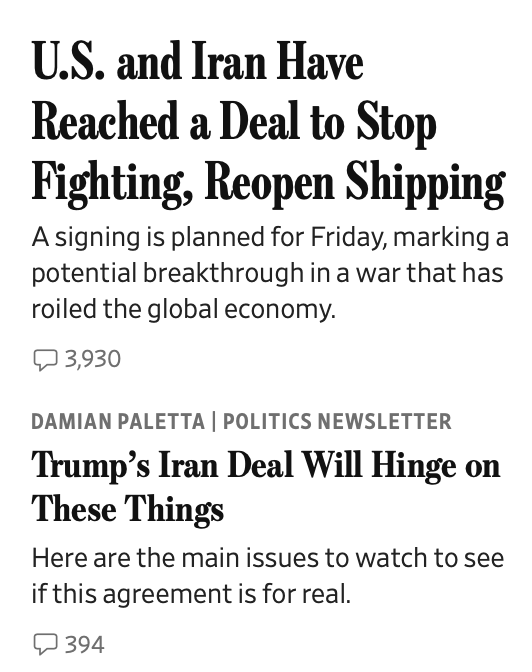
And keep in mind that even if Tehran and Washington do get over this hurdle, it is a long long long way for achieving a settlement. Trump himself and the general agreement incapableness of the US, made worse on Trump’s watch, are positioned to be insurmountable obstacle to getting to a final resolution. An indicator is that Trump has yet to reach a single final trade agreement. Even the Wall Street Journal signaled doubt. From its landing page:

If an MOU is signed and negotiations start and then break down, or take so long as to leave the conflict in an extended half-pregnant state, that could still result in great economic harm even if the pace at which the damage compounds lowers a bit.
The elephant in the room is whether the US will capitulate to continued Iran control of the Strait of Hormuz, with Oman cut in to improve legality and optics. The talks could break down fast over that. Even though, as we will show below, Trump has shifted from making hardline to ambiguous noises on this key issue, the US idea of what Strait of Hormuz being open and what the US have said have been in two different universes. And even if Trump has decided he has to give in, that does not mean he has the tenacity to hold firm when he gets pushback from hardliners.
The short sanity check list from the Wall Street Journal:
Is the deal, well, real? Here’s what to keep a close eye on:
The Strait of Hormuz. Trump suggested that the Strait of Hormuz, a vital commercial thoroughfare that Iran had been tormenting for months, would be opened after the deal is formally signed on Friday….
The blockade. The White House has imposed a naval blockade on Iranian ships, with the goal—essentially—of economic strangulation. Trump announced Sunday that he was lifting this blockade in conjunction with Iran opening the Strait of Hormuz. If the blockade is removed, Iran might be much more likely to continue negotiating with the White House on other things, as it could ease pressure on their economy.
Israel. One of the biggest strains on the talks in the past months has been Israel, which has continued bombing inside Lebanon. Iran has said this was a deal breaker. Trump initially brushed aside concern about Israel’s strikes against Iran, but in recent weeks he has become furious that Israel wouldn’t stand down. Israel’s strikes continued into Sunday morning, drawing a stern response from Trump. Will Israel now back away?
Both of Trump’s “Deal on” tweets were all about the Strait of Hormuz, suggesting that the getting back to something approaching normalcy has become an overriding concern:


Trump may even be fully on board with the the legal finesse, that Iran will not charge tolls but can and almost certainly will charge service fees. From the New York Times in Trump Claims Strait Will Be ‘Permanently Toll-Free’ Under Agreement With Iran:
President Trump said in an interview on Sunday afternoon that the agreement he had reached with Iran would ultimately assure that the Strait of Hormuz was “permanently toll-free,” and asserted that, despite the objections of Prime Minister Benjamin Netanyahu of Israel, he had saved Israel from nuclear obliteration.
Mr. Trump also insisted that if Iran failed to reach a final nuclear accord with the United States — a process that his aides say they expect will begin on Friday in Switzerland — he would restart military attacks on Tehran or make the United States “the guardian of the Middle East” in return for 20 percent of the region’s revenues…
“He’s a very difficult guy,” Mr. Trump said of the Israeli prime minister, “and to be honest with you, he should be very thankful to us for doing this. Because if Iran had a nuclear weapon, Israel wouldn’t be around for two hours.”
Mr. Trump’s assertion that the United States would, if necessary, become a paid police force for the Middle East would be a striking, if very Trumpian, departure. The president would, in effect, be turning American protection of the region — and the U.S. nuclear umbrella — into a mercenary force, there in return for profit. The arrangement would essentially reject the post-World War II American tradition, in which the United States used its power to assure global peace and prosperity…
But pressed on Sunday on whether he had won the agreement of Gulf states to such an arrangement — including American allies like Saudi Arabia and the United Arab Emirates — he did not offer a direct answer, suggesting instead that he had just begun to discuss the issue. It would only happen, he suggested, if Iran remained an adversary.
Mr. Trump described Iran’s current leadership, including the new supreme leader, Ayatollah Mojtaba Khamenei, as pragmatists. It was a vastly different tone from the one he took on the opening day of the war…
While the text of the agreement has not yet been published, Mr. Trump seemed to be describing Iranian concessions that the country has not yet made, or that have been kicked to the follow-up negotiations. The memorandum of understanding, for example, suspends tolls in the strait for only 60 days, and then promises a regional dialogue about the future. Iran had never charged tolls before the war, so the president is essentially celebrating a return to the prewar status quo….
He also insisted that Iran would be forever limited to enriching at low levels that “could never be used by the military.”
“They can never go beyond a certain amount,” he said. But when asked whether that limit was the same as in the Obama-era agreement — which limited enrichment to 3.67 percent, a level that is usable in power reactors but not weaponry — he said only that the new accord would assure that “they can only enrich for nonmilitary purposes. Forever.”…
Mr. Trump insisted, as his aides have, that Iran would receive no relief from sanctions or release of its frozen financial assets until it delivered on its commitments.
He maintained that he was in no rush to get the near-bomb-grade fuel out of its underground sites,…
He said the United States would, over time, join with Iran in “down-blending” the enriched nuclear material, which would bring it to reactor-grade. But he offered no deadline and sounded vague about the timing….
Mr. Trump also suggested that the United States would have what he called “strong policing powers” to make sure that Iran was not conducting nuclear work in violation of any of its commitments. He said that the previous deal allowed inspection demands to stretch out for months, but that the accord he is striking would provide for near-instant access. Iran has not spoken publicly about any such agreement.
If Trump does indeed stick to the terms implied here, that does amount to making major retreats from previously, noisily-stated positions, such as Iran must hand over all its “nuclear dust,” not engage in nuclear enrichment even for peaceful purposes, and go back to status quo ante regarding the Strait of Hormuz, as no Iran control at all.
However, even these big moves are short of what Iran has insisted on. Iran has correctly seen the US as totally untrustworthy and has insisted that the US take meaningful action before Iran moves as now-necessary demonstrations of good faith. Recall that Mehr News had posted a 14 point set of terms, which Trump had angrily denounced as not what was agreed.3
Iran’s Foreign Ministry has strongly signaled that the substance of their 14 points remains intact even if the verbiage moved about. It may also be that Iran settled on getting half of its sought-after $24 billion in frozen assets upfront for a pre-signing halt of the US blockade. From Tasnim News:
In a statement released on Monday night, the SNSC [Supreme National Security Council] secretariat said that the Islamic Republic, under the guidance of its martyred Leader Ayatollah Seyed Ali Khamenei, the directives of the current Leader Ayatollah Seyed Mojtaba Khamenei, the unwavering support of the Iranian people, and the tireless efforts of the country’s armed forces, has completed a period of difficult and intensive negotiations.
“Based on the approval of the Supreme National Security Council, the text of the memorandum of understanding regarding the end-of-war negotiations (Islamabad talks) between Iran and the United States was finalized on the evening of June 15,” the statement read.
“Under the agreements reached, the war and military operations on all fronts, including Lebanon, are ended immediately and permanently. Furthermore, the naval blockade against Iran is terminated immediately and completely.”
Note that the formal approval on the Iran side creates rigidity; they have created a big barrier to modifications if Trump throws a hissy.
Similarly, from PressTV:
Iran’s Deputy Foreign Minister for Legal and International Affairs has announced that the memorandum of understanding (MoU) between Iran and the United States has been finalized and will be officially signed on Friday in Switzerland, while emphasizing that the agreement is built on “active distrust” of the enemy.
“We have incorporated all our important positions into the draft MoU,” Kazem Gharibabadi said on Sunday.
“This memorandum does not mean trusting the enemy; it has been written with active distrust. We will monitor the implementation of US commitments.”
The deputy minister declared that starting Monday night, the US naval blockade against Iran will be terminated, along with “the immediate and permanent end of the war and military operations on various fronts, including Lebanon.”
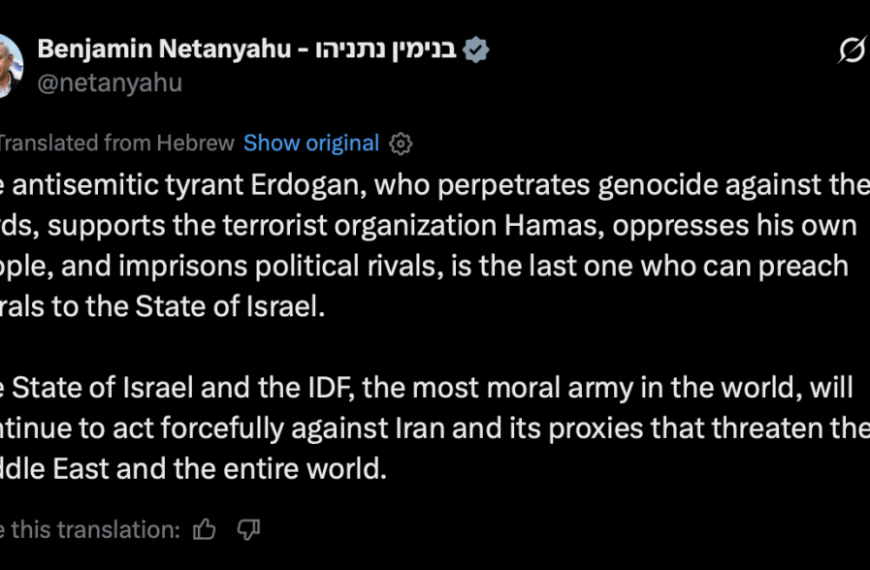
As we’ll soon discuss, this means Iran is requiring the US to leash and collar Israel, which Israel is predictably resisting:
Ben-Gvir says ‘Trump’s agreement’ doesn’t bind Israel as Netanyahu stays mum https://t.co/8rwRzmP7Qq
— Haaretz.com (@haaretzcom) June 15, 2026
Even if Iran does not charge fees while talks are on but controls traffic, it can clearly impose them if things go pear-shaped. That could in turn result in some states trying to evade the charges, which could result in Iran firing on vessels which would have the effect of choking transit (insurers would raise rates; some ship owners would not risk passage). We flagged this issue early on, that ship operators were not confident any conflict-resolution would hold, and many said they would hold back for a couple of months to be sure conditions had stabilized before sending vessels through the Strait of Hormuz.
A new story on Lloyd’s List reaffirmed the cautious stance of insurers and carriers. From A fragile thaw in Hormuz but timing and sequence now matter:
- Shipowners rushing to reposition vessels and markets are rallying, yet insurers for now are holding firm on high war‑risk premiums, insisting on ‘solid evidence’ of lasting safety before lowering rates
- Industry bodies warn that mine clearance and a return to the formal Traffic Separation Scheme are essential, as Iran’s blockade has permanently altered regional risk and demonstrated its leverage over the strait
- While a pause in hostilities will free stranded mariners and boost tanker and bulk markets, the sector sees this as a fragile reprieve rather than a return to normality, with elevated risk now embedded in long‑term decision‑making
But the flip side is that Trump on a visceral level may have come to recognize that in backing Israel and assuring a global economic depression, that Israel was the part of the equation he could budge. Politico reported that oil executive had warned Trump in person of the coming oil supply cliff. Producer and consumer inflation were already coming in hot.4
Regardless, as we said from the outset, this conflict would prove to be a test to destruction. And that is happening, albeit incrementally. We had pointed out that one possible, albeit seemingly unlikely, way for the conflict to fizzle out was that the Gulf States would pull away from the US and come to understandings with Iran. That is tantamount to the end of US dominance in the Middle East.
That loss of US standing is progressing apace. The Iranian attacks after the second-to-last Israel of bombing of Israel lead to Iran retaliation, with Iran striking not just sites in Israel but also ones in Bahrain, Kuwait, and Jordan. The inclusion of Jordan and the omission of Iran’s favorite punching bag the UAE (and the Saudis) is significant. First, the UAE seems to have realized that it cannot fight Iran and win, and is coming to a modus vivendi. From Middle East Eye in UAE paid Iran billions of dollars to halt strikes: Report (hat tip Kevin W):
The UAE paid Iran billions of dollars in return for a halt to attacks on the country in an about-face for the Gulf state that staked out the most hawkish position on Iran, lobbying the US to continue waging war on the Islamic Republic, Reuters reported on Friday.
The UAE has already delivered $3bn to Iran as part of the agreement, which two regional sources said reached as high as $10bn. Two other sources told Reuters that the UAE would eventually pay Iran $20bn.
The report reflects a stunning turn of events for Abu Dhabi and an indicator that Iran has emerged stronger from the war.
The UAE joined the US and Israel in conducting dozens of strikes on Iran during the war. It also tried to prevent Pakistan from mediating an end to the conflict.
Saudi Arabia had to supply a fresh loan to Islamabad after the UAE called in its debt obligations as punishment for hosting talks….
Last week, the UAE hosted members of Iran’s Islamic Revolutionary Guard Corps for a meeting with Sheikh Tahnoun bin Zayed al-Nahyan, the UAE’s national security adviser and deputy ruler of Abu Dhabi…
The UAE also dispatched diplomats to engage in face-to-face talks with senior Iranian officials this week to de-escalate tensions, Bloomberg reported.
A Gulf diplomat told MEE their government believed the meeting was held in Tehran as part of an effort to ensure the UAE wasn’t attacked….
Reuters did not say whether the billions of dollars provided to Iran came from accounts linked to Tehran, which Abu Dhabi had weighed freezing, or from Emirati sovereign funds…
The Reuters report comes after the Washington Post reported that Qatar agreed to close its Ras Laffan refinery in exchange for Iran not launching further strikes on it. Qatar denied coordinating the shutdown with Iran.
Second, the attack on Jordan is significant because the US has had to shift operation from bases closer to Iran to Jordan, putting it in Tehran’s crosshairs.
And this retreat from US bases is likely to be permanent. The US has gotten its allies to foot most if not all of the cost of these installation. Do you think the Gulf States are willing to put up a lot of dough to rebuild these sites when they are faced with other reconstruction cost, when they have also found that these garrisons put a target on their backs?
And the US loss of capability grows. The body of tweet by AMark4XX describes fresh losses:
➡️ Iranian forces are actively destroying American radar installations across the Persian Gulf.
➡️ Recent strikes hit key US-linked systems in Kuwait and Bahrain, including advanced ASR-1000L and R-327 Commander radars.
➡️ These actions aim to blind potential attackers and prevent surveillance during heightened tensions.
And of course, the other test to destruction underway is of the Netanyahu regime and his Greater Israel project. Given Israel Lobby control of Congress, it seems hard to believe that the US will not stand pat as Israel continues to attack in Southern Lebanon, which is virtually guaranteed under a fabricated claim of self defense. The Israeli public seemed to lose a good bit of confidence in Netanyahu when Team Trump leaked that Trump had torn into Netanyahu over his threat to bomb Beirut: “Everybody hates you now. Everybody hates Israel because of this.”
Netanyahu’s incentives would be to defy Trump so as to shore up his weakening position in Israel and stay out of prison. It seems difficult to believe that Trump would drop the hammer on Israel by, say, cutting off intel support or having US men and materiel entirely sidelined when Iran retaliates.5 So it still seems very likely that Israel will again act as a spoiler.
Mind you, the Overton window is shifting in the US. A friend who has Fox News on as background noise said that the Sunday morning political show discussed the imminent “deal” with newscasters speculating that Israel might attempt to wreck it. This was apparently the first time he had ever heard a word critical of Israel on Fox, that this change in posture was significant.
I am not an expert, but a contact who has worked in Israel and in Saudi Arabia and watches regional developments argues that if Netanyahu goes down, so too does Israeli influence in the US. He does not think the Ben Gvirs can form a government. Natalie Bennett isn’t skilled or connected enough to manipulate Trump and US officials any where near as effectively. But that may merely translate into a slow erosion of Israel’s leverage, given its vast influence over Congress.
Not independently confirmed, but enjoy the schadenfreude:
Confirmed reports that Donald Trump had a psychiatric meltdown in the White House this morning after he realized his imaginary Peace Deal wasn’t going to be signed for his birthday.
— Spencer Hakimian (@SpencerHakimian) June 14, 2026
Done for today! See you tomorrow!
____
1
🇮🇷🇺🇸🇮🇱 NEW: Iran just turned down $12 BILLION dollars in exchange for not attacking Israel — after Netanyahu’s strike on Beirut
Iran’s loyalty to Lebanon is not for sale, unlike Netanyahu and Trump’s mothers and daughters
— Jackson Hinkle 🇺🇸 (@jacksonhinkle) June 14, 2026
BREAKING: Iran directly rejects Trump’s offer for money and economic benefits in exchange for not responding to Israel’s strike on Beirut, saying an attack on Israel is imminent, per Channel 12.
Trump separately claimed that “no money will exchange hands” in any Iran deal,…
— The Hormuz Letter (@HormuzLetter) June 14, 2026
2 Mind you, that does not mean the US and Israel do not have a nefarious plan afoot. We quote a fresh New York Times interview with Trump on the MOU later in this post. Reporter David Sanger was struck by how freakily cheery Trump was.
Recall that when Trump and the Pakistan mediators not only sayid an agreement was completed by the weekend but had even set up electronic signing procedures so it could be executed quickly, in counterpart. Former diplomat Aurelien said it is not customary for pacts of this sort to be signed by national leaders. This would keep Mr. Market happy for the entire trading week. It also allows Zionists, US hawks and Christian evangelicals time to work over the fabulously fickle Hair Furore.
3 These are the 14 points, per Mehr News:
1) Permanent and immediate cessation of war on all fronts, including Lebanon.
2) The US’s obligation not to interfere in Iran’s internal affairs and to respect the sovereignty of the Islamic Republic of Iran.
3) Complete lifting of the naval blockade within 30 days.
4) The US’s obligation to withdraw its troops from areas around Iran.
5) Resumption of the operation of the Strait of Hormuz within 30 days in accordance with Iranian agreements.
6) Suspension of sanctions on the sale of oil, petrochemical products and derivatives, as well as full access of Iran to its financial resources.
7) The need for the US and its allies to present plans for the reconstruction of Iran worth at least 300 billion US dollars.
8) 60 days of negotiations to reach a final agreement on nuclear issues and the complete lifting of primary and secondary US sanctions, as well as UN Security Council and IAEA Board of Governors resolutions.
9) Confirmation of Iran’s obligation under the Treaty on the Non-Proliferation of Nuclear Weapons not to produce nuclear weapons.
10) During the negotiation period, the US pledged not to increase its forces in the region or impose new sanctions.
11) The release of 24 billion US dollars of Iran’s frozen funds within a 60-day period of final negotiations. Half of this amount should be provided to Iran before the start of negotiations.
12) The formation of a supervisory mechanism for the implementation of the agreement.
13) The final agreement will be approved by a UN Security Council resolution.
14) Final negotiations will not begin until the release of half of Iran’s frozen funds, the suspension of sanctions on Iranian oil and the lifting of the naval blockade, and the final agreement will only cover the fate of enriched materials and enrichment, the lifting of sanctions and a plan for the economic reconstruction of Iran. Discussions about Iran’s missile program and support for resistance groups are definitively off the agenda.
Note it is not clear that Trump can deliver much on sanctions relief. From Paper Politic (hat tip Chuck L) in Senators Try to Trump-Proof Any Iran Deal, but the Math Is Brutal:
The Senate’s Leverage Play
Start with the paperwork. Under INARA, the administration must transmit the deal text and related materials to Congress, kicking off a review period during which lawmakers can attempt to block sanctions relief.That mechanism matters because Iran policy is, in practice, a sanctions policy. Congress writes many of the sanctions into law, presidents often rely on waivers and licensing, and lawmakers can try to narrow those escape hatches if they think a White House is getting ahead of them.
Trump’s Second-Act Shadow
The durability argument is not theoretical, because Trump ran the experiment in public. On May 8th, 2018, he announced the U.S. exit from the Obama-era nuclear pact and reimposed sanctions, a move that reshaped the incentives for both Iran and U.S. allies.For senators looking to pressure a White House negotiating, that line is the leverage. If a future president can reverse course on day one, Tehran has to price in the risk, and lawmakers can argue that only Senate-ratified terms count as a real commitment.
Also note the status of the $24 billion is murky. A recap from NO1:
The $12B cash claim is contested: a White House official says it’s false and the deal is performance-based, step by step (JenniferJJacobs); others report $12B immediately plus oil/gas waivers (MonitorX99800). Reuters-sourced draft cited a $25B unfreeze. Lifting the blockade alone is ~$500M/day for Iran per Fox’s Tomlinson (ByronYork).
Recall that the DropSite New talk about Iranian concerns about Trump’s mental health flagged this lashing out as evidence either of Trump bad faith or confabulation, that Trump was mixing up ideas that were topics of discussion for later discussion with the MOU points that had supposedly been agreed, as in the Pakistani negotiators to which Jeremy Scahill had been speaking had confirmed these terms.
4 From Michael Shedlock:
- Final Demand: 1.1 percent in May, 1.1 percent in April
- Final Demand Goods: 2.8 percent in May, 1.9 percent in April
- Final Demand Services: 0.3 percent in May, 0.7 percent in April
- Final Demand Food: 0.6 percent, 0.2 percent in April
- Final Demand Less Food and Energy: 0.4 percent in May, 0.7 percent in April
And Marketwatch last week: CPI report today: Inflation tops 4% for first time in 3 years. Is this the peak? — live updates
5 Trump had been looking even more weak-kneed:
Who is this helpless-president routine meant for? The Iranians don’t believe the US president is incapable of curbing Washington’s dog, no one with a brain believes it. Apparently Ravid’s readers & some MAGA dead-enders still believe, because it partly absolves Trump/USA. https://t.co/kBOBx1K87i
— Mark Ames (@MarkAmesExiled) June 14, 2026



 By
By