
In what has become something of its own genre over the past few years, Israeli and Turkish officials are once again threatening one another.
Turkish President Recep Tayyip Erdoğan and Israeli Prime Minister Benjamin Netanyahu traded accusations last week after Erdoğan said Israel’s attacks on Syria and Lebanon threaten Türkiye. He threw in Israeli destabilization efforts in Africa and the Mediterranean for good measure.
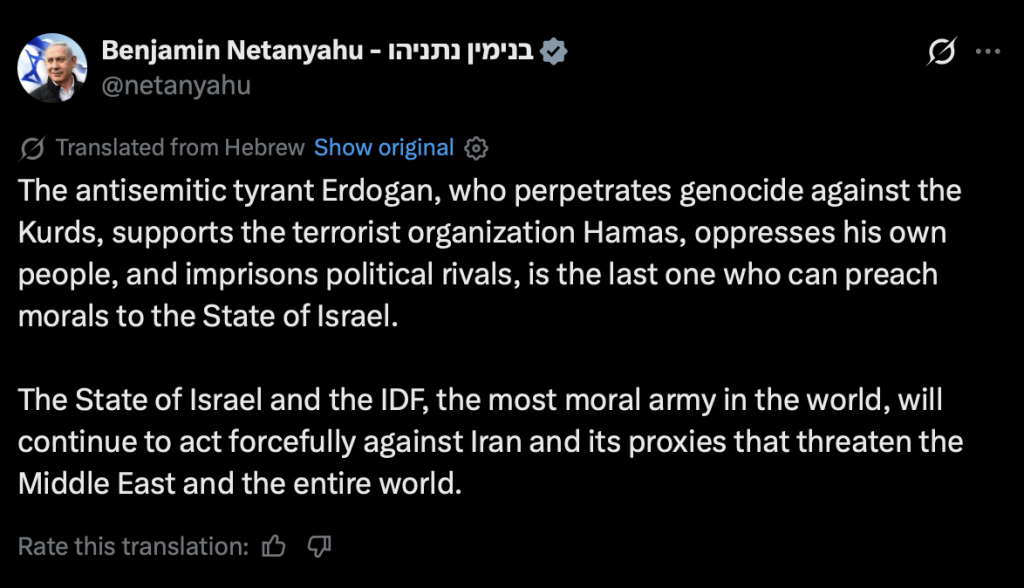
Netanyahu quickly got out a response, managing to troll everyone in the process:

To which Erdogan replied:
“Those who follow Hitler’s path should not forget their fate will be like that of other tyrants in history,” he said.“Under the current administration, Israel has become a factory producing distress, fueled solely by blood and tears, and producing nothing but instability and chaos,” he said, vowing to “ensure the perpetrators of such massacres are held accountable.
If only he were serious. While the media focuses on the latest exchange of verbal missiles, here’s what they’re not talking about: Turkish democracy has gone kapoof, and the US is embracing Erdogan at the same time as Israel paints a target on its back. First, the domestic scene in Turkiye.
On May 21, the head of the main opposition center-left Republican People’s Party (CHP), Özgür Özel, was removed by an Ankara court, which annulled the party’s 2023 leadership contest. It’s the latest episode of Türkiye’s justice system being used to wipe out the opposition. A year ago, the CHP’s presidential candidate, the mayor of Istanbul Ekrem İmamoğlu, was arrested. Numerous CHP mayors have since met the same fate, while some have been convince —by threat or blackmail— to switch to Erdogan’s Justice and Development Party. These efforts have largely nullified the CHP victory in the 2024 local elections, which was at the time the biggest setback in Erdogan’s two-decade rule.
What’s been the response in Western capitals? Mostly crickets. Instead of “the West” using Erdogan’s ongoing crackdown on speech and the opposition as an opportunity to help fuel destabilization in Türkiye, we see instead a deeper embrace of Türkiye.
Now, we must state the obvious: that Washington and European governments care little about democracy, and their criticisms are self-serving and often hypocritical. That’s not really the point here, however.
It’s what that silence tells us, especially at a time when, at least publicly, Türkiye is being teed up by Israel as a future target.
The Trump administrations have never been interested in the democracy-human rights talking points, but it’s still a go-to favorite in the EU. Yet Brussels is mum on the democratic crackdown and Erdogan’s comparison of Israel to Nazi Germany—even as it uses Kaja Kallas’ mild comparison of Israel to apartheid South Africa (one of the few semi-correct statements to come out of her mouth) as an excuse to send her back to Estonia.
Trump, on the other hand, prefers to talk in dollars or deals. And what’s happening there also speaks volumes.
On Wednesday, the Trump administration checked off another box on Erdogan’s wishlist by dismissing a criminal case against Turkish state bank Halkbank over allegations it helped Iran evade sanctions through an oil-for-gold scheme.
It was yet another reminder that although Israel and Türkiye might be vying for influence, resources, and supply chain positions across multiple theaters, in the imperial core of Washington —even if it is dominated by Zionists— there is an ongoing cooperation streak. Let’s note a few.
Last August, the Trump Route for International Peace and Prosperity (TRIPP) was created. The 43-kilometer corridor across southern Armenia that would connect Azerbaijan to its autonomous Nakhchivan exclave bordered by Türkiye, and Ankara is the biggest winner of the whole scheme.
Ankara and Baku are already working on building an electricity corridor to Europe that will run through TRIPP. It wouldn’t be surprising to see pipelines follow the electricity corridor path, as both Türkiye and Azerbaijan have long favored such plans. A US-Armenian joint venture company—with Washington’s 74-percent controlling stake— was just established by the U.S. International Development Finance Corporation Board of Directors.
TRIPP helps Türkiye expand its influence into Azerbaijan and the Organisation of Turkic States in Central Asia. At the same time, it could help wean Türkiye off Russian gas supplied by the Black Sea pipeline TurkStream if Azerbaijan can dramatically increase output (unlikely) or gas is somehow moved across the Caspian in sizeable quantities (more unlikely).
Still, the Azeri gas currently being sent to Türkiye via Georgia also moves onto the EU, which helps explain Brussels’ silence over Erdogan moves and statements that in the past would have drawn reprimands. Türkiye’s ability to send loads of refugees to Europe also doesn’t hurt, nor does its growing role in the EU’s “great rearmament.”
On the topic of gas, back in September, Türkiye inked a $43 billion, 20-year LNG import deal in the US. That comes on the heels of a $1 billion 2024 LNG deal with ExxonMobil. The US is also helping Türkiye develop shale fields.
In January, the empire brokered an agreement between Israel and Türkiye in Paris. From The Cradle:
Turkish Foreign Minister Hakan Fidan was present in Paris and played an active role in the negotiations. Its demands were clear: US support for the SDF must end, and the so-called “David Corridor” must be blocked. In exchange, Turkiye would not obstruct Israeli operations in southern Syria.
It was a transactional alignment – and it worked.
There is also ongoing cooperation in Iraq. US troops are shifting from Baghdad and western Iraq to Erbil, the capital of the Kurdistan Regional Government (KRG) where Türkiye has dozens of military installations. Both Washington and Ankara played big roles in resolving the oil revenue dispute between Baghdad and the KRG, and in September oil exports to Türkiye resumed.

That oil can be used domestically to help reduce Russian imports and it also makes its way to Türkiye’s Ceyhan port, from where Türkiye continues to export oil to fuel the same Israel carnage that Erdogan now compares to “Hitler’s path.”
It’s a strange ol’ world.
In May, the KRG also signed major oil and gas deals with two US companies to help increase output that will flow through Türkiye.
Mix all this with the EU’s vow (they really mean it this time!) to completely halt imports of Russian fossil fuels by the end of 2027, and it looks like Washington is making good on the 2022 Atlantic Council veiled threat/promise that “Türkiye can become an energy hub—but not by going all-in on Russian gas.”
This all comes as Turkish-Russian ties return to the old normal after a years-long thaw driven by Russia’s presence in Syria, the failed coup attempt in Turkey, US support for Kurds, and opportunities offered by the EU economic self-sabotage. Ankara also now has to worry about a strengthening Russia (and Iran).
So is it any surprise that Trump waves off the rhetoric of Erdogan and Netanyahu?
Reporter: Do you think there is a chance for conflict between Israel and Türkiye?
President Trump: I like Erdogan a lot. He is a strong person… I don’t think that will happen with Türkiye, not as long as I am president, because Erdogan respects me and I respect him. pic.twitter.com/qdwJAqbl73
— Open Source Intel (@Osint613) June 10, 2026
That’s similar to what Middle East imperial viceroy Tom Barrack said in April:
JUST IN: US Ambassador to Türkiye Tom Barrack:
Israel aligned with Türkiye, like Israel aligned with Abu Dhabi, like Saudi Arabia could be aligned with Israel and for the prosperity of the Israeli people, to me, that’s the answer.
So I think this rhetoric is going to go away.… pic.twitter.com/dHLcPAjWCT
— Sulaiman Ahmed (@ShaykhSulaiman) April 17, 2026
Barrack also told the forum in Antalya that Turkiye is key to Israel’s energy security.
“Everything comes from Türkiye. It’s fiber optics. We’re talking about Azerbaijan and Armenia, which is flowing oil, gas, information, data and materials. Where does it go? How does it go?” he said.
Those comments seem key to how the imperial center is trying to arrange the puzzle pieces.
Washington wants Türkiye’s attention focused to its North on Russia and to the East on the Caspian and Central Asia in a bid to weaken Russian influence there. Türkiye is obliging, and leaving Moscow in a tricky spot. Ankara hasn’t applied sanctions on Russia, has provided an alternative gas route to Europe, hasn’t allowed the passage of NATO warships into the Black Sea, but it has worked to undermine Russian influence across the Caucasus and Central Asia. Here’s Andrew Korybko recently commenting on President of the Russian International Affairs Council Dmitriy Trenin downplaying the challenges posed by Türkiye:
[Trenin] also said that “Moscow watches closely Ankara’s efforts to bring the various Turkic nations under the umbrella of a Türkiye-led organization” but added that “it doesn’t particularly fret over it.” Trenin then elaborated that “All Turkic-majority states of the former Soviet Union pursue multi-vector foreign policies. Türkiye is but one vector. Russia no longer takes the former Soviet republics for granted, and it is learning to compete with other powers to protect and promote its legitimate interests there.”
Trenin interestingly opined that “Baku, however, does not enjoy playing a little brother to Ankara. The geopolitical balance in the South Caucasus is very complex, but the countries in the region are not to be viewed as mere puppets of the great powers.” It’s true that Azerbaijan isn’t Turkiye’s puppet, but with all due respect to him, he appears to downplay the strategic significance of their military alliance. Another constructive critique of Trenin is that he’s ignoring that Armenia is subordinating itself to both of them.
He concluded that “As things stand now, it is other NATO countries, not Türkiye, that are seen in Moscow as a clear and present danger” and said that Russia would appreciate Turkiye playing a greater role in the SCO and BRICS as a means of even more optimally managing their rivalry than they already are. Trenin is smart enough to know that Turkiye is leading the expansion of NATO influence along Russia’s entire southern periphery via TRIPP, however, so he’s almost certainly downplaying this for diplomatic reasons.
On that Azerbaijan alliance, you know who else is very tight with Baku? The government on “Hitler’s path.” On June 5, CNN revealed what’s long been an open secret: that Azerbaijan operates as a forward operating base for Mossad and the Israel Defense Forces (IDF).
Israel secretly deployed elite military and intelligence units to Azerbaijan during the war with Iran as part of a network of covert sites across the Middle East to facilitate operations against Iran, four sources familiar with the matter said.
The forces operated out of several locations in southern Azerbaijan, two of the sources said, adjacent to Iran’s northern border and, at its closest point, only about 60 miles from the Iranian city of Tabriz, which Israel struck during the war.
Special commando units were also deployed to the location and carried out intelligence-gathering missions and drone operations, the other two sources said, giving Israel a valuable perch from which to see into northern Iran during the war.
Unsurprising. Israel has long provided Baku with advanced weapons, which along with Türkiye helped Azerbaijan enjoy an overwhelming advantage against Armenia in the 2020 war. That in turn helped pave the way for TRIPP—another example of all roads leading back to Washington.



 By
By