
“It’s just a square.”
That’s the three-star review of Nelson Mandela Place in Glasgow by someone named Katie Nicholson on Google.
Katie isn’t entirely wrong. A statue for the freedom fighter and former South African president is set to be unveiled in October, but for now there’s not a whole lot to see at the spot, listed as a tourist attraction on Google Maps.
But the couple of street signs tacked to buildings on West George Street, not far from the city centre, sit as an elegant and understated middle finger to apartheid South Africa.
The South African consulate left this location for some reason. (ABC News: Che Chorley)
In 1986, while Mandela was still in prison on Robben Island, the Glasgow City Council changed the name of St George’s Place to Nelson Mandela Place.
It meant that the South African consulate under the then-ruling National Party was forced not only to see the name of one of their chief antagonists as they entered the Stock Exchange building every day, but also send out correspondence bearing his name.
They opted to use a PO Box address before moving from the location in the early 90s.
After Mandela was released, he came to the city to thank the people for their solidarity in 1993.
Nelson Mandela thanked Glasgow in 1993, between being released from prison and becoming president of South Africa. (Getty Images: Chris Bacon/PA)
“While we were physically denied our freedom in the country of our birth, a city 6,000 miles away, and as renowned as Glasgow, refused to accept the legitimacy of the apartheid system, and declared us to be free.”
That cry of freedom is as synonymous with the Scottish as it is with Mandela himself.
So, how does a celebration of this Commonwealth sit with a city and country that has always had a fraught relationship with oppressors generally and the English specifically?
ABE – Anyone but England
Andy Murray got to represent Scotland in the 2022 Battle of the Brits. (Getty Images: Mark Runnacles/Battle of the Brits)
Tennis great Andy Murray once perplexed some (read: Americans) less au fait with the unique rivalries within the UK when he was asked who he’d be supporting at the 2006 FIFA World Cup and replied: “Anyone but England.”
Scotland isn’t on its own in this regard.
In the Ashes last summer, Australia’s injury-plagued men’s Test team scored a triumphant professional 4-1 victory, but more Australian joy was derived from watching another epic capitulation of an England team that had declared itself the saviour of Test cricket, teaching us all how to entertain, if not actually win much of anything.
We cheered every humiliating faceplant and fumble at least as much as we celebrated the all-time world-class performances of Travis Head and Mitchell Starc.
The recently completed World Cup was another reminder of the collective glee shared by so many in watching England stumble.
The Sun has set on the British Empire, and yet this celebration remains. (ABC News: Che Chorley)
There’s just something about the schadenfreude for Scots, Aussies and dozens of other nations in watching England lose.
Sure, you’ve got the Parthenon Sculptures and Rosetta Stone, but we’ve got Ellyse Perry and Steve Smith.
“There is this standard, reflexive idea of that they would prefer almost everybody to win other than England, as the most powerful part of the United Kingdom,” Western Sydney University emeritus professor of culture and research David Rowe told ABC Sport.
“I think for some people it’s serious, for some people it’s just a bit of fun.”
Loading Instagram content
There are jokes to be made, but also reflections on the very real subjugation that went on for centuries, and arguably only ended in 1997 when Hong Kong gained its independence.
This celebration of empire remains a peculiarity as calls grow to decolonise our language and our lives.
For a perfect example, the Parthenon Sculptures mentioned earlier are more famously known as the Elgin Marbles, named for the lord who nicked them from Greece and brought them back to Old Blighty at the start of the 19th century.
“I mean, the Commonwealth of Nations is, let’s face it, anachronistic,” Rowe said.
Flags that don’t always get to fly wave prominently at the Commonwealth Games. (ABC News: Che Chorley)
“There are people who … don’t know much about it or, if they schooled up on it, educated themselves about it, would realise that this is an anachronistic organisation based on an empire that no longer technically exists.”
Although, many in the still-constituent Scotland would tell you the legacy, if not the actuality, of the empire remains in many ways.
“There are plenty of people in Scotland, including its leading Scottish National Party, who really would prefer to separate from the United Kingdom and who are mightily displeased by Brexit,” said Rowe, a sports sociologist who consulted on the Glasgow Life team tasked with helping boost the city’s standing on the global sporting stage.
“There are plenty of Scots who felt a greater affinity with the European Union than with England.”
Strange, anomalous and anachronistic
A time machine is perhaps a fitting vehicle of entry of an event harking back to the past. (AAP: Andrew Milligan/PA Wire)
At the opening ceremony of the 2026 Commonwealth Games, King Charles III and Queen Camilla were warmly welcomed by the packed crowd at Glasgow’s Hydro, perhaps surprisingly considering the same crowd’s hearty refrains of Flower of Scotland barely an hour later.
The Scottish anthem retells Robert the Bruce’s legendary victory over King Edward II of England at the Battle of Bannockburn in 1314.
The thrust of the rousing choon, and Scotland’s identity more broadly, is about how this small but mighty land of hard folk repelled the crown time and again on the back of sheer grit and pride.
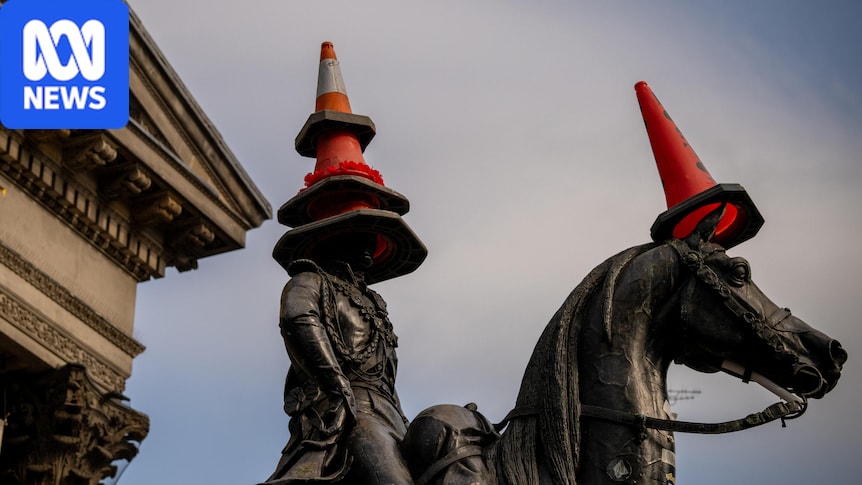
So ingrained in their identity is sticking it to the English that, instead of tearing down statues of old royals and dignitaries like the Duke of Wellington, they have simply given up on removing the traffic cones placed on his head.
And yet, twice in the past 12 years, Glasgow has gone out of its way to host what is correctly dubbed the Friendly Games, welcoming dozens of nations whose primary unifying theme is that they were once conquered by the “bastards” from that anthem.
“It does strike me as something of an irony that it’s not that very long ago that Scotland had a referendum to sever its ties with the United Kingdom and the British Crown, and now it’s hosting a Commonwealth Games,” Rowe said.
“I think it’s having a bit of fun, all the kilts and all the Scottish culture, reminding people that Scotland has its own identity and has not just been subsumed by the United Kingdom.”
The Commonwealth Games has the royal seal of approval. (Getty Images: Aaron Chown/WPA Pool)
If you need more evidence of the strange bedfellows in effect, Rowe said you need only look at the event’s original name.
It was called the British Empire Games from 1930 to 1950, the British Empire and Commonwealth Games until for the next four editions, and the British Commonwealth Games until 1972.
“So even more coded British,” Rowe told ABC Sport.
“And it’s a strange body in some ways, if you consider that it is a monument to colonialism and imperialism. And yet the members, most of whom were formerly under the jurisdiction of the British crown, were colonised, have now voluntarily agreed to join an organisation which was formed out of that imperial arrangement.”
It also provides those in the British Isles a chance to beat England while representing Scotland, Wales, Northern Ireland, Guernsey, Jersey or the Isle of Man.
Scottish knights of the British Empire Chris Hoy and Andy Murray have won a combined 13 Olympic medals for Great Britain.
Duncan Scott is Team GB’s most decorated Olympic swimmer, Mark Cavendish has won a world championship and Olympic silver with the Union Jack next to his name, but both turned around to beat the English while flying the Scottish saltire and Isle of Man’s triskelion during the Commonwealth Games.
Duncan Scott has won more Olympic medals than any other British swimmer. (Supplied: Commonwealth Sport)
So how does the home crowd feel watching their sporting heroes flying those flags?
“I think it means more to them to compete for Scotland,” one Glasgow local, Peter, told ABC Sport.
“You can see it in their faces when they do better. It does mean a lot more to them to represent their home country.”
There’s perhaps a hint of personal projection in this fan’s assessment, as summed up by his mate, Pat.
“I would hope that it does [mean more] for them, because it would for me,” he said.
Duncan Scott with the 2014 and 2026 mascots, the latter sporting a traffic cone for a horn. (Getty Images: Jane Barlow/PA Images)
No amount of raucous crowd support or national pride is going to turn a 45-year-old bricklayer who’s had a hot dog for breakfast into a 10-flat 100m runner. But at the tippy-top of sport, where the margins are at their finest, it’s got to be worth a few hundredths of a second.
Angharad Evans swam for Team GB at the 2025 world championships in Singapore, missing the semifinals and finishing a brutal 18th overall in the 100m breaststroke as she went almost two seconds slower than her time at the national trials.
She carried those scars with her until she exorcised them with a spectacular victory at the Tollcross International Swimming Centre, winning her first international gold medal and thanking the crowd for getting her to the wall 0.12 of a second ahead of Aimee Canny.
Angharad Evans said the Tollcross crowd carried her for the final 10 metres. (Getty Images: Quinn Rooney)
“Scotland was there to witness that and that was a very, very special moment for me,” she said.
“I thanked them because leading into competitions it’s so easy for doubts and negative thoughts to play a part in my mindset leading up, and I walk out and they just really uplift me and give me the confidence I need and boost me up.
“They often talk about how proud they are of us bringing back gold medals and PBs, but I’m immensely proud to have the Tartan Army supporting me in the crowd.
“Wearing the blue and white, hearing the crowd, being part of Scotland just carries you to the end. I don’t think I would have had the strength and the courage I did in the last 10 metres if I wasn’t in the blue and white and didn’t have that crowd behind me.
“They absolutely helped me get to the end and finish in first place. So it’s a medal for me but it’s also a medal for Scotland.”
All that from an English-born 23-year-old who is still learning the words to that famous Scottish anthem.
Loading…

 By
By