
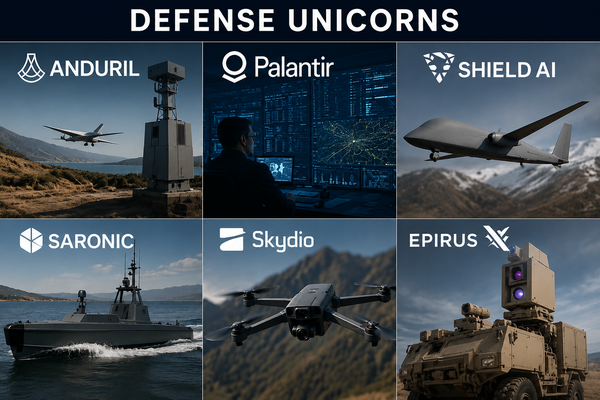

A growing chorus of Silicon Valley entrepreneurs, venture capitalists, and technology enthusiasts argues that the American defense establishment is overdue for disruption. A number of venture-backed defense technology unicorns have emerged to exploit this opportunity. They promise to bring the speed, innovation, and entrepreneurial dynamism that have transformed commercial industries ranging from retail and transportation to communications and finance. Artificial intelligence, autonomous systems, advanced software, and agile development practices are presented as solutions to a Pentagon procurement system often criticized for bureaucracy, cost overruns, and technological stagnation.
The appeal of this narrative is understandable. Many of the most transformative technologies of the past three decades emerged not from government laboratories or traditional defense contractors but from entrepreneurial firms operating within competitive commercial markets. If startups revolutionized so many sectors of the civilian economy, why not national defense?
The answer lies in a misunderstanding of the nature of the U.S. defense establishment. The Silicon Valley unicorns are not confronting a collection of inefficient firms that have somehow escaped the discipline of competition. They are confronting one of the most durable institutional ecosystems ever created. The defense establishment has survived wars, scandals, budget cuts, acquisition reforms, technological revolutions, and repeated predictions of disruption. Like an evolutionary ecosystem, it changes continuously while preserving its essential structure. The defense unicorns may produce valuable technologies. What they are unlikely to do is transform the U.S. defense ecosystem.
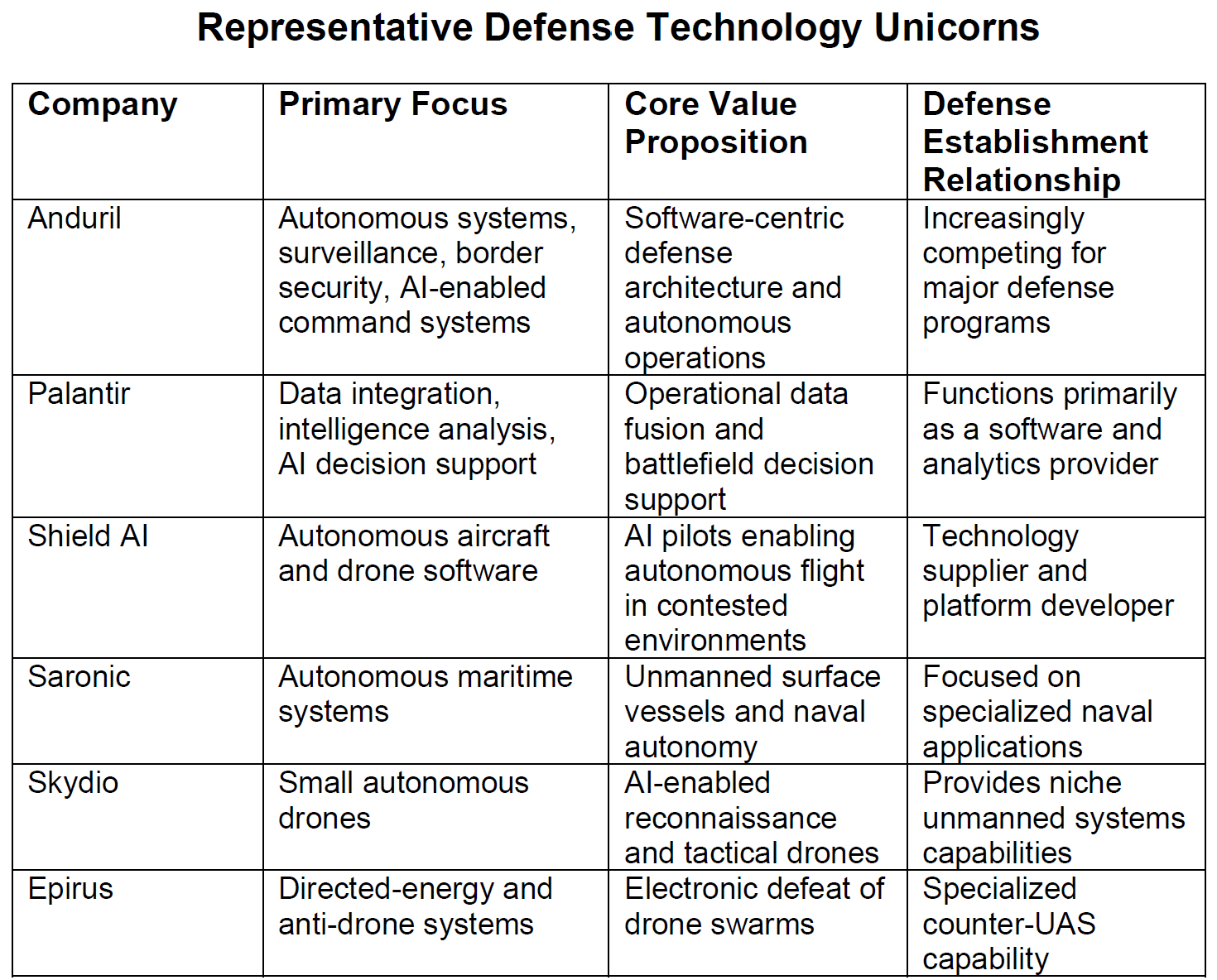
The Promise of the Defense Unicorns
The Silicon Valley worldview is grounded in a powerful historical experience. Entrepreneurial firms have repeatedly overturned established incumbents through superior technology, better incentives, and more efficient management. The startup community therefore tends to view institutional inertia as evidence of failure and disruption as evidence of progress.
This perspective is reinforced by the halo effect surrounding successful commercial technologies. Smartphones, cloud computing, social media platforms, and AI systems have reshaped daily life with astonishing speed. It is tempting to assume that the same formula can be applied to military organizations.
Yet this assumption overlooks a fundamental reality: military institutions operate under a radically different set of incentives and constraints than commercial enterprises. As management theorist Peter Drucker famously observed, culture eats strategy for breakfast. The defense establishment possesses a deeply embedded culture shaped by decades of operational experience, bureaucratic adaptation, political relationships, and organizational learning. The resulting ecosystem is far more resilient than many disruption advocates assume.
Military organizations are among the most culture-bound institutions in modern society. They develop shared assumptions regarding risk, authority, discipline, training, procurement, logistics, and combat effectiveness. These assumptions are reinforced through professional education, promotion systems, operational experience, and institutional memory. Technologies can be purchased. Organizational cultures evolve much more slowly.
Capitalism and Government Optimize Differently
The central weakness of the disruption narrative is the assumption that the U.S. defense establishment is merely a poorly managed corporation. Startup firms optimize for speed, growth, innovation, and efficiency. Venture failure is not merely tolerated; it is considered a necessary form of market discipline. Investors expect experimentation, risk-taking, and occasional collapse.
Government institutions optimize differently. Their priorities include stability, continuity, legitimacy, accountability, and reliability. Military organizations in particular must function under conditions where failure carries extraordinary consequences. A failed startup may disappoint investors. A failed military capability may cost lives, lose wars, or undermine deterrence.
The defense establishment is therefore not malfunctioning capitalism. It is a different optimization system entirely. Many of the characteristics criticized by reformers—extensive testing, redundancy, documentation requirements, regulatory compliance, and risk aversion—appear inefficient from a commercial perspective. Yet these same characteristics often exist because military organizations are attempting to minimize catastrophic failure. This difference in optimization explains much of the persistent disconnect between Silicon Valley expectations and defense realities.
The Strengths of the Dinosaurs
The major defense contractors are often portrayed as lumbering dinosaurs surviving solely through political influence and bureaucratic inertia. This caricature misunderstands how these organizations evolved. The defense industrial base functions as a complex ecosystem linking contractors, military services, congressional committees, regulators, think tanks, analysts, lobbyists, and procurement officials. These relationships have developed over decades and create forms of institutional resilience that are difficult for newcomers to replicate.
More importantly, the dinosaurs are not static. They have survived Vietnam, the post-Cold War drawdown, acquisition reform initiatives, the Revolution in Military Affairs, network-centric warfare, counterinsurgency campaigns, and successive waves of digital transformation. They have repeatedly adapted to new technologies while preserving their position within the broader ecosystem. This adaptability is their greatest strength.
Many practices that appear sub-optimal from a business perspective perform important survival functions within the political and bureaucratic environment of defense procurement. The dinosaurs have evolved not simply to build weapons but to navigate the institutional landscape in which weapons are funded, approved, sustained, and employed.
The Fragmentation Problem
Defense startups excel at achieving narrowly defined technical objectives. Most unicorns focus on niche capabilities: autonomous drones, AI-enabled targeting, software platforms, sensors, communications systems, or logistics applications. Such specialization allows rapid innovation, particularly when software is a key enabler of product capabilities.
Military organizations, however, do not fight wars with components. They fight wars with operational systems. A drone, algorithm, sensor, or software package may solve a technical problem without solving a military problem. Military value emerges from integration and coordination of assets rather than pure invention. A successful military capability requires integration across doctrine, training, logistics, intelligence, command structures, maintenance organizations, and operational planning. Individual technologies matter, but their value ultimately depends upon how effectively they function within larger military structures.
This presents a fragmentation problem. Startups may excel at developing individual high-tech components while remaining poorly positioned to integrate those components into operational military capabilities. The dinosaur defense contractors have the breadth of experience and resources to address such technology integration issues.
The Scale Problem
Silicon Valley excels at producing software, sensors, algorithms, and other high-value technological components. These capabilities can generate substantial military advantages, but they do not by themselves constitute military power. Nations do not fight wars with applications. They fight wars with integrated systems supported by extensive industrial and logistical infrastructures.

Boeing B17 WWII mass production
Modern military power depends upon the ability to design, manufacture, deploy, sustain, and replace complex equipment on a massive scale. Aircraft carriers, fighter aircraft, submarines, satellites, armored vehicles, munitions stockpiles, logistics networks, maintenance facilities, and training organizations require industrial capacities that extend far beyond software development. The challenge is not merely inventing a capability but producing and sustaining it under wartime conditions. The ability to manufacture sufficient quantities of drones, missiles, vehicles, or munitions to offset attrition is often as important as the sophistication of individual weapons. The superiority of systems that cannot be replaced is ultimately irrelevant.
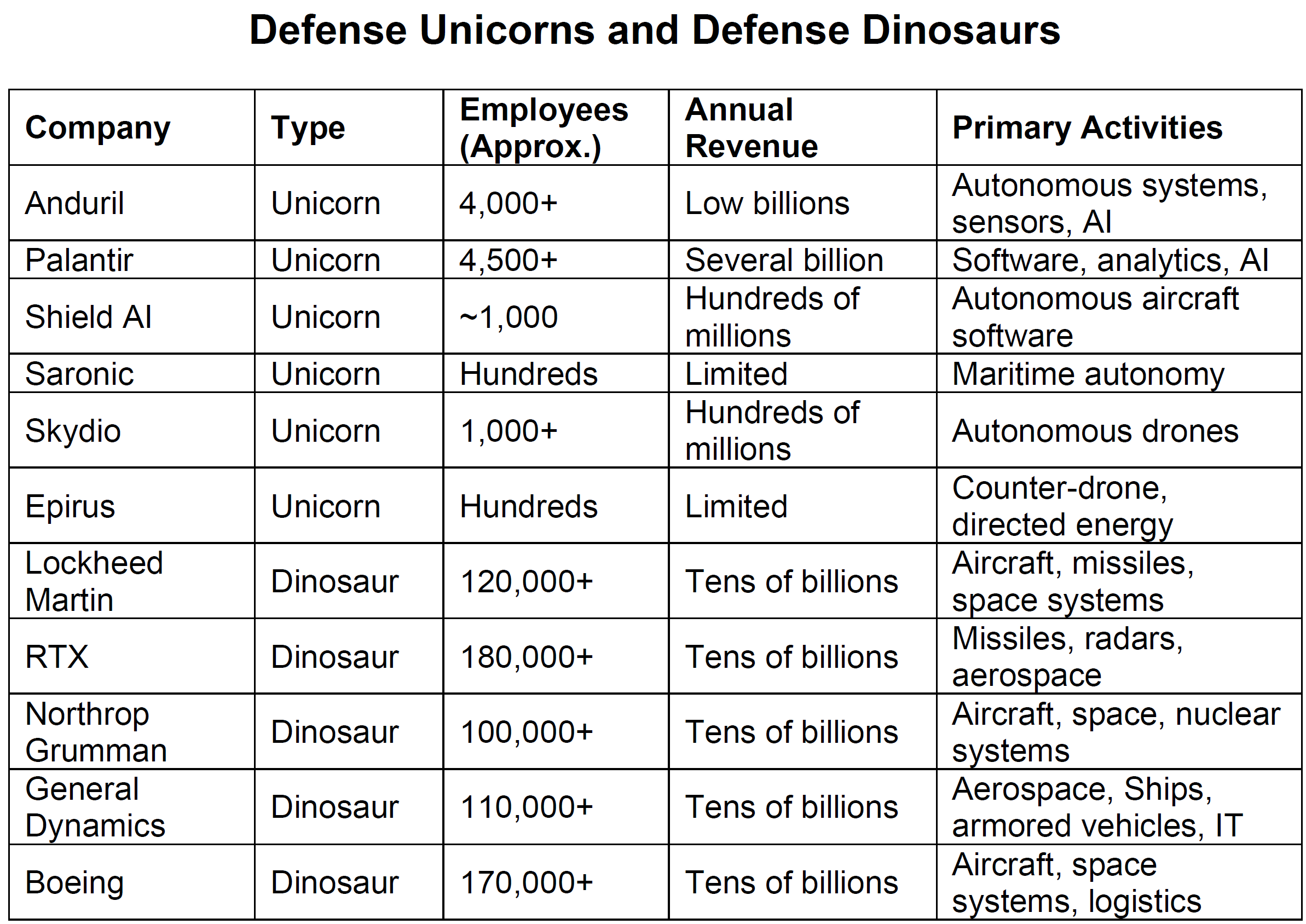
This distinction is often overlooked by disruption advocates. Building a successful software company and building a military production enterprise require fundamentally different organizational capabilities. A startup may develop an exceptional autonomous targeting algorithm. Converting that innovation into thousands of deployable systems supported by maintenance personnel, supply chains, spare parts inventories, training programs, and operational doctrine is a vastly larger undertaking.
The established defense contractors have accumulated these large-scale capabilities over decades. Their value to the defense establishment lies not simply in engineering expertise but in their ability to manage complex production networks, regulatory requirements, logistics systems, and long-term sustainment obligations. These capabilities are expensive, difficult to replicate, and often invisible to outside observers.
For many defense unicorns, the greatest challenge is therefore not invention but expansion. Developing a promising technology is only the first step. Transforming that technology into an enduring military capability requires entry into a world dominated by scale, integration, and sustainment. In that environment, the dinosaurs possess advantages that will be difficult for startups to match.
Speed Versus Integration
The main startup advantage is speed. Startups embrace iterative development, tolerate failure, and accept high levels of technical and financial risk. They can move rapidly because they control relatively small systems and face limited integration requirements.
Military organizations face a different challenge. The more capable a military system becomes, the more interconnected it becomes. Aircraft, satellites, sensors, logistics networks, command systems, intelligence assets, and weapons platforms must function together under demanding operational conditions.
This creates what might be called an integration tax. Every new capability introduces additional training requirements, logistical burdens, maintenance demands, interoperability concerns, and operational risks. The process of integration inevitably reduces development speed and organizational flexibility. As a result, innovation often occurs faster than military organizations can absorb it. The problem is not technological stagnation. The problem is that the speed of innovation exceeds the speed of integration.
The Stealth Precedent
Advocates of defense disruption often represent the latest emerging technologies as revolutionary, but history suggests otherwise. Stealth technology represented one of the most transformative military innovations of the modern era, but its institutional impact on the defense ecosystem was negligible.
Stealth fundamentally altered the relationship between aircraft and air defenses and provided extraordinary operational advantages. Stealth fighter aircraft could launch missiles to down enemy planes long before they were detected by adversary fighter radars. Stealth attack aircraft could bomb targets deep within the radar coverage of integrated air defense networks.
Yet stealth did not revolutionize the defense establishment. Instead, the establishment absorbed it. Initial exploitation occurred rapidly through highly specialized programs, such as the F-117 strike aircraft. Wider implementation proved much slower, more expensive, and more complicated. The evolution eventually produced major acquisition programs such as the B-2 and F-35, accompanied by familiar institutional pathologies including budget overruns, schedule delays, shifting requirements, and contentious oversight battles.
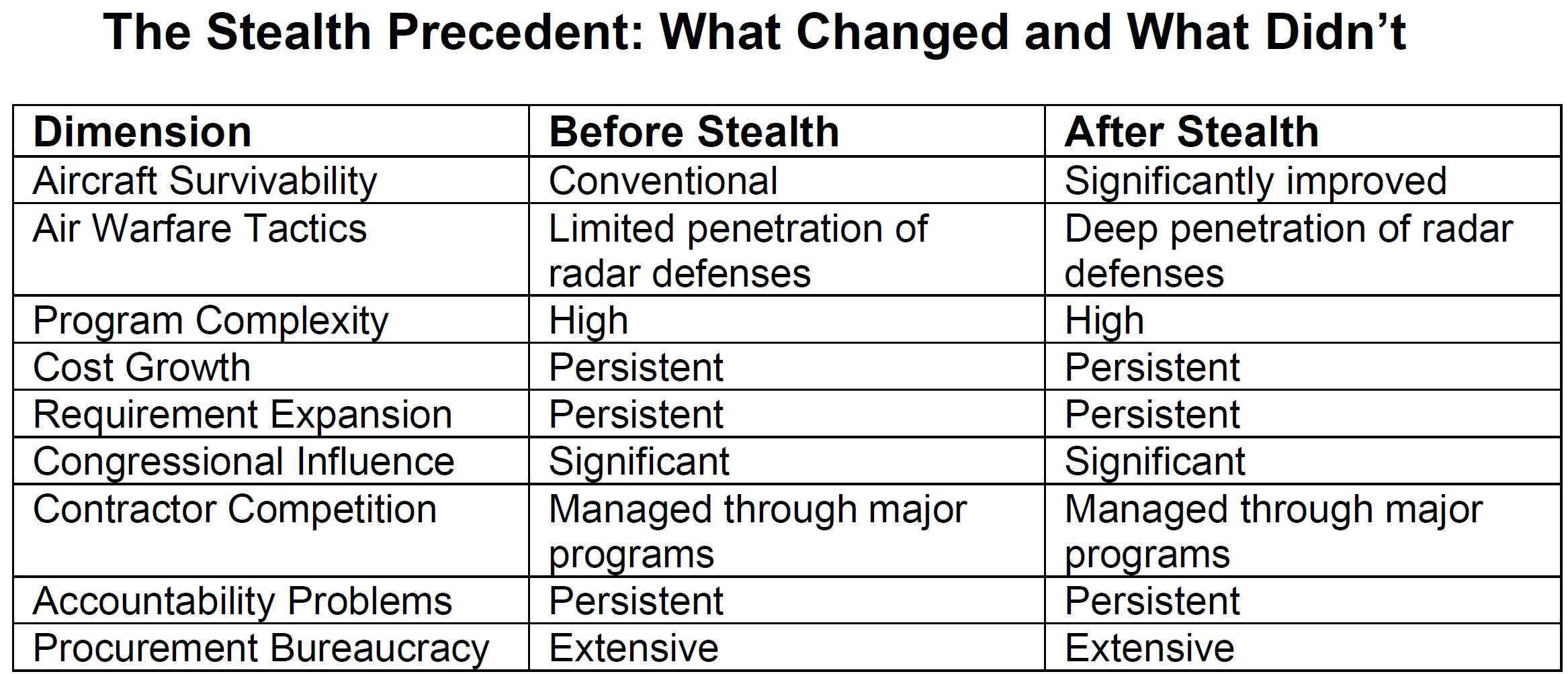
The lesson is not that stealth failed. The lesson is that revolutionary technologies do not eliminate institutional dynamics. They become subject to them. The same process is likely to occur with AI, autonomy, directed energy, and other disruptive technologies currently championed by defense unicorns. Stealth did not transform the major defense contractors. The revolutionary technology ultimately became part of new acquisition programs managed by the existing ecosystem.
The Wartime Technology Transformation Exception
The exception to this slow assimilation pattern is wartime expediency. World War II witnessed extraordinary rates of technological innovation and adoption. Radar, nuclear weapons, jet aircraft, codebreaking, and countless other transformative capabilities advanced with remarkable speed. The key difference was not technology but incentives.
Existential threats altered institutional behavior. Risk tolerance increased. Bureaucratic constraints weakened. Experimentation accelerated. Rapid adaptation became a strategic necessity. Under such conditions, startups and unconventional organizations often thrive.
History shows that these periods are temporary. During World War II, organizations such as the German V2 rocket program, the MIT Radiation Laboratory, and the Manhattan Project operated with unusual freedom from normal peacetime constraints. Yet after the war, procurement institutions gradually reasserted their traditional processes and controls. Once the wartime emergency passes, institutions generally return toward equilibrium. Stability, accountability, and procedural control reassert themselves. The extraordinary institutional receptivity to innovation in wartime rarely persists into peacetime.
The wartime exception proves the rule. Transformational innovation becomes possible when normal institutional incentives are suspended. It does not demonstrate that those incentives disappear permanently.
Why Unicorns Become Dinosaurs
The ultimate irony of defense disruption is that successful unicorns tend to become the organizations they once criticized. As firms grow, they encounter procurement requirements, compliance obligations, congressional oversight, regulatory frameworks, political pressures, and customer expectations. They develop government affairs offices. They hire former officials. They learn to navigate appropriations processes and acquisition regulations.
The defense establishment rewards firms that can reliably satisfy institutional requirements. A startup may initially differentiate itself through technical innovation and organizational agility, but growth increasingly depends upon mastering the bureaucratic, political, and operational realities of defense procurement. Winning contracts requires familiarity with acquisition processes. Expanding programs requires congressional support. Sustaining capabilities requires compliance, reporting, testing, certification, and long-term customer relationships.
The evolutionary pathway is remarkably consistent:
Disruptive Reformer → Established Contractor → Entrenched Incumbent
Firms that begin as innovators eventually acquire large workforces, extensive facilities, regulatory obligations, government relations staffs, and long-term contractual commitments. The organizational priorities that accompany these responsibilities naturally shift. Stability becomes more valuable than disruption. Predictability becomes more valuable than experimentation.
Preservation of existing programs becomes as important as development of new ones.
In many cases, successful unicorns are not merely transformed by the ecosystem. They are absorbed by it. Larger defense contractors frequently acquire promising firms in order to obtain technologies, talent, intellectual property, or market access. The startup survives, but as a component of a larger organization whose incentives are shaped by the broader institutional environment. The dinosaur swallows the unicorn.
The result is a recurring pattern. New entrants arrive promising transformation. Some fail. Some succeed. A few become major defense contractors. Over time the ecosystem assimilates each generation of innovators while preserving its fundamental character. The names change. The technologies change. The inhabitants change. The ecosystem endures.
The Dysfunctions That Will Persist
This assimilation process explains why defense procurement problems persist across generations of technology. Program bloat, cost overruns, schedule delays, block obsolescence, and weak accountability are not primarily technological problems. They are institutional problems.
Cost overruns provide a useful example. Defense programs frequently experience escalating costs, not because contractors lack technical competence, but because requirements evolve continuously during development. Military services seek additional capabilities. Congress seeks industrial benefits for constituent districts. Contractors seek contract growth. Program managers attempt to satisfy competing stakeholders. The result is a predictable expansion of scope that few participants have incentives to resist.
Schedule delays emerge from similar dynamics. Advanced military systems must satisfy operational, technical, regulatory, budgetary, and political requirements simultaneously. Every stakeholder can introduce new demands, but few possess incentives to simplify programs. Complexity accumulates faster than it can be managed.
Accountability suffers for much the same reason. Major acquisition programs often involve thousands of participants distributed across government agencies, military commands, contractors, subcontractors, and legislative bodies. Responsibility becomes diffuse. When failures occur, the complexity of the process makes it difficult to identify accountable actors.
Even technological obsolescence reflects institutional realities. Development cycles for major military platforms often span decades. By the time a system reaches operational deployment, portions of its technology may already be outdated. This outcome is a consequence of the scale, complexity, and bureaucratic oversight associated with modern defense acquisition.
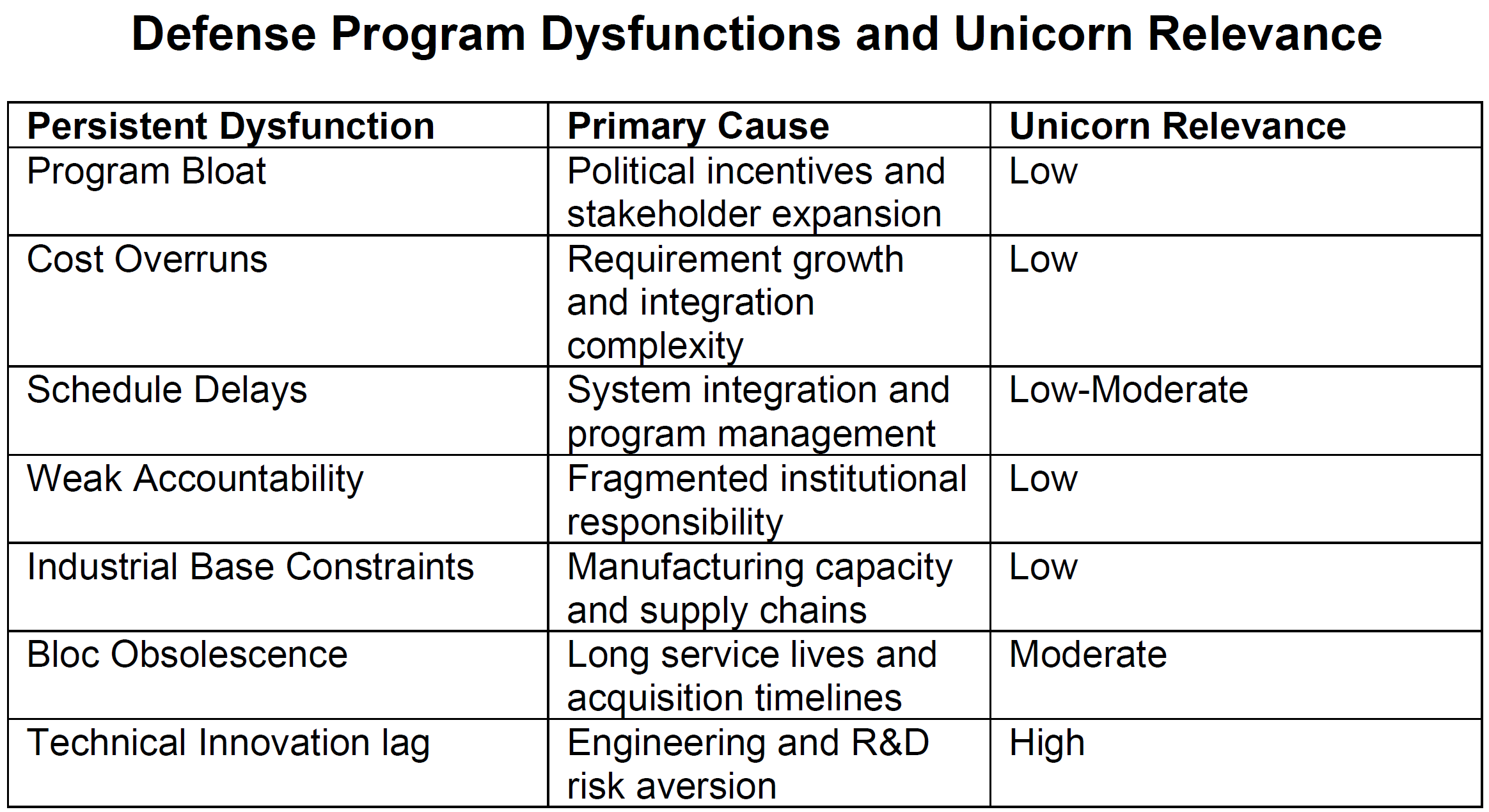
The arrival of defense unicorns is unlikely to alter these underlying dynamics. Startups entering the ecosystem must eventually navigate the same procurement regulations, congressional oversight, testing requirements, budget cycles, operational demands, and political constraints that shape incumbent contractors. Technologies may change. Companies may change. Yet the institutional incentives that generate acquisition pathologies remain.
The Leopard Principle
Giuseppe Tomasi di Lampedusa captured a recurring feature of political transformations in his novel, The Leopard: “If we want things to stay as they are, things will have to change.” In the novel, the change is admitting wealthy bourgeoisie into the hereditary governing elite to preserve the power hierarchy.
For the U.S. defense establishment, new technology elements will be incorporated to preserve the fundamental character of the ecosystem. The defense ecosystem evolves continuously. New technologies emerge. New companies enter. New organizational structures appear. New doctrines are adopted. New security priorities are identified. Yet the underlying structure of the system remains remarkably stable: a complex governed by the intersecting interests of corporations, military leaders, and politicians.
Conclusion
The defense unicorns will almost certainly contribute valuable technologies. Some may become major contractors. Others may reshape specific segments of the military marketplace. What they are unlikely to do is transform the ecosystem itself. The dominant forces shaping defense outcomes remain cultural, political, bureaucratic, and economic. Technologies evolve within these structures rather than replacing them.
The defense dinosaurs will survive not because they resist change but because they adapt just enough to survive within the ecosystem. The dinosaurs will eventually swallow many of the unicorns, but this will not endanger their habitat. The U.S. defense ecosystem has survived every previous technological revolution by adapting just enough to absorb it. There is little reason to believe the impact of defense unicorns will be different. Reform of the U.S. defense establishment will come only through sweeping institutional changes that fundamentally alter the environment of this ecosystem.


 By
By