
The Scarcity Fleet
The world’s major navies possess impressive warships in remarkably small numbers. The United States operates nuclear-powered aircraft carriers, advanced submarines, guided-missile destroyers, amphibious assault ships, maritime patrol aircraft, satellites, and a growing collection of unmanned systems. Individual platforms can search enormous areas, communicate across the globe, and launch precision weapons hundreds or thousands of miles. Yet this extraordinary technological capability has produced an increasingly scarce form of sea power.
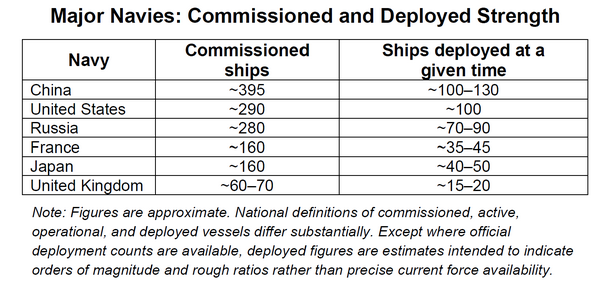
A navy does not fight with its inventory. Ships undergo maintenance and overhaul. Crews train. Vessels transit between theaters, replenish, repair, rotate home, and respond to competing demands elsewhere. A fleet that appears formidable in a table of ships can become surprisingly small when the question changes from How many warships do we own? to How much combat power can we keep continuously available in this particular part of the ocean? Here are some relevant statistics:

The figures in the table are necessarily approximate, but their scale illustrates the problem. Even the world’s largest navies operate surprisingly small numbers of deployed ships across enormous maritime spaces. By the standards of the two world wars, even their nominal fleets are tiny. Modern navies have compensated by concentrating extraordinary capability in individual platforms, but that concentration is precisely what makes those platforms scarce, difficult to replace, and consequential to lose.
Modern naval power is also concentrated in extraordinarily expensive platforms. An attack submarine combines propulsion, sensing, communications, weapons, stealth, navigation, and the machinery required to sustain a human crew for months. A destroyer similarly bundles sensors, computers, communications, missiles, propulsion, electrical generation, defensive systems, command facilities, and hundreds of sailors inside a single hull. These ships are technological marvels, but they are difficult to build, expensive to operate, slow to replace, and painful to lose.

This concentration of capability shapes how we think about naval power. We count carriers, submarines, destroyers, missile cells, aircraft, and tonnage. We ask whether one ship can defeat another and debate the relative merits of particular platforms. But the artifact may be the wrong unit of analysis. The real product of a navy is not ships. It is useful naval effects: finding an adversary, maintaining surveillance, communicating information, denying access, protecting commerce, delivering weapons, rescuing people, and controlling maritime space where and when required.
Historically, there were compelling reasons to package these functions together. A ship operating beyond the horizon had to carry its own sensors, communications, weapons, propulsion, crew, supplies, and much of the command structure needed to employ them. Mobility of the function required mobility of the machinery performing it. The ship therefore became both the physical and conceptual unit of sea power.
That technological necessity is beginning to disappear. Global satellite communications can connect objects separated by thousands of miles. Inexpensive processors can perform tasks locally that once required specialized facilities. Autonomous systems can navigate, monitor their condition, exchange information, and operate for long periods without people aboard. Small sensors can be widely distributed, while long-range precision weapons allow the sensor detecting a target and the weapon attacking it to occupy entirely different locations.
Most importantly, people no longer have to accompany most of these functions. Remove the crew and sleeping quarters, galleys, potable water, sanitation, medical facilities, watch rotations, evacuation provisions, and much of the machinery and logistical infrastructure required to sustain human beings can disappear with it. If capability is sufficiently distributed, an unmanned platform need not even be particularly survivable. Losing an individual machine can become an ordinary operating event rather than a naval catastrophe.
The emerging alternative is therefore more consequential than replacing a crewed ship with an autonomous version of the same ship. That would merely automate the existing paradigm. The more radical possibility is to unbundle the warship itself. Sensing can reside on distributed surface, subsurface, airborne, and orbital nodes; communications can travel through proliferated networks; processing and command can occur elsewhere; and weapons can reside in dispersed unmanned magazines. The result would be less a fleet of robotic ships than a persistent, predominantly unmanned maritime infrastructure capable of generating naval effects.
Such an architecture could reverse several assumptions embedded in contemporary naval thinking: scarcity could give way to abundance, concentration to dispersion, platform integration to functional disaggregation, episodic deployment to persistent presence, and platform survivability to network resilience.
None of this requires predicting the precise shape of a future fleet. Batteries, communications, autonomy, sensors, manufacturing, and weapons will continue to change the engineering tradeoffs. The more fundamental question concerns architecture. Networking and autonomy now permit naval designers to distribute functions, multiply nodes, remove people from most of them, and integrate their effects across the battlespace. If this model proves economically and operationally superior, the transformation will be much larger than the arrival of naval drones. The fundamental unit of sea power may cease to be the manned ship. This article explores the nature of this potential sea change in naval power.
Unbundling the Warship
A modern warship is not a single capability. It is a collection of capabilities required to travel together. A guided-missile destroyer must move through the water, generate power, navigate, search the air and sea, detect submarines, communicate, process information, launch weapons, defend itself, survive damage, and sustain hundreds of sailors. Each function brings equipment, space, weight, power, cooling, maintenance, and personnel requirements. More importantly, those requirements interact.
A more powerful radar requires more electrical power and cooling. Additional generating capacity requires machinery and space, increasing displacement and propulsion requirements. More weapons require magazine space, structural support, fire protection, and handling systems. As the platform becomes more capable and expensive, protecting it becomes more important, adding defensive systems and redundancy. More equipment requires more people; more people require berthing, food, water, sanitation, medical facilities, ventilation, and still more machinery.
Complexity breeds complexity. The problem can be called design entanglement: the additional complexity created when otherwise separable functions must accommodate one another because they occupy the same platform. Mundane ship design issues can be as revealing of entanglement as the exotic.
The Gerald R. Ford, perhaps the most technologically sophisticated warship ever constructed, illustrates the mundane consequences of design entanglement. Thousands of sailors require elaborate sanitary, laundry, ventilation, food, water, medical, and other support systems that contribute nothing directly to launching aircraft, detecting threats, or delivering weapons. Yet these systems consume space, power, weight, maintenance, and engineering attention because people are aboard, and their requirements must coexist with everything else packed into the hull. Failures in the Ford’s sanitary system and a laundry fire have required repairs and disrupted operations. Thus, even failures in systems unrelated to combat can degrade the availability of the combat platform that contains them.
Once many functions are bundled into a single artifact, its cost therefore becomes more than the sum of its principal capabilities. Functions impose requirements upon other functions, which create still more requirements. This can be termed the bundling premium. For most of naval history, paying that premium was unavoidable. A ship operating beyond the horizon could not leave its propulsion plant somewhere else. Its lookout could not remain ashore. Its weapons had to travel with it, officers had to interpret information and issue orders, and sailors had to operate and repair the machinery. The functions of the combat system therefore had to inhabit approximately the same physical object.
Modern networking has begun to break this constraint. A sensor detecting a target no longer has to reside on the platform launching the weapon. The computer processing the data need not be colocated with either. The officer authorizing an engagement may be somewhere else again. Satellites and other networks can connect them, while weapons can receive external targeting information and employ their own terminal sensors.
The combat sequence can therefore be physically separated: Sense → Locate → Decide → Strike. A surface or orbital sensor might detect a contact; passive acoustic systems could contribute additional observations; processing might occur locally or ashore; a distant authority could authorize action; and the weapon could arrive from an aircraft, shore battery, crewed ship, or unmanned magazine that never detected the target itself. The functions remain integrated. The machinery performing them does not.
This process is functional disaggregation. Once functions can be separated, platforms can be designed around narrower purposes. A surveillance node does not need missile cells. A missile magazine does not need an expensive long-range radar. A communications relay does not need torpedoes. A passive acoustic sensor does not need high speed. Many such machines need no accommodations for people because they contain no people.
The design question consequently changes from How many capabilities can we pack into this ship? to Does this function actually have to reside on this platform? Every time the answer is no, an opportunity for simplification appears. The resulting savings can extend far beyond the elements removed. Eliminate the crew and the platform need no longer be a floating community. Remove the large radar and its power and cooling requirements vanish with it. Eliminate high speed and propulsion requirements fall. Reduce the value concentrated in one hull and elaborate defensive systems become less necessary. Make the platform inexpensive enough and replacement may become more economical than adding protective systems.
Unbundling also changes modernization. Upgrading a conventional warship can affect power, cooling, weight, stability, software, maintenance, and other systems. In a distributed architecture, an obsolete sensor node can instead be replaced without redesigning the missile magazine. New processors, communications equipment, batteries, and sensors can enter the force incrementally rather than waiting for an entire class of ships to be replaced.
Networking, however, is not free. Communications systems, satellites, software development, cybersecurity, processing, integration, and command infrastructure all cost money. The proper comparison is therefore not between an inexpensive drone and a destroyer, but between complete architectures capable of producing comparable useful effects.
The cost structures nevertheless differ. Software and communications protocols can carry substantial development expense while being replicated across thousands of machines at relatively low marginal cost. Physical complexity must be manufactured, installed, powered, cooled, carried, and maintained on every platform containing it. Unbundling therefore confers a cost advantage whenever the cost of networking separated functions is lower than the bundling premium required to colocate them on a common platform.
Autonomy makes that proposition more consequential. Once people need not perform most naval functions, platforms can become simpler, more specialized, more numerous, and more expendable. Naval architecture can begin to exchange the exquisite capabilities of individual warships for the aggregate capabilities of a population. The warship does not disappear. It ceases to be the only sensible container for naval power. The resulting question is more interesting than how to build a better ship: What kind of navy would we build if we stopped assuming that the navy had to be built principally from manned ships?
Imagine Another Form of Naval Power
Imagine a naval force composed predominantly not of ships carrying people, but of unmanned machines distributed across the maritime environment. Thousands of relatively inexpensive surface vessels patrol slowly or remain on station carrying optical, infrared, electronic, radar, acoustic, and environmental sensors. Submersibles listen beneath the surface, periodically repositioning or communicating. Some systems remain dormant for long periods. Satellites provide communications and wide-area observation. Aircraft and shore installations contribute additional sensing and processing. Dispersed unmanned magazines carry long-range weapons, while a much smaller number of crewed ships and submarines perform missions for which people and sophisticated multifunction platforms remain valuable.

These units do not resemble a conventional fleet, but collectively they can perform many of its functions. Nor is this simply a very large drone swarm. The swarm is a tactic; the naval mesh is a force architecture. It can extend from the seabed to low Earth orbit, and its components need not be identical, travel together, operate continuously, or even communicate continuously. What matters is that their functions can be combined when required to produce useful naval effects.
A surface sensor might detect an unidentified vessel and pass a preliminary track through a satellite network. Orbital observation could narrow its location, while a passive acoustic system contributes another identification clue. Distributed processing could combine the observations. If the vessel were determined to be hostile and an engagement authorized, a weapon might arrive from an unmanned magazine hundreds of miles away. No single platform would have performed the mission. The combatant exists at the level of the mesh.
Simply replacing today’s ships with unmanned versions would preserve much of the existing architecture. An autonomous destroyer carrying an elaborate radar, large missile battery, sophisticated communications, high-performance propulsion, and extensive defensive equipment would still concentrate capability and cost in one hull. Ocean Presence points in the opposite direction: specialize the machines and integrate their effects.
A surveillance node can be optimized for persistence and sensing, a communications node for connectivity, a submerged magazine for concealment and weapon storage, and a service vehicle for inspection and repair. Command and processing can migrate rather than reside permanently aboard a flagship. The architecture therefore need not respect traditional boundaries among ships, submarines, aircraft, satellites, and shore installations. Those categories describe physical objects; a distributed combat system is organized around functions.
This also changes what it means for a naval force to be unmanned. Unmanned does not necessarily mean autonomous, and autonomy does not necessarily mean autonomous weapon release. Machines can navigate, avoid obstacles, monitor their condition, manage power, classify sensor data, and maintain station without possessing authority to decide that a human being should be killed. Navigation and routine sensing might be highly autonomous, target identification might combine automated processing with human review, and weapon employment could remain subject to explicit authorization. The architecture requires distributed machinery. It does not require distributed sovereignty.
Its most important systemic design principle is No Privileged Nodes. A privileged node is not merely expensive or unusually capable; it is one whose loss causes disproportionate degradation of the system. The relevant test for every component is therefore simple: If this node disappears, does the system continue functioning? If eliminating one relay disconnects a region, communications are insufficiently distributed. If destroying one processing center blinds the network, processing must be replicated. If one satellite can disable command, the satellite has become a capital ship in orbit. If one arsenal contains enough striking power that its loss changes the campaign, too much capability has been concentrated there.
This principle must extend beyond the visible machines. Ten thousand autonomous vessels would not constitute a genuinely distributed force if all depended upon one communications gateway, command center, software implementation, satellite constellation, or maintenance facility. True dispersion requires limiting failure modes, not merely platforms.
Communications can have alternate pathways, processing can migrate, regional clusters can continue operating when disconnected from global networks, sensors can corroborate one another, and manufacturing can draw upon multiple suppliers. Software requires particular care because mass production encourages standardization while perfect standardization can create common-mode vulnerabilities. The Space Shuttle addressed an analogous problem by supplementing four redundant primary flight-control computers with an independently developed backup flight system. Redundancy protected against individual failures; diversity provided protection against common-mode failure. A naval mesh can follow the same principle: standardize the interfaces; constrain the failure modes.
Different classes of nodes can therefore use different propulsion systems, communications paths, processors, sensors, software implementations, and operating patterns while exchanging information through common protocols. Heterogeneity, often an inconvenience for a tightly integrated fleet, can become a source of resilience in a distributed one.
The resulting force might have no formation in the traditional sense. Some machines would move constantly and others only occasionally. Some would communicate frequently while others remained silent for weeks. Some would operate continuously while others slept, recharged, or waited in reserve. New units could enter as old ones failed, were destroyed, or became obsolete. The traditional fleet tries to preserve a relatively small number of valuable platforms; the mesh accepts continual change in its population while preserving the functions generated by that population.
That is also a different conception of presence. Today, naval presence usually means sending something somewhere: a carrier strike group enters a region, destroyers patrol a sea lane, submarines deploy, or maritime patrol aircraft arrive at forward bases. When those forces depart, much of the presence departs with them.
An abundant unmanned network can endure. Individual machines may rotate, fail, recharge, relocate, or disappear while the network persists. Naval capability no longer has to be created primarily by repeatedly deploying scarce platforms into a vast ocean. It can become a persistent property of the maritime environment itself. That is the strategic possibility behind Ocean Presence.
Ubiquity Is Victory
The oceans are enormous and fleets are small. This fact has shaped naval strategy for centuries. Ships cannot be everywhere, so naval power is concentrated where commanders expect it to matter. Fleets patrol important waters, escort valuable traffic, defend bases, search for adversaries, and mass for battle. Geography creates gaps when the force available to occupy it is limited.
An abundant distributed mesh changes that arithmetic. Its advantage does not arise because an inexpensive unmanned vessel can defeat a destroyer in a duel. That is the wrong comparison. The relevant question is whether thousands of heterogeneous nodes can collectively perform useful naval functions more persistently and over a larger area than a much smaller number of sophisticated platforms.
Sensing provides the clearest example. A conventional fleet concentrates powerful radars, sonars, electronic surveillance systems, and trained operators aboard relatively few platforms. A mesh can distribute less exquisite sensors across thousands of locations. Surface nodes can carry radar, electro-optical, infrared, acoustic, and electronic sensors. Submerged systems can listen passively. Satellites can provide wide-area observation and communications. Aircraft, commercial data, seabed systems, and shore installations can contribute additional observations.
No individual sensor needs to reproduce the capability of an Aegis destroyer, maritime patrol aircraft, or sophisticated submarine sonar suite. The architecture can instead exploit repeated observation from different locations, at different times, and through different physical phenomena. The mesh does not solve identification by making individual sensors exquisite. It solves it by making observations abundant, heterogeneous, persistent, and mutually corroborating.
This creates a form of resilience that a scarce sensor architecture cannot easily reproduce. Destroy one sensor and another may observe the same area. Jam one frequency and other communications or sensing modes remain. Deceive one type of detector and the deception may not fool another. The governing principle remains: No Privileged Sensor.
Ubiquity also changes the meaning of distance. The 1941 attack on Pearl Harbor succeeded partly because the Pacific between Japan and Hawaii contained enormous areas in which an attacking force could move without continuous observation. A modern distributed architecture cannot guarantee detection, but it can populate what was formerly empty space with repeated opportunities to observe, classify, and report. A defensive mesh therefore converts distance from empty space into warning depth.
The same principle applies beneath the surface. Submarines derive much of their effectiveness from the difficulty of finding them in a vast ocean. A sufficiently dense field of passive acoustic and other sensors would not abolish submarine stealth, but it could create repeated opportunities for detection and correlation. The problem facing the submarine changes when avoiding one exquisite sensor is replaced by avoiding many imperfect ones over time.
Persistence matters as much as sensor quality. A maritime patrol aircraft eventually returns to base. A destroyer changes station. A submarine leaves patrol. Satellites pass overhead. An inexpensive sensor population can instead provide overlapping observations over long periods, with individual nodes rotating through active, dormant, charging, maintenance, and reserve states.
Weapons need not be distributed as densely as sensors. Forward sensing does not require forward weapons. Once targeting information can move through the network, long-range weapons can remain dispersed in locations chosen for concealment, survivability, logistics, or political convenience. A sensor hundreds of miles from a missile magazine can still contribute to an engagement.
This produces one of the architecture’s most important reversals. Conventional fleets commonly concentrate assets in order to concentrate combat power. A distributed mesh can keep the assets dispersed while concentrating their effects on a particular target. Concentration of effect no longer requires concentration of assets.
That asymmetry gives the architecture a natural defensive bias. A state does not necessarily have to send a fleet hundreds or thousands of miles to defend its maritime approaches if sensing, communications, dormant reserves, and distributed weapons are already embedded there. The attacker must enter the defender’s information environment before it can accomplish many naval missions.
Ocean Presence is therefore inherently scalable. A global power might construct meshes spanning several oceans, but a state concerned primarily with its own coastline, archipelago, strait, or regional sea need not reproduce that architecture worldwide. It can concentrate sensors, communications, reserves, and weapons within the geography it must defend. A regional mesh can consequently achieve greater local density than a much larger global navy can economically maintain everywhere. Geographic limitation becomes an economic advantage rather than necessarily a military weakness.
Common protocols and secure interfaces could eventually permit national or regional meshes to federate for coalition operations without requiring common ownership of the underlying platforms. But the architecture does not depend upon global scale. A regional mesh can be sufficient for the mission it is designed to perform.
The defensive advantage does not make the concept inherently defensive. A power seeking to operate farther from home could project mesh components forward, seed surveillance systems into contested areas, deploy mobile magazines, employ aircraft and satellites as additional layers, or progressively establish network density around strategically important maritime spaces. Offensive operations become partly a problem of creating sufficient mesh density where effects are required.
This suggests a different way of thinking about naval geography. A conventional fleet moves a concentration of combat power from one region to another. A mesh can already occupy a region and draw additional combat power into it through communications and long-range weapons. The conventional fleet brings combat power into the battlespace. The mesh already occupies the battlespace.
At sufficient density, the distinction between presence and control begins to blur. Traditional naval theory treats control of maritime space as something fleets establish, exercise, contest, and eventually relinquish. But a persistent mesh need not first arrive to establish control. It is already embedded in the operational environment, continuously sensing and retaining the capacity to concentrate effects.
This does not mean literal ownership of the ocean, perfect surveillance, or the elimination of contested space. It means that an adversary may become unable to use a maritime region for consequential military purposes without encountering significant capacity to detect, track, and attack it. Sea control and sea denial consequently begin to converge: the objective is not to occupy every point in the battlespace, but to make consequential hostile action persistently hazardous. At sufficient mesh density, ubiquity is victory.
The Arithmetic of Abundance
The attraction of abundance is easy to state but easy to misunderstand. Ten thousand mediocre machines are not necessarily superior to one hundred excellent ones. Numbers become militarily useful only when the units are sufficiently capable, available, and integrated to produce useful effects. A simple heuristic illustrates the relationship:
System capability ≈ Number of nodes × Availability × Individual capability × Integration
This is not a literal equation for combat power. It is a way of identifying the variables an abundant architecture must exploit. A mesh can accept lower individual capability if sufficiently large numbers, high availability, and effective integration compensate for it. Conversely, multiplying machines that rarely work, contribute little, or cannot cooperate merely produces abundant clutter.
This distinction matters because modern naval procurement often optimizes the individual platform. Better sensors, greater speed, longer range, more weapons, greater survivability, and additional missions make the artifact more capable. But those improvements generally increase cost and complexity, reducing the number that can be purchased and often the fraction continuously available. Platform optimization can therefore produce system-level suboptimization.
A distributed architecture moves the design objective upward from the individual machine to the population. The relevant question is not whether each node is impressive, but how much useful capability the entire architecture can sustain in the relevant geography.
Numbers also change the consequences of loss. If a navy possesses only a handful of a particular high-value platform, losing one removes a substantial fraction of the capability and may alter operations immediately. When the same function is distributed among hundreds or thousands of nodes, the loss quantum becomes smaller. Destroy one of ten platforms and nominal capacity falls by 10 percent. Destroy one of ten thousand roughly equivalent nodes and it falls by one-hundredth of one percent. Real networks are not homogeneous, so the arithmetic will rarely be that clean, but the principle is fundamental: small loss quanta permit graceful degradation.
This is one reason No Privileged Nodes matters so much. Numerical abundance provides little resilience if critical functions remain concentrated. Ten thousand sensors connected through one indispensable relay are not a resilient architecture. Thousands of launch platforms dependent upon one targeting system merely relocate the single point of failure. True dispersion requires not merely distributing platforms, but limiting failure modes.
A conventional fleet and a mesh can consequently respond very differently to attrition. A fleet may remain highly capable until the loss of a carrier, replenishment ship, command facility, specialized sensor, or other critical asset causes a sharp reduction in mission capability. A well-designed mesh should instead lose capability incrementally as nodes disappear.
Abundance also permits capability to exist outside the immediately active force. Some nodes can be dormant, undergoing maintenance, charging, repositioning, stored ashore, or held as replacements. Others can be manufactured during a campaign. Effective force size therefore extends beyond what happens to be operating at a particular moment. A second heuristic captures this:
Effective force = Deployed force + Reserve force + Regenerable force
Again, the equation is conceptual rather than predictive. A replacement available in six hours is different from one available in six months. A stored sensor is different from a missile magazine requiring weeks of preparation. The value of regeneration depends upon the duration and tempo of the conflict. But the system boundary matters: a force capable of replacing losses during a campaign possesses combat power that an inventory snapshot does not capture.
This introduces an industrial dimension largely absent from comparisons of individual weapons. A conventional navy may require years to replace a lost destroyer or submarine. A mesh built from standardized components and manufactured on commercial-style production lines could potentially replace some classes of lost nodes continuously. The relevant contest then becomes partly one between destruction rate and regeneration rate.
Weapons themselves may remain expensive. Long-range missiles, advanced seekers, torpedoes, and sophisticated sensors will not become cheap merely because their containers are unmanned. But they need not all reside aboard platforms burdened with the requirements of a multifunction warship. Weapons may remain expensive; their containers need not be.

Nor does the architecture require finding an economically optimal number of nodes in advance. Battery technology, satellite communications, sensors, autonomy, manufacturing methods, weapons, and countermeasures will continue to change the tradeoffs. A concept of naval architecture should not depend upon whether the ideal arsenal node carries eight missiles or sixteen, whether a sensor costs $50,000 or $200,000, or whether a particular battery provides three rather than four weeks of endurance.
Those are engineering and procurement questions. The architectural question is whether distributing functions across numerous networked nodes can produce more persistent, resilient, geographically relevant combat power per unit of resources than concentrating those functions aboard a much smaller number of complex platforms. If the answer is yes, abundance is not merely a matter of having more things. It changes the mathematics of availability, attrition, reserves, replacement, and ultimately combat endurance. The traditional fleet attempts to build platforms so capable and survivable that they will not be lost. The mesh accepts that nodes will be lost and instead designs the force so that their individual loss does not matter very much.
An Arsenal Beneath the Sea
Consider one notional component of such a force: the submerged arsenal node. A conventional attack submarine is among the most complex machines humans build. It must move quietly at high speed, navigate underwater, detect adversaries, communicate while remaining concealed, launch weapons, survive damage, generate power, and sustain a crew for months. Its extraordinary capability is purchased at extraordinary cost.
But suppose the requirement is narrower: place a magazine of long-range weapons beneath the ocean, keep it difficult to locate, allow it to reposition occasionally, maintain enough communications to receive instructions, and launch when authorized. That machine need not be an attack submarine. Remove the crew and most of the requirements associated with sustaining people disappear. Remove the requirement to hunt other submarines and much of the sophisticated sonar suite can disappear. Remove sustained high speed and propulsion can become smaller and simpler. The arsenal node might require little more than a pressure-resistant missile magazine, modest propulsion, navigation, power, communications, health monitoring, and launch-control systems.
Its principal protection would be concealment rather than combat. Such a node could spend much of its life quiet. It might move infrequently, communicate intermittently, and remain dormant for extended periods. Dormancy would reduce energy consumption, acoustic emissions, communications exposure, and maintenance demands. Periodic health checks could confirm that the system remained functional. A node that fails to report within its expected interval can be treated as degraded, investigated when practical, or replaced.
Mobility adds another form of protection. A conventional fixed missile installation remains at known coordinates once discovered. A submerged magazine that moves occasionally can make targeting information perishable. An adversary may determine where the node was yesterday without knowing where it is today. The arsenal vessel does not have to outrun the hunter. It only has to outrun the hunter’s information.
That principle becomes more powerful when combined with numbers. If many broadly similar objects are dispersed across a large region, some active, some dormant, some moving, some stationary, and perhaps some functioning only as decoys, an adversary confronts both a search problem and a classification problem. Detection no longer guarantees identification, and identification does not guarantee that location remains valid long enough to attack. Mobility makes location information perishable; decoys make classification information uncertain.
This concept does not require every node to be identical. Different sizes, propulsion systems, operating patterns, signatures, and capabilities can complicate classification further. The objective is not perfect invisibility. It is to impose uncertainty about which objects matter, where they are, and what capabilities they contain. The strategic strength of the mesh architecture is not invisibility, but adversary uncertainty.
Magazine size creates an important tradeoff. A very large submerged arsenal might reduce the number of platforms required and simplify logistics, but it would also recreate the concentration problem the architecture is intended to escape. If one node contains a substantial fraction of available weapons, finding and destroying it becomes strategically rewarding to an adversary. The design objective is therefore not the smallest possible magazine. It is a magazine small enough that attrition remains operationally tolerable.
Uncertain order of battle magnifies the effect. In a conventional fleet, an adversary can estimate how many carriers, destroyers, submarines, and major bases exist. Their locations may be uncertain, but the population is comparatively small and its composition reasonably well known. A mesh can contain dormant nodes, reserves, decoys, replacements, and newly manufactured units entering continuously.
An adversary may know how many nodes it has found without knowing how many remain. Destroying ten detected arsenal nodes does not answer the operational question if the attacker cannot determine whether ten, fifty, or a hundred others remain. That uncertainty has strategic value because military planning depends upon estimates of residual threat. A fleet commander considering entry into a contested region does not merely ask whether some enemy weapons have been destroyed. The commander must estimate whether enough surviving weapons remain to jeopardize the mission. When the opposing order of battle is uncertain, proving that suppression has succeeded becomes harder.
The arsenal node therefore illustrates a broader feature of Ocean Presence. Properties that are liabilities for scarce platforms can become advantages when capability is distributed across an abundant population. Limited endurance can be compensated by rotation. Modest individual capability can be compensated by integration. Vulnerability can be compensated by small loss quanta. Intermittent communications can improve concealment. Uncertainty about individual nodes can strengthen uncertainty about the force as a whole. A submerged arsenal vessel should not be considered a cheaper attack submarine. That would merely reproduce the old architecture at lower cost. Its efficiency comes from doing one thing well: carrying strike weapons while allowing the rest of the mesh to sense, identify, decide, communicate, and sustain.
Force Endurance
A persistent naval mesh does not require persistent individual machines. This distinction is essential because endurance is one of the strongest apparent advantages of conventional warships. Nuclear submarines can remain submerged for months. Large surface combatants can operate for extended periods with replenishment. Small unmanned systems generally have much less fuel, battery capacity, payload, and mechanical endurance. But platform endurance is not force endurance.
A distributed architecture can maintain continuous capability by rotating responsibility among many nodes. Some operate while others recharge, undergo maintenance, reposition, remain dormant, or wait in reserve. The relevant requirement is not that every machine remain active continuously, but that enough of the population remain available to sustain the required effects.
A simple relationship illustrates the point: Deployed nodes > Active nodes. A notional population of 10,000 nodes operating at an average 20 percent duty cycle still provides approximately 2,000 active nodes at a given time. Different nodes will have different duty cycles, missions, locations, and availability requirements. But abundance permits a force to possess depth behind its fighting edge. The active layer can be supported by machines charging, resting, moving, being serviced, or waiting to replace losses.
Quantity creates depth, and depth creates endurance. Energy can be managed on the same principle. A small autonomous platform need not generate continuously the peak power required by every activity. Solar, wave, wind, thermal, fuel-cell, or other sources can accumulate energy slowly in batteries or other storage systems and expend it intermittently for propulsion, sensing, processing, or communications. The relevant long-term condition is simply:
Average harvested or supplied power ≥ Average long-term consumption. Not every node will satisfy that condition independently. Some can return to charging stations, exchange batteries, rendezvous with service vessels, or be replaced by charged units. Others may be designed for finite lives. The energy architecture, like the combat architecture, can be distributed.
This produces a fluid geometry. Nodes can disperse while sensing, aggregate temporarily for charging, servicing, data exchange, or weapon replenishment, and disperse again before concentration becomes a vulnerability. Disperse for survivability, aggregate for effect, disperse again.
Maintenance also changes when individual platforms cease to be indispensable. A conventional warship normally has to be repaired because the navy needs that particular ship returned to service. A mesh can often restore the function by substituting another node. The mesh does not have to repair the node in order to repair the network. This model is already in use in the Starlink satellite constellation, where spare satellites in orbit can replace failed units. Maintenance consequently becomes less like preserving a collection of prized artifacts and more like managing a population. Machines enter service, rotate through operating states, fail, receive software updates, are repaired or replaced, and eventually leave the force.
That population can also evolve continuously. Conventional warships remain in service for decades, making modernization difficult because new equipment must coexist with hulls, power systems, cooling systems, software, and design decisions made years earlier. A distributed force composed of shorter-lived standardized nodes can introduce improved processors, batteries, sensors, communications, propulsion systems, and software in successive production runs.
There need not be one definitive configuration. Older and newer generations can coexist so long as common interfaces allow them to contribute to the network. The architecture can therefore absorb technological change incrementally rather than through occasional generational replacement of entire ship classes.
Continuous replacement also turns industrial capacity into a component of operational resilience. If nodes can be manufactured rapidly enough, combat losses become partly a competition between destruction and replenishment. A force that loses twenty machines per week while producing thirty is in a fundamentally different strategic position from one whose losses require years of shipyard work to replace.
This does not mean that mass production is automatic merely because the machines are smaller. Military acquisition can make simple objects expensive, while specialized components, secure communications, sensors, weapons, and quality-control requirements can constrain production. Mass producibility must therefore be designed into the architecture from the beginning.
That means favoring standardized interfaces, modular components, manufacturable structures, commercial production methods where appropriate, multiple suppliers, and designs that tolerate substitution. A node intended to exist in thousands should not require artisanal production methods inherited from shipbuilding.
The potential industrial base consequently extends beyond traditional naval shipyards. Electronics manufacturers can produce processors and communications equipment. Battery and motor manufacturers can supply propulsion components. Commercial robotics firms can contribute autonomy and control systems. Composite and metal fabricators can produce structures. Existing missile factories can produce the expensive payloads carried by relatively inexpensive magazine vessels.
This may prove one of the architecture’s greatest advantages in a prolonged conflict. The conventional fleet is optimized around preserving a limited inventory of highly capable platforms whose replacement times can exceed the duration of the war. A distributed force can be designed around continual loss, replacement, modification, and growth. The objective is not to build machines that last forever. It is to build a force whose functions endure even though its machines do not. The conventional fleet seeks campaign endurance largely by preserving scarce platforms. The naval mesh attains it through depth, substitution, regeneration, and continual adaptation.
A Conventional Fleet Versus Naval Mesh
The obvious objection to Ocean Presence is that a capable adversary will attack the mesh and neutralize it. Surface nodes can be sunk. Communications can be jammed. Satellites can be attacked. Submerged systems can be hunted. Software can be compromised. Charging stations and shore facilities can be struck. Sensors can be deceived, and manufacturing plants can be targeted.
None of these observations refutes the architecture. The relevant question is whether an adversary can suppress enough of the system, across enough of the required geography, for long enough, to accomplish its military purpose. That distinction separates weapon effectiveness from suppression efficiency. A destroyer may be able to destroy a small unmanned surface vessel easily. A helicopter might eliminate several. Electronic warfare may disable communications within a particular area. But a countermeasure that efficiently defeats an individual node is not necessarily an efficient means of suppressing a distributed population.
The attacker therefore confronts a different question from the familiar platform duel: can the mesh defeat your fleet mission? Suppose the mission is to escort a convoy through contested waters. The fleet does not win merely by destroying hundreds of sensors. It must suppress the residual mesh sufficiently for the convoy to pass at acceptable risk. Suppose the mission is an amphibious landing. Destroying numerous nodes is useful only if enough sensing and strike capacity can be suppressed, over the relevant approaches and for the required period, to permit transports and landing forces to operate. Suppose the mission is sustained interdiction. The attacker must maintain sufficient freedom of action not merely during one engagement but throughout the campaign.
Operational success thus depends on sufficiently degrading the adversary naval mesh, but a distributed system can remain militarily consequential after suffering severe losses. If half its sensors disappear the remainder may still provide adequate warning. If communications become intermittent but regional clusters can operate locally, effective communications may remain. If some magazines are destroyed but enough surviving weapons can still threaten concentrated ships, strike capability is retained.
The adversary fleet therefore must achieve mission-effective suppression: enough degradation, over enough area, for enough time, to make the intended operation feasible. This creates an important asymmetry between concentrated and distributed forces. A conventional fleet often contains a relatively small number of assets whose loss can collapse a mission: carriers, amphibious ships, replenishment vessels, specialized sensors, command facilities, or major surface combatants. The mesh may contain thousands of nodes, no small subset of which is individually decisive.
The fleet has a mission-kill threshold. The mesh has a degradation curve. A distributed force does not have to destroy the entire opposing fleet. It may need only to push that fleet across its mission-kill threshold. Conversely, the fleet may have to suppress the mesh below a residual-threat threshold before it can safely accomplish its purpose.
Search compounds the problem. A conventional fleet presents a comparatively small collection of identifiable high-value targets. A mesh presents a large population whose members may move, remain dormant, communicate intermittently, resemble decoys, or appear only when they perform some function. A conventional fleet presents targets. A mesh presents a search problem.
This does not make nodes impossible to find, but it changes the economics of finding enough of them. An attacker may possess excellent surveillance and weapons but still have to allocate sensor time, communications capacity, aircraft sorties, missiles, fuel, personnel, and command attention to identifying and suppressing large numbers of individually modest targets. That expenditure constitutes a suppression tax. Every aircraft searching for sensor nodes is unavailable for another mission. Every missile expended against a low-cost platform is unavailable for a higher-value target. Every jammer devoted to degrading mesh communications consumes power, spectrum, position, and attention. Every ship hunting unmanned systems is spending time not accomplishing whatever strategic purpose brought it into the region.
The mesh defender therefore need not make suppression impossible. It can succeed by making the cost of obtaining operational freedom disproportionate to the value or feasibility of the attacker’s mission. The defender does not have to destroy the attacking fleet. It need only raise the cost of obtaining operational freedom above the value or feasibility of the fleet’s mission.
Electronic warfare illustrates the distinction. Jamming can certainly disrupt a network, but a robust mesh can use alternate frequencies, directional communications, optical links, satellites, local processing, preplanned behaviors, and regional autonomy. A jammer may suppress some links without suppressing the function. It also creates its own signature: the jammer must transmit to obtain its effect, while a passive node can obtain much of its survivability by remaining silent.
Cyberattack is potentially more dangerous because software commonality can produce correlated failure across enormous populations. That is why diversity of implementation, compartmentalization, authenticated updates, degraded local modes, and independent fallback systems are architectural requirements rather than optional cybersecurity enhancements. The mesh is not resilient merely because its hardware is dispersed.
The strongest countermeasure may eventually be another mesh. An adversary could deploy its own autonomous sensors, hunters, jammers, decoys, and distributed weapons to suppress the defender’s network. But this objection has an unusual implication. A counterargument that requires the adversary to adopt the defining characteristics of the proposed architecture does not refute the paradigm; it helps validate it.
This does not guarantee victory for the mesh. Geography, surprise, intelligence, training, weapons, industrial capacity, command quality, and technological advantage will still determine outcomes. A poorly designed distributed system can be defeated, just as a poorly employed fleet can be defeated. The claim is narrower: defeating individual components is not equivalent to defeating the networked ensemble.
This suppression problem may give a distributed architecture a stabilizing property. Concentrated forces can sometimes tempt an adversary with the prospect of disabling them through a sufficiently effective first strike. A mesh built around small loss quanta, uncertain order of battle, geographic dispersion, and continuous regeneration offers no comparable center of gravity. An attacker may destroy substantial portions of it without knowing whether enough residual sensing and striking capacity survives to defeat the intended operation. By making disarmament difficult to confirm, the mesh architecture can reduce the prospective value of preemption. Its deterrent strength would reside not in the invulnerability of particular weapons, but in the assured survival of sufficient capability to matter.
Any opposition force must therefore answer four questions. How much of the mesh can it suppress? Across what geographic area? For how long? And at what cost relative to the mission being enabled? Unless those questions have favorable answers, the mesh will deny an adversary operational freedom. The conventional naval group must destroy enough of the mesh to survive. The mesh need only destroy enough of the surface group to collapse its mission. Victory is not the destruction of the opposing force. Victory is the defeat of its purpose.
Can We Actually Build It?
Ocean Presence may sound futuristic because no navy has yet assembled forces into the architecture described here. But most of the required technologies already exist. The U.S. Navy has operated the Sea Hunter and Sea Hawk large unmanned surface vessels, developed the Orca extra-large unmanned undersea vehicle, and experimented with numerous smaller autonomous systems. DARPA’s NOMARS program has explored vessels designed from the outset without accommodations for people, while its Manta Ray program has demonstrated long-endurance unmanned underwater vehicles intended to operate with minimal human logistical support.

DARPA Sea Hunter 135-foot autonomous surface vessel demonstrates the feasibility of a persistent, ocean-going sensor platform.
Defense industry has advanced along parallel paths. Autonomous vessels already perform hydrographic surveys, offshore inspection, oceanographic research, and other persistent maritime tasks. Satellite communications connect seaborne machines globally. Machine vision, inexpensive processors, inertial navigation, batteries, electric motors, satellite navigation, and autonomous control systems have benefited from enormous civilian R&D investment.
The weapons are not hypothetical either. Modern navies already possess long-range antiship missiles, land-attack missiles, torpedoes, mines, and other weapons capable of receiving targeting information generated elsewhere. Ocean Presence does not require inventing a radically new class of weapon so much as reconsidering where existing and future weapons must reside.
Recent U.S. operations provide a small but revealing glimpse of these different economics. In September 2026, Iranian forces recovered an American Anduril Dive-LD unmanned undersea vehicle near the Strait of Hormuz after the vehicle reportedly malfunctioned during survey operations. The loss was undesirable, but no submarine crew was captured or killed and no enormously expensive attack submarine had been risked to perform the mission. An unmanned architecture can treat some platforms as consumable without treating their crews the same way.

None of these programs proves that the complete Ocean Presence architecture will work. Existing unmanned systems continue to suffer failures, communications remain vulnerable, underwater autonomy is difficult, energy limits persistence, and weapons integration raises demanding engineering and command-and-control problems. Demonstrating individual components is not the same as demonstrating a resilient combat system.
But proof of the complete architecture is not the relevant technological threshold. The question is whether its constituent functions require scientific breakthroughs. They largely do not. The problem is increasingly one of systems engineering: determine the effects required, allocate those functions among appropriate nodes, establish common interfaces, build resilient communications and command structures, test degraded modes, and manufacture the resulting systems at useful scale.

Saronic Marauder, a purpose-built autonomous surface vessel designed for long-range operations and modular payloads
Development should proceed in both directions. Existing prototypes can reveal what inexpensive autonomous machines can actually accomplish, while naval planners work backward from required operational effects to determine what combinations of sensing, communications, weapons, endurance, mobility, and human control are necessary. Neither technology-push nor requirements-pull should dominate the architecture.
Manufacturing may prove as important as autonomy. A force intended to contain thousands or tens of thousands of machines cannot be produced as though each were a miniature warship. Designs must exploit standardized components, modular production, commercial electronics, motors, batteries, processors, communications equipment, and manufacturing techniques wherever military requirements permit.
That does not mean simply buying commercial drones and sending them to war. Military systems require secure communications, resilience to electronic attack, reliable navigation, environmental hardening, weapons safety, authentication, and operation under conditions commercial designers may never contemplate. Commercial technology supplies building blocks, not a finished combat architecture.
The important fact is that those building blocks are proliferating independently. Autonomy is improving because of robotics and artificial intelligence. Batteries and motors are improving because of electric transportation and consumer electronics. Satellite communications are proliferating because of commercial space investment. Sensors and processors are becoming cheaper because enormous civilian markets demand them. Manufacturing technologies continue to reduce the cost of sophisticated machines. Ocean Presence therefore does not require waiting for a single miraculous invention. It requires assembling technologies already advancing for largely unrelated reasons into a different naval architecture. The critical innovation may be less a new machine than a new answer to an old design question: Which functions belong aboard the warship?
From Conventional Fleets to Ocean Presence Mesh
A transition to Ocean Presence is unlikely to occur through a deliberate decision to replace the fleet with a mesh architecture. It is more likely to begin by adding unmanned systems to the existing fleet. That process is already underway. Unmanned vessels can extend surveillance, perform mine countermeasures, carry additional weapons, relay communications, scout ahead of crewed ships, and undertake dangerous missions. In this first stage, the organizing unit remains the traditional fleet. Unmanned systems are auxiliaries that make existing ships more capable.
As warship functions become unbundled and distributed across unmanned platforms, the fleet gradually ceases to be a collection of self-contained combatants supplemented by unmanned systems and becomes a network in which crewed ships are specialized mesh nodes. At first, the mesh augments the fleet. Eventually, the fleet may augment the mesh. This inversion is more radical than replacing sailors with automation because it changes the system boundary. A carrier, destroyer, or submarine would remain formidable, but its significance would increasingly derive from what it contributes to a larger distributed combat system.
This transition will encounter institutional resistance because naval organizations are built around ships and fleets. Procurement programs, maintenance systems, training pipelines, command structures, career paths, budgets, traditions, and measures of combat power all reflect the platform-centric architecture. Naval language itself reveals how deeply the assumption is embedded. Fleets deploy. Ships take station. Task forces concentrate. Flagships command. Sailors go to sea. We speak of ship’s companies, sea duty, port calls, escorts, screens, battle groups, and command at sea. These terms developed because naval power historically resided aboard manned vessels. A naval mesh has no quarterdeck.
That cultural inheritance does not make naval institutions irrational. For centuries, the ship really was the necessary container for naval power. Organizations appropriately evolved around the technological architecture available to them. The danger arises when an inherited organizational structure begins determining which technological possibilities are considered appropriate.
This creates a familiar path dependency. If the requirement begins with design the next destroyer, the answer will probably be a destroyer. If it begins with replace the capabilities of the current destroyer, the result may still be several expensive platforms reproducing essentially the same architecture. The more revealing question is: What naval effects must be produced, and what is the least costly and most resilient architecture capable of producing them?
That question does not prejudge the answer. Some functions may still strongly favor large crewed ships. Aviation operations, boarding, diplomacy, command functions, humanitarian assistance, large payloads, and certain forms of maintenance and logistics may continue to favor manned vessels. The decisive transition occurs when the navy ceases asking how unmanned systems can support ships and begins asking which functions still require ships at all.
Conclusion
For most of naval history, sea power has meant putting scarce ships in important places. Technology changed the ships dramatically, but not the underlying model. From sailing fleets to carrier strike groups, naval power remained something assembled, deployed, concentrated, sustained, and eventually withdrawn.
Autonomy, global communications, proliferated sensing, long-range precision weapons, and increasingly capable unmanned systems now permit a different model. Functions concentrated aboard the warship can be separated physically while remaining integrated operationally. Sensors need not travel with weapons. Weapons need not travel with command centers. People need not travel with most of either.
The resulting force would not simply be today’s navy with the sailors removed. It could consist of a predominantly unmanned maritime infrastructure organized around different principles: no privileged nodes; distributed failure tolerance; dispersed assets with concentrated effects; capability through quantity; and deterrence through assured residual capability. Its components could be individually less important precisely because the system is designed to survive their loss.
The strategic consequences extend beyond survivability. Persistent sensing can turn distance into warning depth. Dispersed weapons can threaten concentrated forces without concentrating themselves. Industrial capacity can make regeneration part of combat power. An unmanned architecture can treat platforms as consumable without making sailors casualties.
The warship will not disappear. The more consequential question is whether it will remain the organizing unit around which naval power is constructed. That will ultimately be determined by comparative strategic efficacy: which architecture can produce the greatest quantity of persistent, geographically relevant, integrated combat power for the resources devoted to it? If distributed systems win that competition, naval power will reside increasingly in the integrated network of assets across sea, seabed, air, space, and shore.
That transformation may eventually challenge one of the oldest concepts in naval strategy: command of the sea. Traditional naval power seeks to establish control by moving sufficient force into a maritime region, defeating or deterring opposition, and preserving freedom of action there. Control is consequently something a fleet acquires, exercises, and can lose when the balance of forces changes or the fleet departs.
Ocean Presence suggests another possibility. If sensing, communications, weapons, reserves, and regeneration are persistently distributed through the maritime environment, naval power need not travel before it can be exercised. An adversary instead faces the problem of suppressing an extensive network designed to survive attrition. Command of the sea begins to give way to something closer to persistent control through ubiquitous operational denial.
No network will literally own the ocean. Maritime space will remain contested, systems will fail, adversaries will find countermeasures, and geography will continue to matter. But the relationship between naval power and geography can change. Traditional fleets seek to control maritime space by concentrating sufficient force within it. Ocean Presence seeks to make military power a persistent property of the maritime space itself. The future of naval power may therefore lie not in commanding the sea with fleets that periodically arrive, but in creating a naval ocean presence that never leaves.


 By
By