
The notion that a majority of Mexicans would support US military action is beyond risible, and clashes with the findings of other recent polls.
Like a broken record playing a warped tune, the Trump administration is once again ramping up its threats of military intervention against Mexican drug cartels. On lead vocals is, of course, Marco Rubio. Last Thursday (Sept. 10), the secretary of state asserted that “the Mexicans have done more than they have ever done to go after these groups, but it is not nearly enough.”
Rubio also reiterated a bogus claim that has become popular among Trump 2.0 figures — namely that Mexico does not control large parts of its own territory, and therefore needs US military support, whether it wants it or not:
“I don’t think it’s a mystery to anyone. There are territories, extensive territories in Mexico, that are not governed by the State, they are controlled by drug trafficking organizations.”
The statement has received pushback from experts on both sides of the US-Mexican border, including the Mexico-based crime journalist Ioan Grillo:
Narco cartels are a huge problem but this is misleading. There are no areas in Mexico 100% controlled by narcos that the Mexican state can’t go into. But the cartels act as a shadow power in much of the country. The difference matters if you want a solution that actually works… https://t.co/7BzqUpdLtA
— Ioan Grillo (@ioangrillo) September 9, 2026
Rubio also asserted that Mexico’s “number one problem, confirmed in survey after survey” (an important theme in this article) is security, adding that political candidates, judges and journalists “are routinely murdered” in the country.
Rubio was speaking from the US embassy in Quito, where he contrasted the efforts of Ecuador and Mexico against the drug cartels — which is ironic given the homicide rate in Mexico has almost halved since President Claudia Sheinbaum took office in October 2024, while Ecuador is currently the most dangerous country in Latin America, with a homicide rate of 51.3 per 100,000.
Mexico’s dramatic improvement in security, with July being the least violent in a decade, has got virtually no air time in the English language media, with Bloomberg being an exception. It no doubt clashes with the general narrative Washington is trying to drive home — that Mexico is no longer capable of looking after its own security.
The numbers show a striking turnaround for a country known for gruesome cartel violence, with homicides now roughly half their 2020 peak https://t.co/TZC9E56ZpG
— Bloomberg (@business) September 2, 2026
The situation in Ecuador could not be more different. After signing a security agreement with Washington based on the Clinton Administration’s disastrous Plan Colombia insurgency program in January 2024 and opening the door to US troops and three-letter agencies, the violence has continued to surge. Although Ecuador is not a cocaine producer, more than 70% of the world’s supply flows through its borders.
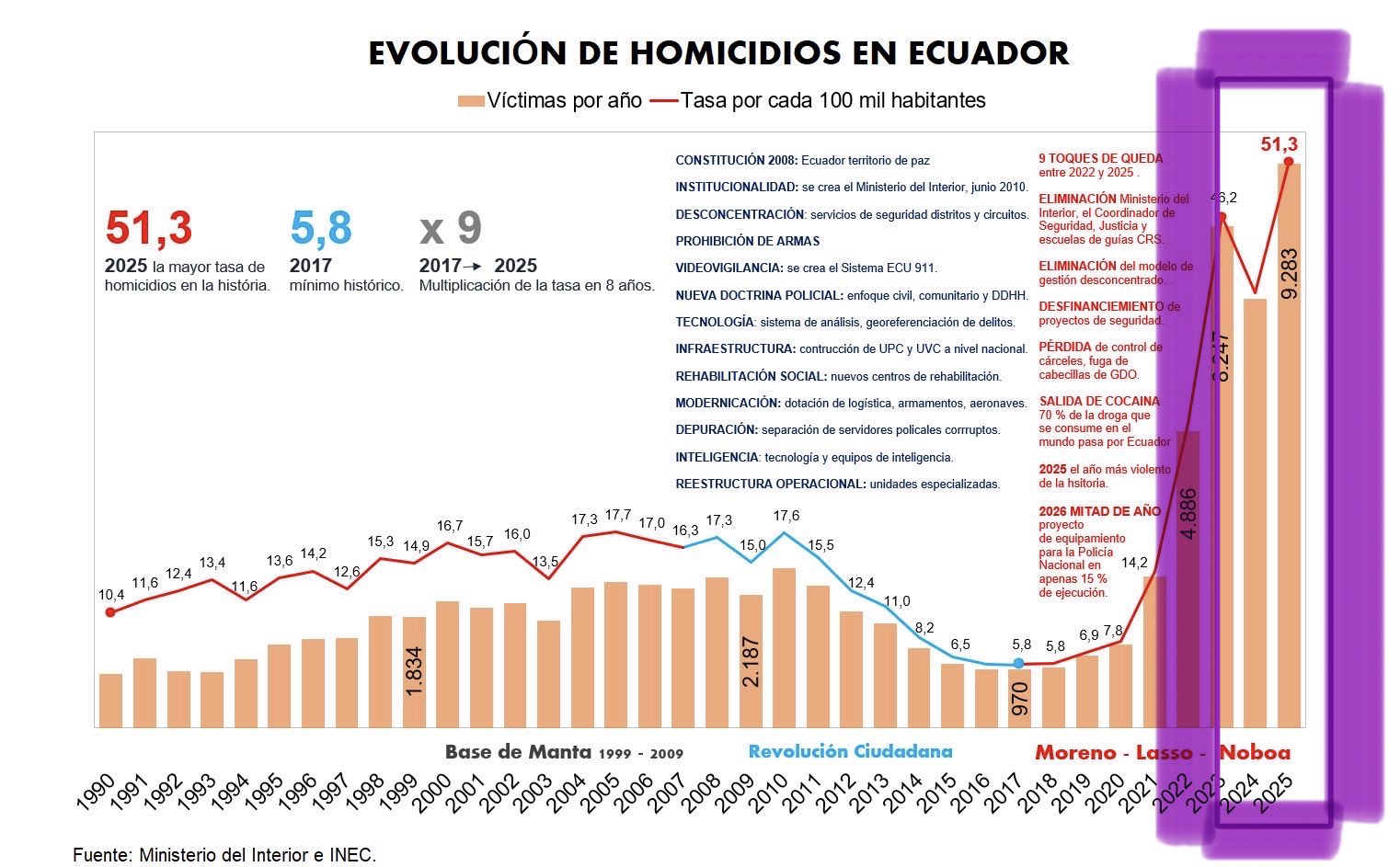
In 2025 alone, the number of homicides increased by 31%, according to Insight Crime. In the graphic below, you can see how the number of homicides per year has risen almost 10-fold since 2017, the year Lenin Moreno replaced Raphael Correa as President. Under the next three US client governments of Moreno, Guillermo Lasso and now Daniel Noboa, the murder rate has skyrocketed from 5.8 per 100,000 inhabitants to 51.3.

Under Noboa, whose family business has been linked to multiple cocaine seizures in banana shipments to Europe, the violence has continued to rise despite — or rather because of — his government’s unprecedented crackdown. As we have already seen in Colombia and Mexico, drug-war militarisation inevitably leads to more death while the drugs continue to flow.
Colombia, now under new management, has already signed on to the Trump administration’s Americas Counter Cartel Coalition (ACCC or A3C). Rubio wants Mexico to do the same, and that is not beyond the realms of possibility, especially if the Trump administration dangles certain carrots on bilateral trade between the two countries.
Today, we welcomed Colombian Ambassador María Consuelo Araújo Castro as Colombia officially joined SHIELD of the Americas. We look forward to our continued partnership as we strengthen regional cooperation, and create a safe and more secure Western Hemisphere. pic.twitter.com/zt55wgCfK0
— Special Envoy Kristi Noem (@EnvoyNoem) September 14, 2026
“These groups are very dangerous, they need to be confronted. And our hope, our intention, is to do so in collaboration with the Mexican government. That’s the ideal, but eventually that threat is going to have to be faced, one way or another,” Rubio said, resurrecting the ever-looming spectre of a US military intervention in the country.
A Strange Poll
A day after Rubio’s statement, the MAGA-aligned cable news network News Nation ran a story claiming that a leaked poll attributed to the US State Department has revealed that “a majority of Mexican citizens are in favor of the United States taking action against the cartels, which control Mexico,” including:
- U.S. indictments of Mexican officials accused of cartel ties.
- U.S. strikes on alleged drug traffickers in the Caribbean and Pacific
- U.S. attacks on drug labs or arrests of cartel members inside Mexico without notifying the Mexican government
- The U.S. military unilaterally killing alleged cartel members in Mexico
Here’s the problem: the article does not include the complete document, does not mention the firm that carried out the survey and does not even offer clear details about the survey’s questions or answers. All we are told is that a local research firm interviewed 1,000 residents aged 18 and older, which is a very small sample, to obtain the results.
The story appears to have got little traction in the US media. Even FOX News doesn’t seem to have bothered to cover it. However, a number of Mexican news outlets did report the story, largely uncritically, including Excelsior and Aristegui Noticias. Neither outlet mentioned News Nation’s pro-MAGA bias.
But this is not the only poll to have generated controversy in Mexico. A few days ago, Simón Levy, a former government figure who has become a serial peddler of anti-government fake news on social media, conducted a poll on X. The poll question, addressed to Lévy’s Mexican followers yet written in English, which in itself speaks volumes, was:
As a Mexican are you willing to allow US special forces to enter Mexico to capture politicians with arrest warrants from that country?
Unsurprisingly, 89% of Levy’s followers voted yes. If nothing else, the exercise serves as a reminder of why Twitter polls are so meaningless:
- Results heavily depend on who follows a particular account; a poll posted by an individual creator only reflects the biases of his or her specific audience. In the case of Levy, most of his followers are rabidly pro-US as well as opposed to Mexico’s Sheinbaum government.
- Participation in the survey requires no identity control, meaning single individuals can vote using multiple accounts.
- Automated bot accounts and fake profiles can easily skew vote counts. As we have learnt in the recent Honduras-gate scandal and Cerimedo affair, Latin America’s populist right movements are extremely bot-dependent.
But none of that stopped Derek Maltz Sr, a former acting administrator of the US Drugs Enforcement Agency, from seizing on the results of the survey as evidence that “Mexican citizens overwhelmingly want US military special forces to apprehend corrupt politicians in Mexico.” The Mexico-based journo Kurt Hackbarth tartly described Maltz’s tweet below as the “chef’s kiss of US intervention efforts”:
Thanks to the survey conducted by @SimonLevyMx , you can see that the Mexican citizens overwhelmingly want to use 🇺🇸 military special forces to apprehend the corrupt politicians in Mexico so they can face justice in America! pic.twitter.com/S1AzbzLw8f
— Derek Maltz Sr (@derekmaltz_sr) September 13, 2026
Maltz Sr then doubled down with the following tweet:
Decimating the terror cartels by using ALL tools available, including the unmatched capabilities of the United States military is a huge win for the people of Mexico and for the safety and security of people around the world.
These ruthless criminal terror organizations have… https://t.co/uqiLWt0wMj
— Derek Maltz Sr (@derekmaltz_sr) September 13, 2026
Beyond Risible
Perhaps the most absurd aspect of this whole saga is that Mexico is probably the least likely country in Latin America, if not the world, to ever support US military intervention. It is already permanently scarred by previous interventions, having lost over half of its territory to its northern neighbour in the mid-19th century. Why would it want more of the same?
Indeed, Mexico has been invaded so many times by its northern neighbour over the past 200 or so years (at least 10, according to the Council on Hemispheric Affairs) that it is home to a National Museum of Interventions — presumably the only one in the world — which is well worth a visit if you’re ever in Mexico City.
The notion that a majority of Mexicans would support unilateral US military intervention is beyond risible. That’s not to say that a small or even largish minority of Mexicans might be deluded enough to think that a US intervention could be beneficial for their interests — and that is clearly borne out in recent polls (that have not been bankrolled by the US State Department).
In a January poll conducted by De Las Heras Demotecnia, 76% of respondents said they would be opposed to US military intervention. Bloomberg-affiliated El Financiero regularly polls Mexicans on their views regarding the possible use of US force on Mexican territory. The latest edition, published in February, found that 78% of Mexicans disagree with the use of US military force to combat criminal groups in Mexico.
That was the highest percentage registered in two years — not much of a surprise given the poll was carried out shortly after the US’ military attack on Venezuela, abduction of its president, Nicolás Maduro, and establishment of a protectorate over the country. Seventy-four percent of respondents said they were even against collaborating with the US to fight organized crime after Donald Trump’s return to the White House. Again, a two-year high.
In other words, Mexican opposition to US military intervention is, if anything, rising. By contrast, a majority of Mexicans appear to be in favour of handing over former Sinaloa governor Rubén Rocha Moya, whose links to the Sinaloa cartel are common knowledge, to US justice. The polling firm Enkoll reported that 60% of respondents are in favour of handing him over. The daily newspaper Reforma has the number at 57%.
But there is a world of difference between wanting the Mexican government to extradite a corrupt narco-politician to the US and wanting the US military to come and abduct him, as it did with Nicolás Maduro, leaving over 100 dead bodies in its wake. As with the Cartel of the Suns fairy tale, this is purely about manufacturing consent for another US intervention.
The three-pronged narrative the Trump administration is trying to sell is that: (a) Mexico cannot control its own territory; (b) the Mexican government is involved with drug trafficking; and (c) U.S. citizens are in ever-greater danger. This triple narrative helps prepare the ground for escalatory measures including tariff pressures, CIA interference, or direct intervention.
Let’s be clear: the CIA’s role is not to combat the drugs trade; it is to destabilise governments, organise coups and remove hindrances to US empire and hegemony. In fact, the agency has arguably been the biggest single facilitator of the global drugs trade since WW2, helping the trade flourish, either actively or by turning a blind eye, in Asia (through the Kuomintang and Air America), Europe (the Corsican mafia), and Latin America (Batista, Noriega, Escobar).
As we have argued since 2023, while the drug cartels are a huge, and growing, problem for both the US and the Americas as a whole, the US’ rapidly escalating war against the drug cartels — now designated as “narco-terrorists” — across the entire Latin American region is, at bottom, a smoke screen for another campaign of regional plunder and domination, which is now playing out.
As the Mexican historian and geopolitical analysts Cristian Nader pointed out in a recent interview, drug trafficking is not just a business; it is a vital “gringo lever” to access and control strategic resources, and has been for the best part of 80 years:
If you step back a little from the present and look at the nineteenth century, you find something revealing: drug trafficking, as a global industry, was invented by the United Kingdom. The world’s first major drug trafficker was Queen Victoria, not Pablo Escobar.
The British Empire flooded China with opium produced in colonised India. It was a commercial, political and military operation at the same time. Opium circulated because there was an imperial structure that pushed it with a very clear objective: to break China, which was reluctant to open up to the British “free market”.
Drugs were a weapon of war to break a population and lock an entire country into a century of humiliation. That model — drug trafficking as a commercial, political, and military mechanism — was inherited and honed by the United States.
Since World War II, Washington understood that drug trafficking could be a useful tool to destabilise non-aligned governments, finance covert operations, arm paramilitary groups and control its own population.
It is no coincidence that in the early 1940s, when the United States needed opium for the Second World War, it asked the Mexican government for permission to plant poppies in the mountains of Sinaloa, Durango and Chihuahua.
The famous Golden Triangle of north-western Mexico was not invented by local drug traffickers but by the US government. Since that time Mexico has functioned as a poppy “orchard” for the United States.
Look at what happened in Southeast Asia during the Vietnam War. The CIA set up an airline called Air America that, officially, served intelligence and supply operations. In reality, it was a front to move opium and heroin produced in the Golden Triangle countries of Laos, Myanmar and Thailand.
[Heroin] was used to finance local anti-communist forces, and the surplus was distributed through other channels. When the remnants of the Kuomintang — the Chinese Nationalist army defeated by the Communists — relocated to that area, they became partners in the CIA’s business.
That same logic was repeated decades later in Afghanistan. When the U.S. invaded the country in 2001, the first thing troops did was not destroy poppy crops, but protect them.
I was in Afghanistan investigating poppy production when a farmer told me something I’ve never forgotten.
He said the Americans told him he could grow opium—if he gave them information.
The moment he said it, the conversation was shut down.
This is how things actually work on…
— John Kiriakou (@JohnKiriakou) April 3, 2026
The War on Drugs is primarily about controlling strategic resources and supply routes. As the tweet below shows, Trump administration officials are now peddling the notion that Venezuelan oil will help to refill the US’ strategic petroleum reserve at a massive discount as the country’s self-inflicted fuel crisis begins to bite — completely ignoring the fact that Venezuelan oil is simply too heavy for the US’ strategic petroleum reserve caverns.
The most impoverished country in the Western Hemisphere is being made to sell oil at less than half of its market value to the country that invaded it. https://t.co/JFSaeLGqXp
— Francisco Rodríguez (@frrodriguezc) September 14, 2026
The same logic that applies in Venezuela with oil and gold, or in the so-called lithium triangle in South America, also applies in Mexico, which boasts the world’s largest reserves of silver — a vital resource for the global digital transformation — in addition to lithium and hydrocarbons. All Washington needs to do is build the right narrative, just as it did in Venezuela, and enough US voters will lap it up.
Trump brags that “we took over the oil of Venezuela—65 billion barrels of oil,” and the crowd applauds. pic.twitter.com/xf0OtYkLHr
— Glenn Diesen (@Glenn_Diesen) September 12, 2026
As former Republican Congressman Ron Paul once said in his 2012 farewell address to the US House of Representatives (a quote which is now part of the opening credits of Judge Andrew Napolitano’s Judging Freedom podcast): “tragically our government engages in pre-emptive war, otherwise known as ‘aggression’, with no complaints from the American people.”


 By
By