

This is Naked Capitalism fundraising week. 532 donors have already invested in our efforts to combat corruption and predatory conduct, particularly in the financial realm. Please join us and participate via our donation page, which shows how to give via check, credit card, debit card, PayPal. Clover, or Wise. Read about why we’re doing this fundraiser, what we’ve accomplished in the last year,, and our current goal, supporting the Coffee Break/Sunday Movie features.
Trump rejects Iranian ceasefire terms, says he’ll likely attack again after the mid-terms and the war between Saudi Arabia and Yemen continues to heat up.
Trump Trashes Ceasefire Talk
The Wall Street Journal got the exclusive:
President Trump has rejected Iran’s proposal for a seven-day ceasefire and has told aides he expects to resume bombing Iran after the November midterms, U.S. officials said.
Tehran’s proposal would have reopened the Strait of Hormuz and resumed nuclear talks in return for the U.S. lifting its blockade of Iranian ports, which is causing deep damage to the country’s economy. Trump says openly that Tehran is begging for a deal after the midterms that dismantles its nuclear program.
But privately Trump is skeptical Iran would meet his demands and has told his staff that he sees a renewed bombing campaign as likely, the officials said.
Trump’s current position indicates the conflict’s stage—a liminal space between war and peace—is likely to tilt back toward hostilities. But the president, who has declared victory since the earliest days of the seven-month fight, alternates between pursuing diplomacy, ordering airstrikes and tightening sanctions around Iran. His views today could shift as the war drags over the coming weeks, officials said, and could be affected by the results of the midterms.
Trump’s bellicosity was making headlines on multiple fronts today, although the other two (talk of a plan to invade Cuba, supporters calling for martial law before the election) were even more nebulous than this nothing burger from TACO Trump, but the net effect is to alarm and frighten the casual headline scanner who doesn’t have the wherewithal or time to parse the details of this nonsense.
Trump’s comments and rumors of peace continue to impact the oil markets, per Oil Price:
November WTI crude oil futures spent the week trading a possible reopening of the Strait of Hormuz against the risk that shipping conditions have not normalized. The contract fell to $88.67 Tuesday after reports that Iran could reopen the Strait within seven days, then recovered to $96.78 Thursday as the diplomatic story ran into the same problem it had all week: no agreement, no normal tanker traffic, and no proof the physical market is back to normal.
Meanwhile the US admissions of casualties continue to mount.
The Count Mounts, What a Horrible Toll
The Washington Post reported Thursday on “dozens” of troops added to tally of US wounded in the war with Iran:
The Pentagon’s public tally of troops wounded during the Iran war was quietly increased by 37 this week without explanation from the Defense Department.
The increase includes 29 Navy sailors and eight Marines, according to a review of the Pentagon’s public database of personnel killed and wounded during U.S. conflicts and other military operations overseas. The web portal is called the Defense Casualty Analysis System, or DCAS.
As of Wednesday, the total number of troops wounded during the Iran war is 861, according to DCAS. More than half are categorized in the Pentagon database as having occurred in “Overseas Operations” since the start of a July ceasefire between Washington and Tehran that later collapsed. Before then, killed and wounded troops were tallied under “Operation Epic Fury,” the Trump administration’s name for the Iran war.
The DCAS database does not explain how these 37 troops were wounded or when. A Navy official said all the sailors returned to duty following the unspecified injuries.
Will Schryver commented on the news, “”Sailors” and “Marines” are typically found in warships. Somehow 37 of them became casualties in recent weeks, and have now been added to the butcher’s bill. This strongly suggests something rather serious occurred on one or more US Navy warships.”
He elaborated, “Emerging evidence suggests General Rezaei was quite possibly telling the truth” and cited a post he made on the 6th:
🤔 General Rezaei frames the event as a deliberate demonstration — a new missile detonated “over” a US warship, which he insinuates shocked the Americans, who then ran away.
It does occur to me that cluster warheads would wreak havoc on a carrier deck and bridge. https://t.co/sg4CCNQdmG
— Will Schryver (@imetatronink) September 6, 2026
Schryver went on to say,
“🤔 Did Iran Actually Strike A US Carrier?
In early September, General Mohsen Rezaei claimed that Iran had fired anti-ship missiles at US ships in the Arabian Sea, and suggested both ships had been damaged and promptly withdrew.
Although it remains unconfirmed, it has been widely rumored that the ships struck were the USS George Washington (CVN-73) and a US destroyer.
CENTCOM adamantly denied these claims.
Meanwhile, in a rare if not unprecedented development in this war, no US Navy warships have been spotted on commercial satellite images anywhere near the Gulf of Oman in recent weeks.
The entire fleet appears to have withdrawn to a safer distance.
Now we learn the Pentagon has quietly added 37 sailors and Marines to its ever-expanding list of Iran war casualties.
I will permit the reader to connect the dots.”
Sheer speculation, but Schryver has a good track record as an astute observer of military affairs.
Meanwhile a CBS story features a US commander being dropped right in the grease.
‘Commander rejected plans to rebase farther from Iran before deadly drone strike’
Ouch. The officer fading the heat for apparent deadly bad decision making is Brig. Gen. Clint Barnes and here’s what the (anonymously sourced) CBS piece says:
The dozens of U.S. troops bombarded by Iranian drones at a small Kuwaiti port in the opening days of the Iran war could have relocated to safer positions in western Saudi Arabia, multiple sources told CBS News, but those plans were rejected by the unit’s commanding general despite intelligence warning of a potential attack on their post.
About one week before the launch of Operation Epic Fury, most American soldiers and Air Force personnel stationed in Kuwait were moved to Jordan and Saudi Arabia — farther away from Iranian missile range. At least two options were scouted, planned and presented to the leadership of the 103rd Sustainment Command, the Army Reserve unit that ran logistics for U.S. Central Command: one was Logistical Support Area (LSA) Jenkins, a U.S. military base near the southwest port city of Yanbu, and another was Prince Sultan Air Force Base, just southeast of the Saudi capital city Riyadh.
A third option, supported by the commander, Brig. Gen. Clint Barnes, was to follow the playbook from the unit that was previously deployed to Kuwait before the 103rd arrived in September 2025. During the 12-day war between Israel and Iran that July, the active unit briefly moved from their home base at Camp Arifjan in Kuwait to Port of Shuaiba, roughly 30 miles south of Kuwait City and just 65 miles southwest of Iran.
…
The revelations are the latest in a series of whistleblower accounts made by active and reserve service members regarding the decision-making process leading up to and following the deadliest attack of the war. Six U.S. troops were killed in the strike on March 1, and more than 20 were wounded.
Jim and Stacey Khork, the Gold Star parents of Maj. Cody Khork, told CBS News in an exclusive interview that their son, as one of the unit’s force protection officers, was among the key soldiers warning Barnes of the site’s vulnerability.
The piece goes on to quote multiple Gold Star families (that’s one award no one aspires to receive) who blame Barnes for the unnecessary deaths of their children. Grim stuff.
Speaking of grim stuff, there’s a bit of dire news from Israeli domestic politics I need to cover.
Deep In a Hole, Israelis Keep Digging
From Haaretz (archived):
If their recent conduct is any indication, many in the anti-Netanyahu opposition would prefer to lose the upcoming election – allowing Prime Minister Benjamin Netanyahu to remain in power – than to accept the basic democratic principle that the votes of Palestinian citizens of Israel are equal to those of Israeli Jews.
While polls show that the opposition has no path to a majority without support from at least one of the Arab-led parties, opposition leaders are vowing not to form a coalition with them – and are now joining in the attacks on their legitimacy.
The Middle East’s only democracy setting a fine example, as per usual.
And they continue to take their losses in Lebanon, a small price to pay to wipe the slate clean of a world historic civilization I guess.
🚨Israeli Channel 12 Publish Footage Of Soldiers Being Ambushed By Hezbollah In Lebanon
The ambush was carried out in the Ali al-Taher area, inflicting a large number of casualties on the occupying army. pic.twitter.com/wt4W7d4k7z
— MintPress News (@MintPressNews) September 25, 2026
But it can always get worse, especially with Bibi Netanyahu around:
Israeli analyst tells me Netanyahu might launch strikes against Iran before the Israeli elections, particularly if his numbers begin to drop.
He’ll calculate that it won’t defeat Iran, but it could defeat his election rivals.
Which is all that appears to matter to him…
— Trita Parsi (@tparsi) September 26, 2026
And with Trump disavowing any chance of a peace deal, the Iranian threats to expand the war take on a more ominous cast.
Iranian Officials Threaten a Much Wider War
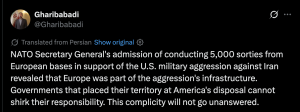
The Iranian Deputy Foreign Minister for Legal and International Affairs Kazem Gharibabadi responded to NATO Secretary General Mark Rutte’s ill-advised remarks at the Chicago Council on Global Affairs event in Des Moines, Iowa where he bragged:
“5,000 planes taking off from European bases in support of Epic Fury since 28 February this year. 5,000, and that was counting until mid-April. In the meantime, probably much more. But this, the numbers I have from the Ankara Summit: 5,000 sorties – crucial. You could argue it would have been impossible to do Epic Fury without having Europe as a power protection platform for the United States.”
Gharibabadi responded:

NATO Secretary General’s admission of conducting 5,000 sorties from European bases in support of the U.S. military aggression against Iran revealed that Europe was part of the aggression’s infrastructure.
Governments that placed their territory at America’s disposal cannot shirk their responsibility. This complicity will not go unanswered.
This report from Iran International shows that Gharibabadi is not alone among Iranian senior officials talking along these lines (also don’t forget Mohsen Rezaee, Secretary of Iran’s Supreme National Security Council, and his threats yesterday to punish Iranian neighbors who cooperate with the US ban on Iranian flights.)
IRGC spokesman Hossein Mohebbi made that logic explicit on September 23, declaring that “Iran will certainly change the geography of the war” and adding that “our targets will no longer necessarily be the same as before”.
A day later, Yahya Rahim Safavi, military adviser to Iranian Supreme Leader Mojtaba Khamenei, gave the clearest indication yet of how far that geography might extend.
In a video released by the IRGC-linked Fars News Agency, Safavi said the front could expand further in response to continued warfare, “reaching the Indian Ocean and perhaps beyond”.
He added that linking Hormuz and Bab el-Mandeb “will change the battlefield”.
Fars noted that it was the first time an adviser to Khamenei had explicitly mentioned the Indian Ocean, home to the US-British base at Diego Garcia, nearly 4,000 kilometres from Iran.
In an earlier interview reported by Fararu, Safavi said Houthi advances mean the United States now faces a new challenge at Bab el-Mandeb and in the Red Sea.
IRGC Aerospace Force commander Majid Mousavi warned that “if you make the sacred Strait of Hormuz unsafe, we will turn the entire region into hell for you from across Iran”.
Before we move on to the more heated kino on the Saudi Arabian front, I need to handle a correction.
Correction: Iranian Exports
Important correction: Wednesday I said in error that not much Iranian crude was getting out of the Strait.
I meant to say that not many Iranian tankers are exiting the Strait but a fair bit of Iranian oil may be.
Here’s the correction I added to Wednesday’s post for those who haven’t gone back to review the post:
Iranian crude exports via clearly marked Iranian tankers, meanwhile, are essentially shut down.
But keep in mind as Professor Marandi has repeatedly pointed out that Iranian crude is leaving the Persian Gulf via other means:
“One is through the Iranian corridor, and they just pass through and go — like Chinese ships or Iraqi ships, because they didn’t fight against Iran. But for the countries that fought against Iran… there are 2 ways to go. One is through the American corridor. In that corridor, some of those ships go through with American consent, with Iranian consent. And some of them actually carry Iranian oil. So it’s very complicated.”
And there are also reports of ship-to-ship transfers of Iranian crude:
Iran continues to export oil despite U.S. sanctions and a naval blockade, relying on a network of vessels and intermediaries as well as tactics designed to conceal identities and manipulate navigational data.
Tehran is currently exporting about 260,000 barrels a day, its lowest level of oil sales in six years, compared with roughly 1.67 million barrels a day before the war.
But the continued flow of exports, even at sharply reduced levels, underscores Tehran’s ability to circumvent restrictions on its oil trade.
Meanwhile, CENTCOM claimed to have redirected 122 commercial vessels during the blockade, which is interesting because they were claiming that same count in early June. Perhaps this has to do with the Trump regime’s claims that the war authorization clock restarted in July?
Ok, let’s get to the front where the battles are happening.
Saudis and Friends Rattle Sabres
MBS’ press team worked the Washington Post into posting this bit of scare talk:
Classified documents provided to Congress include an assessment by the U.S. intelligence community that Saudi Arabia has not ruled out the option of developing a nuclear weapons program, U.S. officials told The Washington Post.
The sobering intelligence outlook has compounded concerns from some U.S. lawmakers about President Donald Trump‘s agreement to assist Saudi Arabia with establishing a civilian nuclear program, which they fear could enable the development of a nuclear weapon and spark an arms race in the volatile Middle East.
And when it comes to flapping gums, the Saudis have plenty of help from their friends, via Dawn.com:
Saudi Arabia, Turkiye and Pakistan held military chiefs of staff talks on Friday with the objective to explore ways to assist Riyadh under the Makkah Defence Alliance.
The Turkish defence ministry published photographs of the three military officials in uniform, stating that the meeting had taken place, without disclosing where.
🗓️ 25 Eylül 2026
Genelkurmay Başkanı Orgeneral Selçuk Bayraktaroğlu, Türkiye, Pakistan ve Suudi Arabistan arasında imzalanan Mekke Ortak Savunma Anlaşması kapsamında, Riyad/Suudi Arabistan’da düzenlenen toplantıya, Pakistan Savunma Kuvvetleri ve Kara Kuvvetleri Komutanı Mareşal… pic.twitter.com/HjmfRxGMMD
— TSK (@TSKGnkur) September 25, 2026
They further discussed the current situation in the region, underscoring the importance of upholding the principles of international law, good neighbourliness, mutual respect for the sovereignty of states, and non-interference in their internal affairs, as well as ensuring the security and freedom of navigation, the statement said.
Moreover, they reiterated their determination to work together towards achieving sustainable peace and stability in the region, support efforts towards de-escalation and encourage peaceful resolution to crises.
During the meeting, the ministers also reviewed progress made towards establishing the general secretariat and committees and working groups under the Makkah agreement, as well as preparations for the commencement of their work, the FO statement said.
Stern stuff.
But the Saudis can bomb civilians and have been hard at it, per China Daily:
Yemen’s Houthi group said Wednesday that Saudi Arabia had carried out 52 air and missile strikes against Houthi-held areas across five Yemeni provinces over the past 24 hours, as intensified fighting and aerial attacks continued on several fronts.
Houthi military spokesperson Yahya Sarea said in a statement posted on social media platform X that Saudi F-15 and Typhoon fighter jets, operating from the Saudi air bases of Khamis Mushait and Taif, along with missiles launched from the direction of the Saudi city of Jizan, struck areas in the provinces of Hodeidah, Taiz, Al-Bayda, Marib and Saada.
The strikes killed and wounded a number of people, including women and children, and damaged telecommunications networks, schools, bridges and roads, Sarea said, without providing a casualty toll.
Although the open source intel account MenchOsint points out the number of Saudi strikes is declining:
Yemen’s Ansarallah Armed Forces says that in the past 24 hours, Saudi Air Force carried out 14 airstrikes (including rocket attacks from Najran) targeting the provinces of Taiz, Amran, Marib, and Saada. – Statement
*airstrikes down from 54 to 14 daily, whether driven by fear of… https://t.co/T3MGYVbaOm pic.twitter.com/gPz7SSw4LV
— MenchOsint (@MenchOsint) September 25, 2026
The Saudi Grand Mufti is channeling Kaja Kallas or Keir Starmer and calling on Saudi troops to “be ready to sacrifice lives to defend nation from Houthis.”
They’ve also got their puppet “President of Yemen” calling for a “general mobilization” and offers amnesty to Houthi defectors.
This round of Saudi gum flapping was completed by Maj. Gen. Turki al-Maliki saying, “the escalation and violations by the terrorist Houthi militia will be dealt with firmly.”
What’s Ansar Allah’s response?
Ansar Allah Cleaning House
Both literally in newly liberated territory:
After the liberation and clearing of Mocha from the Saudi occupation, the new local authority is carrying out a large-scale clean-up campaign of the city’s coasts and streets to remove the garbage left behind by the Saudi occupation and its mercenary tools.
Al-Mukha is being…
— ابراهيم ناجي Ibrahim Naji (@Ibrahym22Nagi) September 25, 2026
And figuratively on Saudi territory (this attack was included in yesterday’s report but the tweet below has maps and deets):
🇾🇪|Yemen Just Hit Back: Preemptive Strike on Saudi Forces in Jizan. Hundreds Killed, Command Centers Destroyed, Weapons Depots Ablaze.
The Saudi enemy launched over 200 missiles from Jizan into Saada and Hajjah. It massed forces on the border. It prepared for a new escalation.… pic.twitter.com/LoVeoFmibs
— Aprajita Nafs Nefes 🦋 Ancient Believer (@aprajitanefes) September 25, 2026
This tweet collects a number of claims by Ansar Allah, note they’re contradicted by Saudi news reports, who ya gonna believe?
🇾🇪🇸🇦|Yemen Just Hit Seven Saudi Cities Simultaneously. Tabuk for the First Time. Ras Tanura. Aramco in Yanbu. King Fahd Air Base in Taif. The Saudi Air Defense System Is Not a System. It’s a Suggestion.
1,018 airstrikes and missiles. That’s what Saudi Arabia has launched at… pic.twitter.com/9NpLl3CN5H
— Aprajita Nafs Nefes 🦋 Ancient Believer (@aprajitanefes) September 25, 2026
Alright one piece of analysis and then some YouTube and we’ll call it an Iran War update.
Why Saudi Money Can’t Buy Victory
The Substack account People’s Art of War has some insights I thought I’d share in their piece “You Can’t Rent Victory“:
The coast is flat, exposed, underpopulated, and lacking in resources.
Now do the math Riyadh faced in 2015. Holding that coast means infantry. Lots of it. They must fight and supplied on hostile ground.
Saudi Arabia had the money for infantry, but lacked the resources to and willingness sustain infantry under such a harsh geography.
It bought local and foreign mercenaries, while using expensive strike aircraft to wage a bombing campaign. While the Houthis had the advantage of geography and population to recruit from
Those two purchases are the entire story of this war — because they never, ever connected.
They’ve got a keen infographic on the Saudi bombing campaign against Yemen for lo, these many years:

They then detail the Saudi mercenaries inability or unwillingness to act as effective spotters for Saudi airpower and how that creates a massive Achilles’ Heel for a force that fears its own planes:
On defense, it’s worse. A fighting retreat, a defense in depth only work if infantry, artillery, and ground attack aircraft can coordinate and know each’s positions.
Break that coordination and awareness, and your defense falls apart. Aircraft can’t distinguish retreating troops from the enemy. Every move becomes retreat and break a line, before your own jets hit you.
What do you get?
You get a hired army that fears its own aircraft more than the enemy. Friendly fire is psychologically devastating. Getting hit makes a survivor question every advance and distrust their leadership and patrons.
An army that worries about this regularly will refuse to take initiative and retreat without permission. Do this at a large enough tactical scale, and you get a rout.
They also go into the specific make up of the mercenary forces fighting on behalf of the Saudis and UAE and their spotty history of internecine conflict and collective failure and this dramatic contrast with their Ansar Allah opponents:
The Houthis are the inverse of the Saudis. Ideologically charged, socially rooted in the northern highlands, fighting on home terrain, with nothing to sell and therefore nothing to lose to blockade. They cannot be defeated by any finite demonstration of firepower, because their war-making capacity is social and ideological rather than fiscal
So yeah, good luck with your war now that it’s coming home and heading for the Riyadh Ritz Carlton, your Highness.
Around the Tubes
I usually go for the lesser seen content creators that might be new to many readers, but today I’m in the mood to play it like Frank Sinatra did on his 1950 Christmas special and stick “strictly to favorites.”
Are Pakistan and Turkey joining the war in Yemen? | Mohammad Marandi joins India & Global Left for a worthwhile discussion that (spoiler alert) doesn’t violate Betteridge’s Law of Headlines.
Can’t go wrong with Ambassador Chas Freeman talking to Nima Alkhorshid.
You want alt-star power? I bring you John Mearsheimer and Chris Hedges.
Stay safe, ya’ll!



 By
By