

POTUS Trump, much of his regime and many American CEOs were in China yesterday to meet with President Xi Jinping so the Iran War was on the backburner to some extent.
UPDATED: May 15, 8:15AM ET
I missed the Saudi non-aggression pact proposal and they did a massive prisoner swap with the Houthis. Added that after the Straits section.
But there was a little bit of ship seizing, a sprinkle of ship sinking, continued fighting in Lebanon, and some votes in Washington, D.C.
Trump responds to Xi’s “Thucydides Trap”
Xi’s opening remarks included a reference to the “Thucydides Trap” which is popularly understood to mean that conflict between a rising and a declining power is inevitable:
Xi Jinping: The whole world is watching our meeting. Currently, transformation not seen in a century is accelerating across the globe and the international situation is fluid and turbulent. The world has come to a new crossroads. Can China and the United States overcome the Thucydides Trap and create a new paradigm of major country relations? Can we meet global challenges together and provide more stability for the world?
Trump interpreted this to mean that Xi was putting China in the rising power position and the U.S. in the declining power position and he responded on Truth Social to Xi’s remarks and here are the key bits:
When President Xi very elegantly referred to the United States as perhaps being a declining nation, he was referring to the tremendous damage we suffered during the four years of Sleepy Joe Biden and the Biden Administration, and on that score, he was 100% correct. Our Country suffered immeasurably with open borders, high taxes, transgender for everybody, men in women’s sports, DEI, horrible trade deals, rampant crime, and so much more!
President Xi was not referring to the incredible rise that the United States has displayed to the world during the 16 spectacular months of the Trump Administration, which includes all-time high stock markets and 401K’s, military victory and thriving relationship in Venezuela, the military decimation of Iran (to be continued!) — Strongest military on earth by far, economic powerhouse again…
Trump also spoke to Fox News’ Sean Hannity and added the following about the Iran War, via the NYT:
“He said he’s not going to give military equipment, that’s a big statement,” Trump said, attributing the remarks to Xi. “He said that today, that’s a big statement, said that strongly. But at the same time, he said, you know, they buy a lot of their oil there, and they’d like to keep doing that. He’d like to see Hormuz Strait open.”
Today Xi and Trump will engage in smaller meetings that Trump likely hopes will produce some of those famous “deals” he likes to brag about so much.
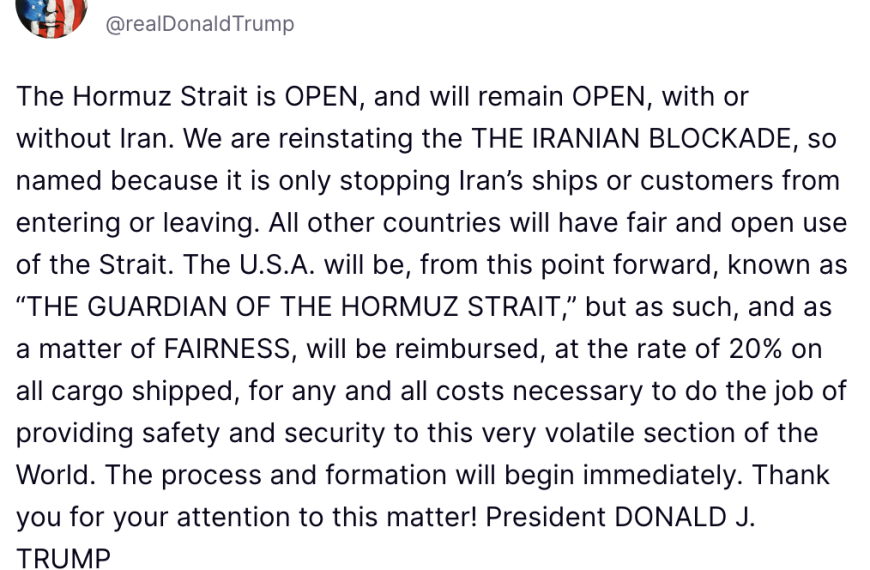
Now let’s move from East Asia to West Asia and talk about the Strait of Hormuz.
Ship Seized, Another Sunk
The AP reported on the day’s maritime doings in the war zone:
A ship anchored off the United Arab Emirates was seized and taken toward Iran and another — a cargo ship near Oman — sank after being attacked, authorities said Thursday, as tensions escalated near the Strait of Hormuz.
It wasn’t immediately clear who was behind these incidents, but they happened as a senior Iranian official reiterated his country’s claim of control over the waterway and another said it had a right to seize oil tankers connected to the U.S.
The BBC had more on the ship that got seized:
A vessel reportedly operating as a “floating armoury” in the Gulf of Oman has been seized by Iranian military personnel, according to the maritime risk management company Vanguard.
The ship is now “bound for Iranian territorial waters”, the UK’s Maritime Trade Operations (UKMTO) organisation said.
BBC Verify has checked ship-tracking data from MarineTraffic which shows the vessel – identified by Vanguard as the Honduras-flagged Hui Chuan – last broadcast its location 70km (40 miles) north-east of Fujairah in the UAE on Wednesday.
Hui Chuan’s operators told Vanguard it was operating as a floating armoury which stores weapons for security firms who protect ships at sea from attack by pirates.
And the ship that got sunk:
…an Indian-flagged vessel was attacked off the coast of Oman on Wednesday, according to Indian officials.
The Haji Ali “reportedly sank” off the coast of Oman, following a suspected explosion believed to have been caused by a “drone or missile”, according to Vanguard.
“All Indian crew on board are safe and we thank the Omani authorities for rescuing them,” Indian authorities said on Thursday.Ship-tracking data from MarineTraffic shows the 57m (187ft) vessel left Berbera Port in Somalia on 6 May. Its intended destination was Sharjah in the UAE, the Indian shipping ministry said.
The ship was carrying livestock “when a fire reportedly broke out onboard, forcing the crew to abandon ship before the vessel sank,” Vanguard said.
Iranian leadership also went on the offensive on social media with Parliamentary Speaker MB Ghalibaf hitting the US defense budget and Trump’s Secretary of Defense War Pete Hegseth:
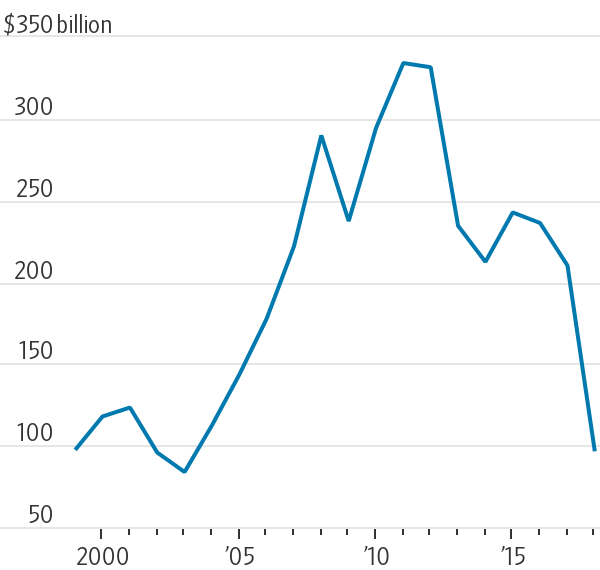
So you’re funding Hegseth the failed TV host at rates unheard of since 2007, so he can cosplay as Secretary of War in our backyard in Hormuz?
You know what’s crazier than $39 trillion in debt? Paying a pre-GFC premium to fund a LARP and all you’ll get is a brand new GFC. pic.twitter.com/YBGWEzYgru
— محمدباقر قالیباف | MB Ghalibaf (@mb_ghalibaf) May 14, 2026
The Saudis have been busy.
Saudis Making Moves Against the War
FT had the scoop:
Saudi Arabia has discussed the idea of a non-aggression pact between Middle East states and Iran as part of talks with allies on how to manage regional tensions once the US-Israeli war with the Islamic republic ends, diplomats said.
Riyadh is eyeing as a potential model the 1970s Helsinki Process that eased tensions in Europe during the cold war, said two western diplomats, as the region anticipates a postwar Iran that is weakened but still poses a threat to its neighbours. They added that the non-aggression pact was among various ideas being considered.
…the months of war have created a new sense of urgency among Arab and Muslim states to rethink their alliances and the region’s security apparatus.
Many European capitals, and the EU institutions, have swung behind the Saudi idea and have urged other Gulf countries to support it, the diplomats said. They view it as the best way to avoid future conflict and provide Tehran with guarantees that it also would not be attacked.
They also did a prisoner swap with Ansar Allah, again per the FT:
Yemen’s warring parties have agreed to the biggest prisoner swap in more than a decade in a sign that Saudi Arabia is stepping up efforts to de-escalate tensions in the Arab state and keep Houthi rebels out of the war in Iran.
Under the deal, the Iranian-aligned Houthis and Saudi-backed Yemeni government will release 1,750 detainees, including seven Saudis held by the rebels.
It is the largest prisoner swap since Saudi Arabia intervened in Yemen’s civil war in 2015 to lead a coalition against the Houthis, after the rebels ousted the internationally recognised government and seized control of the capital, Sana’a.
Analysts say the deal is an important trust-building step as Saudi Arabia seeks to revive a stalled UN-led peace process, keep a check on tensions in Yemen and encourage the powerful Houthis not to become further involved in the US-Israeli war with Iran.
Now let’s drop by Lebanon.
Hezbollah Support Still Strong
This is per the BBC:
Last Saturday an Israeli air strike, at lunchtime and without warning, destroyed a building where a family displaced by the war were sheltering in a town in southern Lebanon called Saksakiyeh. A ceasefire, announced last month, has failed to stop the conflict between Israel and Hezbollah, the Shia Muslim armed group. In this part of the country, Israel’s attacks come day and night.
…
Nine people were killed there. The Israeli military said it had targeted Hezbollah members who were operating from a building that was being used for military purposes, and that they had posed an “immediate threat”.It did not give details. Relatives said the victims were a woman in her 70s, a son and his wife, another son, her four grandchildren, and her great-granddaughter, who was two years old. (The Israeli military said it was “reviewing reports regarding harm to uninvolved civilians”.)
…
Some of the people I met were exhausted from constant wars but, as the Israeli attacks and occupation continued, many still believed Hezbollah was the only force capable of defending them.
Meanwhile, the Lebanese government, a force capable of defending no one, and Israel continued their negotiations in Washington per Reuters:
The United States cast Israel-Lebanon talks held in Washington on Thursday as “productive and positive” and a State Department official said more discussions aimed at ending their conflict will continue on Friday.
A senior Lebanese official said earlier that Lebanon will demand that U.S. ally Israel cease fire in the face-to-face talks, as Israel and Iran-backed Hezbollah continued to trade blows despite a U.S.-backed truce declared last month. An Israeli government spokesperson said the talks were taking place with the goal of disarming Hezbollah and reaching a peace agreement.
That wasn’t the only Iran War related action happening in DC on Thursday.
War Powers Vote Fails in the House
The Democrats’ “Rotating Villain” game was strong as they lost a War Powers resolution by one vote, when the co-sponsor of the bill voted against, via the WaPo (archived):
The House on Thursday failed to advance a resolution requiring the Trump administration to end its war in Iran — the first time it has considered such a measure since the lapsing of a legal deadline for lawmakers to authorize the conflict.
The measure failed after a dramatic tie vote of 212 to 212, with three Republicans joining nearly all Democrats.
The Senate on Wednesday rejected a similar initiative.
Rep. Jared Golden (Maine), the lone Democrat to vote no, indicated in a statement that he would support a forthcoming “clean” bid to halt the war.The measure that failed Thursday was proposed early in the war by a faction of pro-Israel Democrats — Golden among them — as a compromise intended to win some Republican backing. It would have given the Trump administration 30 days to seek lawmakers’ explicit authorization to prolong the conflict.
In explaining his no vote, Golden argued that those terms are no longer relevant because hostilities have already gone on longer than the War Powers Act permits.
Three Republicans voted to end the war in the House: Thomas Massie of Kentucky, Brian Fitzpatrick of Pennsylvania, and Tom Barrett of Michigan.
Wednesday’s failed vote in the Senate featured three GOPers breaking with Trump: Lisa Murkowski of Alaska, Susan Collins of Maine, and Rand Paul of Kentucky.
That wasn’t the only Iran War related activity in the Senate this week.
Before we get to the depressing lies of the Trump regime, I want to shout out Virginia Senator Tim Kaine for telling the Iranian side of the conflict with the U.S. in the Senate. He reviews the 1953 coup, the brutal U.S. backed dictatorship of the Shah, America’s role in backing the Iraq-Iran War and shooting down an Iranian passenger jet:
This is by far the smartest , and most honest take I have seen coming out from our elected officials in Congress.
Kudos to Senator @timkaine for telling the truth: pic.twitter.com/kqSDUY7JrJ— Sina Azodi (@Azodiac83) May 14, 2026
Now let’s get back to the usual lies.
Only One “Civilian Casualty Event”
US Admiral Brad Cooper testified in the Upper House and the NYT typed it up:
The senior officer overseeing U.S. combat operations in Iran told senators on Thursday that the destruction of an Iranian school, which Iranian officials said killed 175 people, may have been caused by a U.S. bomb and was the only civilian casualty event he knew of in a campaign of more than 13,600 strikes.
Admiral Brad Cooper’s testimony suggested that he believed that the U.S. military’s record since that Feb. 28 strike had been near perfect, a fact belied by investigations from human rights groups and news media organizations. Senators greeted Admiral Cooper’s claims with deep skepticism, and a human rights group that investigates civilian casualties in war called it “ridiculous.”
The U.S. military still has not taken responsibility for the school strike, which Admiral Cooper, the head of U.S. Central Command, said remained under investigation.
The New York Times has verified damage to 22 schools and 17 health care facilities. The Iranian Red Crescent Society, the country’s primary humanitarian relief organization, said on April 2 that at least 763 schools and 316 health care facilities had been damaged or destroyed in the war.
At least 1,700 Iranian civilians have been killed in the war, according to the Human Rights Activists News Agency.
University of Chicago Prof. Robert Pape argues we likely haven’t seen the last casualties of America and Israel’s war on Iran, civilian and otherwise.
Escalation Trap Snapping
Pape responded to Robert Kagan’s “Checkmate in Iran” piece on his Substack:
…Kagan argued that the United States may already have suffered what he called a strategic defeat “that can neither be repaired nor ignored.” He warned that “there will be no return to the status quo ante” and acknowledged that Iran had fundamentally altered the regional balance despite weeks of devastating American and Israeli strikes.
That assessment matters because it amounts to a delayed recognition of the very structural problem many of us warned about before the war began.
For months, I argued that limited bombing campaigns against Iran were unlikely to produce decisive political outcomes because Iran’s dispersed missile systems, denial capabilities, and regional leverage made durable coercion extraordinarily difficult. The danger was never simply failed airstrikes.
The danger was that tactical frustration would generate pressure for broader escalation.
Kagan is now implicitly acknowledging the first half of that mechanism.
But his conclusion points toward more escalation.
Once policymakers accept that tactical military success has failed to produce strategic resolution, pressure grows inside Washington for expanded escalation. If short bombing campaigns fail, advocates demand longer campaigns. If airpower alone proves insufficient, pressure shifts toward broader targeting, expanded regional operations, cyber escalation, maritime confrontation, or eventually some form of ground commitment tied to securing missile sites or nuclear infrastructure.
That is the “trap” in the Escalation Trap.
Let’s wrap with some videos.
Prof Marandi Meets Sneako
Sneako is a massively popular live streamer with more than 1 million followers on YouTube and another million on X, and lately he’s been hosting Iranian spokesprofessor Seyed Mohammad Marandi on some of his Kick.com livestreams.
The link above should go directly to the 48 minute mark of the livestream which is where Sneako welcomes Prof. Marandi and their hour-long discussion begins.
But here’s the excerpt that’s getting shared on X:
Professor Mohammad Marandi claims Iran will help any sect of people that are being OPPRESSED, not matter the the race, religion or gender, even if they are Jewish 🤯🇮🇷
“We will defend the oppressed, even if the people being oppressed are Jewish” 💯 pic.twitter.com/lMKTcDLqrz
— GOATKO (@Goatedko) May 14, 2026
Readers may enjoy comparing Marandi’s discussion with Sneako with his visit with Judge Napolitano yesterday.
Janta Ka on the Xi-Trump Summit
US President Donald Trump on Tuesday failed to convince his Chinese counterpart, Xi Jinping, to pressure Iran to allow the free passage of ships through the Persian Gulf. On the other hand, the Chinese president warned the US to not meddle with affairs in Taiwan. Rifat Jawaid argues that this a huge setback to Trump, who was hoping to get China on his side during this historic visit.
Aguilar on Nima
Green Beret Lt. Col. Anthony Aguilar is best known as a whistleblower on Israeli atrocities in Gaza but he was talking tactics with Nima:
Lt. Col. Anthony Aguilar: What’s very interesting to me is that the battlefield in southern Lebanon has not only become a peripheral conflict in the war with Iran in a way it has become the driving factor because Israel’s stance on the war in Iran not ending overall because Iran has tied Lebanon to (ceasefire negotiations) and that Israel intends to continue to fight in Lebanon.
Hezbollah has gained not only motivation for standing against an existential threat to Lebanon, but they are having quantifiable, measurable effects against the IDF in southern Lebanon militarily and psychologically.
When you look at the success that Hezbollah is having on the battlefield in southern Lebanon south of the Litani River (it) has become the the the rock of the Litani.
That is not surprising because it is clear to see the Israeli defense forces are designed to conduct defensive homeland style operations. They are very good in Gaza when they are dropping 2,000 pound bombs on neighborhoods and fighting unarmed women and children. when they have to go up against an enemy that is well equipped, well-trained, has motivation to defend, we see that they are not doing well.
Next let’s widen our scope a tad from the usual alt-media suspects.
That’s all for today, hang tough, y’all.



 By
By