
Yves here. Joseph Busby’s article below is of seminal importance and I hope readers will give it the attention it warrants. Busby contends that even though the UN has far too often fallen well short of its lofty aims, the Trump speech at the last General Assembly meeting was such a full-bore repudiation of any pretense of its authority that it will come to be regarded as a de facto end point. Busby catalogues some of the UN’s many failures over time. But the Trump remarks were an impossible-to-deny proof that the US is at war with the UN, which was already clear to those paying attention via measures like the sanctioning of the UN’s Special Rapporteur for the occupied territories of Palestine and the International Criminal Court.
The fact that the UN is a dead man walking matters even more because BRICS summits have consistently sought to reaffirm the UN as a key institution in the emerging multi-polar order. The expressed aim is to change its governance and give the so-called Global South more sway, such as by making India a permanent member of the Security Council, which would mean conferring veto rights. But Busby describes how the UN is immune to reform. He analyzes other international groups, such as the SCO and ASEAN, explaining why they are not good candidates for expansion to fill the UN’s shoes. Busby identifies the Community of Portuguese Language Countries as having the best governing structure of potential UN replacements and argues it should serve as a prototype for BRICS as it grows up.
An aside: If close Trump ally Flavio Bolsonaro wins the presidential elections in Brazil, which now seems likely, that will be a major setback to BRICS’ development.
By Joseph Busby, the founder and director of Reality-Based Analysis Group (RBAG), an independent geopolitical analysis firm founded in Vienna in 2017 and affiliated with the Association for the Promotion of International Development and Stability (APIDS, apids.at). Originally published at the RBAG site
I. The Straw
Much ink has been spilled detailing the unprecedented 22 September 2026 speech given by US President Donald Trump at the gathering of the General Assembly of the United Nations and the reverberations around the world of his historic and ominous breach of protocol. It is the contention of this essay that history will point to his speech as the identifiable moment in which the end of the project of the United Nations became inevitable. Dysfunction and disrespect within and about the United Nations are so commonplace that they are considered more the norm than the exception. This, perhaps, is to be expected in a forum purportedly representing all of the peoples of the world and their individual priorities and complaints. It has survived the paralysis of the Security Council through the entirety of the Cold War, the passage of countless ineffective resolutions, allegations of waste, fraud, abuse, double standards and bureaucratic inefficiency. It has seen its peacekeepers stand by and witness genocide in Srebrenica and Rwanda without interfering to uphold one of the very, very few measures passed unanimously by the full General Assembly: the Convention on the Prevention and Punishment of the Crime of Genocide, a crime which it also has failed to stop in Gaza. Its greatest sponsor, the United States, has withheld dues, and joined, quit, and rejoined its various agencies as American domestic policies saw fit. It witnessed false claims by US Secretary of State Colin Powell, infamously brandishing a vial purportedly representing Iraqi anthrax, a biological weapon, coercing the world to join in a war against Iraq which UN Secretary-General Kofi Annan declared illegal. Yet, the institution survived and continued, not fading into the irrelevance promised in 2002 by then US President George W. Bush. So why is this moment any different? What is so monumental about the statements given by the current American President that herald the end or replacement of the United Nations?
Specifically, it is that the United States, through its actions, has crossed a line beyond mere dysfunction and disrespect. The rupture is not merely of decorum; it is of the fundamental premise upon which the institution itself was built. As a permanent member of the Security Council, the United States, under President Trump’s leadership, operates with complete impunity and is thus utterly immune from effective censure or repercussion for actions, irrespective of what they may be. The Islamic Republic of Iran is also a full member of the United Nations, yet it is expected to sit and face not only humiliation in the public forum but direct threats of “annihilation” and destruction at the whim of the leader of the primary sponsor of the United Nations itself.
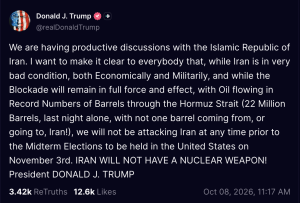
From the podium, Trump announced to the assembled heads of state and their representatives, and a global audience, that he personally would decide whether he would “let” Iran have a deal or “annihilate the Islamic Republic” and “drive them into hell with no chance of survival.” These words, themselves, are a crime. The overt threat is a violation of Article 2(4) of the founding Charter of the United Nations itself, which forbids both the use of force as well as the threat of the use of force against member states. The United Nations was formed in large part to prevent the crime of “aggression,” and the sovereign equality of its member states is its core governing principle. Freedom of speech this is not: President Trump’s words were not framed as an unusually blunt form of diplomacy, which is how his similar 2017 threat against North Korea in the same forum can be described. In that case, the United States and North Korea were not engaged in overt hostilities and his threat was swiftly followed by a diplomatic resolution and smiling handshake photo opportunity. Trump’s 2026 threat was delivered by the head of the state which unilaterally attacked Iran, assassinating its leadership, murdering its children, destroying its infrastructure, renouncing peace negotiations and continuing to mull renewed campaigns of destruction.
As a member of the Security Council, the United States is immune from consequence for this crime and this is what makes this moment different from other, ostensibly similar, ugliness. Ugandan dictator Idi Amin made a similar claim for the extinction of the state of Israel from the same podium in 1975; Iranian President Mahmoud Ahmadinejad’s disparagement of the Holocaust in the 2000s prompted diplomatic walkouts similar to those of September 2025 and 2026 which were provoked by similarly outrageous statements by Israeli Prime Minister Benjamin Netanyahu. Israel holds the United Nations in particular contempt, denigrating its membership as a “swamp of antisemitic bile,” declaring its Secretary-General persona non grata, outlawing and then seizing the offices of the UNRWA (the United Nations Relief and Works Agency, the organization dedicated to assisting Palestine). Uganda is a small state, incapable of imposing its will on the world stage; Iran stands proud but vulnerable to the sanctions the United Nations was all too eager to impose upon it. Israel, however, stands under the protective umbrella of its political sponsor, the United States, and operates with complete impunity, safe in the knowledge that the Security Council veto wielded by the United States is effectively and reliably theirs as well. This is a time of open and acknowledged Israeli genocide against the Palestinian people, with the serial use of the veto by the United States protecting Israel from any consequences of its murderous policies. Only the United States veto, a proxy vote for Israeli demands, has prevented the full membership of the State of Palestine in the United Nations. And now, the leader of the United States, the Israeli sponsor, and chief aggressor in the ongoing conflict against Iran is allowed to openly threaten the annihilation of a member state without any fear of consequences. The UN, as currently constituted, requires the state of Iran to face this humiliation without political remedy. With US support for Israeli violence against Palestine proving that genocide is indeed a policy option for America’s adversaries in West Asia, is Iran expected to continue to face open threats for its own destruction in a chamber ostensibly based on the equality of its members? What lesson are other nations to draw? This essay contends that the lesson is not that nations such as the United States and Israel can act with impunity in perpetuity – rather it is the opposite: in a multipolar era, the global majority will not continue to agree to participate in a system in which the scales are tipped so radically against them. This leaves two options: reformation of the United Nations or the creation of an alternative organization.
II. Manipulation of the Machine
Proposals for reforming the UN almost universally revolve around two issues: the now inequitable distribution of the five veto-holding permanent seats of the Security Council; and demands by India, (whose population represents approximately one-sixth of all humanity), or any state on the African continent, to join or replace either the United Kingdom or France, whose seats are the aftermath of empires lost and a war won, unlike the seats held by the superpower states of Russia, the United States and China. However, any reform which keeps in place the current veto powers is doomed to failure as it fails to address the ultimate source of the UN’s now fatal condition. The ongoing simmering conflicts and violence in the Middle East, including the genocide of the Palestinians, are threatening the very legitimacy of the institution. A body founded to outlaw aggression instead finds aggression flaunted, practiced, and promised with complete impunity from its very podium.

The double standards have rarely been so stark. On the final day of February 2026, the United States and Israel attacked Iran without provocation, assassinating its Supreme Leader along with much of his family. On the same day, the United States bombed a school in the town of Minab, killing at least 156 innocents, overwhelmingly young children. Iran immediately invoked Article 51 of the UN Charter, the right of self-defense, and officially requested action by the UN Security Council. The Council took action, less than two weeks later, adopting Resolution 2817 on 11 March condemning Iranian retaliatory counter-attacks on US bases and interests in the Gulf States and Jordan. Russia and China abstained. No mention of the US-Israeli attacks was included in the Resolution. A Russian draft urging all parties to cease violence failed and no resolution condemning the American attack was even put to a vote. From the very podium from which he threatened Iranian “annihilation,” Trump referenced Resolution 2817condemning Iran; he failed to mention that US veto power ensured that no similar resolution condemning his or his country’s actions could even be contemplated.
The inequality stretches far beyond words. The so-called “snapback sanctions” against Iran of Resolution 2231 of 2015 are a mechanism built to specifically allow the triggering of sanctions by any single permanent member of the Security Council – in this case the United States – specifically disallowing any potential veto or lifting of them by the other members; Russia and China tried, but their effort was stopped by the United States.
That 28 February unprovoked “decapitation strike” and the following onslaught of bomb and missile strikes are a nearly perfect example of the UN General Assembly’s own definition of the crime of “aggression.” Earlier, in the Nuremberg Tribunals themselves, aggression was deemed the supreme international crime, as but for the initial starting of a war, none of the later crimes would have had opportunity to occur. Definitions of the crime of “aggression” are hotly disputed and differ slightly between the UN and the International Criminal Court (ICC). However, Trump’s words are impossible to take lightly as, not only do they violate Article 2(4) of the UN Charter, which bars the threat of force, his specific words are inextricably linked to deeds already taken and currently in action, including sanctions, bombing, blockades, and the movements of the mechanisms of death and destruction. Idi Amin’s comments were empty threats; Trump’s were an avowal of potentially genocidal escalation. And it was done in full knowledge not only of the rules but of his immunity to them. Only the Security Council can authoritatively and officially determine the crime of aggression, and in this case the aggressor holds the veto. This is the abuse of power, and in combination with the US history of contempt for the organization, it is egregious enough to finally break the institution.
For generations, leaders of the United States have treated international law as a tool that binds other, lesser, states and can be ignored or implemented at will. It never ratified the UN Convention on the Law of the Sea, although its lawyers never fail to invoke this convention to challenge its competitors or adversaries. It signed the Rome Statute of the International Criminal Court only to revoke its signature and then brazenly attempt to intimidate and threaten the individual prosecutors and judges of that court when it turned its eyes on potential crimes committed by the US or Israel. In 2002, US went so far as to potentially threaten to physically invade The Hague, by passing the “American Service-Members Protection Act” authorizing the use of force to free “US or allied personnel” detained by the ICC. When the World Court ruled against it, for mining harbors in Nicaragua, it withdrew from the Court’s jurisdiction. It has joined and quit and rejoined the World Health Organization, the Human Rights Council, and UNESCO. Perhaps most notably, it has provided the veto as a proxy for another state, Israel, which does not sit on the Council at all, effectively giving greater rights on the international stage to a nation of less than 10 million than India, with over a billion souls, is allowed. And the US wields this proxy veto brazenly, voting at Israel’s bidding without any visible shame, protecting and arming the warlike state and casting the sole veto against the full UN membership of the State of Palestine, Israel’s adversary and closest target. This contempt for settled international law extends to rhetoric; after the Cold War, during the hegemonic unipolar era, the West referred to this uniquely American perspective as the “rules-based international order.” The “rules” were unwritten, uncertain, situation-specific, and favored one and only one power. As that era has ended, a multipolar world cannot and will not continue to stand in submission to the changing whims of various United States administrations. It is beyond dispute that the United States will not give up its veto power and a United Nations with true, actual equality would not be hostage to the veto of one of its members, especially if cast on behalf of another power. How then can the UN be reformed?
III. Article 108: Why It Cannot Reform
Reform of the UN, by design, is almost impossible. The founding Charter itself, which entered into force in October 1945, includes Article 108, which has never been altered or amended in any way. It states that any amendment to the Charter requires a two-thirds majority of the General Assembly, a two-thirds ratification by the members, and approval by “all” of the permanent members of the Security Council. Article 109, which allows review of the Charter, requires the same unanimity of the five veto-holding states. Thus, any action involving the veto, whether to expand, restrict, or limit it in any way, is itself subject to being vetoed by any of the five veto-holding states. And, again, this is by design. In 1945 the powers that had emerged victorious from the Second World War made clear that they would only join the organization under the Yalta formula permanently allowing them, and only them, the power of a veto. Despite protest from smaller states, the situation was plain: in a world rebuilding from the devastation of war, an unequal power structure sitting atop an ostensible group of equals was preferable to no organization at all. Thus, it must be understood that the veto is not a flaw that has been uncovered over time; it is the system as designed.
The sole circumstance in which the veto system could be reformed is if all five permanent members of the Security Council agree to it. This is not going to happen. Two permanent seats on the Security Council, those of France and the United Kingdom, are the vestiges of empires lost, and provide outsized power on the world stage to what are now distinctly middle-power states. Russia and China, true superpowers, learned the danger of not using their veto powers, specifically in 2011, when both states abstained from vetoing UN Security Council Resolution 1973 “authorizing all necessary measures to protect civilians” in Libya. This resolution, ostensibly for humanitarian grounds, became the legal pretext for NATO’s offensive operation toppling Muammar Gaddafi’s government, leaving Gaddafi to a brutal death and Libya in a state of violence and uncertainty; a decade and a half later, Libya remains a failed state. It is hard to overstate the impact of what Russia and China perceived as the abuse of Resolution 1973; one of its many ramifications was the beginning of the transformation of then-President of Russia Dmitry Medvedev into the staunch anti-Western war hawk he famously is today.
Had either nation vetoed the resolution, the war might not have taken place and much might have been different. Or perhaps Washington would have unilaterally attacked anyway, in an overtly “illegal” war. For the behavior of the often-mercurial United States is the remaining variable regarding the future of the UN. It is conceivable, should the United Nations fail to agree or perform in a way demanded by the current American President, that he may order a complete abandonment of the organization itself, defunding it, withdrawing the United States totally, renouncing it as the deepest swamp of an international deep state. Indeed, Trump has already taken steps in this direction, by mid-2026 issuing a series of Executive Orders and Memoranda serially defunding and withdrawing the United States from dozens of UN bodies. His own party has introduced legislation in both the United States Senate and the House of Representatives demanding full legal withdrawal from the United Nations. In what passes for political humor in the United States Senate, their version is literally named the “Disengaging Entirely From the United Nations Debacle” Act (the “DEFUND Act”) and it demands an end to all funding, participation in UN activities, the repeal of the United Nations Participation Act of 1945, and the removal of diplomatic immunity from UN officials. The House version, the “American Sovereignty Restoration Act,” has become a perennial submission and demands much the same. President Trump has not publicly lent his support to either.
What would happen to the United Nations if either piece of American legislation were passed into law and the United States did formally withdraw from the UN? The Charter would not change; Articles 108 and 109 would remain the same; and the designed inability to reform would remain. Without the United States, but with a hollowed-out Security Council, the credibility of the organization would decline. The US is, by far, the largest patron of the UN, providing more than 20% of the overall budget, and even higher percentages to peacekeeping and other agencies. The UN does not operate with a surplus and cannot afford to continue with a loss of over a fifth of its revenue. Thus, the departure of the United States is not a solution, as tempting as it may seem. Further, with the United States out of the picture, the four remaining veto holders would remain in the hierarchy above the General Assembly, and the inequality of the system would become even sharper. Russia and China are purposefully building equality-based infrastructure across the world via various mechanisms and organizations, all predicated upon sovereign respect in a multipolar world. A post-American Security Council with Russia and China in place might appear to set the stage for a showdown pitting the Global South against Western Europe, but in reality Russian and Chinese votes would be for their own sovereign interests. Hypocrisy is nothing new in politics, but inequality does not sit well with multipolarity.
Thus, American departure or no, the United Nations is at a breaking point. Should the United States remain, the United Nations is revealed as impotent in the face of the American use of the veto both to shield itself and Israel. Should it depart, the institution would not only be insolvent, but would also be exposed for its hypocrisy: in a multipolar world in which all countries are purportedly equal, evidently some countries remain more equal than others. Thus, the solution is neither reform nor the departure of the United States. It is the creation of an alternative body, a new organization based on the principles of the equality of states, principles enshrined in the countless documents and treaties negotiated between the powers since the end of the Cold War, which have led to the creation of the multipolar world. As these pages have demonstrated in “Roadmap to the Multipolar World,” Russia and China have diligently laid the groundwork for the era we are now in. What remains is the creation of a truly multipolar global body, based on the principle of sovereign equality, without veto. Fortunately, there is a precedent, and for thirty years it has quietly provided an example of how countries great and small can successfully operate in an environment of radical equality.
IV. Requirements
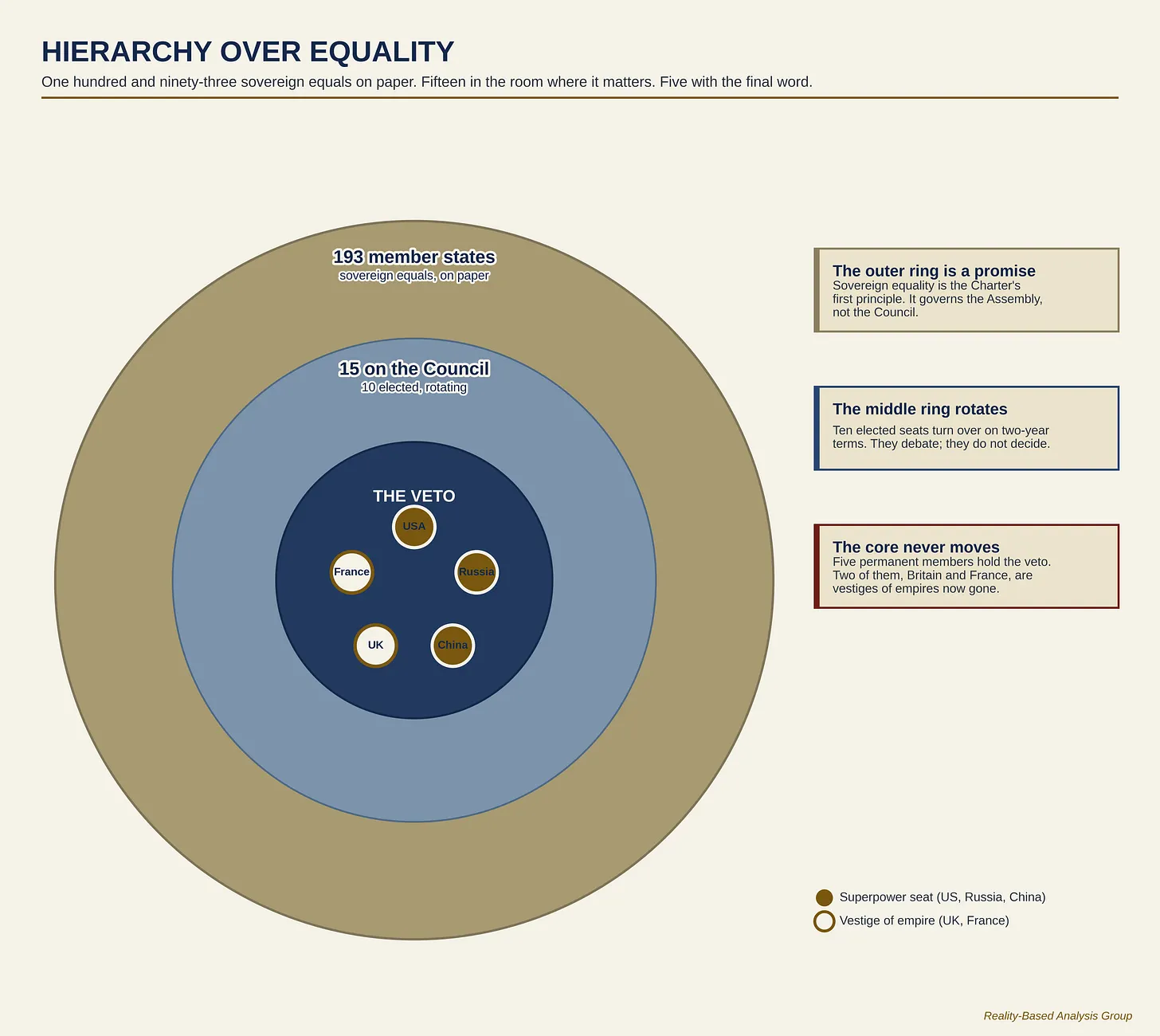
The fundamental flaw of the structure of the United Nations is that it is predicated at once upon the equality of its members while simultaneously self-organizing into the hierarchy of actual decision-makers which are the five permanent members of the Security Council. The rotation of other members into the Security Council gives the appearance of equality, but in reality highlights the perpetual inequality of the system. At any given time, of the 193 members of the UN, only 15 participate in the decisions that really matter, and final say is always, literally always, given to the core five who alone hold the final right of refusal. Perhaps this was appropriate for a world reeling in the aftermath of a war which also signaled the dissolution of Empire, or suitable for the bipolar contest for power of the Cold War. It has become clear that it is a system inappropriate for either the era of unipolar hegemony, as made clear by the pronouncement of the United States preference for the “rules-based order,” or its successor, today’s multipolar world.
Equality is the crux of the issue. Any organization which would supplant today’s UN must be organized around the mutual respect of true equality in which no member has the ability to veto measures regarding its own conduct or that of its favored partners or patrons. Respect for state sovereignty ties in explicitly with equality. This is the issue of the European Union (EU), in which the organization itself becomes a government which supersedes individual sovereign decision-making. The EU is dominated by Germany, and to a lesser extent by France; no association of equals would be voluntarily joined if it risked de facto sovereign domination by greater powers.
The power to punish, yet not compel, is critical. Respect for sovereignty and equality dictate that there is no ability to force a member state to act against its will, or against its perceived self-interest. This would impinge upon sovereignty. However, it must have the ability to punish, to withhold, to provide ramifications for behavior or actions on the world stage that its peers agree are not congruent with the values and principles of the organization. These issues will always arise, in matters of war, particularly, or the overthrow of a government, either in a domestic coup d’état or a sponsored regime change operation against another government. Here the body must possess sufficient power to influence rather than dictate; this is the power to sanction, to expel, to exclude. Without teeth of this nature, any global organization is impotent to effect change and becomes a discussion group rather than a serious forum for global leadership. The United Nations has all of these powers and more; its flaw is that the permanent five are immune from them.
The final condition is intangible. Much as the US Dollar, the currency undergirding much of the world economy, rests solely on faith (specifically “the full faith and credit of the United States”) rather than on anything so tangible as a gold reserve, the credibility of a successor agency to the United Nations would require being taken seriously by its members, with its judgments and statements understood as valuable and truly consequential. Members must embrace and hold the value of the organization. Mockery of the United Nations is routine within the United States, arguably its most powerful member, but it is much less common elsewhere. The Russian Federation, for example, is famous for explicitly, fastidiously, satisfying itself that it is following the letter of the law to ensure that it feels comfortable that its actions, especially regarding the conflict in Ukraine, are compliant with its obligations under international law. That much of the rest of the world, including at times the UN itself, takes issue with Russian legal analysis is a separate point; what is critical is that Russia takes extremely seriously, not only the underlying international law governing signatory countries around the world, but also the numerous Resolutions enacted by the Security Council. Indeed, Russia operates the same way with respect to other organizations to which it belongs, such as the Shanghai Cooperation Organization (SCO), and would approach any overtly intended replacement for the UN in a similar fashion.
This is the model for taking an organization seriously and it is easily transferred to other organizations. In order to truly succeed, all member states would need to emulate the same behavior. In a multipolar world in which the vast majority of states have never experienced the opportunity for true equality in negotiation and partnership with the great powers, it is not difficult to envision the demand for it.
V. The Competition
But why is an entirely new organization even needed? Why not simply expand the SCO or a similar existing body? There are several existing, functioning, important organizations currently in operation whose activities in part overlap with those of the United Nations. These fall, generally, into two categories: those which envelop and partially fuse states into a larger organization, and those which treat each member as an independent entity. To each can be applied the four-part test enumerated above.
The Shanghai Cooperation Organization is usually named first. A quarter-century old, founded as an expansion of the 1996 “Shanghai Five,” it currently consists of ten full members: China, Russia, India, Pakistan, Kazakhstan, Kyrgyzstan, Tajikistan, Uzbekistan, Iran, and Belarus, with Mongolia and Afghanistan as observer states and fourteen “dialogue partners,” only one of whom, Egypt, is from Africa or the Americas. Otherwise, it is a wholly Eurasian organization. The SCO represents 3.4 billion people, roughly 40 percent of the world’s population, and between a quarter and a third of global production. Its Council of Heads of State meets annually, in rotating locations, with a Secretariat in Beijing and counter-terrorism organ in Tashkent. Sovereign non-interference and formal equality are built into its foundation; however, in practice decisions are dominated by Russia and China. It is a hierarchical caucus rather than an authority.
The Association of Southeast Asian Nations (ASEAN) is also overwhelmingly regional. Founded by five states in Bangkok in 1967, it doubled in size in its first thirty years, then added only one more nation in the following three decades, Timor-Leste, whose 2011 application was admitted fourteen years later. ASEAN states include almost 700 million people and nearly 4 trillion US Dollars of combined output. The Secretariat is based in Jakarta. ASEAN decides everything by consensus and holds non-interference so critical that it refers to it as “the ASEAN Way.” It scores well regarding equality and sovereignty but the ASEAN Way effectively prevents any form of punishment whatsoever, the sole exception being the barring of Generals from Myanmar’s ruling junta from summit participation in 2021; a symbolic punishment which caused no measurable change in Myanmar’s behavior. ASEAN did create a “Five-Point Consensus” document on the crisis which was so comprehensively ignored that it was quietly shelved shortly after creation. ASEAN fails the enforcement criteria, and it is difficult to see an organization with such sclerotic growth expanding to include the rest of the world.
The remnants of the British and French Empires provide instructive cases although each fails in a different way. The flaw in the British Commonwealth is immediately identifiable: King Charles III remains the sovereign head of state for fourteen member states, in addition to the United Kingdom of Great Britain and Northern Ireland. He is the head of state in only fourteen of the fifty-six member states because some members specifically removed the British Crown from their own governments; other states, such as Togo, Gabon, and Rwanda, never having been pink on the Imperial map, joined for their own political reasons. On paper, the Commonwealth consists of 2.7 billion people, has a secretariat in London, biennial heads-of-government meetings, and decision by consensus without veto. Its Ministerial Action Group has acted to suspend nations for various causes, including Fiji, Nigeria, Pakistan, Zimbabwe, and Gabon. However, an association of equals with the same monarch for 25% of its members is not an association of equals.
La Francophonie, officially the “Organisation internationale de la Francophonie,” was established in 1970 and designed to provide the illusion of equality. It holds a biennial summit, has a secretary-general, a permanent council, a charter, and a rule of consensus among its more than eighty members. However, the reality is that the French exchanged the exploitative apparatus of empire for direct control of the currencies of fourteen African nations, which they control ruthlessly and for their own benefit. Until reforms in 2019 and 2020, member states were required to hold half of their foreign-exchange reserves in Paris. The West African and Central African CFA francs are controlled and guaranteed by the French Treasury; officially pegged to the euro at a fixed rate of 655.957 franc to one euro. The CFA francs are explicitly designed to serve France, and the exchange rate favors French imports and the export of capital over local industrial development. Further, while the exchange rate cannot be changed by the African nations who use it as their currency, it can and has been changed by the French government when it suits its desires. In 1994, France devalued both by 50 percent, overnight. The once lauded and promised replacement, the West African eco, removed the reserve deposit requirement, but left the exchange rate and control in place; it is also delayed. Anger across la Francophonie at their former colonial masters is tangible and the past decade has seen a massive shift across West and Central Africa against the French. Burkina Faso, Mali, and Niger have led the way, quitting la Francophonie altogether; moving to create their own currency, the sira; expelling French military forces and closing their bases; and reclaiming their independence. When denouncing and departing an organization is key to reclaiming independence, it is not an organization based on equality amongst members; thus on this measure la Francophonie is unsuitable as an organizational replacement for the UN.
Two bodies remain for analysis, the structure of each based in part upon that of the United Nations: the European Union (EU) and the African Union (AU). The EU has 27 members and almost 450 million people. Its sovereignty outweighs that of its individual members; its decisions can override national law, a fact made visible in ongoing intra-European debates over immigration and refugee policies. It has a genuine enforcement mechanism, which can withhold funds, issue fines and suspend voting rights. It is the sole example of an organization outside the United Nations which truly has, within limits, the power to compel. However, it does so at the clear expense of its members’ sovereignty, and that price is one which the nations of the Global South would not pay. It retains national vetoes, in areas such as treaty negotiations, taxation, and foreign policy, with the foreseeable paralyzing results. Beyond this, the EU is dominated by Germany and France. As such, it is perpetually caught in the friction between its goal of making all of its constituent parts into one vast whole and the reality that there are significant differences for legitimate reasons between Iberians and Scandinavians, Germans and Greeks. The EU fails the sovereignty test and is not a company of equals.
The AU is the newest organization of its type in the world, founded in 2002 as the successor to the Organisation of African Unity. It was deliberately designed to be an improvement on the UN, replicating its structure but dismissing the veto. With fifty-five member states (representing almost 1.5 billion people) the AU has a Peace and Security Council with no permanent members and no veto powers. The fifteen nations of the Council are elected, ten for two-year terms, five for three, with a chair rotating monthly based on the alphabetical order of the elected members. The AU asserts a right to intervene, and thus compel, in Article 4(h) of its Constitutive Act (the AU “Charter”), in cases of genocide, war crimes, and crimes against humanity. It routinely suspends nations who have come into power via coup d’état, most recently Mali, Guinea, Sudan, Burkina Faso, Niger, and Gabon. The AU’s weakness is not in its design. Much as many of the most liberal constitutions in the world look beautiful on paper but fail in their compliance and execution, the AU’s stated aims exceed their capacity to fulfill them. The AU shows that it is possible to have a large council of equals without a veto. What it has not demonstrated is that its attempts to coerce matter: when suspended, the governments of Mali, Niger, and Burkina Faso simply walked away and Burkina Faso is now considered by many to be the darling of the continent, with Captain Ibrahim Traoré leading the anti-colonial way forward for proud independent African states. Meanwhile, the AU’s sole legal claimed right to intervene, Article 4(h), has never been funded, invoke, or attempted. The AU overtly positions itself as learning from and improving upon the model of the UN; regardless, the weight of its punishments remains unproven.

VI. The Precedent as Prototype
The Community of Portuguese Language Countries (CPLP) was founded in Lisbon in 1996 and is the aftermath of the Portuguese global empire. It consists of nine states: Angola, Brazil, Cabo Verde, Guinea-Bissau, Mozambique, Portugal, São Tomé and Príncipe, Timor-Leste and Equatorial Guinea. It is based on radical equality, irrespective of size or history. Decisions are based on consensus and are binding. The presidency rotates every two years, and new members are only admitted by unanimous consent. There are no hierarchies, no permanent seats, and no individual vetoes; the requirement of consensus is a veto of sorts, held by everyone. The CPLP meets all four of the criteria required of a successor to the United Nations: equality, sovereignty, ability to punish, and seriousness of purpose and membership.

A succession crisis in 2025 demonstrated in practice the equality of status between CPLP member states. At the 2025 CPLP Heads of State summit in Bissau, the capital of Guinea-Bissau, there was a contest for the next presidential term between G20 giant Brazil and tiny Equatorial Guinea, whose population of 1.7 million is less than a tenth the size of greater São Paulo. Neither side emerged with sufficient support and neither could control the assembly; as of the present writing, negotiations continue between both parties. Leading the organization, even for a two year term, is something serious enough for Brazil to truly desire it, yet its overwhelming size confers it no advantage in the contest. Sovereignty is respected as well; the CPLP legislates nothing on behalf of its members. Even agreements among members, such as the Schengen-like 2021 mobility agreement signed in Luanda, Angola, are non-binding without individual ratification.
The second pair of requirements, the power to punish and the value placed in the organization were both on display in a separate crisis, also in 2025. In late November, soldiers seized power in Guinea-Bissau, the country holding the Presidency of the CPLP at that time. The CPLP swiftly moved to suspend it from the organization, doing so in less than three weeks. Unlike a similar scenario when Burkina Faso, Mali, and Niger withdrew from la Francophonie and appeared happy to leave, the rebel junta which had seized control of Guinea-Bissau complained bitterly of unfair treatment, accused the organization of breaching its own statutes, and officially demanded to remain not just a member of the CPLP, but to retain its leadership position. When it was clear that they were to be suspended, the rebel leadership preemptively withdrew their membership and remain outside the bloc to this day.
The CPLP exists because it is based on common ground, shared Portuguese language and heritage. The Portuguese did not give up their empire willingly and fought bitterly to hold it. Ironically, the way in which they lost it is what made the success of the CPLP possible. Unlike the British or French, whose post-imperial organizations retain their superior positioning, the Portuguese lost their empire not only through colonial wars and agreements, but via an abrupt revolution at home. The 1974 overthrow of the Caetano government signaled the complete end of their imperial ambitions. Portugal retained no power over their former colonies, no currencies, no sovereignty over them, no defense pacts; what remained were ties of language, culture, history and heritage, the human ties created during the time of empire which outlasted the empire itself. This leveled the playing field and allowed for the CPLP to be created as an organization of equals. The CPLP is nine nations scattered across the globe; it is the multipolar world organized in miniature, and it is the prototype for what the successor to the UN must be.
VII. BRICS: Opportunity from Chaos
And here we have the opportunity. Once merely a banker’s term for the nations Brazil, Russia, India, and China (with the 2010 addition of South Africa, hence: BRICS), it is the sole existing group spanning the world, in fits and starts, with all the complications and contradictions expected of a body ambitious enough to be called truly global. In 2006 it became official with the inaugural meeting of the original four “BRIC” nations’ foreign ministers. Three years later they held their first full summit in Yekaterinburg, inviting South Africa the next year. Officially an “informal intergovernmental coordination forum,” BRICS has built the 2014 Shanghai-based New Development Bank, the $100 billion Contingent Reserve Arrangement (a currency-swap pool among member states), added annual summits and a rotating Chair, currently held by India. It consists of eleven full members (the original five, plus Egypt, Ethiopia, Iran, the United Arab Emirates, Indonesia, and potentially Saudi Arabia, whose status fluctuates: it was invited to be a full member, has not formally joined, yet is officially counted by BRICS Chair India as a member). There are 10 Partner countries, a tier created in 2024: Belarus, Bolivia, Cuba, Kazakhstan, Malaysia, Nigeria, Thailand, Uganda, Uzbekistan, and Vietnam. Decisions are made by consensus. There is no formal veto.

Dismissed by many as “a disaster” or “a mess” due to rivalries and even open hostilities between its members, BRICS is not a haven of single-minded nations. Its members disagree and fight one another just as frequently as the members of the UN do. Egypt and Ethiopia are locked in a long-running dispute over water allocation from the Nile River and Ethiopia’s massive Grand Ethiopian Renaissance Dam (GERD); Indian and Chinese troops have shed each other’s blood in an unresolved border dispute; Iran and the UAE have sporadically attacked each other as part of the greater conflict between the United States, Israel, and Iran. There is no common currency, although there is much speculation that one is in the works, not for minting and personal usage, but for intra-governmental payments and clearances, an escape hatch from a dollarized world economy. In fact, the sole point on which they all do appear to agree is that we are in a multipolar world, and an era in which respect for sovereignty and equality are paramount.
Critically, BRICS does not yet have a charter, a founding treaty, a permanent secretariat, or a fixed independent budget. This is an opportunity. What BRICS has is weight, seriousness, significant sources of funding, respect for sovereignty and a commitment to multipolar equality. Specifically, this means that what BRICS actually lacks is a full and serious organized body worthy of its place succeeding the United Nations. The CPLP provides the prototype. BRICS can build such an organization: free from the veto, free from hierarchy, equal in the Portuguese manner, respectful of each member state’s sovereignty, with the ability to fund its operations and with the willingness to exclude any member unwilling to obey rules it adopts to govern state conduct. BRICS is the opportunity, and from the chaos of its current membership, it has the chance to create a new and equal order.
VIII. Possibilities
In a BRICS global forum, no nation would be expected to sit in humiliation while an aggressor vocally contemplates its genocide. No nation would be prevented from becoming an equal member by a greater power wielding a veto against not only principle but against the rest of humanity. Iran would face its accusers as an equal; Palestine would sit in its earned place with its sovereignty respected as much as that of any great power. Much as the magnificent powerhouse that is Brazil sits in equality in the CPLP with tiny Cabo Verde, a BRICS global forum would treat all nations of the world as equal, sovereign, and free to pursue their policies according to their imperatives. No member’s vote would be worth more than another’s and no nation would be granted impunity for its actions or statements.
The United Nations has demonstrated that its very structure is inappropriate for the multipolar world. An era based on equality of states cannot be governed from a table of fifteen states, five of which can use their veto power as a shield for either their own crimes or those of others. Sovereign nations can no longer be forced to face ritual humiliation by a hierarchy designed to put certain nations in a lesser position than others. The nine countries of the CPLP have shown the way forward and they have spent the past thirty years proving that equality between partners, whether giant or small, is possible; that a veto-less forum of equal consensus can function and is worth fighting to be a part of. Registering discontent with bad behavior at the United Nations is not enough. In a unipolar era, with nowhere else to turn, walking out of the General Assembly hall in New York during an adversary’s speech was a first step. In our multipolar era, building a separate hall for a new BRICS global forum, in which equality, sovereignty, and consensus are enshrined in its very governance, is the next.


 By
By