
EXCLUSIVE: The operators of Snowy Hydro 2.0 are bracing for a more than 10-fold cost blowout in the mega project that is already running seven years behind the original schedule.
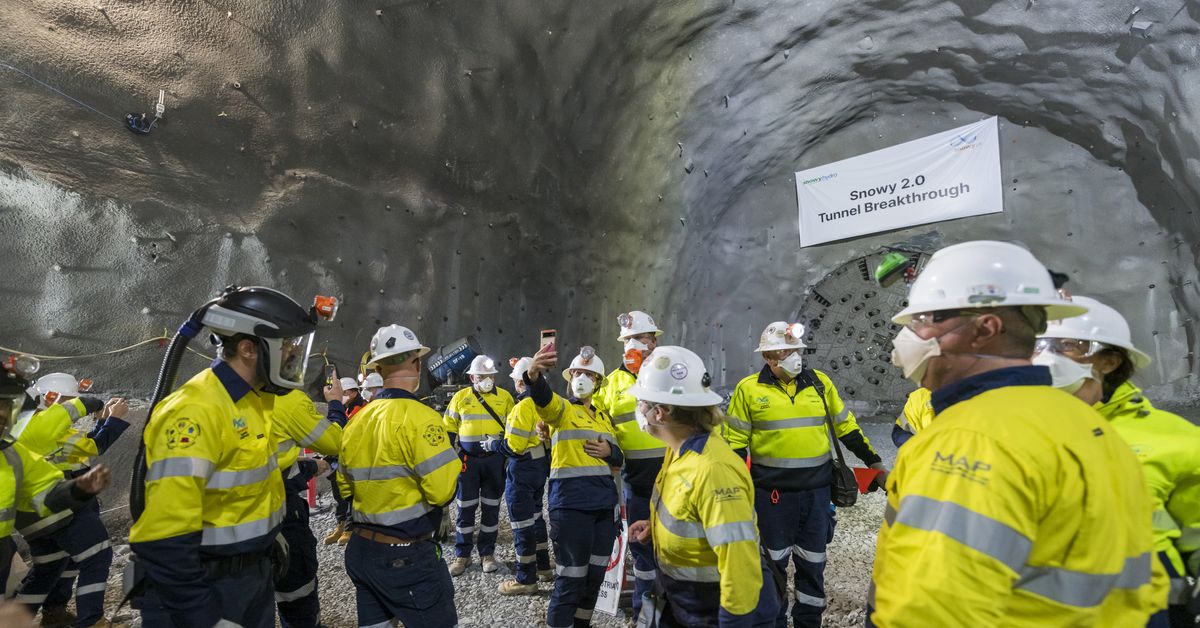
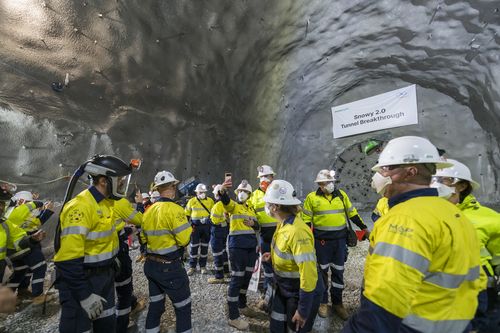
9News visited Snowy 2.0 at an important milestone – the breakthrough of tunnel boring machine (TBM) Eileen into a cavern deep underground, completing her six-kilometre section of the tunnelling task.
TBM Florence, which infamously got stuck for 11 months just 150 metres into her dig, is now seven kilometres into her 15-kilometre task, with project director Dave Evans confident she can reach boring speeds of 90 days for every remaining kilometre.
“The logistics of getting deep underground to build such a big power station comes with challenges, and that’s what we’re here for,” Evans said.
“This project that we’re building will last 150 years, so it’s going to be here for hell of a long time.”
All up, 19 kilometres of the project’s 27-kilometre tunnels have been bored by the four TBMs.
When completed, Snowy 2.0 promises to be Australia’s biggest battery, storing the equivalent of 26 million home batteries by using excess solar and wind energy to pump water into the upper Tantangara reservoir for release when power is needed.
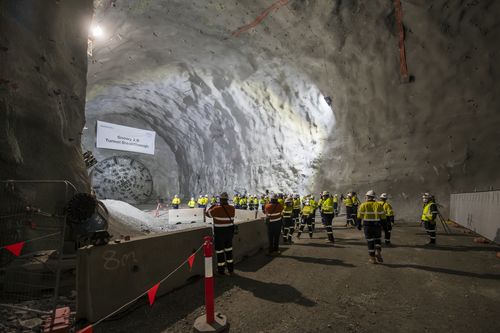
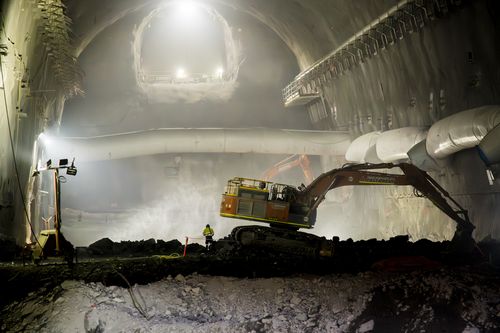
9News visited the enormous cavern nearly one kilometre below the surface that will house a six-turbine generator.
The 200-metre-long cavern is big enough to fit the Sydney Opera House and at 67 metres tall could comfortably fit the Leaning Tower of Pisa.
But the spiralling cost of Snowy 2.0 remains problematic.
The projected cost escalated to $6 billion, then lifted to $12 billion in 2023, with Snowy Hydro chief executive Dennis Barnes conceding this figure will be exceeded and the completion date pushed back to late 2028.
“We’re not going to get it done for $12 billion so we’ve asked our contractor to do a line-by-line assessment, which they’re due to complete in the next couple of weeks,” Barnes said.
9News understands the project’s latest price tag will be about $22 billion – 11 times the original estimate.
Barnes defended the blowout, saying the project was “one of the most complex engineering projects underway in the world” that demanded millimetre precision in a remote part of Kosciuszko National Park.
“The announcements in the early days were all pre-feasibility stage,” he said.
“Obviously, as you do more, you learn more. And progressively, over the last 10 years or so, we’ve gone through a few stages where we’ve understood more.
“Although there was the famous $2 billion by 2021 announced, no work had been done at that point.
“When we got to about 40 per cent of the way through the project, three years ago, we reset the project. We said when it was going to finish, and we said how much it was going to cost. Now, some of those have proven wrong, but until you do the work, you don’t really know.”
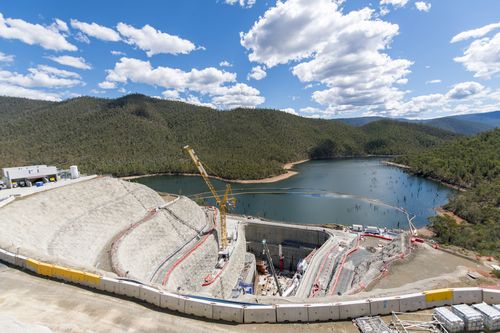
One of the major financial pressure points for the project is labour and associated logistical costs such as fly-in fly-out arrangements, accommodation and meals.
Workers on the TBMs are paid more than $300,000 under two weeks on, one week off arrangements.
Last week, Finance Minister Katy Gallagher said the Albanese government was committed to the project, notwithstanding the fact that the “incoming government had to deal with the consequences of that poorly scoped, poorly designed project”.
“It is a huge, massive infrastructure undertaking and it has encountered several challenges that were not understood at the point that that project was approved by the former government,” she said.
“We’re working through all of those issues, as you’d expect.”
NEVER MISS A STORY: Get your breaking news and exclusive stories first by following us across all platforms.

 By
By