

This is Naked Capitalism fundraising week. 1088 donors have already invested in our efforts to combat corruption and predatory conduct, particularly in the financial realm. Please join us and participate via our donation page, which shows how to give via check, credit card, debit card, PayPal, Clover, or Wise. Read about why we’re doing this fundraiser, what we’ve accomplished in the last year, and our current goal: funding bonuses for our terrific writers.
The narrative battle to control the Iran War continues, as does the kinetic battle to control traffic through the Strait of Hormuz, the American pressure on Iran’s economy, continued international push and pull on diesel stocks, nervous predictions of renewed fighting, and Saudi Arabia’s conflict with Yemen.
Let’s start with the many conflicting narratives because no one seems able to get their collective stories straight.
There Was a Crooked Man or Two Who Told a Crooked Tale or Two, Maybe
Another day of contending narratives with Trump telling TIME, “by annihilating Iran, we’ve created peace in the world. With Iran, I don’t think you could ever have peace” and Iran’s acting defense minister Brig. Gen. Majid Ebn-e-Reza telling Press TV, “Do not hide the confusion in the White House behind imaginary war dramas” and “public pressure, the exhaustion of US forces, and the rising costs of war have thrown your calculations into disarray.”
Trump also had a bit of self-conflicting narrative syndrome when he told TIME that reports of US munitions shortages were “mostly fake news” but did admit that “some forms of ammunition are a little bit lower than other forms.”
There were also conflicting narratives about Iranian offers to allow nuclear inspectors with Bloomberg taking the “yes they did, according to our anonymous sources” position and the Islamic Republic News Agency (IRNA) taking the “oh no, we didn’t” position.
There was another interesting narrative conflict with Trump musing to Fox News that Iran was behind the attack on the flydubai pilot by the flydubai co-pilot, and saying “(Iran will) be hit, very hard, don’t worry,” even as Israeli officials told the Jerusalem Post that their working assumption is the attacker was a “lone wolf.”
For his part, Israeli Prime Minister Benjamin Netanyahu is keeping an open mind, telling Fox News, “It’s too early to say whether he had any connections with Iran or with anyone else” but he claims to have “indications that Iran and its proxies are trying to conduct attacks against Israel and Israelis right now.”
Ali Abunimah of Electronic Intifada says, “One should never take anything “Israel” says at face value but nor would I immediately run to “false flag.” The “Israeli”-UAE relationship is the jewel in genocidal Zionism’s normalization crown and this does not help it. “Israel” has no obvious reason to disrupt trade, tourism and commerce with the Zionist UAE regime. While we don’t know all the facts, we do know that three years into the Gaza holocaust, the Tel Aviv butcher regime is deeply and widely despised. We cannot rule out that three years of shredded babies can drive people to such acts. But in any event, a full, credible independent investigation is needed and we’re unlikely to get that.”
But Iran’s PressTV doesn’t let any such concerns hold them back from publishing “Netanyahu plotted false-flag aircraft hijacking to drag Trump into new war against Iran.”
Brett Erickson of Obsidian Risk Advisors questions why Iran would engage in this kind of attack at this time:
The flydubai… it just doesn’t add up for this to be an Iranian operation. It absolutely could have been a lone wolf, but WHY would Iran choose this way to escalate?
It forces Israel and the U.S. back to full scale war without imposing ANY real economic cost that they could employ through other avenues of escalation.
It hands the Israeli Lobby in the United States to have unlimited ammunition to force Trump’s hand… with WHAT exactly to show for it?
That doesn’t add up.
Former UK diplomat Craig Murray retweeted some skepticism about the whole attack. Murray’s not the only one asking questions on Elon’s free speech platform.
Speaking of asking questions, let’s seek some answers about tanker traffic through the Strait of Hormuz.
Everyone Agrees Iran Is Striking Shipping, Differs About Number of Ships Struck
Unlike Iran’s claims over the weekend to have struck 19 ships in the Strait, some Western media are confirming more limited hits. Reuters cites Marisks, which says three Liberia-flagged tankers were struck on the 29th; National Security Journal says four ships.
United Kingdom Maritime Trade Operations reports another tanker was hit Thursday with a fire on board. This may be the same 2.5 million barrel (bbl) supertanker that Fars claims was hit near the Omani coast.
Bloomberg is reporting that Iran loaded no oil onto tankers in all of September. Readers should remember Professor Mohammad Marandi’s claims that Iranian oil is leaving the Gulf via other countries’ tankers.
Time will tell if Western MSM will confirm IRGC Aerospace adviser Brig. Gen. Ali Balali’s claims to Fars that Iran has developed a long-range ballistic missile with the capability to strike moving targets (regardless of the veracity of this particular claim, the article is worth reading for the description of the sequencing of the Iranian strikes on the Muwaffaq al-Salti air base in Jordan, which has been repeatedly confirmed by Western media).
Mutual Assured Recession
US Treasury Secretary Scott Bessent’s “Operation Economic Outcast” has expanded to include what they call a Russian-linked criminal network that allegedly helps Iran evade sanctions to the tune of $91.5B annually.
CBS reports that flights out of Tehran’s Imam Khomeini Airport are down 42% after the US imposed secondary sanctions on any country that allows Iranian flights.
Iran’s Press TV reports on the Iranian pressure on Iraq to allow flights, particularly to Iraqi cities important to Shia pilgrims.
Meanwhile, the US is threatening France and Germany with an export ban if they don’t release their strategic diesel stores, per Reuters.
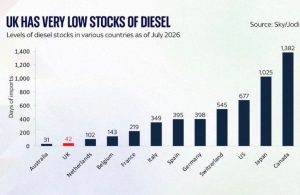
Which can’t be comfortable given the overall shape of European diesel reserves, per Ed Conway of Sky News, who cited the JODI (Joint Organisations Data Initiative) database.

And Bloomberg reports that US diesel prices are hitting record highs, which will “rip through the US economy,” per CNBC, and crude oil prices are jumping too on “renewed conflict fears” via Rigzone.
All of which has Trump seriously considering a US diesel export ban, per CNBC. Apparently, he hasn’t read Goldman Sachs’ warning that it will cause “blowback”, or the warning from TotalEnergies’ CEO that it could raise gasoline prices, or the roundup of analysts telling Reuters the same thing, or the one the Washington Post ran, or CNN’s or TIME’s or CBS’ or RealClearEnergy’s or even the Atlantic Council’s.
Perhaps Trump thinks he can defy the expert consensus again — after all, despite the price increases we’ve seen since the war began, they haven’t risen the way virtually every expert predicted they would, requiring many explainers to help those baffled understand how Trump’s sanguine predictions performed better than the experts.
He’s blithely unconcerned with expert opinion about his threats to resume attacking Iran after the US midterm elections as well.
Fretting About Future Scenarios
The Washington Post is reporting on a “possible surge of thousands of naval forces to the Middle East in coming weeks”:
The planning is meant to create flexibility for the president and commanders overseeing the war, these people said, by moving up to three aircraft carriers and their escort ships into the region in November. The officials spoke on the condition of anonymity to discuss military movements.
Combined, the carrier strike groups would include nearly 20,000 troops, up to 150 fighter jets and numerous destroyers capable of launching and fending off missile attacks. There are about 50,000 U.S. troops deployed in the Middle East, U.S. officials have said.
The carriers involved in the discussion, reported earlier by the Wall Street Journal, are the USS George Washington, which was in the Arabian Sea on Thursday, the USS George H.W. Bush, presently in the Indian Ocean, and the USS Theodore Roosevelt, which deployed in recent days from San Diego and must make its way across the Pacific Ocean, the officials said.
The Navy also recently deployed a three-ship task force of Marines and sailors, the Makin Island Amphibious Ready Group, from California. It could join a similar unit, the Boxer Amphibious Ready Group, that has been deployed to the Middle East for months, officials said. Each task force includes more than 4,000 sailors and Marines.
Former CIA analyst Cole Bucy and the Atlantic Council’s Nate Swanson took to the pages of Foreign Policy to predict Trump’s likely next moves while “none are likely to deliver the outcome he seeks”:
The United States, possibly joined by Israel, could decide to launch new, more intense strikes against the same types of targets—military installations, deployed missile systems, and energy infrastructure—that were struck in March. In this scenario, the United States could certainly impose further pain and degrade Iran’s military and its ability to threaten the Strait of Hormuz and its neighbors.
…
The best-case scenario is that Trump uses such strikes as a pretext for returning to negotiations. However, the risk is that Iran may again focus its retaliation on the Gulf states, which are already growing skittish about the collateral damage they’ve faced. The worst-case scenario for Trump would be if he authorizes strikes against Iranian civilian infrastructure, prompting Iran to reciprocate with strikes on vulnerable Gulf energy sites.
…
Another possibility is that Trump seeks a high-profile “finale” to claim victory, thereby bringing the war to a narrative conclusion even without securing his initial objectives. This could involve actions such as a special forces operation intended to secure the highly enriched uranium (HEU) that is currently buried underground but remains the biggest near-term nuclear threat. Eliminating Iran’s stockpiles would greatly reduce the risk of an immediate nuclear breakout and would enable Trump to claim that the war was part of a coherent strategy to significantly degrade Iran’s nuclear program. Alternatively, Trump could launch a surprise raid to seize the Iranian oil terminals at Kharg Island and hold them for ransom as part of a peace deal.Needless to say, this would be highly risky, possibly involving significant U.S. casualties.
They also consider another scenario:
Putting U.S. troops on the ground represents the best chance for overthrowing the Iranian regime, but the downsides are obvious. Iran is a vast nation, four times the size of Iraq, with more than 90 million people and more than a million members in its military and security services. Most estimates of a successful U.S. ground campaign suggest it would require at least several hundred thousand soldiers—and as many as 1 million. The U.S. military campaigns in Iraq and Afghanistan would likely be considered cakewalks in comparison.
Some U.S. hawks are still hoping Trump takes this step, even they are loath to say so out loud, given how politically toxic the idea remains. As a result, this will remain Trump’s last—and least likely—option.
They also consider the possibility that Trump will walk away from the war, before concluding, “The reality is, Trump is stuck with bad options for exiting this quagmire. The only thing worse would be doubling down on destructive and futile escalation.”
I wonder if anyone gave Saudi Arabia’s Crown Prince Mohammad bin Salman similar warnings before he renewed fighting with Yemen in July, ending the truce that had held since 2022.
The Saudis vs. Ansar Allah
The Saudis are working hard to control the narrative, claiming, per Al Jazeera, that Ansar Allah (“the Houthis”) attacked the holy city of Medina with a drone that hit the Taibah distribution station, which feeds the Prophet’s Mosque. Ansar Allah denies the allegations.
Brett Erickson is also skeptical:
I would be EXTREMELY skeptical of the claims that Ansar Allah targeted facilities in Medina. Saudi Arabia has REPEATEDLY attempted to craft false narratives (see: Mecca) around Ansar Allah targeting holy sites in Saudi. Ansar Allah has ZERO intention to hand Saudi the ammunition to form a large scale global coalition to save them from getting routed by Ansar Allah. Beyond this… Ansar Allah would not in a million years target Mecca or Medina on principle alone. This is Saudi disinformation.
Arab News duly reports that Saudi Arabia has intercepted four drones and two ballistic missiles in a new round of attacks on Jazan and Khamis Mushait.
For their part, Ansar Allah is accusing the Saudis of bombing the city of Sanaa; it is unclear if this included the Old City, a UNESCO World Heritage Site. Either way, bombing Sanaa is something the Saudis had largely avoided since the 2022 truce and constitutes a major red line crossing that Elijah J. Magnier says can be expected to inspire a brutal retaliation from Ansar Allah.
It may have come already if the analyst who calls himself AJ Signal is accurate:
𝗜 𝗧𝗼𝗹𝗱 𝗬𝗼𝘂 𝗧𝗵𝗶𝘀 𝗪𝗮𝘀 𝗖𝗼𝗺𝗶𝗻𝗴. 𝗧𝗵𝗲 𝗗𝗮𝘆 𝗦𝗮𝘂𝗱𝗶 𝗢𝗶𝗹 𝗕𝗲𝗰𝗮𝗺𝗲 𝗜𝗻𝗱𝗲𝗳𝗲𝗻𝘀𝗶𝗯𝗹𝗲…
This morning Yemen’s Ansarallah Houthis appear to have struck Saudi Aramco’s oil infrastructure in the Eastern Province.
EUMETSAT Meteosat imagery caught a… https://t.co/FBu2zgMSLo pic.twitter.com/ytUUX8OH0q
— AJ Signal (@aj_geo_analysis) October 1, 2026
There are other posts that purport to support the claims:
Reportedly footage from Yanbu earlier today. This is the crude export terminal. pic.twitter.com/h9UNeaLAId
— barry with the NED (@bonzerbarry) October 1, 2026
Anadolu reports claims from the Saudi-controlled Taiz Military Axis that 100+ Houthis were killed on the Humair, Bani Bakari, Al-Aqrud and Samea fronts by 6 government airstrikes.
Ansar Allah-sympathetic outlet MintPress News counters with another side of the story:
🚨BREAKING: Saudi-proxy Militias Are Retreating Towards Taiz City As Yemen’s Armed Forces Rapidly Advance
After the elimination of a leading commander of the Saudi-backed PLC, the Yemeni Army appears to have demoralised their opponents according to reports on the ground. pic.twitter.com/Dekf2T5jEN
— MintPress News (@MintPressNews) October 1, 2026
Let’s look at a few YouTube videos and some related links and call it a post.
Around the Tubes
The center-left edge of the Overton Window from Breaking Points
US military vet and former Rand Paul staffer Jim Webb brings the libertarian anti-war perspective.
Swiss intelligence analyst Jacques Baud has been sanctioned by the EU for his verboten views.
The Electronic Intifada is well outside the American news Overton Window.
Related Links
Follow and support my work at NatWilsonTurner.com.


 By
By