
[Today’s Iran War post launched largely complete. However, I expect to make some refinements and add any late-breaking items, so please return or refresh this page at 8:00 AM EDT
There is still a reporting disconnect between the consequences of the latest, intensifying exchanges between the US and Iran, with the US flirting with Iran and its allies clamping down even harder on energy and other critical material transits through the Middle East, and in a worst case scenario, Iran permanently lowering standards of living across the world by devastating petrochemical infrastructure. Admittedly, it is not very sexy to write up “The US hit XYZ islands and ports you never heard of and struck ZZZ bridge, while Iran attacked ZYX port” particularly since most outlets can’t readily assess the level of actual damage. They will wake up if Iran takes an out-of-recent-band move, like hitting a US destroyer.1
But the big takeaway is sobering. Trump is openly committing more war crimes by damaging and destroying critical civilian infrastructure in Iran. He has announced that he intends to do so even more ferociously next week if Iran does not “come to the negotiating table,” by which he means capitulate. Iran has again cleared its throat.
Iran said that the Strait of Hormuz was an inviolable ‘red line,’ warning that if the US President carried out his threat to attack Iran’s infrastructure, it would strike all infrastructure across the Gulf region https://t.co/lQJLqyQvES pic.twitter.com/WBHnq3p27G
— Reuters (@Reuters) July 16, 2026
I do like the touch of calling Trump “the empty-headed President.”
Oil being in adequate supply near term is resulting in one factor that could check him, an oil price surge, unlikely to kick in soon enough to make any difference. That likely explains bizarre complacency about Iran’s threats and ability to further choke energy and other supplies out of the Middle East, via damaging or otherwise preventing the use of the port at Fujairah (roughly 1.7 million barrels of oil a day from the UAE) and enlisting the Houthis to close the Bab el-Mandeb strait, blocking the transport of 4 million barrels a day of oil from the Saudis, as well other key products, such as LNG to Europe. Iran has made more pointed threats:
Reuters says that Iran is moving closer to going live with having Ansar Allah block Red Sea traffic if the US continues attacking Iran civilian targets:
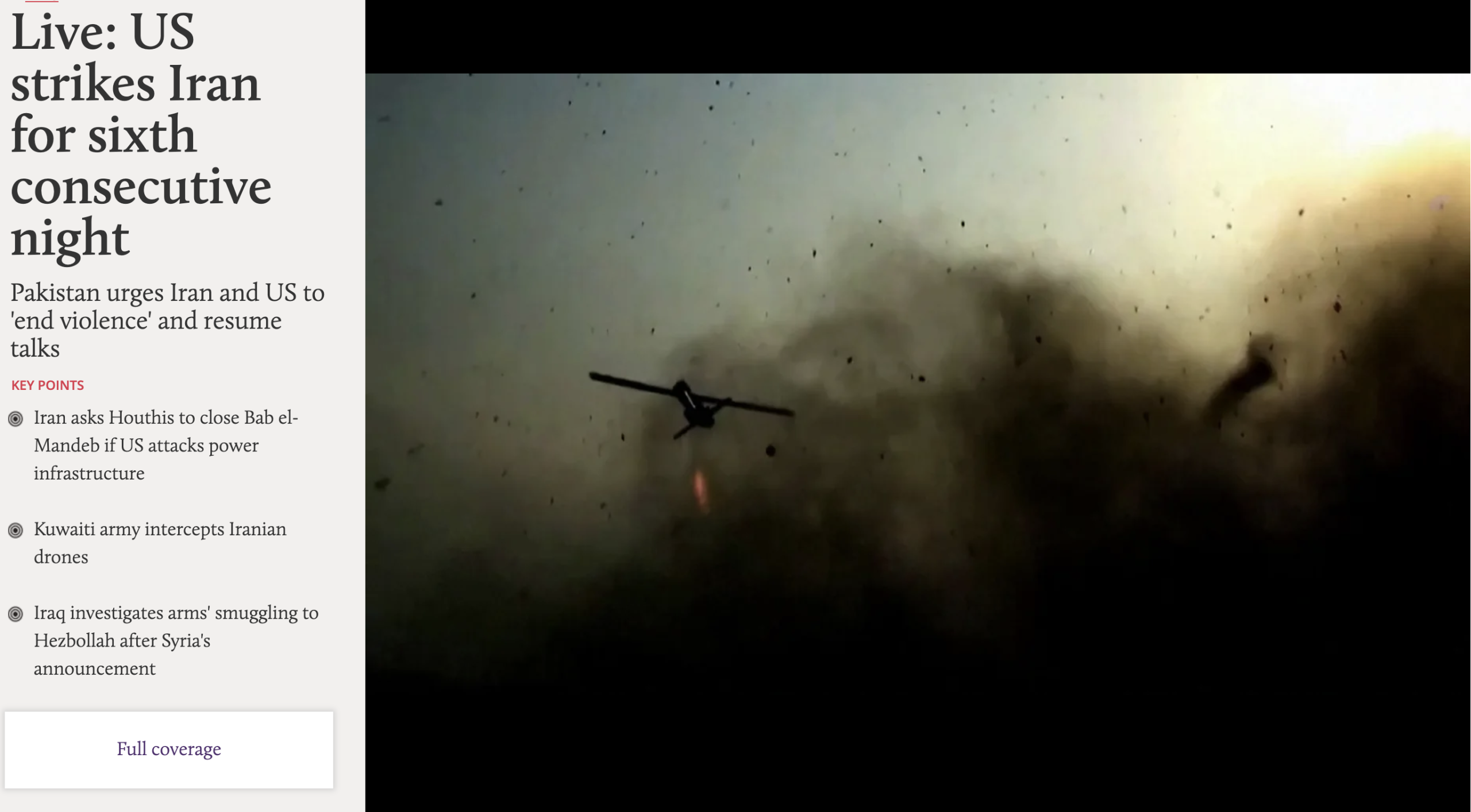
Iran has asked Yemen’s Houthi movement to stand ready to close the Red Sea oil route if the United States strikes Iranian power infrastructure, three sources told Reuters on Thursday, posing a potent new threat to global energy supplies.
The idea has been discussed within the Islamic Republic’s leadership, and the message has been conveyed to Iran’s Houthi allies, two senior Iranian sources and a regional source familiar with the matter said, speaking on condition of anonymity.
The sources said the Houthis had been informed recently of Tehran’s request, which has not been previously reported.
Aljazeera has a terrific discussion of the possible closure of the Bab el-Mandeb, including its increased importance in light of the threats against the Strait of Hormuz, the ease of Ansar Allah action and the lack of good responses, the impact on countries in the region and LNG supplies to Europe, and important technical details, such as the inability of the biggest VLCCs to use the Suez Canal.
There is the wild card of a possible tech rout. The current Bloomberg lead story is Stocks Tumble as Chipmakers Suffer Steep Losses: Markets Wrap. Yes, top AI semiconductor producer TSMC was on the casualty list. Recall that Ed Zitron has repeatedly stressed that chip manufactures are the only players in the AI space that were making real money. If they are now shown to have feet of clay, what hope is there for the sector? Oh, and SpaceX had a very bad day, see also from Bloomberg SpaceX Scrubs Launch of Starship Rocket After Engine Failure and SpaceX Post-Listing Collapse Threatens IPO Market’s AI Euphoria/. Recall when the stock market swooned after Liberation Day, the dollar did too, due to foreign investors cutting positions. A weaker dollar is likely to result in higher Treasury interest rates, as in US funding costs.
Admittedly, the level of attacks is lower than of the earlier all-out war and appears to be a sheer punishment campaign, which as we already know from Robert Pape, is destined to fail. But to use Pape’s nomenclature, Trump is not ready to accept the L. And Trump is currently on a path go far enough up the escalation ladder to trigger very very damaging retaliation from Iran.
What is disconcerting in the escalation underway is at the “playing with fire” level and no one appears ready to stage an intervention. As you’ll see below in our mainstream media updates, there is some more alarm but it appears not proportionate to the state of play. See NO1’s reading of the temperature via his daily summary:
Iran retaliates across five Gulf states after US hits civilian infrastructure— HIGH
- US ran a 6th consecutive night of strikes, openly targeting civilian infrastructure: the Bandar Khamir overpass (struck with cars on it), the Gariveh Bridge, a third Hormozgan bridge, a railway junction feeding Shahid Rajaei port, a Bandar Abbas telecom tower, and a civilian airport at Iranshahr (HormuzLetter, AryJeayBackup).
- Ground cost: 8 killed, 20 injured per ejmalrai; one killed and eight wounded in a Bandar Abbas neighbourhood (ILRedAlert); a strike near an Ahvaz cancer hospital forced 121 children off chemotherapy (AryJeayBackup).
- Iran struck back into Kuwait, Jordan, Bahrain, Qatar and Syria. Bahrain’s BAPCO refinery (~400k bbl/d) was hit and set ablaze — the clear shift from military to energy targets (HormuzLetter, DD_Geopolitics, Glenn_Diesen).
- The King Fahd Causeway (Bahrain–Saudi) was targeted — “a bridge for a bridge” (HormuzLetter, imetatronink). Al Udeid in Qatar hit by 3–4 impacts (HormuzLetter).
- Caveat on the claims: Iran’s boast of killing US special forces at Al-Tanf, Syria collides with the fact the US fully withdrew from that base in February (AMK_Mapping).
Iran hitting a Bahrain refinery as part of its retaliation is particularly significant, since it is officially putting petostate energy assets on the menu. Yet the Gulf states seem to be on board with this Trump campaign. They are the only set of actors, besides Mr. Market, that could bring him to heel, as they did with Project Freedumb and his plan to impose 20% transit fees on Strait of Hormuz traffic. but there is no evidence that they are yet trying to restrain Trump. Indeed, the UAE is acting on its own against Iran:
BREAKING: The UAE has reportedly entered the war against Iran directly, launching Yabhon Loitering kamikaze drone at Bandar Abbas in its first known use of the weapon in the conflict, per Iranian media.
A major Iranian escalation is now increasingly likely. Iran’s IRGC has… pic.twitter.com/XYEJnRVEXC
— The Hormuz Report (@HormuzReport) July 16, 2026
In addition, Netanyahu has postponed his planned trip to Washington this weekend, with it not clear he would meet Trump. Needless to say, it would further weaken Netanyahu’s re-election prospects if Trump were to refuse a visit request that Netanyahu would be certain to make.
Trita Parsi provides a very fine overview in a new talk with Mario Nawfal. Recall that even though Paris has great command of information, his analysis often skews to being unduly hopeful about a negotiated resolution. The lack of anything like that here is telling.
Key sections from Parsi a lightly cleaned-up machine-generated transcript:
This is not at the level as the full out war that we saw prior to the MOU. It is at a lower level. It is as you mentioned not Tehran, it’s mostly Southern Iran.
It is also not necessarily very strategic targets.
It frankly does look to me as if Trump just is upset, is in a bad mood and he wants Hegseth to show him daily images that something is blowing up in Iran.
And if you listen to how Trump often times talks, he’s very frustrated that people are saying that Iran won the war or that the US lost the war because he says, “Look, look what we did to their navy. Look how much we blew up.” He essentially thinks that whoever blows up the most on the other side is the winner of the war, essentially erasing the link between how a tactical success can be translated into a strategic success. All of them are just the same. Just destroy as much as possible. And of course, the US has done that in many cases and completely lost the war and in this case it’s not terribly different.
So, I do think that there is an approach here that just doesn’t seem to have a clear objective at least militarily except for thinking, “Let’s just inflict a cost and then the Iranians will back down.” And I’ll address why I don’t think that works.
But secondly, there’s also a risk of a major escalation in the coming days.
That things are not at the level where he initially wanted it to be and that may actually be because this was not thought through. This was not planned. This is part of how impulsive Trump at times can be and he’s essentially ordering, I want to see action. And then the US military has to take action even if it’s not strategically particularly thought through. Just do something while they’re figuring out, okay, what’s the larger plan? And then a week later, 10 days later, they start implementing that….then we may be looking at something much different, which actually even if the intensity of the bombing does not end up being at the same level as in March or April. It may end up nevertheless being a larger war because the likelihood of the escalation on the Houthi side, for instance, is now greater. As we talked before, the runway for this war is much shorter before the economic implications are going to be intolerable on the American side…
And I would say that it would particularly increase the risk of escalation because I am not seeing the Iranians backing down. The American assumption appears to be if we inflict a cost on the Iranians because they refuse to allow for the situation in the the strait in which they’re not in complete control or that they’re not controlling the southern part of it. That the Iranians will back down and realize that they’re better off agreeing to some sort of a compromise in which they no longer have the strait as a weapon.
But the message the Iranians are receiving is the exact opposite. That they absolutely have to control the Strait, all sides of it, in order to prevent Trump’s military plans. Because their assumption at the end of the day is that the United States is still hostile, is not reconciled, is likely to start the war again, and the more the US is bombing in order to get the Strait out of their control, the more valuable the strait will become in the eyes of the Iranians as a way of countering the United States.
Trita later highlights a point we made, about the significance of Rubio meeting with the GCC states and securing their agreement to a position tantamount to saying Iran must not control the Strait of Hormuz:
Rubio made this visit to uh the Gulf, had a meeting with the GCC countries.
Out of that came a statement that had even the Omanis signing on to a very harsh position…And then Rubio himself afterwards comes out and says, “Look, uh neither fees nor tolls are acceptable.
“The Strait has to be completely free.
Everything has to go back to what it was before February 27th, when the US itself started the war.” Is it a reasonable position?
Absolutely.I think it’s a totally reasonable position. The problem is this.
An MOU had been signed, and the MOU essentially was aimed at finding a compromise on this issue.
What Rubio then puts forward, and what he gets the GCC countries, including Oman, whose position was not this before, is to sign on to essentially no compromise, just going back to the way it was before….
It’s one of these things that you do as a poison pill that just undermines the negotiations.
Trita and Mario also discuss at length fake news circulated by Israeli media has decided to support attacks on Iran, as well as ones that Kuwait and Bahrain were going on the attack, which apparently Iran did not believe. But this shows how thick the information fog is and how readily it can be exploited.
Now to updates, staring with Middle East Eye’s live feed:

From the body:
Vessel hit 19 nautical miles away from Oman, maritime body says
A tanker was hit by an unknown projectile on Thursday while sailing about 19 nautical miles east of Oman’s Khasab, the United Kingdom Maritime Trade Operations (UKMTO) agency reported on Friday.
According to UKMTO, the crew were safe and no environmental impact was reported.
And in the “I want a pony” category:
China and Pakistan urge resumption of US-Iran peace talks
China’s Foreign Minister Wang Yi and his Pakistani counterpart Ishaq Dar urged that a ceasefire be reached between the US and Iran.
The two countries called for a resumption of dialogue between Washington and Tehran and that all parties fulfil their commitments and abide by the Memorandum of Understanding.
From Bloomberg:

From Fears Mount of US and Iran Escalation After Sixth Day of Clashes:
Concerns are growing that the US and Iran will intensify hostilities, with the sides clashing for a sixth straight day and Tehran refusing to back down over the Strait of Hormuz.
The US hit southern Iran overnight, widening the scope of its targets by striking six road bridges, according to Iranian state media. There were separate reports of attacks on the southern town of Bushehr, which houses the country’s only nuclear power plant, and the western province of Lorestan.
Iran responded by firing on US bases in Kuwait, Jordan and Bahrain — the three countries that have borne the brunt of the Islamic Republic’s counterstrikes since fighting picked up early last week — and on Oman’s As Salamah Archipelago, which sits on the strait.
Qatar, one of the main mediators between Washington and Tehran, said it intercepted incoming missiles.
Bloomberg dishes out reality a spoonful at a time in Trump Confronts Limits to US Power to Secure Strait of Hormuz:
Iran’s speedboats, missiles, drones and mines can still wreak havoc in the Strait of Hormuz, defying daily strikes from the US navy. The flow of shipping through the strait dwindles, and rising oil prices are adding to the pressure on President Donald Trump. Fully securing the strait would likely require a much larger military operation, something the White House has so far sought to avoid amid public opposition to the war.
Oddly, I have not seen much play given to the Iran strike on a Bahrain refinery. Admittedly Alexander Mercoursis stresses that refineries are hard to damage in a lasting manner. And this may have been intended to serve as a warning shot:
BREAKING: Initial reports Iran has struck the BAPCO oil refinery in Manama, Bahrain, with a large fire breaking out. pic.twitter.com/QHu8DgGImX
— The Hormuz Letter (@HormuzLetter) July 17, 2026
Jon Elmer provides more sobriety via a look at the effect of Iran attacks on uS bases. As he explains, that analysis has been made more difficult by information censorship in the form of satellite companies being pressured to publish only degraded images in theater.
CENTCOM has been flexing its blockade muscles:
U.S. Marines from the 11th Marine Expeditionary Unit conduct a verification boarding aboard M/T Wen Yao in the Gulf of Oman, July 16.
As of today, American forces have redirected 3 commercial vessels trying to run the blockade, disabled 1 that didn’t comply, and boarded 1 to… pic.twitter.com/vbjArHuLaO
— U.S. Central Command (@CENTCOM) July 16, 2026
On Netanyahu’s postponed visit, from Middle East Eye”s live feed:
Netanyahu cancels trip to the US scheduled for next week
Israeli Prime Minister Benjamin Netanyahu has cancelled a trip to the US which was scheduled for next week.
He will not travel due to the postponement of the funeral of Senator Lindsey Graham, his office said.
A day prior to the cancellation, a senior Israeli official said that Netanyahu wanted to meet Trump during the visit, but it was not yet clear if he would be able to, according to Reuters.
A White House official denied there were any meetings scheduled between Trump and Netanyahu, Axios reported.
I saw no mention of Netanyahu’s travel plans on the landing page of Times of Israel of Jerusalem Post. However, the Jeruslaem Post lead story highlighted political fracture:

In comments, reader raspberry jam described what might be the start of a severe rupture:
I don’t have time for a long, detailed update at the moment – possibly later today or tomorrow – but wanted to share a few quick updates from the last few days in Israel political events. I suggest following the Conflicts Forum weekly updates of translations of Hebrew media for the next update that will cover this past week. The last week’s entry had a very evocative title of The Netanyahu Government’s Final Days and indeed the Knesset is due to be dissolved next week in advance of elections on October 27.
The political situation in Israel continues to deteriorate. The Haredi draft exemptions have been forced through and since then further bills on gender segregation in (non-religious) schools, additional welfare for Haredim, and direct orders by sitting ministers to local police to disobey orders. The IDF has publicly come out against the sitting government’s position regarding the draft exemptions and in some statements appears to be siding with the opposition or at least against the actual government. The Haredi leader and MK is now accusing the IDF of election interference.
I think typically when the army sides against the sitting government there is extremely high likelihood of civil war however given the goverment is about to dissolve for several months it may just be posture broadcasting as the internal factions begin to fight for control in the post-Netanyahu era.
And the Telegraph provides more evidence of the Iran desire for revenge. From Trump family shown with coffins on chilling Iran billboard:

____
1 Despite the widespread recognition that aircraft carriers are big sitting duck, I doubt Iran would attack one unless it has developed the precision strike capability to punch a hole in the airstrip without sinking the ship. Iran does not want to scupper an aircraft carrier, both due to the resulting nuclear contamination and the odds that the number of deaths would produce a “rally around the flag” effect.


 By
By