
[Today’s post yet again launched before complete. Please return at 8:00 AM EDT for a final version]
The Iran war front seems deceptively quiet despite the intensification of risks and in particular, the increase in the odds of very bad outcomes. Trump’s epic flip-flopping, the Groundhog Day-ish-ness of the kinetic and negotiation dramas, and the bizarre extreme optimism among market participants seem to have been numbing. Normalcy bias means people in advanced economies expect to be subject only to the slow grind of neoliberal extraction, as opposed to the bottom dropping out. Market experts have described how more rational trader, who bet on oil price rises using highly leverage futures, have been burned so many times that they won’t try again until it is certain that a bull market dynamic for energy has really set in.
But as Nassim Nicholas Taleb has pointed out, the turkey has the most confidence the farmer is his friend the night before he is slaughtered, because it is then that he has the most observations of having been housed and fed.
More specifically, Trump is attempting to engage in a more intense escalation to force Iran to back down in some not-well articulated way, which varies between “return to the negotiating table” and “open the Strait of Hormuz.” Iran as we know well is perfectly willing to “open” it under their management. The US has launched more intense and more wide-ranging strikes, with Iran hitting back harder, including in a well-focused way on elements of logistical support for a possible ground operation. As we’ll discuss, the US has also reimposed its blockade and Trump is now threatening to engage in yet more war crimes by attacking Iran energy facilities next week if Iran does not “return to the negotiating table” which is his code for capitulation.
Yet the US, as Iran knows even if they would not put it this way, is subject to Stein’s law: “If something cannot go on forever, it will stop.” Iran knows that the US can, at most, sustain four weeks of pretty fierce bombing. The best thing that could happen to Iran would be for the US to attempt a ground operation. The US would not get a mere bloody nose but a broken jaw and teeth.
As many have pointed out, sustainment would be impossible and losses would be high. Iran might be lucky enough to get hostages.
The window for that sort of misguided operation, given temperatures and humidity in the region, would not seem to arrive until October, when it seems vanishingly unlikely that energy, particularly diesel, won’t be much pricier and even have gone into shortages by then. Economies run on diesel, not gas. Jet fuel shortages (admittedly at smaller airports) are already stating to manifest in Europe.
Keep in mind that Trump is a coward. He TACOed yet again on his loopy threat to charge 20% fees in the fantasy-land where the US got control of the Strait of Hormuz.
So in our humble opinion, the limiting factor for Trump is the oil cliff, which he has now put back into play. He will not be able to stare down a marked increase in paper oil prices. He will also have great difficulty dealing with a further rise in diesel prices and possible shortages. His team does not even remotely have the competence to devise and implement a rationing scheme.
But when might that start to bite? The very disaggregated nature of energy markets and limited data-gathering1 means there is a lot of guesstimation. How far down could the US draw the Strategic Petroleum Reserve?
The aggressive Trump posture suggests that he will get the ever-compliant Pete Hegseth to approve drawing down to the statutory minimum of 150 million barrels,2 perhaps buying Trump enough time to conceivably get to October. Many experts believe the actual minimum is higher due to damage to the salt caverns. Given current trajectories, we seem likely to test that.
Keep in mind also that the SPR is about 60% sour crude, so the drawdowns provide some relief on the diesel supply front.
Another big wild card is China. China considerately drew on its own reserves rather than buy oil in the market, even at Trump-manipulation-lowered prices. It rejected buying unsanctioned oil as unduly pricey. Now with lots of Iran oil on tankers at sea and now sanctioned, which means subject to discounts, and China also falling short of its growth targets, it seems possible that China will continue to operate to the advantage of the US, as in continue to not buy much non-Iranian oil.
Even the normal low-oil-price enthusiast Javier Blas of Bloomberg seems a tad uncertain:
Excluding any US-Iran talks about Hormuz, China remains the most important factor for oil prices for the next 60 days or so. All eyes on Beijing.
Ex-China Asian oil imports have recovered to normal levels (see 📈⤵️), within the 2023-2025 range. What China does next is crucial. pic.twitter.com/jJTUd5ZCGR
— Javier Blas (@JavierBlas) July 15, 2026
But Trump is still getting a break from China:
China’s oil imports plunged in June
Purchases fell 41% from a year earlier to their lowest level since 2016
Possible reasons:
a) China is drawing down crude stockpiles
b) It’s replacing oil with other energy sources
c) It’s consuming less energyhttps://t.co/qfmLnjPoVU— Ziad Daoud (@ZiadMDaoud) July 15, 2026
The Wall Street Journal, in The U.S. and Iran Reckon With Shrinking Options to End the War, also highlights time pressures on Trump, but following US orthodoxies, depicts Iran as having less endurance capacity than most independent media commentators believe. To put it another way, “What about ‘existential threat’ don’t you understand?” From The U.S. and Iran Reckon With Shrinking Options to End the War:
President Trump would prefer a resolution before the November midterm elections and before oil prices surge back to painful levels for Americans. Tehran is hoping it can outlast Trump before a reimposed U.S. naval blockade cripples its already reeling economy—and without provoking another large-scale American and Israeli attack aimed at toppling the Islamic government.
Each side has concluded that its best course is to resume the conflict at a low level while waiting for the other to buckle, analysts said. “It’s really about endurance now,” said Hamidreza Azizi, a visiting fellow specializing in Iran at the German Institute for International and Security Affairs.
For Tehran, the immediate task is to maintain its chokehold on the Strait of Hormuz, using its battered but still formidable array of small boats and antiship missiles to block oil tankers and other ships from exiting the Persian Gulf. Achieving such an aim would raise the pressure on Trump, as it did after the war began, but there is less time now before U.S. voters go to the polls.
For Washington, the challenge is to find a way to slip out of that knot, by degrading Iranian military sites that threaten shipping and by curtailing Iran’s oil exports from the gulf with a reimposed naval blockade. The strategy had limited success early in the conflict, but it might show better results as the toll on Iran mounts.
“Iran basically thinks that it can attack enough vessels that they’ll effectively suppress shipping in the strait,” said Rosemary Kelenic, director of the Middle East program at Defense Priorities, a Washington think tank. “Trump seems to think the U.S. has found a way to get significant quantities of oil out of Hormuz, even if the Iranians don’t cooperate.”
How often have we heard the “Russia is about to run out of missiles” storyline? A sanity check from Chamberlain’s Ghost at Twitter:
Just remember that Iran hasn’t fired a single anti-ship ballistic missile in this entire war yet, even though we know they’re in possession of a formidable arsenal of such weapons. The point is not that they are going to use one but to illustrate that they too still have formidable assets at their disposal in addition to a remaining estimated 70% or more of their missile stockpile. This escalation is not going to be a one way street.
And the Trump view on the ability to get oil out of the Gulf is deranged, even before getting to the live threat to shut down the Bab el-Mandeb strait (more on that soon) and the not-sufficiently-recognized de facto shut down of Fujairah:
Fujairah is done.
“Sinokor and MSC executives are concerned the Islamic Revolutionary Guard Corps will continue to attack their ships to try to shut down the shuttle market, said people familiar with the matter. At least two captains on their tankers have refused to go through… pic.twitter.com/DzCU5gZXJr
— HFI Research (@HFI_Research) July 15, 2026
JUST IN: Despite two U.S. aircraft carriers and with heavy air cover, the United States could not keep the Gulf’s biggest oil bypass open. Fujairah Port has effectively ceased operations, removing roughly 6 million barrels per day from the market, according to @HFI_Research .… pic.twitter.com/LGvMl1TviZ
— The Hormuz Report (@HormuzReport) July 15, 2026
With the US SPR largely drained, the temporary “surge” of escaped Strait barrels ~ absorbed, Chinese buying returning, and the Strait by any rational definition “closed”, charts like these should once again matter: pic.twitter.com/iZlIFdxjns
— Eric Nuttall (@ericnuttall) July 14, 2026
The other big issue, as Brandon Weichert treated long form in a recent Mario Nawfal interview, is Iran is not a materialistic society. The government legitimacy does not rest on delivering prosperity. It could not possibly still be standing after so many years of sanctions if that were the case.3
We’ll now go to updates, and also turn to some commentary, including the unintentionally-revealing sort.
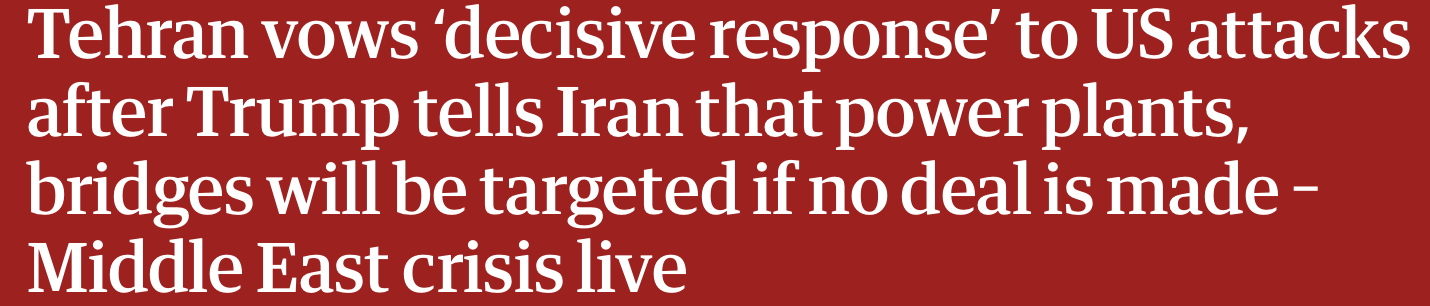
The order of the day is threat display. From the Guardian’s live blog:

To dial back a bit, recall the US blockade went live yesterday afternoon US EDT. A recap of Trump’s latest table-pounding, from Anadolu Agency in Trump says US to hit Iran’s power plants, bridges next week unless Tehran returns to talks:
US president says strikes will continue ‘until I say it’s enough,’ adds he believes Iran has ‘no choice’ but to make a deal
US President Donald Trump said Tuesday that strikes against Iran will continue and intensify in the coming days, warning that the United States will begin targeting the country’s power plants and bridges next week unless Tehran returns to the negotiating table.
“We’re hitting them very, very hard. We’re hitting every single thing that they have along the shore, along the waterfront…They’ll continue until I say it’s enough,” Trump said during an interview with Fox News.
Asked if he is considering hitting energy targets, he responded: “I’ll save the energy targets for last, but ultimately we’ll hit energy targets.”
“We’re going to hit them very hard tonight. We’re going to hit them very hard tomorrow night. We’re going to hit them very hard the night after. And then next week, it gets really bad for them, because next week comes the power plants. Next week comes the bridges. We’re going to knock out all their power plants. We’re going to knock out all their bridges unless they get to the table and negotiate,” he added.
Trump said he believes Iran has “no choice” but to make a deal, adding that US representatives were in contact with Iranian officials as recently as an hour before the interview.
“They want to make a deal…You better make a deal. You’re not going to have anybody left,” he said.
This story also includes the TACO on the 20% fee:
Trump said the US wants to keep the Strait of Hormuz open, adding: “I was going to charge a fee, but instead, they (Gulf states) would rather spend a lot of money in the United States, which frankly is better, because I don’t like the idea of a fee. It’s got to remain free because otherwise, others will do the same thing.”
“The only way you can negotiate with these people is through strength, and the only strength is military strength — and that’s what we’ve done,” he added.
“Two days ago, we had a deal, and then they broke it at the last moment,” he said.
The comments came after the US Central Command (CENTCOM) said Tuesday that American forces launched another round of strikes against Iran to “continue degrading Iranian capabilities used to attack commercial shipping in the Strait of Hormuz.”
CENTCOM later announced that the US had resumed its naval blockade of Iran, saying more than 20 US Navy warships and hundreds of military aircraft were operating across the Middle East.
Axios has duly amplified the Administration desire to appear ferocious: From The Kobeissi Letter on Twitter:
BREAKING: President Trump held a Situation Room meeting on Tuesday to discuss a “massive offensive” in Iran, per Axios.
Details include:
1. The offense will include strikes that are wider in scope than the current strikes around the Strait of Hormuz
2. Trump was joined in the Situation Room by JD Vance, Marco Rubio, Pete Hegseth, Dan Caine, John Ratcliffe, Steve Witkoff and other senior officials
3. The meeting reportedly focused on new plans for “devastating strikes on strategic targets in Iran”
Trump said Iran “better make a deal” or they are “not going to have anything left.”
Brett Erickson on Twitter argued that much could be inferred from the actions the US did or did not take, given its limited runway as described above:
The initial 24 hours of the now official US blockade will be very significant because the United States is obviously operating on a short timeline.
These are the primary actions I am watching for.
(Not cheering for, not cheering against, just… read)1) Will the United States strike Iranian vessels LOADING at oil terminals?
2) Will the United States interdict vessels OUTSIDE of the blockade line?
3) Will the United States conduct military strikes on critical Iranian economic infrastructure?
4) Will the United States strike civilian infrastructure (roads, bridges, rail lines, power plants, water infrastructure)?
5) Will the United States turn to full naval escorts along the Omani Route?
6) Will the United States conduct an AIR blockade of Iran?
I hate to single out the normally very informative Robert Pape, but this short segment below with Mario Nawfal illustrates the consequences of not knowing the limits of your knowledge. As regular readers here well know, not just military experts but also reasonably observant laypeople have described how a US attempt at a ground operation, even if we spent half a decade building up a remotely adequate sized army and munitions, would fail due to many obvious factors: Iran’s terrain, the extreme difficulty of even getting forces into theater, as well as logistical obstacles.
Below, Pape depicts a limited invasion as a somehow realistic, if high cost exercise for the US, and bizarrely depicts Iran as having difficult in dislodging US forces, as if they’d have to send in ground forces of their own to oust them. Huh? Just deny them resupply, pound them with missiles, and hunt the rest with drones:
How would American (and Trump in particular) react to Iran publishing the sort of videos of FPVs killing soldiers that have become common in Ukraine?
Pape further posits that if Iran were to engage in that sort of activity of sink a destroyer or two, that it would rally the US behind Trump and against Iran. Americans are dumb but they are not that dumb. Remember that North Vietnam actually lost the Tet Offensive, but the fact that they put the US and South Vietnamese on the back foot knocked back fading public support for the conflict even further.
Now to some detail on the kinetic action. From Aljzaeera’s live feed:
- US Central Command says it began a new round of attacks on Iran at 6am EST (13:00 GMT) to take out coastal military installations targeting commercial shipping.
- More than 30 civilians have been killed and 260 wounded in US attacks on southern Iran over the past few days, Iranian officials say.

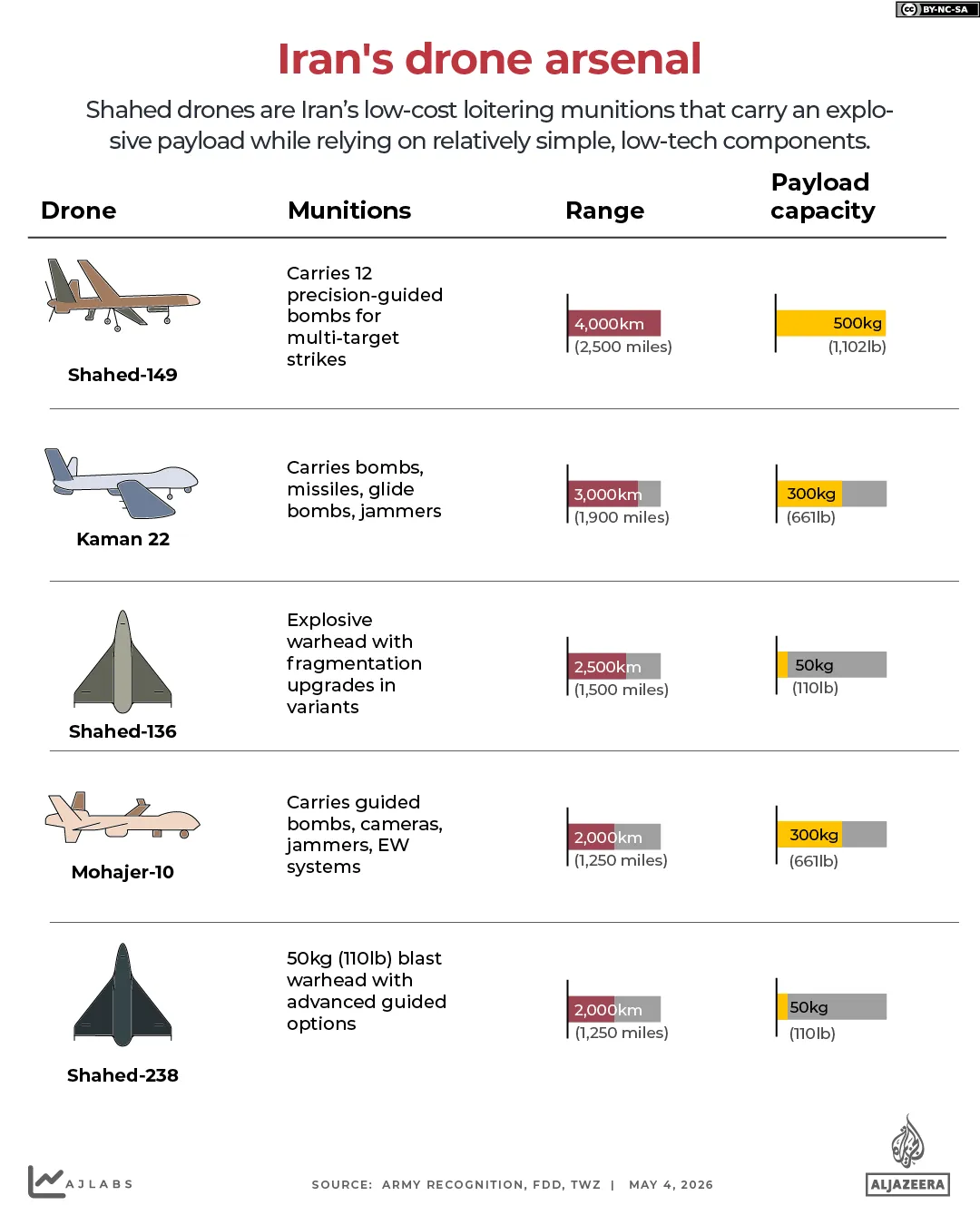
Before we continue, we feel compelled to remind readers that the idea the that US can meaningfully degrade Iran’s ability to harass and blow up ships in the Strait of Hormuz is ridiculous. Iran can (and likely soon will) mine the Oman channel. Recall from the failed great Ukraine counter-offensive that mining can be done by air. It has underwater drones. It has apparently many many speedboats stored in caves. It has drones of many sizes and varieties.
Germane recent entries from Aljazeera:
US launches wave of new air strikes on Iran: CENTCOM
The US military says it has launched a new round of daytime attacks on Iran beginning at 6am Washington, DC, time (10:00 GMT, 1:30pm Tehran time).
“The strikes are designed to further degrade military capabilities Iranian forces have used to attack commercial shipping in the Strait of Hormuz,” the US military’s Central Command (CENTCOM) said in a post.
At 6 a.m. ET today, U.S. Central Command forces began launching a wave of strikes against Iran. The strikes are designed to further degrade military capabilities Iranian forces have used to attack commercial shipping in the Strait of Hormuz.
— U.S. Central Command (@CENTCOM) July 15, 2026
Energy for all or none, says IRGC
Iran’s Islamic Revolutionary Guard Corps (IRGC) threatened to cut off all energy exports from the Middle East over the reimposition by the US of naval blockade on its ports.
“The export of oil and gas from the region will be either for everyone or for no one,” it said in a statement….
Patience with Iran over Gulf attacks ‘may fall apart very soon’
Zeidon Alkinani, founding director of the Arab Perspectives Institute, says that under-attack Gulf states face pressure on having to choose sides after the US and Israel launched the war on Iran…
“Geopolitically and strategically, it is very evident that Iran is taking this as an opportunity to have a militarised upper hand in this region and showcasing its ability to attack these countries – including ones advocating for diplomacy,” he added.
“The patience within the Gulf and the view of Iran may fall apart very soon.”
As we noted yesterday, it seems Trump-level self-destructive for the Saudis to escalate against Ansar Allah now over its small air-blockade breaking by getting one plane in and out and then a second. It isn’t hard for them to effectively close Bab el-Mandeb when merely allowing an occasional flight through and feigning incompetence in preventing it would keep things from getting out of hand. But I heard (forgive the lack of a specific YouTube citation) that MBS had actually asked Trump for a green light to mix things up with Ansar Allah, which Trump in his current escalatory mood, provided. And per Tracy Shuchart on Twitter:
keep and eye on this, this is the first time since the Houthis directly targeted Saudi Arabia since 2023 >
Houthis target Saudi airports as ballistic missiles intercepted
Saudi Arabia says air defenses intercepted missiles launched at the country’s south; reports say Houthi attacks targeted Abha airport and two air bases in retaliation for strikes on Sanaa airport (YNet)
We have pointed out that one not-sufficiently-acknowledged impediment to any sort of resolution is the rising hostility of the Gulf States to Iran. That was demonstrated by the meeting between Secretary of State Rubio and the GCC a few weeks back, when they signed a statement opposing Iran control of the Strait of Hormuz. As we said, as much as they are furious with the US, they do not want to become hostage to Iran.
From NO1:
- Targets Iran claims hit: Muwaffaq Salti, Prince Hassan and King Faisal air bases (Jordan), Ali Al-Salem and 5th Fleet-adjacent sites, Sheikh Isa (Bahrain), Al Udeid (Qatar) (Nordexium); satellite imagery of a damaged Al Udeid maintenance facility circulated (tom_bike). A Kuwaiti navy vessel was reportedly struck (MenchOsint).
- Recurring OSINT read: US Gulf bases are effectively indefensible as Patriot/PAC-3 stocks deplete — 8 interceptors vs 4 Iranian missiles, all 4 impacted (imetatronink, Pataramesh). MQ-4C Triton and P-8s pulled out of Jordan (IranObserver0). US troop withdrawal from Iraq reportedly set for Sept 30 (mutludc)
The Press TV landing page gives a high-level view of Iran actions:

An assessment of the current Iran kinetic strategy:
I disagree. Iran is conducting a systematic counter-base campaign, with front-loaded and preferential targeting of US radars. If anything, the Iranian counter-base campaign has become more effective, not less. They’ve started using jamming-resistant terminal guidance which has… https://t.co/jggcYX0xMw pic.twitter.com/I2VTBrnl2O
— Policy Tensor (@policytensor) July 14, 2026
And some interceptor shortfalls seem to confirm Iran targeting success:
JUST IN: Despite two U.S. aircraft carriers and with heavy air cover, the United States could not keep the Gulf’s biggest oil bypass open. Fujairah Port has effectively ceased operations, removing roughly 6 million barrels per day from the market, according to @HFI_Research .… pic.twitter.com/LGvMl1TviZ
— The Hormuz Report (@HormuzReport) July 15, 2026
We’ll stop here for today. See you tomorrow!
____
1 I have no idea if this is still the case, but when I worked with Japanese, they had remarkably granular economic data, such as on the sales of two burner versus four burner gas stoves.
2 The president can go down to the statutory minimum if he declares an energy emergency and the Secretary of Defense certifies that doing so would not impair national security.
3 Recall that economist Stephen Hanke, using PPP GDP per capita, has argued that that measure show the trend in average living standards, and that Iran and Saudi Arabia have been the best performers in the region since the 2008 crisis, showing almost identical, if low, growth rates. This is indirectly confirmed by Nima of Dialogue Works, who recently visited Tehran for the first time in over a decade, and said it was more prosperous.



 By
By