
[Today’s Iran war post launched before complete. Please return or refresh this page at 8:30 AM EDT for a final version]
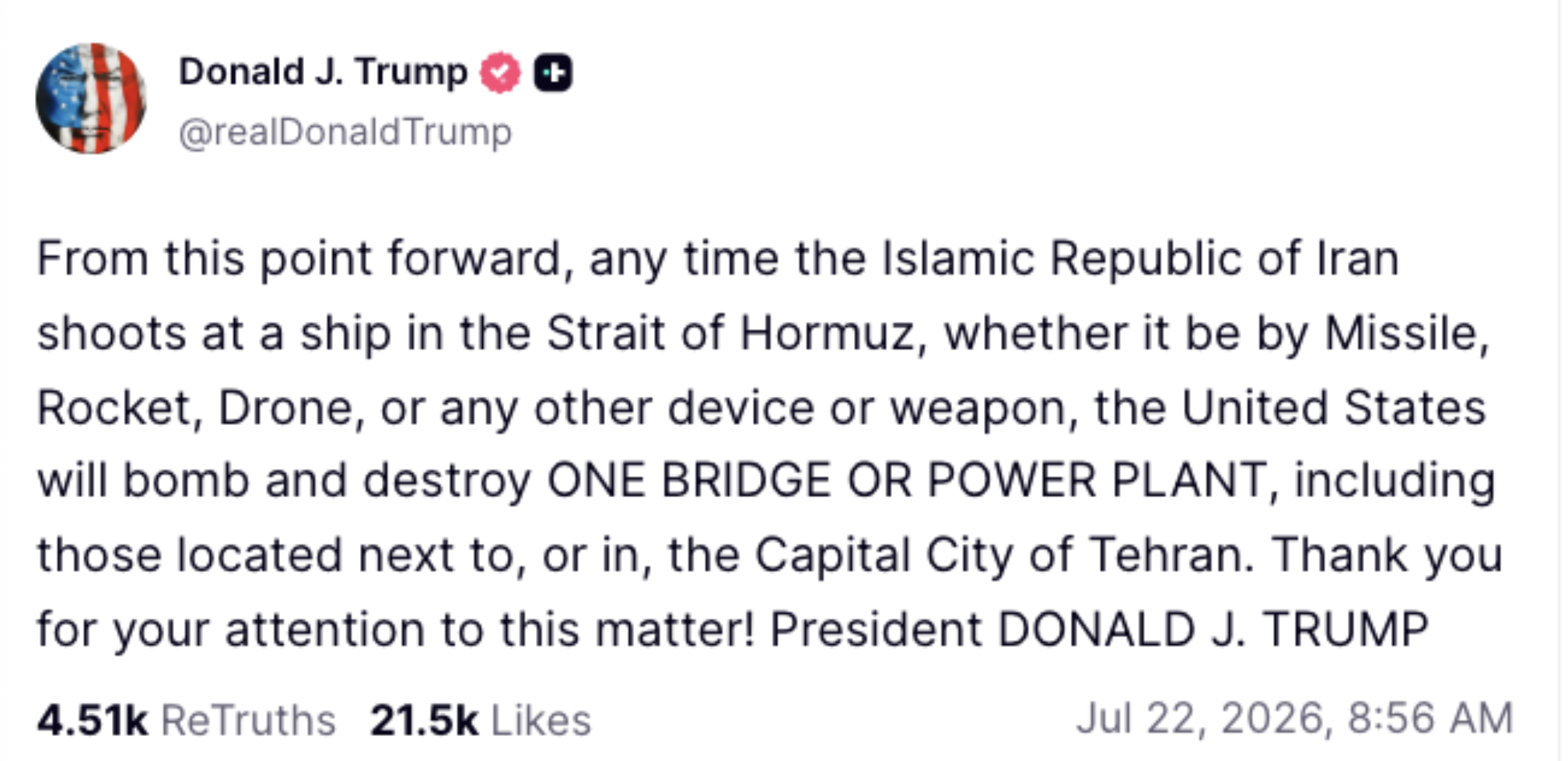
Trump continues to escalate verbally. promising yet more war crimes, as the US reportedly moves more equipment to the theater. As we will see, top Iran officials responded swiftly and tartly, promising responses that would be economically devastating. The new formulation is that if Iran cannot freely export its oil, no one from the Middle East will be able to either.
Even though many will be inclined to skip over this particular demand, which is tantamount to not simply ending the US blockade but also lifting the sanctions, which was also in the Memorandum of Understanding (MOU),1 it is inconceivable that this will actually occur. The MOU language is “terminate,” which is to reverse the underlying authorization, and not merely issue waivers that can be reversed at any time. This is yet another marker that Iran will accept nothing less than a complete US capitulation, which the US simply will not provide.
Admittedly, due to the economic devastation that will engulf the world if Iran sticks to its strong form position and pressure from China and Russia in particular, who will not be immune to fallout, Iran may relent before, as the US chest-thumpers would put it, they have finished the job. But it seems very likely that Iran will persist in its relentless destruction of US bases and assets in the Gulf environs. 2
As the US is broadcasting that it is about to make a big jump up the escalation ladder, and the daily exchanges are also at a fiercer level, press attention has weirdly fallen off, even with Ansar Allah greatly upping economic pressure via its blockade on Saudi traffic through the Red Sea. Even Mario Nawfal noted that the media is not paying much mind to these big events. Admittedly, Ansar Allah hitting two tankers did goose oil prices a bit, to $96 a barrel, and generated above-the-fold coverage in the Financial Times and Bloomberg
We’ll discuss a bit more what the US might do, and will include a debunking of the idea that Pickaxe Mountain is a nuclear enrichment site (the claims are not just that Iran is now housing enriched uranium there but also centrifuges).
First to the latest Trump and Iran threat displays:

The replies from Iranian officials came very quickly, the first from the chief negotiator MB Ghalibaf, as translated by Twitter:
The equation of this war is clear: either all or none!
In a region where we do not sell oil, no one will sell oil. If our security is not ensured, no infrastructure will be safe, and the security of the strait is in the absence of American forces. We have repeatedly said that the situation of the strait will not return to pre-war conditions.
And from Foreign Ministry spokesperson Esmaeil Baqaei on Twitter:
The repeated U.S. attacks and threats against Iran’s peaceful nuclear facilities not only constitute a flagrant violation of the core principles of the UN Charter, international law, and the relevant resolutions of the IAEA Board of Governors, General Conference, and UN Security Council, but also reveal the United States’ deep-rooted enmity toward Iran’s scientific progress and technological development.
Iran’s nuclear activities have been fully declared to the IAEA in accordance with its safeguards obligations. Washington’s obsessive focus on Kolang Kouh where no nuclear activity is taking place is nothing more than a fabricated pretext for aggression, destruction, and sabotage.
By the way, where is the Director General of the IAEA, who is also a candidate for UN Secretary-General?
The Iranian people stand resolute and united, ready to confront with full strength any act of U.S. hostility or violation of their country’s sovereignty and national security.
Iran has declared that, effective tonight, any seizure of an Iranian vessel by the United States as part of its naval blockade will be met with a retaliatory strike against a regional energy infrastructure target.
Drive gasoline price in the United States to $5 per gallon!— Mahdi Khanalizadeh (@Khanalizadeh_EN) July 22, 2026
And Iran is issuing more warnings. From Aljzaeera’s live feed:
Iran warns of ‘new strategies’ if US attacks on southern infrastructure continue
Brigadier General Amir Mohammad Akraminia, spokesman for Iran’s army, has warned that the country’s security forces will “implement new strategies and scenarios to make the war impossible for the aggressors to continue” should US attacks on Iran’s southern infrastructure persist.
“Following the American side’s violation of the memorandum of understanding, we are now witnessing a new phase in the war,” he told Iran’s Defence Press news agency in an interview.
Akraminia said Iran’s armed forces were carrying out retaliatory strikes in response to what he described as US aggression, adding that such operations “will continue as long as US attacks against the country’s infrastructure and coastal areas persist”.
There is finally a bit of alarm about the intensification of the energy squeeze due to Ansar Allah choking the Saudi supply through Yanbu port which is now reported to be 4.9 million barrels a day. The lead story at the Financial Times:

From the article:
In a statement on its Al-Masirah television channel on Thursday, a spokesperson for the Yemeni group said it used missiles and drones to target the ships Encelia and Layla, accusing them of violating its embargo of the Red Sea.
The Houthis warned this week that they were imposing a maritime blockade on the kingdom as they threatened to reignite a decade-long war with Saudi Arabia.
Saudi state news agency quoted an official confirming that one of the tankers, the Encelia, was targeted, resulting in a fire at the bow of the vessel. It said the crew was safe….
Several tankers carrying Saudi crude through the Red Sea had turned around this week as the Houthis broadcast radio warnings to ships.

From Bloomberg’s landing page:

From Houthis Open New Front in Iran War by Targeting Ships in Red Sea:
Washington carried out its 12th consecutive day of airstrikes on Iranian military sites overnight, including missile and air-defense facilities. Iran again fired upon US bases and military sites in Kuwait and Jordan.
The skirmishes show little sign of easing, with neither the US nor Iran backing down or saying it’s time for new negotiations. The attacks by the Houthis have escalated the conflict further, even if hostilities remain less intense than during the height of the war in March and early April.
The Red Sea has emerged as a vital workaround for crude exports, particularly from Saudi Arabia. The port of Yanbu became the main outlet for Saudi oil exports, allowing it to bypass the Strait of Hormuz, through which hardly any vessels are sailing.

Bloomberg highlighted a video on its landing page that sounded a further cautionary note.

From the transcript of Oil Market Is ‘Out of Buffers’: McNally. McNally argues that what he calls Round 2 of the conflict is set to be worse that Round 1, that the world will be lucky if Ansar Allah does not destroy the Yanbu terminal, which is within their ability. He anticipates that the loss of buffers and the uptick in Chinese demand (how much how soon is a big wild card), will lead to oil prices in the $100 to $110 range in a few weeks. He adds:
As we sit here today, even at $94.00 Brent, there’s enormous optimism in the price. One of the distinctive features of this whole thing has been an entrenched optimism among traders. Look at equities haven’t even looked back since early April. And I think that optimism is unwarranted and I think that bubble could burst. And if so, we’re going to reprice much higher, I’m afraid….
And my colleagues on the refining side and the oil analysis side pointed out that when you run your refineries hot and we have been utilization rates at 95% persistently over and over again. I mean you delay maintenance, you choose to run that refinery. And but at some point these refineries need work. They need downtime and repairs and things. And as we get into the fall, we’re going to need to do that work at the same time. These margins are going to be great. And then comes the risk of storms, unplanned outages. And we do see it’s about 5 to 600,000 barrels a day refining capacity is at risk of to unplanned outages when you’ve you’ve sort of driven your refineries so hard for so long. So it is a, it is a precarious thing.
The key point is not that McNally said anything earth-shaking but that Bloomberg gave his views prominent play.
However, as far as US buffers are concerned, we had opined recently that the US could go below the 250 to 300 million barrels to 150 million, since the President and Secretary of Defense could issue waivers to allow the US to use reserves that are normally required to be held back for bona fide emergencies, like monster hurricanes and wars of non-choice. DropSite reports that the US plans to go even lower that we has posited:
U.S. DOE claims that petroleum reserve can run far lower than previously estimated: A spokesperson for the U.S. Department of Energy told MarketWatch on Tuesday that the U.S. Strategic Petroleum Reserve’s “true operational minimum” is roughly 70 million barrels, well under the 250 to 300 million barrels the oil industry has generally treated as the practical limit.
The SPR, which has drained to its lowest level in 40 years, has roughly 246 barrels remaining for emergencies, the DOE claimed. It has shed more than 104 million barrels since the beginning of the U.S. war on Iran.
On the kinetic war front, Douglas Macgregor, in his world-weary mien, discusses with Mario Nawfal the escalation ideas that the war hawks are selling hard on Fox News. He believe Trump will continue in off again, on again mode until either military limitations or the state of the markets force him to relent:
[I will provide key sections from a machine generated transcript when I return]
Janta Ka’s new update includes a short section on why the US depiction of Pickaxe Mountain as a nuclear site is bogus.
From a lightly-edited machine transcript:
Jawaid: The only intention behind this is for Israeli slave Trump to use nuclear weapons against Iran since there is absolutely no other way to penetrate the Pickaxe mountain.
CNN [Wolf Blitzer]; Let’s begin with this latest report of Iran moving its advanced centrifuges and
enriched uranium to this new underground fortified site. How concerning is that?Brett McGurk, former National Security Council: If that’s true, Wolf, that’s deeply uh deeply concerning. This is this site is called Pickaxe x Mountain. It’s near Natanz and it is you remember Fordow from last summer which uh US military forces very effectively struck. Pickax Mountain is deeper and kind of more complex. We saw them building this site when I was in my position in the White House.
[We] obviously raised a lot of questions about it. Very clear what it’s for., it’s for just this enriching uranium and getting the threshold of of weaponization. if they were able to move cascades of centrifuges into that site uh and if those centrifuges are spinning that’s deeply concerning and would be a new uh element that we didn’t fully know about because one assumption has been well since the operation last June uh that the nuclear program more or less has been set back significantly. So I’d want to learn more.
Jawaid: Thankfully there are some nore voices in the US pushing back on this nonsensical claim.
CNN, Robert Kelly, former chief nuclear inspect in Iraq: I think the first thing you need to look at is the Israeli intelligence is not intelligence. It’s the third of leaks that have been put off for the last two weeks that are designed to confuse.
So don’t mix up this as and calling it intelligence. It is something is put forward to try to mislead us.
Pickaxe has been known for years. If you look at Pickaxe, you’ll see a a lack of things that should be there. It’s not connected to the previous enrichment site which is only a few kilometers away. It doesn’t have the right indications like it doesn’t have enough electricity. It doesn’t have a cooling system there and and it has these trucks going in and out which you wouldn’t have if you have a sensitive centrifuge plant in there.
But if you want to really really see where this comes from, we’ve been told now for weeks that the US has satellite imagery that would tell us if the stockpile of enriched uranium was being moved. And that stockpile is a couple dozen small cylinders about the size of a fire extinguisher. So we know that they can’t move this around because we’ve been told that. And now suddenly Israel tells us that thousands of centrifuges which were much much bigger and would require an awful lot of effort. Thousands of centrifuges have been moved and we missed it.
After a ritual beating of Pete Hegseth, the House gave the Pentagon $1.5 trillion and Israel the keys to the house. The procedural issue in the Senate are different so it is remotely possible it will stay stalled there. Nevertheless:
Unfortunately, the House just voted to merge the most secretive & sensitive elements of our defense & intelligence apparatus with a foreign government.
This bill still has to clear the Senate.
Call your senators & representatives and tell them to not support the NDAA until the… https://t.co/32IS8zX8hx
— Joe Kent (@joekent16jan19) July 22, 2026
For additional grist for letters and calls to your Senators, former Lieutenant Colonel Karen Kwaitkowski is blistering:
From a lightly-edited machine transcript:
Weichert: So Karen, um what does this mean? Is Israel now the 51st state or what are we doing here?
Kwaitkowski: Yeah. No, is Israel is Washington. They don’t even need to compete with the other 50 states because the other 50 states don’t have anything to say about it. Clearly, the House,
Weichert: They didn’t debate this.
Kwaitkowski: They didn’t talk about it. And you know, it’s bad enough that we’re fusing our military with the IDF. As as we were talking, a poorly trained organization that does not share American values in any way, shape, or form. They are an army of, I mean if you can think of the worst ICE agent disaster where a guy like went into a crowd and started shooting, didn’t know what they were doing ,all masked up, of course then that would be that’s the IDF. Why would we want to fuse with that? This is what we’re trying to get rid of in our military.
We want to have a military that is highly professional, extremely welltrained, extremely um uh you know functional in whatever that we need to ask them to do. And of course obviously the military is not ICE military should not be operating. It doesn’t have a warrant to operate on American soil. But > I’m sure that’s coming….
But also, they voted for 1.15 trillion. This massive massive amount of money.
This is on top of the beg that Hegseth has for all the money he spent already on this Iran war which they went into with the American people opposed it 70% opposition the Congress opposed it for the most part but never addressed it.
Okay. Never approved it. And then Trump miraculously ended it be right before the 60-day period [when the War Powers Act authorization ended]
Due to this post getting to be a bit long, forgive us for one-stop shopping on the Trump-Saudi nuclear pact, via Trita Parsi’s new post, The US-Saudi nuclear deal makes no sense. Key sections:
A few points on the shocking U.S.–Saudi nuclear deal announced.
1. This reflects a weaker American bargaining position, not a stronger one.
The broader context is China. The Biden administration pursued a nuclear deal with Saudi Arabia, as part of a broader expansion of Trump’s Abraham Accords, in part to pull Riyadh closer to Washington and away from Beijing. But Washington’s position has deteriorated since then. The credibility of the U.S. security umbrella has weakened, GCC states have become more strategically autonomous, and Saudi Arabia has gained leverage by diversifying its partnerships.
The result appears to be that Washington had to offer substantially more to try to keep Saudi from drifting further toward China, while getting substantially less in return.
2. By any historical standard, this is an extraordinary Saudi victory.
Compared to previous negotiations, Riyadh has secured remarkable concessions. It no longer appears to have to normalize relations with Israel as part of the package. It is reportedly not required to sign a traditional Section 123 agreement that would deprive KSA of enrichment technology. And there are no comprehensive IAEA safeguards comparable to those Washington has long insisted upon elsewhere.
If these reports hold, Saudi Arabia has achieved what few thought Washington would ever accept….
4. This may prove a stepping stone toward an even greater disaster: Security Guarantees for Saudi
As Rosemary Kelanic points out, this deal provides Riyadh with leverage it can use in the future to force Washington to provide it with security guarantees. Saudi Arabia can threaten to build nuclear weapons unless the U.S. offers it Article 5-level security guarantees….
5. This likely weakens Washington’s negotiating position with Iran.
….It becomes impossible to argue that Saudi Arabia may enrich uranium while Iran cannot, although Tehran was never going to accept zero enrichment in the first place. But proposals that earlier had been entertained – such as a 5- to 10-year moratorium on enrichment – may now also be out of reach.
Moreover, and perhaps more importantly, it becomes harder to insist on intrusive international inspections for Iran while accepting a far lighter non-IAEA inspection regime for Saudi Arabia. And it becomes much more difficult to portray enrichment itself as an unacceptable proliferation risk.
So much for Trump as a consummate deal maker…
More kinetic updates, this one from Aljazeera’s live feed:
Iran claims more attacks on Jordan
Iran’s Islamic Revolutionary Guard Corps (IRGC) claimed attacks on US assets in Jordan, saying it has “destroyed a radar of the American THAAD missile defense system with lightning strikes”.
It said a “Patriot system and a C-RAM radar were also targeted and destroyed, and the fuel tanks of the American base were set on fire”.
It added that “a large helicopter equipment warehouse and a helicopter repair and maintenance shed were also set on fire and destroyed”….
Earlier, the IRGC also claimed attacks on US military assets in Kuwait.
And some tidbits:
👀 These are the kinds of little details that speak volumes about what has really been happening in the US war against Iran. https://t.co/z4i7MY1nEF
— Will Schryver (@imetatronink) July 22, 2026
______
1 Paragraph seven:
The United States of America undertakes to terminate all types of sanctions against the Islamic Republic of Iran, including the United Nations Security Council resolutions, IAEA Board of Governors resolutions, and all unilateral US sanctions, primary and secondary, in an agreed upon schedule as part of the final deal. The Islamic Republic of Iran and the United States of America acknowledge the critical importance of the sanctions termination issue above mentioned, and expressed their intentions to immediately address these issues in the negotiations in order to achieve mutual agreement on them.
2 If only the US would learn from cats. Iran would accept some form of the US slinking away:
From comments: “I love how cats always trashtalk before fighting.”


 By
By