
This is Naked Capitalism fundraising week. 1284 donors have already invested in our efforts to combat corruption and predatory conduct, particularly in the financial realm. Please join us and participate via our donation page, which shows how to give via check, credit card, debit card, PayPal, Clover, or Wise. Read about why we’re doing this fundraiser, what we’ve accomplished in the last year, and our current goal: more original reporting.
[Today’s Iran war post launched before complete because reasons. Please return at 8:00 AM EDT for a final version]
The main kinetic action in the Iran and related Yemen conflicts are in Yemen, as the Saudi-backed government announced a campaign to retake terrain seized by Ansar Allah. Again, it is important to stress that the putative “internationally recognized government” represents a minority of the population and does not control the capital. Because the new news with respect to Iran is mainly of the diplomatic and posturing sort, we thought we’d turn to the debate over oil transits and related economic issues. Many are perplexed to see Iran having shifted from its posture of saying it would drive events and not be put in the position of reacting to the US, as well as saying it controlled the Strait of Hormuz even as oil is transiting on the Oman side under US escort. Many have defaulted to ad hominem attacks on data providers when as we will see soon, independent oil analysts object to this reaction. But as we will see, the matter of control is more complicated than one might think on a first pass.
Let me pause and thank the many many generally extremely supportive reader comments after I posted a somewhat frustrated note which keyed off the view of established reader Expat2Uruguay, that the comments quality had declined and some of the posts were too -insider-y. We are in the midst of particularly intense information overload, in no small measure due to propagandizing and even attacks on those who refuse to truck in the official story-line (just look at the treatment of Jacques Baud, George Galloway, and now Ian Proud for some of many examples). That extends not just to the Iran and Ukraine wars but AI and domestic politics in many nations. This can be very stressful to watch and even more so if you are personally exposed as most are, if nothing else to rising food and fuel costs.
hile we aspire to having readers provide their information, analysis, and views (and correct our errors!) to enrich our collective understanding, sometimes taking it all in is all the bandwidth that many have. So we do appreciate your readership even if you don’t have the inclination or time now to weigh in.
As for Expat2Urugay’s additional observation, that much of the discussion had become too insider-y to follow, I am not sure what to do. Blogs are more telegraphic; it would be normal to say “Bessent” as opposed to “US Treasury Secretary Scott Bessent” and to assume readers were current on jargon often invoked elsewhere, like MEU = Marine Expeditionary Unit. I intend to unpack specialist terminology more often.
The Guardian provides a solid high-level overview of the Yemeni government operation, and even in its headline signals the Saudi influence. From Yemen’s Saudi-backed government launches military drive to retake all Houthi-held territory. The subhead signals the importance of Ansar Allah cutting the road to Taiz:
The announcement came hours after Iranian-backed Houthis reportedly cut a vital supply route to besieged city of Taiz…
Yemen’s Saudi-backed government has announced the start of a new military operation to retake all territory held by the Houthis, even as the militant group made fresh gains on the ground, reportedly encircling a government-held city…
The announcement sets an ambitious goal for the embattled government, which recently lost swathes of the country’s Red Sea coastline and areas around the Bab al-Mandab strait – a chokepoint for international shipping – after a lightning offensive by the Iran-backed Houthis.
Yemen’s internationally recognised government has struggled to roll back the surge, even with the military support of Saudi Arabia. The Houthis have increasingly targeted Saudi Arabia in recent weeks, and on Sunday said they had attacked oil infrastructure in the capital again.
The statement came just hours after the Houthis cut a vital supply route linking the besieged city of Taiz with the government’s interim capital, Aden, according to four security sources.
The Houthi advance followed days of heavy fighting in and around the city.
“We were informed that the Houthis had taken control of the al-Safiya area, where they cut the main road and took control of the police station,” a police source in the area said.
Three sources with the Yemeni military also confirmed Houthi control over the area and the supply route, with traffic along the road halted and the group now surrounding Taiz city. Fighting in the area was ongoing, they added.
Sources from both sides told AFP on Sunday that fighting in and around the western province of Taiz had killed more than 70 people over the past day.
Some Twitter assessments are more straightforward:
MAJOR BREAKING: The Yemeni President has just announced that the Yemeni Armed Forces will begin operations to effectively wage all-out war against Ansar Allah (Houthis).
The current Yemeni government is heavily backed by Saudi Arabia, and as a result, this will almost certainly be viewed as an escalation of war by Saudi Arabia as well by Ansar Allah.
This is EXTREMELY significant because Ansar Allah has made extraordinary geographic and strategic gains in Yemen over recent weeks, with their now effective control over the Bab al-Mandeb being their most significant.
Beyond this however, Ansar Allah has been consistently retaliating against Saudi Arabian escalations by targeting Saudi energy infrastructure, as well as multiple strikes into the Saudi capital of Riyadh.
This could get VERY out of control…
— Brett Erickson (@BrettErickson28) October 4, 2026
And:
Saudi Arabia’s High-Stakes Gamble in Yemen
The announcement of a Saudi-backed Yemeni counteroffensive comes at a particularly dangerous moment.
The Houthis are not only continuing their attacks on strategic infrastructure in the Saudi capital; their forces are also advancing from Taiz and threatening the routes leading toward Aden.
It increasingly appears that Riyadh has concluded that the diplomatic track has reached its limits, or, more precisely, that continuing down that path would require concessions the Saudis are unwilling to make.
Saudi Arabia is therefore making a major strategic gamble: betting on an advance by its Yemeni partners, backed by a significant air campaign, American intelligence support, and European assistance in protecting critical Saudi infrastructure.
This could become a turning point in the war. A successful counteroffensive could significantly alter the military balance and put the Houthis under pressure they have not faced in years.
But the risks are equally significant. Given the weaknesses and fragmentation of the Saudi-aligned forces in Yemen, a failed offensive could produce the opposite result: a military collapse that threatens the remaining strongholds of Saudi influence in the country.
Yemen may therefore be entering a decisive phase. What happens in the coming weeks could reshape not only the battlefield, but the Saudi-Houthi confrontation for years to come. Riyadh is taking an enormous gamble, and the consequences of failure could be as significant as the potential rewards of success.
#IranWar
#yemen— Danny (Dennis) Citrinowicz ,داني سيترينوفيتش (@citrinowicz) October 4, 2026
Curiously, Middle East Eye’s landing page does not have any Iran or Yemen front stories above the fold. a fresh entry from its live coverage Yemeni government forces claim over 1,120 attacks against Houthi positions:
The spokesperson for Yemen’s government-aligned forces said that 1,122 attacks were carried out against Houthi targets, claiming that around 1,747 of the group’s fighters were killed. Majid Abdullah Al-Nuzaili indicated that the operations took place in Saada, al-Jawf, Taiz and the country’s coast, and were conducted using warplanes, drones, missiles, rockets, artillery and snipers.
In other words, a one-sided account. Aljazeera is already warning that any campaign is not likely to show a quick success:
Yemeni government forces’ battle against Houthis could take ‘years’
The military operation by the internationally recognised government of Yemen to retake territory held by the Houthis will be long and difficult, a defence analyst says.
“All signs are pointing towards a long battle,” said Baraa Shiban, associate fellow in international security at the Royal United Services Institute.
“We might be witnessing yet another round of years of conflict inside Yemen. And, unfortunately, it’s the Yemeni public who are going to bear the brunt of this escalation,” he told Al Jazeera from Istanbul.
While some suggest the operation will wrap up quickly, Shiban said the reality is otherwise. “I don’t think it’s going to be an easy and quick operation. We might be looking into years.”
The already long-running conflict also points towards a failure of the international community, which despite a ceasefire in 2022 has been unable to achieve any breakthrough towards a lasting peace, he added.
“The UN envoy to Yemen hasn’t been able to meet the Houthis for more than two years now, so it’s a failure on all levels – of course, internally but also for the mediators and international community.”
The failure to mention Ansar Allah’s ability to damage Saudi energy infrastructure is curious, as in not acknowledging that the “internationally recognized government” is largely a cat’s paw for the Saudis.
Speaking of damage to Saudi assets:
BREAKING: Yemen’s Houthis now appear to have hit Saudi Arabia’s East West oil pipeline for the second time in weeks, with Pumping Station No. 2 east of Riyadh showing major signs of a fire and a massive smoke plume visible over the facility.
The 1,200 km pipeline was shut on September 11 after earlier drone strikes damaged pumping stations in the Riyadh and Madinah regions, which Saudi Arabia blamed on drones launched from Iraq. It only partially restarted on September 22 at roughly 3.5 million barrels per day, around half its capacity.
NASA FIRMS detected four thermal anomalies at the station, with fire radiative power reaching 88 megawatts and one reading hitting 367 Kelvin.
The pipeline can carry up to 7 million barrels of crude per day to Yanbu on the Red Sea, allowing Saudi Arabia to bypass the Strait of Hormuz. Another disruption could again threaten crude flows through the alternative route.
— The Hormuz Report (@HormuzReport) October 4, 2026
And a fresher tweet (note HFI Research retweeted and they are pretty careful):
🚨 Saudi Arabia’s East-West oil pipeline appears to have been hit again!
New satellite imagery from Oct 4 shows smoke stretching 50km from Pumping Station No. 2 east of Riyadh.
The pipeline had only recently begun recovering from September attacks.
Explore and Compare: https://t.co/nZ1W23J2df
#SaudiArabia #MiddleEast #Oil
— Soar Atlas (@SoarAtlas) October 5, 2026
The Aljazeera live feed also reports that the members of Mecca Joint Defense agreement are meeting in Saudi Arabia, but I would not expect more than small gestures from Pakistan and Turkiye.
Iraq just pushed two million barrels of its own crude through the Strait of Hormuz, the first time in decades. It used a state-owned tanker, and right now that is the only kind of ship crossing at all.
As I have said repeatedly, the private market has pulled out its tankers from risk in the Strait of Hormuz. Tankers are being hit near Oman, war-risk insurance is no longer possible or too costly (if at all possible), and a single run can cost more than a million dollars a day.
No company board of directors can lawfully send a crew and a cargo worth hundreds of millions into a shooting gallery it cannot insure. The only ships still moving are the ones a government owns and is willing to lose.
Iraq gets the other half of it too. A state tanker is a sovereign asset, and Baghdad is close enough to Tehran to get its ships waved through perhaps without getting hit by missiles or drones but this does not stop false flag operations from hitting its ships.
In this strait the only cover that still works is political, and every Gulf exporter that can make that call will soon be doing the same…
Signal, not noise!
— AJ Signal (@aj_geo_analysis) October 4, 2026
Now to the debate over Persian Gulf energy transits. This has been occurring mainly on Twitter and YouTube, so bear with the sourcing. I have to confess to having a reflexive reaction, namely, that some of those who have been arguing that there has not been an increase have relied heavily on ad hominem attacks. Yes, no one should believe what the Trump Administration has been saying. Commentators have pointed out that US officials have been taking outflows on peak days and treating that as steady state, when the nature of the US operation had been to herd ships through in bunches. And there has also been ample doubt about the US assertion that no Iran oil has gotten out. I cannot corroborate it, but that claim seems to be based at best by an absence of tanker-loading at Kharg Island, when Iran has other loading points on its south coast, in addition to being able to truck oil into Iraq and have it exit as Iraqi crude. Some have additionally suggested that Iran could even be operating on a credit system, as in sending oil to certain countries and having them ship out similar amounts, as opposed to on-routing the actual crude sent in.
Keep in mind also that Iran got enough oil out during the post-MOU sanctions-suspension window, and at very good prices, that it appears to have secured enough revenue then to fund the government through March 2027, even assuming no more oil sales.
The big argument (as from ad hom) made by the “more oil transit” skeptics is that oil prices should have fallen more were that so. Oddly they forget the argument repeatedly made by Administration critics, that even if the conflict were to end today, it would take months (as in well over four, even up to a year) to get shipping unsnarled and risk-averse operators confident enough to move towards a semblance of the old normal. And more specifically, any additional oil departing the Gulf still has a long-ish trip before it gets to refineries.
Some have pointed to the high price of dated Brent to support the notion that not much in the way of additional oil is leaving the Gulf:
If Hormuz is ‘opened’ I hope someone told the oil traders.
Physical Brent (Dated) continues super strong for all cargoes trading next week.
You can hedge it but may have to pay almost $22 over December futures!
AALPHA MARKS 02/10/26 0745 BST
CFDs:
05-09/10 Dec 2180— Adi Imsirovic (@AdiSurreyEnergy) October 2, 2026
However:
IRAN WAR: I want to reiterate one thing that I think many will find unpopular. I don’t care.
There IS a very significant amount of oil that the United States was moving out of the Strait of Hormuz. This has been repeatedly and consistent cross-corroborated by companies AND independent experts. To refute this is to selectively apply data as it suits your narrative.
I ALSO believe that the recent “20M bpd”/“96%” figure was curated from a high water point selection of data that is NOT SUSTAINABLE, and we will likely see a significant drop off in the coming weeks.
It should also be noted that CLEARLY Iran can still strike vessels (9 in the last 5 days), and as a result, can very obviously escalate across the Gulf if need be.
But you can’t just selectively apply data when it is consistently cross-validated by both companies and independent experts.
Be objective.
— Brett Erickson (@BrettErickson28) October 4, 2026
Johnson, like Erickson, has consistently argued that paper oil prices are below those in the physical market and has offered explanations as to why:
for anyone following the oil market for more than the past few months, it’s *very* funny seeing people start to say that observed data (Kpler/Vortexa/satellite imagery) is manipulated and for proof we should look at the *implied* estimates from IEA/EIA/Chinese government data 😂 https://t.co/beRZCx7aOL
— Rory Johnston (@Rory_Johnston) October 3, 2026
This tweet does a fine job of squaring the circle:
I have been trying to reiterate this message to the OIL IS FLOWING NEAR PRE-WAR LEVELS, IRAN HAS LOST CONTROL crowd for a few weeks now.
You could be getting 100% of the pre-war flow out of the Persian Gulf and it could not possibly matter less for the price of crude because as long as ships are consistently getting hit, the baked in cost to move that oil is going to be astronomical.
Freight rates for crude used to be 2-3% of the delivered cost, it is now approaching 30%. That is simply not sustainable for the industry and it will continue rising as the pace and success rate of Iranian attacks on shipping increases.
Iran is not losing control of the Strait, it is loosening its grip. They still retain ample capacity to strengthen that grip as needed, as we saw this week with a big jump in attacks and reduction in exports from the week prior.
What does that mean going forward? Nothing good. The US Navy is still too terrified of Iranian anti-ship capabilities to put destroyers anywhere near the Strait and without a physical naval escort presence, Iran will continue to have enough success with these attacks to keep freight rates astronomically high and like usual, that cost is going to be passed on to the consumer.
It is going to get worse before it gets better. I would not be surprised if Brent opens over $103 tomorrow unless we get a heavy dose of Sunday Market Manipulation from the administration.
— Matt Burnell (@mdburnell) October 4, 2026
🇾🇪 As Ansarallah presses into Al-Turbah, Yemen’s Saudi-backed government has announced a new military campaign to retake territory and “end the coup.”
Michigan State University professor Shireen Al-Adeimi explains why Taiz is now a crucial front. The province connects Yemen’s historic north and south to its western coast, while the Aden-Taiz road is the Saudi-led coalition’s only remaining route into northern Yemen.
“Whoever controls that road really has a very strong position,” Al-Adeimi says, calling its potential capture “probably as significant as the takeover of Bab al-Mandeb.”
Ansarallah’s advance follows its capture of Mocha and the Bab al-Mandeb Strait, which gave its forces higher ground overlooking Taiz. Al-Adeimi says recapturing the western coast, or Taiz itself, would be extremely difficult for Saudi-backed forces.
🎥 @shireen818 speaking with Adnan Husain (YouTube). More from Drop Site News below.
— Drop Site (@DropSiteNews) October 4, 2026
Again, forgive me for outsourcing this particular discussion to Twitter but these particularly tweets do a fine job of summing up key issues.
Trita Parsi, in a new article, more firmly states a view he has taken before, that Iran is allowing more oil to exit because it is collecting fees. From Yes, more oil is flowing through the Strait. And here’s why Iran may want it that way:
I cannot verify whether this is true or not, but I have heard directly from the Iranian side that certain countries in the GCC have struck deals with Iran to allow for their oil to get out, and that this is the main reason why more traffic is flowing rather than the Trump administration’s military efforts. “Whatever flows through the Strait, it’s because we are allowing it to flow,” I have been told.
One can dismiss the Iranian account as a desperate effort to claim control over a situation that on the surface is moving against Iranian interest.
But there may also be a logic that explains why Iran would not only allow more oil to flow, but also a narrative in the West that claims Tehran has lost the battle over the Strait.
As Brohard attests in her interview, the current situation in the Strait is unsustainable. As a U.S. serviceperson in the region told me, the cost of U.S. escorts is enormous and simply cannot be sustained. Whatever the cost the U.S. shouldered for keeping Persian Gulf oil secure before the war, it is dramatically higher now – even though the U.S. itself doesn’t buy any of that oil. China does.
Thus, not only was the U.S. subsidizing Chinese oil imports before the war, but those subsidies have increased severalfold as a result of the war.
It is also unsustainable for these GCC countries to continue to buy Iran off. They are doing so because the region expects a third round of the war to begin in the next few weeks and as a result, they need to move as much oil as possible out of the Persian Gulf before hostilities resume
Again, your humble blogger has no way of verifying any of this but the takes above seem more grounded than the too-frequent knee-jerk dismissals of the idea that more oil is exiting the Gulf.
And again remember: the sounder averages, of 8 to 12 million barrels a day, is still below pre war averages. The world is still petroleum-starved and using inventories to fill the gap, even if at a less rapid pace than a month ago.
Briefly because my regular Internet connection has been down for days and is no closer to being fixed than before. There is way way way too much talk of a Treasury market breakdown. FFS, a bear market is not a rout. When I started at Goldman, I worked on corporate bond deals that sold at coupons of 13% to >15%. The markets were functioning fine even if the prices were ugly.
More detail from Rob Urie by e-mail (spreadsheet not reproduced here):
What I see illustrated in the press is the rise in rates since 2020. That is 1) over a six year period, not exactly what I would call a panic, and 2) from an actual social emergency (Covid) when rates should have been low (all else equal) to an inflationary environment when rates should be rising.
I spent 15 minutes redoing the analytics for the US 10 Year treasury . The one year rolling monthly rate vol is close to the lowest that it has been in the series. The three year rate vol is middling. That the one year vol is lower than the three year vol suggests falling rate volatility.
The other significant point from what I wrote is that it quite specifically wasn’t a forecast of future rates. It was / is commentary on the lemming-like nature of the press to repeat dubious memes without thinking about them.
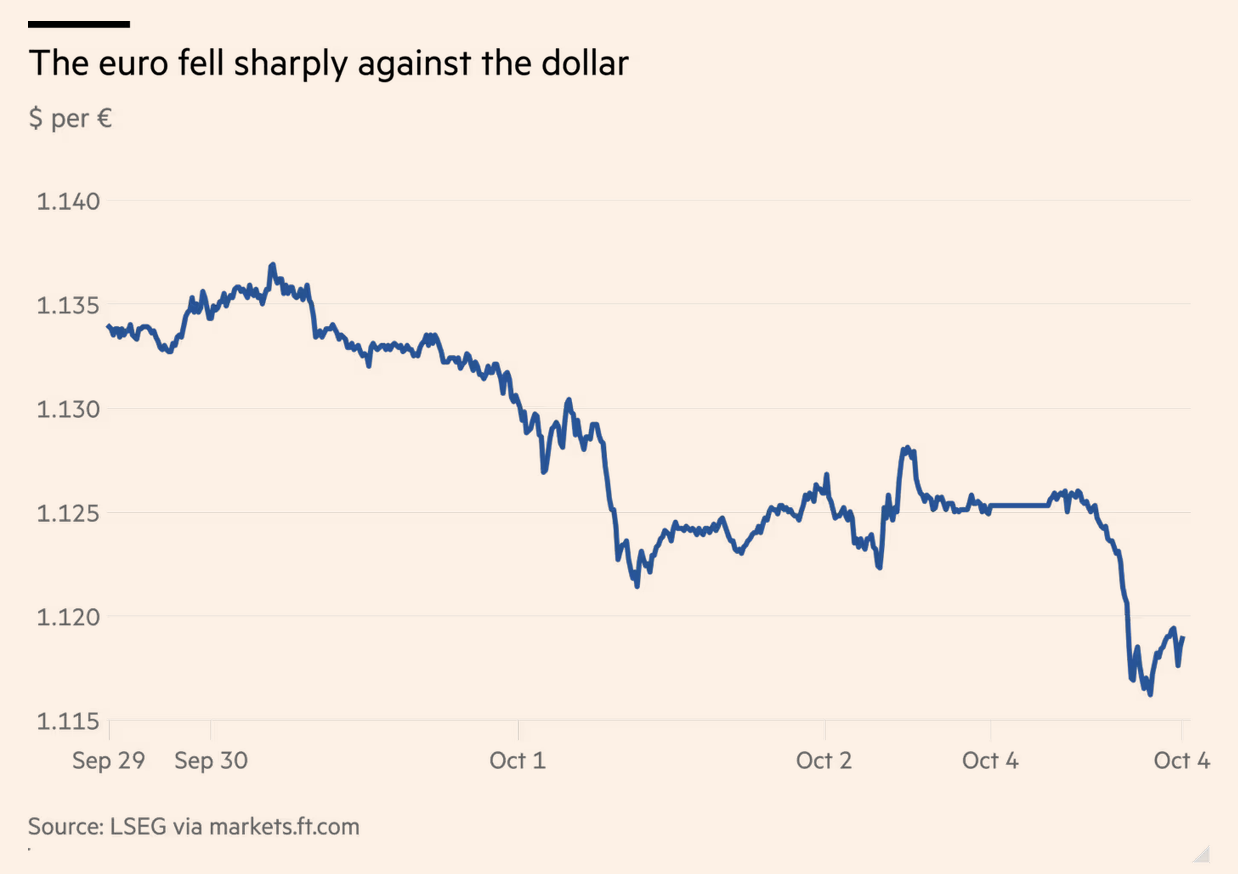
Finally, the lead story in the Financial Times (before the Brazil elections took the top slot), is Euro slides to 17-month low against dollar. A 17 month low is not yet a big deal. But we had indicated earlier that if one was to worry about major currencies ex the yen, the euro should be high on the list, given its de-industrialization and exposure to more energy starvation. Remember, the dirty dollar could remain the cleanest shirt in the laundry hamper. From the pink paper:
The euro fell to a 17-month low against the dollar on Monday, as a sell-off in French debt sent a shudder through Eurozone markets already under pressure from higher oil prices.
The euro weakened as much as 0.8 per cent against the dollar to $1.116 during morning trading in London. It was later at $1.122. The single currency is down 4.5 per cent against the dollar this year.
The move comes after a sell-off in French debt accelerated last week, driving yields on 10-year government bonds close to 5 per cent. Yields, which rise when prices fall, have risen more than 1.2 percentage points since the end of June.
The euro’s slide was “driven by intensifying fears over the destabilising financial conditions in the Eurozone triggered by the sharp sell-off in French government bonds”, said Lee Hardman, senior currency analyst at MUFG.
France has suffered particularly in the global bond sell-off as the march higher in yields has combined with worries over the government’s failure to bring the country’s deficit back down to within 5 per cent of GDP….
The worry started to weigh on the euro last week and hit other Eurozone government bond markets, especially Italy’s, prompting speculation that the European Central Bank would have to respond to stop France’s debt problems spilling into the wider euro area.
“The unfavourable developments have triggered fears over the re-emergence of fragmentation risks in the Eurozone that could impede the transmission of monetary policy,” said Hardman.
Investors are worried that the rise of populist parties ahead of France’s presidential election next year could worsen the outlook further.
The announcement of a snap election in Spain, after Prime Minister Pedro Sánchez had a flagship housing bill rejected last week, has also injected further uncertainty.

So economic woes are spilling into the political arena, and vice versa. But telling that Mr. Market does not see the prospects for anti-war candidates (Marine Le Pen and Jean-Luc Melenchon) doing well in France as a budget/interest rate negative.
Due to length and connectivity issues, we will stop here, but readers might also be interested in US economic tsuris, as reflected in a Wall Street Journal story (lead item earlier) Truckers Are Using Every Trick They Can to Survive Soaring Diesel Prices and from Ambrose Evans-Pritchard at the Telegraph last week (hat tip Vikas S): The Iran war could cost Trump the US farm vote – then his presidency.



 By
By