
[Today’s Iran war post launched largely done but I expect to find and add some more tidbits, so please return or refresh the page at 7:30 AM EDT for the final version]
Because we are now in an overly dynamic situation, let us first get everyone current (as of 7:00 AM EDT when this post first launched) on the resumption of a hot conflict, nominally between Iran and Israel but with clear US and Gulf state support.
The high level version is:
1. Israel struck Beirut, ostensibly in defiance of Trump
2. Iran very quickly (last night local time) attacked northern Israel, but in an arguably proportionate manner. Importantly, Iran has designated this program to be a new phase of the war, calling it is Operation True Promise 5.
3. Israel made Trump look like a fool by returning fire shortly after Trump told the Financial Times that he was in charge and had told Fox that he would tell Netanyahu not to punch back. Israel struck sites in western Iran and Tehran. These were made by Israel jets operating at standoff range, using Iraq and Saudi airspace. The idea that the Saudis are denying the US use of their airspace is thus a fiction.
4. Iran and Ansar Allah responded by hitting more targets in Israel, including the airbase at Nevatim.
5. Israel has attacked Iran again
There may be another Iran response as or shortly after this post goes live.
Note that some of the information we will show below is behind the pace of events. We will endeavor to flag that, but it also behooves readers to pay attention.
This was where things stood about 10 hours ago, before Israel retaliated against Iran and Iran quickly hit back:
Note that as the very first speaker says, Iran intended this to be a warning shot, to get Israel to stop its operation in Lebanon. From a mildly cleaned up machine translation:
Newscaster: What are the Iranian leaders now saying about these latest strikes? And are the attacks over for now?
Mohammed Abal [?]; Well, it sounds like that’s the case because there is a a phrase in the U in the statement by the IRGC saying that this is a shot. this is a warning shot to Israel and that if Israel responds against Iran then the next retaliation or the next phase of attack by Iran will be more devastating and more comprehensive. So that’s that’s clearly an indication that Iran is not intending to continue these missile strikes on Israel and that it is a warning in um because Iran has been threatening to do this for a while now including last week and also even before that saying that if Israel continues to strike in Lebanon and particularly on Beirut then Iran will retaliate.
PressTV on the first round of Iran attacks, in Ramat David airbase, origin of Israeli attacks on Lebanon, hit by ballistic missiles: IRGC
The Islamic Revolution Guards Corps (IRGC) says that its Aerospace Force struck the Ramat David airbase with ballistic missiles, identifying the facility as the launchpad for Israeli aggression against southern Lebanon, including the bombing of Tyre, Nabatieh and Beirut’s southern suburbs.
In a statement released late Sunday, the IRGC said the operation was a direct response to the Zionist regime’s widespread crimes in Lebanon, which have resulted in the killing and mass displacement of civilians.
“In response to the extensive crime of the usurping Zionist regime in southern Lebanon, the killing and mass displacement of the oppressed people of Tyre, Nabatieh and other areas, including Dahiyeh Beirut, the Ramat David airbase, the origin of these aggressions, was targeted by ballistic missiles of the IRGC Aerospace Force,” the statement read.
The IRGC stressed that Iran’s acceptance of the April 8 ceasefire was conditional on a halt to hostilities on all fronts.
Nima of Dialogue Works provided an update after the first set of exchanges.
Key details from his monologue:
1. Iran hit Northern Israel in with about 20 ballistic missiles in five waves, with at least 4 getting through
2. Israelis strikes were standoff only, used Iraq and Saudi airspace and Iraq airbase. Nima claims that Iran has information that other GCC countries were involved too
3. Ansar Allah attacked Prince Sultan airbase so they see the US as involved. Only one missile fired at Israel, that one apparently intercepted Ansar Allah concentrated more fire on the Saudis. No information yet on effect but Nima contends Saudi information suppression is as strong as in Israel
4. This is becoming Trump and Netanyahu v. the global economy. Which will break first?
Keep in mind that Ansar Allah saddling up means that the step of closing the Bab el-Mandib strait is in easy reach on the escalation ladder. If I were Iran and had the luxury of time, I would seek to have Ansar Allah hold off until the oil cliff effect started (per a senior Exxon exec, in two to three weeks) so as to amplify the effect of additional loss of supply.
It is hard to know what to make of Trump embarrassing himself by claiming he could leash and collar Netanyahu right before Netanyahu defied him. At best, Trump is addicted to his vision of himself as Colossus bestride the world, able to bend world leaders to his will. But if he really wanted to check Netanyahu, he has ample means, by threatening to cut off intel and weapons supplies and then ordering the CIA and DoD to follow through.
Yet Trump hoist himself on his own petard, macho-wise. Financial Times Trump says Netanyahu will have ‘no choice’ but to accept a deal with Iran
Israeli Prime Minister Benjamin Netanyahu will have no choice but to accept any deal the US negotiates with Iran, Donald Trump said, because the US president “calls the shots”.
“He won’t have any choice,” Trump told the FT in a telephone interview. “I call the shots. I call all the shots. He [Netanyahu] doesn’t call the shots.”
Trump spoke shortly after Iran launched a salvo of ballistic missiles at Israel in the most serious breach of the ceasefire that was struck in early April.
The president separately told Fox News that he would instruct Netanyahu to refrain from taking retaliatory action against Iran — a position at odds with statements from the Israeli military.
Trump said that Iran’s strikes had not changed his desire to conclude US-Iran negotiations. “It’s not going to have any impact on the deal,” he told the FT.
Mind you, Trump and Netanyahu may well be completely in cahoots, even though it seems very un-Trump-like to let Netanyahu so visibly humiliate him. Note that per Nima in his talk above, that Israel launched its attack on Beirut just when the Pakistan negotiators arrived in Israe.
This is laughable. There is zero chance – I repeat, zero chance – that Israel is acting without massive assistance from the U.S. military. The U.S. military is assisting Israel and Trump ordered it to do so.
Polls show that Americans overwhelmingly oppose this criminal,… https://t.co/g7cyLgvv2H
— Dimitri Lascaris (@dimitrilascaris) June 8, 2026
But perhaps Trump has yet again been persuaded that it would not be that hard to finish Iran off, and now he has Israel acting in the lead role.
Now let us move forward to the next round of Israel attacks and the Iran response. From Aljzaeera:
- Israel’s military says Iran has launched a second wave of missiles towards its territory with sirens sounding across the country.
- The strikes follow Israeli attacks on Iran with explosions reported in Tehran, Tabriz, and Isfahan as tensions escalate after Israel struck the southern suburbs of Beirut, killing at least two people and wounding 20.
Note that per PressTV, the second round of Iran attacks hit Nevatim, which is in the southern part of Israel. From ‘Operation Nasr’: IRGC pounds Israel’s Nevatim, Tel Nof strategic air bases
The Islamic Revolution Guards Corps (IRGC) says it launched a major retaliatory operation targeting key Israeli Nevatim and Tel Nof airbases, warning that all combat units are on high alert for further action.
In a statement on Monday, the IRGC said that its brave fighters of the Aerospace Force started “Operation Nasr” – meaning Operation Victory – earlier in the day as a retaliatory move in response to Israeli military actions.
“This operation was carried out in response to the missile aggression by the child-killing Zionist regime (Israel) against several radar sites in three locations across Iran,” it added.
The IRGC emphasized that the speed of response to the Israeli army’s aggression and the extensive target bank were among the measures taken by the operating groups in this phase….
The IRGC operation came after Iranian armed forces launched a missile barrage at Israeli-occupied territories on Sunday. Israeli media reported that sirens blared in wide areas, including the occupied Golan Heights, Tiberias, Safed, Nazareth, Haifa, and several other cities.
The developments were a direct response to the Israeli regime’s continued aggression against Lebanon, including the use of banned phosphorus bombs and the targeting of Beirut’s southern suburbs of Dahiyeh…
The Hebrew news outlet Israel Hayom reported that Iran fired 10 missiles at Israeli settlements in the West Bank, causing damage to three buildings.
Meanwhile, Israeli media reported that warning sirens were activated at the Hatzerim military base in the Gaza Strip, in Tel Aviv and its southern parts.
One wonders if Iran designating its campaign against Israel as Operation Nasr, as opposed to part of Operation True Promise, means that Iran is making Israel a second and explicit front of its combat.
Aljazeera says that the second round of Israeli attacks, so far Iran has reported no casualties but Israel hit an Iran petrochemical plant in apparent response to Iran hitting one in Haifa, and that there were very loud blasts in Tehran.
Middle East Eye’s live feed identified another escalatory measure from Ansar Allah:
Houthis declare Israeli-linked vessels military targets in Red Sea
Yemen’s armed forces announced a complete ban on Israeli maritime navigation in the Red Sea, warning that any Israeli-linked vessel movement in the waterway would be treated as a military target.
In a statement, military spokesperson Yahya Saree said Yemeni forces had also attacked what he described as a sensitive target in Jaffa, without providing further details.
“Any Zionist movement in the Red Sea will be considered a military target and will be engaged,” the statement said.
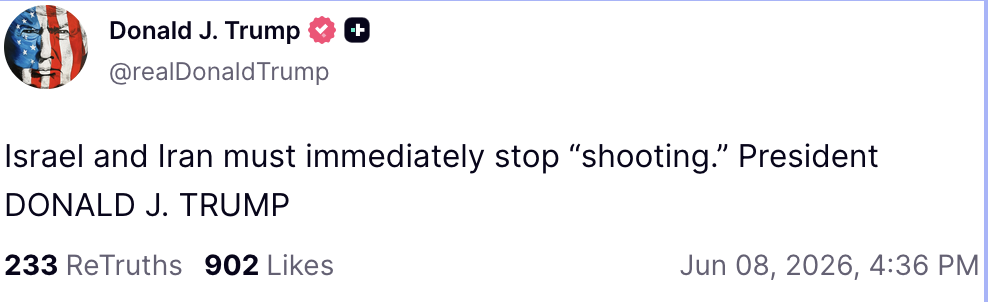
It is not clear why Trump is doubling down on his show of impotence. This tweet went live at 5:36 AM EDT, as in after the second round of Israel attacks, which is guaranteed to elicit a response from Iran:

My guess is that Trump thinks this sort of thing will calm investors’ frayed nerves, since most look to be badly addicted to hopium.
Annoyingly, even with a fake ceasefire and now rapid escalation, the press keeps duly selling the canard that “talks” are anything other than an empty exercise, here Trump administration market manipulation plus Iran feeling obliged to live up to its standing as a mature nation. See this Bloomberg landing page headline as an example:

“Falter”? Help me. Iran had made clear it was not budging on its demand for a return of its frozen assets as a condition for getting out of bed. It might conceivably accept less than $24 billion:
Mohsen Rezaei, senior military advisor to Iran’s supreme leader, said in an exclusive CNN interview that a meeting between US President Donald Trump and Mojtaba Khamenei will not happen. He said that negotiations are currently at a standstill and that Trump must break the… pic.twitter.com/yI7X5TDJN6
— Middle East Eye (@MiddleEastEye) June 6, 2026
This was the US’ insulting counter-offer reply, per Bloomberg in US Floats Steering Frozen Iran Assets to Gulf Allies for Repairs
The Trump administration is seeking to steer Iranian assets toward helping US allies in the Persian Gulf rebuild from damage inflicted by Tehran, and to repair any future destruction.
The effort, which was described by a senior administration official who wasn’t authorized to speak publicly, is unfolding alongside fitful talks between Washington and Tehran on a potential agreement to extend a truce in the Iran war. Negotiations appear to have bogged down over Tehran’s insistence on the release of some $24 billion in frozen Iranian financial assets….
The Trump administration’s approach would put some of the assets on a different path. The Treasury Department will use all tools available to allow Iranian assets to be used by Gulf allies to support rebuilding, the official said…
An initial step is already underway, as the US government looks to calculate cost estimates for the repairs.
Treasury Secretary Scott Bessent has directed his team to assess conditions among US allies in the region and request comprehensive estimates of the costs associated with repairing damage inflicted by Tehran since the start of the conflict, the official said.
Yes, the US seriously acts as if Iran will be put on an allowance based on what the US thinks reconstruction will cost, and foreign states will be allowed free access to Iran and profit from the rebuilding. Did the Trump Administration manage to hire some of the staffers from Weekly World News to dream schemes like this up?
Iran’s chief negotiator Ghalibaf later made clear that the attacks on Beirut further proved US/Israel duplicity, which means discussions are pointless. From MB Ghalibaf, as translated by Twitter:
1/ They are neither committed to a ceasefire nor believe in dialogue, and by demonstrating through the naval blockade and violation of agreements regarding Lebanon that they only understand the language of power.
2/ The naval blockade against the Iranian nation and America’s green light today to the Zionist regime turn American and regime bases and assets in the region into legitimate targets. The hand of our armed forces is open, as always.
Similarly:
⚡️Iranian official says, “At this point, reaching an agreement [with Trump] is not really feasible.”
🔺 “The primary person responsible for the current situation is Donald Trump himself,” the Iranian official told me, referring to Israel’s massive escalation in its attacks…
— jeremy scahill (@jeremyscahill) June 7, 2026
If this tidbit is true, it suggests Trump is ditching the Pakistan channel negotiating channel:
The US asked Qatar to mediate a ceasefire between Israel and Iran. Tehran responded: a ceasefire on all fronts or no ceasefire at all on any.
— Elijah J. Magnier 🇪🇺 (@ejmalrai) June 8, 2026
Israel is looking more and more regged. Recall that IDF leaders have been reporting that the military is on the verge of breaking. Again from Middle East Eye:
Israel plans large-scale mobilisation anticipating prolonged conflict, report says
The Israeli military is planning a large-scale mobilisation of reserve forces, with units expected to be deployed along the borders with the occupied West Bank and Jordan, according to Israeli Army Radio.
And on the real economy front, Brent crude rose by 5% but is still bizarrely below $100 a barrel. But some key markets in Asia are selling off hard in the wake of the AI rout in the US on Friday. From Bloomberg in AI Trade Unwind Rocks Korean Traders Leveraged for One-Way Bet:
Fear was already running high ahead of South Korea’s Monday open, but the ferocity of the selloff still caught some investors off guard.
Within three minutes of the open, the benchmark Kospi had plunged nearly 9%, triggering a circuit breaker. Trading for small caps was suspended in the afternoon, intraday gyrations ran up the most in a month and an increase in leveraged bets likely compounded volatility.
Friday’s US tech selloff and a 42% wipeout of a triple-leveraged Korean exchange-traded fund were the warning signs. By Saturday, viral memes were circulating of precariously-stacked dishes ready to crash. In group chats, traders outdid each other in predicting doomsday scenario and the start of a protracted downturn….
Monday’s rout underscores how South Korea is fast becoming the poster child for artificial intelligence exuberance, concentration risk — and its fragility. The heavy weighting in memory-chip and other AI-linked shares, amplified by retail leverage, made it at one point the world’s sixth-largest stock market but also the most volatile…
Korea’s 14-million strong day traders, who carry considerable heft in its $4.5 trillion equity market, have been at the center of the swings. Margin debt has climbed alongside the rally, with leveraged ETFs tied to chipmakers drawing billions of dollars worth of retail money. While foreign investors dumped local shares this year, the cohort known as “ants” have aggressively stepped in buy.
“Those using leverage are basically in a panic mode,” said Jang Eun-jung, a retail stock trader in Seoul.
The Financial Times warns of contagion in Global stocks slide led by meltdown in South Korea:
Global stocks fell on Monday, led by a meltdown in South Korea’s tech-heavy index, as investors ditched the AI-related companies behind this year’s blistering rally.
In South Korea, the benchmark Kospi plunged at the open, triggering a halt in trading. It closed down 8.3 per cent, while chipmakers Samsung Electronics and SK Hynix dropped 10.2 per cent and 7.7 per cent respectively. The two companies account for about 40 per cent of the index.
In Tokyo, the tech-heavy Nikkei 225 closed 3.9 per cent lower, while the broader Topix fell 2.5 per cent. Taiwan’s Taiex, where chipmaker TSMC dominates, fell as much as 6 per cent before closing down 3.5 per cent.
In Europe, the broad Stoxx Europe 600 was 0.3 per cent lower. Chipmaker ASML, Europe’s largest company by market value, initially fell more than 3 per cent before reversing course to trade flat on the day.
Monday’s declines in Europe and Asia follow a 4.2 per cent drop in the Nasdaq Composite on Friday, the biggest since April last year, after a strong US jobs report prompted traders to raise bets on higher US interest rates.
And again from Bloomberg, Indonesia Market Rout Deepens as Bonds, Currency, Stocks Slide:
Indonesia’s markets slumped on Monday, led by a sharp selloff in sovereign bonds, after the government’s latest attempt to shore up the currency failed to ease concern over its economic management.
The 10-year bond yield surged 36 basis points to the highest in more than a year, after Bank Indonesia said on Saturday that it’s working with the government to boost returns so as to support the rupiah. Still, the currency touched another low and the benchmark equity index fell.
Policymakers vowed on Saturday to stabilize the rupiah and attract inflows, as concerns over the nation’s fiscal spending plans and President Prabowo Subianto’s interventionist economic agenda unsettle investors. The market selloff picked up momentum last week as lawmakers expanded supervision of the central bank, a corruption probe was launched, and new rules governing commodity exports were unveiled.
Texas BBQ spots are shutting down due to high beef prices:
“The biggest reason that the price of beef is so high is that the supply of cattle has been diminishing. With lower supply, there’s going to be higher prices.” https://t.co/08OMJCXeO0
— Frank Luntz (@FrankLuntz) June 7, 2026



 By
By