
[Today’s post yet again went live before finished. Please return at 8:00 AM EDT or refresh this page then for a completed version]
Bloomberg, due to its great reach with investors, is a useful starting point on the official version of Iran news of the day, even though it curiously averts its eyes from Israel predictably acting as a spanner to any resolution of the conflict. Israel is continuing to pound Southern Lebanon as Hezbollah rejected an Israel-favoring ceasefire scheme. Recall that Iran is now also insisting that Israel halt its aggression in Gaza and the West Bank.
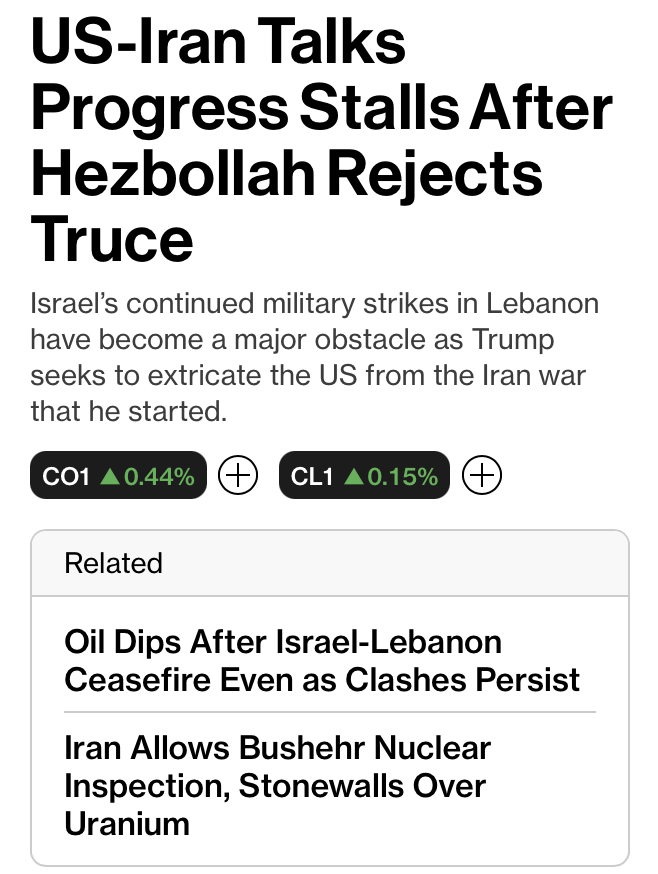
From its landing page:

We’ll turn to the nuclear-related negotiations soon, but note the reader-perception-influencing use of “stonewall” as if Iran was legally obligated to Do Something about its enriched uranium when it isn’t.
First from Bloomberg in US-Iran Talks Progress Stalls After Hezbollah Rejects Truce:
- There was no sign of progress in ceasefire talks between the US and Iran after the worst burst of violence in weeks.
- President Donald Trump said ceasefire talks are in the “final” stages, while Iran’s foreign minister said the negotiations had stalled.
- Hezbollah militants rejected a US-brokered truce in Lebanon, with its chief calling the deal “absurd” and refusing to link its presence in Lebanon with stopping the war…..
Trump has repeatedly claimed a deal is close even as Iran refuses to give in to his demands on its nuclear program and the reopening of the Strait of Hormuz.
Aljazeera helpfully chronicles how Israel is thumbing its nose at the US attempts at implementing a ceasefire in Lebanon. Even though Israel made a tiny gesture in the direction of respecting Trump via not resuming attacks on Beirut, it has been pounding Southern Lebanon hard. From Israel continues strikes, forced displacement as Lebanon ceasefire in doubt:
- Israel’s deadly strikes continue across Lebanon despite the announcement of a new US-brokered ceasefire agreed between Lebanese and Israeli officials in Washington, DC.
- At least 3,526 people have now been killed and 10,733 injured in Israeli strikes on Lebanon since March 2, the country’s Health Ministry said.
From the body of that live feed:
Israeli military issues new round of forced displacement orders in southern Lebanon
The Israeli military has issued a new round of forced displacement orders for the residents of Sarafand, Tuffahta, Babliyeh, Qaqaiyat al-Sanoubar, Marwaniyeh, and Siksikieh in southern Lebanon…
Earlier, the Israeli military issued forced displacement warnings for Aarnaya, Aanqoun and Kfar Kila, three villages and towns in southern Lebanon.
Israel has continued to pound Lebanon with deadly attacks despite the announcement of a new US-brokered ceasefire on Thursday.
And:
Israel kills at least four in wave of attacks on southern Lebanon
Israel has launched another wave of deadly attacks across southern Lebanon, killing several people and hitting residential areas, roads and towns before dawn, Lebanon’s official National News Agency reported…
Israeli aircraft also bombed Nabatieh al-Fawqa, Zibdine, Shoukin and Jebchit, as artillery fire hit Kfar Tebnit, Kfar Reman and areas around Mayfadoun.
Another Israeli strike on Qalawiya Tower killed one person and wounded another.
Near Tyre, Israeli warplanes struck close to Jabal Amel Hospital, targeting the Bank Audi area. In Khiam, Israeli forces carried out a heavy machinegun sweep and a major demolition operation in Bab al-Thaniya.
Finally, Netahyahu is again defying Trump by asserting that there is no ceasefire pact:
Netanyahu reportedly said ‘no agreement’ while Hezbollah opposed to Lebanon ceasefire
Israeli media outlet Ynet is reporting that Prime Minister Benjamin Netanyahu said Israel’s government has not yet approved the implementation of the US-mediated ceasefire between Israel and the Lebanese government.
“There is currently no agreement; Hezbollah is opposed, and therefore I am not making a decision. If they agree, I will bring it to your approval,” Netanyahu is reported to have said at a security cabinet meeting on Thursday evening.
From Middle East Eye’s live feed, now headlined Live: Hezbollah chief demands ‘comprehensive’ ceasefire and Israeli withdrawal:
Halting resistance is ‘Satan’s dream of Paradise’ to Israel, Hezbollah top leader says
Hezbollah Secretary General, Naim Qassem, asserted that the group would continue to resist Israeli attacks.
“For the primary objective to be the disarmament of the resistance as a starting point for any agreement means the elimination of Lebanon’s power and an existential threat to the annihilation of its resistant people,” he said.
He said that the group’s main concern is a “comprehensive cessation of hostilities, a ceasefire, and Israel’s withdrawal” from Lebanese territory.
“The ceasefire must be comprehensive; there can be no separation between the South and the rest of Lebanon, and the Israeli enemy will not have the freedom to kill in Lebanon,” Qassem expressed. “As long as the occupation persists, the resistance will continue.”
Hezbollah abandoning the country’s southern front amid continued Israeli military advancement is “like Satan’s dream of entering
Israeli attacks ongoing despite latest ceasefire agreement
Israeli attacks on southern Lebanon continued on Friday morning, despite a US-led ceasefire agreement reached late on Wednesday.
According to the National News Agency, Israeli shelling targeted the area nearby Nabatieh’s Burj Qalaouiyah and the area around Deir Kifa in Tyre.
Meanwhile, an air strike that hit the vicinity of Jabal Amel Hospital has lead to the wounding of at least 12 civilians.
More commentary:
🪖 SOUTH LEBANON — IDF orders new evacuations as the ceasefire exists only on paper.
📌 LOOK CLOSER: New evacuation orders signal a ground push, not a ceasefire adjustment. With Hezbollah rejecting the framework and Israel refusing withdrawal, Lebanon has shifted from diplomatic… pic.twitter.com/mjgpUHlgUF
— perceptiondaily (@perceptiondaily) June 5, 2026
Hezbollah does appear to be inflicting more pain on the IDF:
🚨BREAKING: Hezbollah Inflict An Israeli Soldier Massacre & Hit A Base Across The Border
A mass casualty event was reported following a “complex ambush” carried out against Israeli forces operating north of the Litani River in south Lebanon.
A base has also been struck by an…
— MintPress News (@MintPressNews) June 4, 2026
Daniel Davis provided a useful high-level recap of the fake ceasefire in Lebanon and why the new iteration is yet another headfake. This segment is suitable for sharing with friends and contacts who are not fully up to speed on this topic.
Davis also shows how Netanyahu brushed off the recent lovers’ spat with Trump, and explains the danger of pending legislation that would “fuse: key aspects of Israel’s military with the US. He urges viewers to raise hell with Congresscritters and particularly recommends in-person visits.
If you press your Congresscritter, note that additional unwarranted goodies for Israel are hidden in other bills and should be stripped out:
NEW: Buried within the Senate Intelligence Authorization Act is a provision to increase intelligence sharing with Israel and impede the president’s ability to reduce cooperation in the future. pic.twitter.com/ET2ZWnfJWP
— Daniel Boguslaw (@DRBoguslaw) June 3, 2026
By contrast, in his latest post, Robert Pape pussy-foots around the issue of US policy (and the world economy) being subordinated to Israel’s extreme sense of entitlement. By contrast, Davis, Douglas Macgregor, Larry Wikerson, and other experts for some time have been debating who is in charge in the US, at least as far as Middle East policy. So Pape’s post, The Lebanon Fuse tries to frame the issue as Lebanon, as opposed to putting Israeli intransigence front and center. Notice the lack of agency at the very top:
The most important fact is not that a ceasefire was announced.
The most important fact is that military operations continued anyway.
Pape later adds:
From Tehran’s perspective, Hezbollah is not simply another regional partner. It is the most important pillar of Iran’s deterrent network outside its own borders. Iranian leaders have increasingly signaled that any durable agreement with Washington requires the survival of Hezbollah as a meaningful military and political force. In effect, Iran has made Israel’s campaign in Lebanon a central issue in the broader negotiations. A deal that leaves Hezbollah broken is far less attractive to Tehran than a deal that preserves its most important regional proxy.
That creates a direct collision between Israeli and Iranian objectives.
Israel’s actions over the past several months reveal objectives that extend far beyond immediate retaliation against Hezbollah. Israeli leaders have repeatedly spoken of maintaining a permanent security zone in southern Lebanon. Israeli forces currently occupy hundreds of square kilometers of Lebanese territory. Large portions of southern Lebanon have been emptied through evacuation orders and continuing military operations.
From a strategic perspective, this creates its own logic.
Once a buffer zone becomes central to Israeli security planning, pressure emerges to push potential threats farther away. That means continued military pressure on Hezbollah. It means continued operations in Lebanon. And it means powerful incentives to resist diplomatic arrangements that leave Hezbollah intact as an organized military force.
At the same time, Israeli leaders remain deeply skeptical of U.S.-Iran diplomacy. Any agreement that stabilizes Iran while leaving Hezbollah, Hamas, and other Iranian partners intact would be viewed by many inside Israel as postponing rather than solving the larger strategic problem.
The result is an increasingly familiar escalation trap.
· Washington wants negotiations.
· Jerusalem wants security.
· Tehran wants Hezbollah preserved.
The problem is not simply disagreement. The problem is that the three objectives increasingly exclude one another. Washington cannot obtain a durable agreement if Hezbollah is dismantled. Tehran cannot accept a durable agreement if Hezbollah is dismantled.
I’ll let readers have at this, but I find this presenation to be astonishing. Pape completely ignores that Hezbollah is party in Lebanon, part of the government, and among other things provides social services. Or has Pape chosen to amplify State Department misrepresentations?
The US statement is wrong. Hezbollah cannot be defined as a ‘non-state actor’. It has ministers in cabinets, holds parliamentary seats (13-15 recently, plus allies), influences government formation, and provides services in Shia areas. It operates within the Lebanese state…
— Elijah J. Magnier 🇪🇺 (@ejmalrai) June 4, 2026
Contrast Pape’s reading with a new Hindustan Times segment which highlights Mojtaba Kahmenei’s latest speech, in which Mojtaba depicted the US/Israel war as a campaign against Iran’s civilization, which has the great merit of being (significantly) true. It also includes what sure look like fresh if not overlarge attacks on Tehran and other cities.
To the next issue with (relying on Bloomberg as our guide to what investors and the mainstream view as noteworthy), via Iran Allows Bushehr Nuclear Inspection, Stonewalls Over Uranium:
Iran permitted monitors at the United Nations atomic watchdog this week to visit its Bushehr nuclear power plant while stonewalling inspectors’ demands to verify the condition and location of its enriched uranium stockpile.
While the visit to Bushehr was welcomed by the International Atomic Energy Agency, it failed to resolve growing concern over the Islamic Republic’s inventory of near-bomb-grade uranium, according to a report by the group. That material — enough to craft about a dozen warheads — hasn’t been verified for a year.
While monitors conducted a three-day visit to Bushehr, “the agency has not received information from Iran regarding the status of any of its other declared nuclear activities,” according to the 10-page restricted report seen by Bloomberg….
IAEA inspections plummeted by more than half last year after Iran imposed new restrictions following the 12-day war that saw Israel and the US bombard their nuclear sites. Monitors have yet to return to damaged sites in Fordow, Isfahan and Natanz, where Iran’s 440.9 kilograms (972 pounds) and 8,599.6 kilograms of lower enriched material was last seen.
Yours truly welcomes input on what Iran’s obligations are under the Nuclear Non-Proliferation Treaty, which Iran signed in the days of the Shah. A never-mentioned-in-polite-company reason for Iran digging its heels in about International Atomic Energy Agency visits is that the IAEA is widely believe in Iran and also by some experts outside Iran to have provided Israel with information that assisted Israel in assassinations of Iran’s nuclear scientists. Articles like Nuclear Safeguards – How far can Inspectors go? on the IAEA’s own site make clear that the matter is not clear cut. An illustrative section:
During an NPT inspection, how widely within the inspected country may inspectors look? May they search only those areas that the NPT member has declared to have nuclear activities? May they look for activities that do not
include nuclear material but may nevertheless relate to nuclear weaponization?Weaponization activities can vary. They might include learning how to design or make nuclear weapons or their components using calculations, computer simulations, models, high-flux neutron generators, high-explosive lenses, high-energy electrical components, hydro-dynamic tests and many other activities that do not require the pres ence of nuclear material. Yet such activities may be useful for making nuclear weapons.
Can IAEA inspectors look for such activities at places other than those where nuclear material is present? If they do, may they ask responsible personnel about the purpose of the activities?
Given Israel’s unpopularity across the world, the time may have come for Iran to balk at going beyond what would be considered cursory IAEA inspections unless Israel joins the NPT. Keep in mind that Iran has been escalating its demands bit by bit as US impotence becomes more evident and the pain of the effective closure of the Strait of Hormuz intensifies. This would have the further salutary effect in the US of widening debate over the extraordinary privileges we provide to Israel at great cost to our own citizens.
This rumor is not confirmed but is the sort of thing the US would do. Mind you, Iran has been braced for a US attack ever since the lame ceasefire started:
US has informed Iran if it does not make a deal military strikes will begin according to sources.
— WarMonitor🇺🇦🇬🇧 (@WarMonitor3) June 4, 2026
And even though it does not impact the current state of play, a new CNN story, Exclusive: Video reveals damage from fire on US aircraft carrier after sources say fire control system failed, demonstrates the US tendency to greatly underplay the seriousness of damage suffered. Key sections:
When a fire burned aboard the world’s biggest aircraft carrier in March as it took part in operations against Iran, the US Navy released a short statement saying the blaze had been “contained,” that two sailors had received medical treatment for “non-life-threatening injuries” and that the carrier was “fully operational.”
But new video obtained by CNN makes clear the fire was more severe and damaging than the Navy suggested. Bunks where sailors slept were totally destroyed, the video shows. What remained of the beds was charred, twisted metal beneath a ceiling also apparently hollowed out by the inferno. Wires dangled from the ceiling and heaps of ashes littered the ground around the bunks, according to the video.
“I seriously thought we were going to lose the ship,” one sailor aboard the ship, the USS Gerald R. Ford, told CNN, describing how he felt while fighting the fire. “It’s either fight or die.”
The ship’s fire-suppression system failed to work, leaving the sailors scrambling to put out the blaze, according to the sailor and a senior US official familiar with the incident.

And on a small informational matter: Iran sources are saying that the photos that allegedly show a Shahed drone hitting the Kuwait Airport do not in fact establish Iran’s responsibility….because they are from the wrong time of day:
Iranian military correspondent for Tasnim:
Didn’t we attack the US bases during the night? Why’s the footage from the attack on Kuwait’s airport during day time?
Which is a very valid point. The launch footages Iran released clearly shows it’s during night time. https://t.co/rbfLzEb1Cb
— Arya Yadeghaar (Backup) (@AryJeayBackup) June 4, 2026
And on the economic front, oil executives are making sure they are not blamed when the US hits the oil cliff, which an Exxon executive forecasts as coming in two to three weeks. That estimate is in line with commodity maven Jeff Currie’s call of around July 4. From Politico (hat tip reader Timmy) in Oil industry warns Trump administration of price spikes within weeks
The oil industry is warning the Trump administration that a Hormuz-sized hole in the world’s petroleum market is steadily draining inventories to levels that are likely to send global energy prices surging in the next several weeks, according to four executives.
Industry executives have flagged the issue to senior White House officials and Cabinet members in recent weeks as part of the Trump administration’s ongoing dialogue with the U.S. energy industry, the people said. The warnings came as recently as late last month as data from the U.S. Energy Information Administration and other sources began showing that fuel makers were increasingly relying on oil and fuel from their storage tanks to replace products no longer arriving from the Middle East.
“We’re at dangerously low levels already,” said one industry executive who was granted anonymity to discuss private conversations with the administration. “We have shared those concerns at the highest levels of government about what’s coming in mid-to-late June. … I hope they are paying attention to inventories right now. You’re hitting tank bottom.”…
Some of the conversations have been general warnings while others have focused on tight inventories of specific fuel types in particular locations, such as jet fuel on the West Coast, a second person involved in the conversations said.
The information around what is happening with shipments leaving the Persian Gulf and getting to their buyers is so polluted as to make it hard to conclude anything. Sal Mercogliano has pointed out that the transit numbers the Persian Gulf Authority provides includes many small wooden-hulled ships and thus does not give a good sense of how much in meaningful oil and cargo hauling is happening. Similarly, even when ships evade the US blockade area in the Sea of Oman, they typically do so via staying within the territorial waters of Pakistan and then India. But after that, they need to use open sea, and the US navy has pounced on some vessels there.
So we don’t know for sure how many of these ships will reach their destinations:
BREAKING: Multiple Iranian-flagged oil tankers carrying 7 million barrels of oil to China successfully broke through the US blockade in the Strait of Hormuz, the first breach since April 17, per Kpler.
— The Hormuz Letter (@HormuzLetter) June 4, 2026
A recent story from Lloyd’s List says the US blockade has had an impact on Iran. From Iranian crude exports collapse under US naval blockade:
- May exports fell 84% from April and were 87% below the average recorded between May 2025 and April 2026
- Iran has shifted to smaller tankers as VLCCs leaving its ports face a higher risk of interdiction by US forces
- The export slump has forced Iran to cut crude production by 800,000 bpd, or 10% month on month, likely keeping exports constrained in the near term
- Saudi Arabia’s East-West Pipeline throughput has been increasing with rising production but constraints at Yanbu is limiting exports
On the private credit front, more ugly news from a then Financial Times lead story, Blackstone caps withdrawals from flagship private credit fund. Note that just about none of these articles clearly explain the central problem: Private credit assets are illiquid. They are loans the fund intended to hold to maturity. But to get more investors into the pool, the managers offered a limited ability to withdraw funds. Oopsie!
From the article:
Blackstone has restricted withdrawals from its flagship private credit fund for the first time after redemption requests surged to $4.5bn in the second quarter, in a sign of the mounting pressure on the asset class.
The world’s largest private investment group said investors in the $45bn Blackstone Private Credit Fund, known as Bcred, attempted to withdraw 10 per cent of the fund’s net assets in the period. The fund granted redemption requests amounting to 5 per cent of its value.
For the first time, Blackstone relied on a mechanism that allows it to restrict investors from pulling their money, following rivals such as Apollo Global Management, BlackRock, KKR and Ares Management, which capped redemptions earlier this year.
Blackstone said the fund’s “structure is a fundamental feature, with investors exchanging some liquidity at times for long-term outperformance”. The firm pointed to Bcred’s 9.3 per cent annualised return since its launch.
The New York-headquartered group also said redemption requests “decelerated” in the second half of May, a signal that outflows from semi-liquid funds could be reaching a peak. Shares of Blackstone rallied 8 per cent in Thursday morning trading.
The exodus from private credit has nonetheless shaken the alternative investment industry, which had tethered its growth to a massive influx of capital from Main Street investors.
Wealth and retail investors have grown wary in recent months, however, as rapid advances in AI have raised questions over the prospects of private equity-backed enterprise software companies, many of which have been financed by private credit groups.
On Thursday, the FT reported that Swiss-listed Partners Group was preparing to cap withdrawals at its flagship US private equity fund for wealthy individuals, a day after gating its European equivalent.
Earlier this week, another very large private credit fund run by investment group Cliffwater told investors that redemption requests had surged to 17 per cent in the quarter.
Blackstone’s decision to honour 100 per cent of investor redemption requests in the first quarter, even as withdrawals rose to 7.9 per cent — breaching a 5 per cent threshold that would have allowed it to gate the fund — opened a rift in the investment industry.
Large rivals and wealth advisers were frustrated by the decision, concerned it would suggest to retail investors that the so-called semiliquid funds they had bought offered more liquidity than promised.
For those new to this topic, or who want a refresher, or would like to educated interested friends and colleagues, the new Jeff Snider talk is extremely good in presenting a lot of detail about how the funds work and why they are now the subject of investor worries in a layperson-friendly manner that is technically accurate, which is no mean featL:
More on screwworm as a beef price increase multiplier. IMHO this is a proper use of all caps:
IF YOU THINK BEEF PRICES ARE HIGH NOW, IMAGINE WHAT THEY WILL BE AFTER FLESH EATING MAGGOTS WIPE OUT A SIGNIFICANT PORTION OF THE REMAINING US CATTLE SUPPLY
WE NEED A NATIONAL EMERGENCY DECLARATION ON NEW WORLD SCREWWORM NOW, WE ARE TIRED OF WAITING FOR COMPETENT ACTION
— Meriwether Farms (@MeriwetherFarms) June 4, 2026
The US spent millions every year tracking and releasing sterile screwworm flies to keep the population controlled and prevent it spreading north of Central America, then Donald Trump and Elon Musk paid those people to resign under the DOGE efforts.
They did this. https://t.co/TAnNEbejl6 pic.twitter.com/4DkqXJceOv
— chris cross big apple sauce 🍎🗽🍕🥯 (@notchrisvolpe) June 4, 2026
We have been warning the public on New World Screwworm for over a year now (some much longer than us)
We even had our account on X suspended for a month when we showed a picture of what an infection looks like in a human, shortly before there was a human case confirmed in the US…
— Meriwether Farms (@MeriwetherFarms) June 4, 2026
If you are in the US and are not a strict vegetarian, beef price increases will affect you. Beef consumers are likely to pare their purchases of beef and buy pork, chicken, and fish in bigger amounts, putting pressure on prices on those protein sources.
Done for today! Whether I see you over the weekend or the next Iran post is on Monday will be determined by developments. Let’s hope things are comparatively quiet.



 By
By