Iran War: Europe Oil and US Diesel Crunch Worsens; Tucker Exposes Massive Trump/Israel Bombing Campaign Right After Midterms; Experts Question Survival of Regimes in Saudi Arabia, Jordan
Iran War: Europe Oil and US Diesel Crunch Worsens; Tucker Exposes Massive Trump/Israel Bombing Campaign Right After Midterms; Experts Question Survival of Regimes in Saudi Arabia, Jordan
[Today’s Iran war update launched not complete because lotto threads to cover. Please return or refresh this page at 7:30 AM EDT for a final version]
The Middle East Iran and Yemen conflicts are hitting the point where key actors in the process of creating state changes, whether intentionally or due to backfires. Recall that state changes result from pumping too much energy into a system, so it suddenly shifts to a less ordered state, like water into steam. To put this another way, from the outset, we had predicted that the Iran war would be a test to destruction. The question is not just which governments refuse to back down before doing themselves fundamental harm but which critical systems also fall prey such as industries dependent on inputs that come from the Persian Gulf.
The predicted energy crunch is arriving on the oil as well as the diesel front. Europe is early in line to suffer from Ansar Allah’s success in cutting off Saudi petroleum exports. Some sightings on the European front:
BREAKING: Saudi Aramco has cancelled all of its September European crude oil allocations and is scrapping every cargo slated for late-September loading onward, with a European lifter saying no Saudi oil cargoes at all until November, per initial reports citing oil trading firm Onyx and market sources.
That takes the world’s largest exporter out of the European market for the rest of September and all of October, a de facto force majeure on Saudi crude to Europe from the 3rd largest energy producer in the world.
— The Hormuz Letter (@HormuzLetter) September 15, 2026
@chigrl $18 premiums over Dated Brent tell you the market is pricing prolonged pipeline downtime, not a one-off outage. European refiners will now bid harder for West African and US grades, and that squeeze spreads fast.
— Silk Road Guide (@SRG_News_NYC) September 16, 2026
Even though the press has turned its eyes to the hot Ansar Allah-Saudi conflict, things are not going well for Team Non-Iran on the Strait of Hormuz front either. From Aljazeera’s live feed:
Strait of Hormuz vessel transits drop to 4, data shows
Preliminary shipping data shows vessel transits through the Strait of Hormuz remaining in the single digits at four on Tuesday, down from seven a day earlier, Reuters reports.
Citing preliminary figures, Reuters said a total of four vessels transited the waterway, with two exiting and two entering…
The figures fall well short of the 10-day average of 18.
And from NO1’s daily newsletter:
Global inventories down to 7.6bn barrels since the war began (Hedgeye); the curve stays backwardated all the way into March (Macrobysunil). Chevron’s CEO now says commercial stocks are drained and strategic reserves largely tapped (Mark4XX, Kalshi). Confidence: HIGH
Diesel prices in the US keep increasing:
BREAKING: US diesel prices officially rise to a new record $6.26/gallon, now up over +80% in 9 months.
Truck drivers are now paying nearly $3.00 more per gallon for diesel than they were in January.
This has pushed average gas prices in California, one of the most expensive states for gas, above $6.00/gallon.
Amid the move, expectations of a rate hike tomorrow have hit a new high.
— The Kobeissi Letter (@KobeissiLetter) September 15, 2026
Recall that interest rate increases will not do anything to curb price increases resulting from a supply shock….at least before interest rates have killed the economy stone cold dead.
Per Bloomberg energy reporter Javier Blas, “US Senate majority leader John Thune says he is ‘open to considering’” an export ban on diesel. Keep in mind that US refineries had been supplying Europe in addition to the US.
As we’ll soon discuss, the picture for Saudi Arabia is not pretty. But first to what this means for the US.
Trump was already under great pressure from the Iran chokehold on the Strait of Hormuz. The Saudi self-sabotage of attacking the Saana airport and then not backing down when Ansar Allah retaliated ferociously puts Trump and the US further under water, both confirming military weakness (our failure to arm and train the Saudis well, Trump’s refusal to assist) and intensifying US energy woes
Tucker Carlson has gotten to the bottom of why Trump was insisting the war with Iran would end right after the midterms. I am hoisting his tweet in full because I am sure he wanted it to be read widely:
According to an informed federal official, in the coming months the Trump administration plans to send a total of 40,000 Mark 84 and Blu-117 bombs to the government of Israel. Each bomb weighs 2,000 pounds. This appears to be the largest transfer of conventional explosive ordnance from the United States in modern history.
How big is this shipment? It amounts to 40,000 tons of bombs. For perspective, the largest American air raid of World War Two was the Eighth Air Force’s attack on Berlin in March of 1945. Combined, the 2,023 Allied aircraft involved dropped about 3,000 tons of bombs. That’s 7.5 percent of what Trump is sending to Israel. That same month, March of 1945, the US Army Air Forces began the single most destructive bombing raid in human history, Operation Meetinghouse over Tokyo. More than 100,000 Japanese civilians were killed. By the end of that operation, the US had dropped 1,600 tons of bombs. That’s four percent of what Trump is sending to Israel. World War Two ended five months later, when the US dropped an atomic bomb on the city of Hiroshima. The shipment Trump is sending to Israel amounts to more than three times the destructive power of that nuclear explosion. There is no precedent for what the Trump administration is doing.
Nor is there a justification. The government of Israel is not fighting World War Two, or even a war. It is engaged in periodic skirmishes with a guerrilla force in Lebanon, and it is working to exterminate an unarmed civilian population in Gaza. Neither front requires modern 2,000-pound bombs.
An American-made Mark 84 has a destruction radius of half a mile. It releases a thermal wave the temperature of the surface of the sun. Within 100 feet of the explosion, rock melts and human flesh turns to vapor. The bomb collapses apartment buildings and leaves craters thirty-five feet deep. Until the war with Iran, the US military generally avoided using the Mark 84 in urban areas. It kills too many civilians.
For the Netanyahu government, that’s been the upside. In the weeks after October 7, the IDF dropped nearly six hundred 2,000-pound bombs on densely populated areas in Gaza, including on more than 100 officially designated civilian evacuation zones. The slaughter was so grotesque and embarrassing that for a moment the Biden administration paused a shipment of Mark 84s. Those shipments quickly resumed under Trump. Now they’ve accelerated.
It’s hard to overstate the scale of the crime the Israeli government is committing in Gaza. Over the last three years, more than a quarter-million Palestinians have been killed or wounded by Israeli forces there. The majority of them have been noncombatants: women, the elderly and tens of thousands of children. Many thousands more remain missing, presumably entombed under the rubble of 200,000 collapsed buildings. So far the Israelis have destroyed 92 percent of all homes in Gaza, and 34 of the 36 hospitals. By comparison, the 1945 Allied bombings of Dresden, now acknowledged as a war crime, destroyed about half of the city’s inhabited buildings.
By any definition, what the Netanyahu government has done in Gaza is genocide. The 40,000 new bombs the Trump administration is sending will be used to do the same in Lebanon, and likely in other countries in the region. If you wanted to extend the Iran war into the indefinite future, this is exactly what you’d do.
So far none of this has received public scrutiny. At some point, inevitably, it will be described in media accounts as an “arms sale.” It is not an arms sale. It is a gift, funded by American taxpayers through the Foreign Military Financing program, an arrangement designed to disguise welfare as capitalism: Congress appropriates money to the executive branch, which transfers the cash to Israel to “buy” American-made weapons, in this case from General Dynamics. Politicians claim this is a win for America. Most voters have no idea they paid for it. The bill in this case is about $3 billion. Add that to the $352 billion the US Treasury has transferred to Israel since 1951.
How did this happen? The request for 40,000 new high-explosive civilian-killing bombs originated at the US Embassy in Jerusalem, which is run by Christian Zionist Ambassador Mike Huckabee and his aide David Milstein, who is the stepson of Fox News host Mark Levin. From there it moved to the State Department, where Marco Rubio enthusiastically approved it.
At this point, only four more people need to sign off before the bombs ship to Israel: Senators Jim Risch and Jeanne Shaheen, the chairman and ranking member of the Senate Foreign Relations Committee; and Congressmen Brian Mast and Gregory Meeks, the top two members of the equivalent House committee. All four are committed neocons. Collectively they’ve taken millions from the Israel lobby. In 2015, Brian Mast traveled to Israel to volunteer for the Israeli military. In 2023, Mast showed up in the House of Representatives wearing an IDF uniform.
It’s hard to imagine any of them hesitating before sending more free bombs to Israel. Only public outrage can stop this.
Americans, call or e-mail your Congresscritters and also your local TV station. They have political sway.
Needless to say, Iran most certainly has taken note of Tucker’s warning. They changed their military doctrine in January 2025 to allow for pre-emptive attacks. More recently, they made clear that they are operationalizing that doctrine more aggressively, as in initiating attacks so as to further weaken US forces across the region and control the pacing of the war, which the US and Israel would otherwise try to extend to provide for rest and rearmament.
Trita Parsi had earlier forecast that Iran would greatly intensify its strikes in the two weeks before the mid-terms so as to pressure Trump into action that would further damage Republican prospects. The literal Tucker bombshell suggests they may change their timing and scope of operations. It would seem to behoove Iran to destroy all military assets in the theater (which could extend to Cyprus and even Incircik) that Israel could use to prosecute this campaign. This post is already overlong so rather than speculate further, I hope readers will discuss in comments what this might amount to.
The press as usual, while waking up to the fact that Saudi Arabia is a world of hurt due to Ansar Allah putting its critical east-west pipeline out of commission for potentially months, with destruction of any repairs probable, getting control of the Bab el-Mandeb coast, the key port of Mokha, as well as important island, and attacking bases and other critical infrastructure in Saudi Arabia, is still underplaying the severity of the situation for the Kingdom and as a result, the global economy. Consider this assessment from Patricia Marins on Twitter:
Saudi Arabia – Defeat Before It Begins
The conflict between the Saudis and the Houthis is a defeat for the Saudis regardless of the military outcome.
The number of missiles in Yemeni hands and the vast oil facilities that are vital to the kingdom’s economy already make it clear who will lose this conflict.
For the Houthis, there is little left to lose that has not already been lost and rebuilt before.
Not long ago, an Israeli strike blew up the presidential palace and killed almost the entire Houthi government. What was the impact on the group? Zero.
Everything is quickly reassembled and rebuilt in an improvised way, as many times as necessary.
Will the Houthis unleash heavy fire against all of Saudi infrastructure? No. They will not do so for now.
In a new talk with Judge Napolitano, Chas Freeman, former US ambassador to Saudi Arabia, said that oil and petroleum product exports represented 44% to 45% of Saudi GDP.
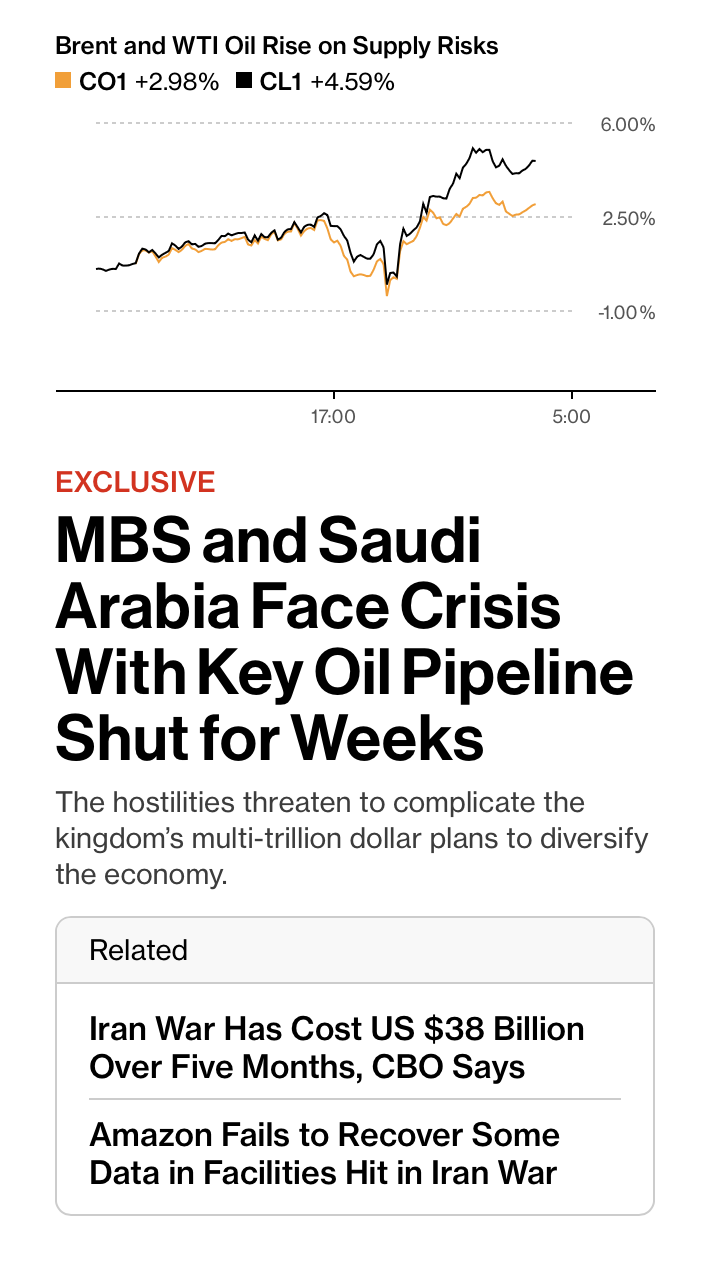
Contrast this assessment with an unduly measured article at Bloomberg. The tell is right in the headline, depicting the likely measure of the export halt as lasting weeks, when months seems more likely ex a big Saudi climbdown . First the landing page yesterday:
From MBS and Saudi Arabia Face Crisis With Key Oil Pipeline Shut for Weeks:
The US-Iran war has reached crisis point for Saudi Arabia and its leader, Crown Prince Mohammed bin Salman, as the Houthis fire at the kingdom on a near-daily basis and capture more territory in Yemen.
The hostilities threaten to complicate Saudi Arabia’s plans to diversify its economy and may push up global fuel prices and add to inflationary pressures, with the potential loss of tens of billions of dollars in export revenue.
The attacks risk hurting Saudi Arabia’s attempts to attract foreign investment and its economy, with the government’s dollar bonds among the worst performers in emerging markets and the potential for the economy to contract.
Notice that the threat to Saudi Arabia is framed as economic, and not one of destabilization and even the risk that the regime may not survive. Readers are encouraged to correct and clarify, but my understand was that oil wealth was the key to Riyadh’s legitimacy, in that the government provides enough in the way of payments to its large underclass to preserve a measure of legitimacy. It can presumably ride out a short loss of petroleum income, but what happens if that become protracted or even open ended?
More from the article:
The kingdom was spared the worst of the Islamic Republic’s counterstrikes against the US and Israel early in the conflict, and was even benefiting from higher crude prices as it used a land pipeline to bypass the Strait of Hormuz.
That all changed when the Houthis started firing at Saudi Arabia on a near-daily basis this month. The Iran-backed militants have also captured more territory in Yemen, where they are based, tightening their control over Bab el-Mandeb, another vital strait for shipping and energy markets. Drone strikes by pro-Tehran militias in Iraq, meanwhile, forced the kingdom to close the pipeline, which carries oil to its Red Sea ports, last week….
UK authorities fear the East-West pipeline, as it is known, may be mostly shut for six weeks, Bloomberg reported on Monday. That would likely push up global fuel prices and add to inflationary pressures, according to several senior European officials.
For Saudi Arabia, it potentially means the loss of tens of billions of dollars in export revenue….
Saudi Arabia has plenty of buffers to help its economy, not least its roughly $1.4 trillion of wealth fund assets and foreign reserves. The country has been able to raise debt on international markets easily this year, attracting plenty of demand.
Houthis Ramp Up Attacks on Saudi Arabia
Saudi Arabia issued alerts for Mecca and Al Ula on Tuesday
Note: Data as of Sept. 14.
Sources: Institute for the Study of War and AEI’s Critical Threats Project, Bloomberg, IMF Portwatch, OpenStreetMap, Saudi Ministry of Energy
Still, the government’s dollar bonds are among the worst performers in emerging markets this month, according to Bloomberg indexes.
The attacks risk hurting Saudi Arabia’s attempts to attract billions of dollars of foreign investment in everything from data centers to its energy industry and electric vehicles.
Monica Malik, chief economist at Abu Dhabi Commercial Bank, sees the Saudi economy contracting 3.1% this year. The slump could deepen to as much as 4.5% — worse than during the height of the Covid-19 pandemic in 2020 — if the East-West pipeline is shut for a month and the government can’t send significant volumes of oil through Hormuz in the meantime, she said.
Notice that the story depicts one month of pipeline closure as the worst case scenario. Some dissenting takes:
Admittedly, Analytica Camillus on Twitter suggests one of the pipeline could be back in service soon ex more Ansar Allah attacks but the other will take a lot longer:
So… the east-west pipeline is really two pipelines (3 if you count a parallel LNG line), one 48in diameter pipeline (the original one from 1981), and another 56in diameter pipeline that came online in 1986.
Along the pipeline’s stretch, there are a series of pumping stations (well, technically, this is one of the “braking stations” — those are more important actually, they modulate the pressure in these pipelines, and there’s only like 5 of them).
The two pipelines (to my knowledge) don’t actually use the same braking stations (and I’m not sure if this one’s for the 48in pipeline or the 56in pipeline), and the other pipeline is actually routed around this particular facility.
So that means there’s good news and bad news for Aramco. The good news is that the other pipeline will probably be back up and running in a few days (until the Houthis blow it up obviously, but we’ll set that aside for now).
The bad news is that this braking station is quite obviously fucked — I said a few days ago that it’d probably take a month to repair it, but Saudi sources put that timeline at between 6 weeks and 8 weeks at a minimum.
Officials are making positive noises, given the givens:
⚫️🟡Repairs to a key Saudi oil pipeline damaged in an attack last week could take three to five weeks, according to two regional officials briefed on the matter.
— Assahifa English (@EnglishAssahifa) September 14, 2026
However:
Satellite imagery now suggests three pump stations were hit, not one.
Pump stations aren’t simple pipeline welds.
They use specialist parts, with long lead times for repair.
Aramco (Saudi state-owned oil company) still hasn’t given a restart date. https://t.co/2IiDS0mBcy
— Frank Curzio (@FrankCurzio) September 15, 2026
Larry Wilkerson had a very important talk with Glenn Diesen where he discussed the poor prospects for the survival of Saudi Arabia as a state. It included important background on the Saudi-Ansar Allah conflict. Wilkerson also took pains to say that any actual or reports of Ansar Allah attacks on Mecca had 90% odds of being an Israeli false flag, with the alternative being Iraq. Nevertheless, the Aljazeera landing page tells us:
Wilkerson first discusses a war planning exercise he was involved in in 1989-1990 From a lightly-edited machine transcript:
Wilkerson: And one of the things we discovered, and I discovered this in a very tactical fashion as a major at Fort Benning, Georgia, training Saudis, Yemen, and others, and finding out the difference between what I would call the southern Yemenis and the northern Yemenis, especially those now constituting themselves as Ansar Allah, the Houthis.
Very tough fighters, very smart, very teamwork, very into one another and into the units that they belong to. That is to say, high morale, competent thinking about things that you would not think that level of soldier would be competent in, but they are.
And then I watched them as they took on that very corrupt, incredibly corrupt government that we were of course fully behind in SA and I watched how that government reacted with our assistance and with Saudi assistance, big time against them, and I said woe is me. This is going to be a huge problem in the future because the Saudis and certainly not the government in SA is corrupt, almost bankrupt, with us holding them up by, you know, the the skin of their neck. This is going to be tough because if these tribes ever get into the fight in a big way…
The minute it happened, with the Minister of Defense Mohammad bin Salman trying to create his bona fides when he first took that position and set himself up exclusively for Crown Prince and then on made his big mistake and attacked them. And ever since then without the United States’s assistance assistance that I tried hard, I mean really hard for a number of years going up against Nancy Pelosi, Steny Hoyer, and a host of other stupid, ignorant Democrats like them, and of course against the Republicans, to get us out of that stupid war because we were the essence of the Saudi ability to continue the struggle. Whether it was extended range F-15s with JDAM kits and bombs, whether it was, and this was key, US provided intelligence or all the other things we didn’t tell the Congress about that we were giving the Saudis and yet they still weren’t able to beat them.
And that was a foreboding situation because I knew when it came time for them to really exercise their valor and their talent that they would be a threat not just to the rest of Yemen, which of course they wish to take over, but also to Saudi Arabia.
And now it’s come true. Ad now we’re paying the piper for that because we, the United States, in our Southwest Asia campaign against Iran, we set a lot of this up. And of course, we set the Saudis up for what’s happening to them right now. And I would say there’s a 50/50 chance we’re going to see Saudi Arabia disappear as a nation state. And I don’t know what means.
Diesen: Say again,Sorry, you said 50/50.
Wilkerson: I said 50/50 chance. It depends on whether we decide we’re going to bolster them and secondarily someone else decides like China. I don’t think that’s coming, because they don’t have much to lie back on. Certainly not a military. Their military I’ve trained their military too. Not that good, not any good at all at ground warfare. The Houthis will eat them up and are eating them up right now.
And Wilkerson points out that the end game could be yet another failed state:
This isn’t an Arab Spring. And we saw how that busted open so quickly. This is force majeure And these people if they leave their tyrannical perches are going to be compelled to leave those perches by force. Think the Houthis for example. Um what does that mean? Because generally speaking, when that is the denouement of a situation like the one we’ve described since World War II really, you have chaos afterwards and maybe you have chaos for a long time. And there’s no one to come in and quiet that chaos. There there are countries with the capability, but they don’t want to come in and do it. And I mean countries like China and Russia and India, maybe even Turkey, but they don’t want anything to do with it.
Larry Wilkerson argues that Jordan is in the most imperiled state (after Bahrain, where Wilkerson speculated that they hadn’t planned to send anyone to a deferred Gulf state meeting with Iran because they had no one to send). From The Hashemite Endgame: The Case That Jordan Is Next:
Nine weeks before the Houthis stunned the region by breaking out of their northern strongholds, Karl Miller told me it was coming…
I lead with that because Miller has now turned the same lens on Jordan, and his conclusion is blunt: the Hashemite monarchy faces economic breakdown and the fall of royal rule inside the coming year…
Miller’s forecast rests on three assumptions stacked on top of one another: that meaningful American protection becomes unreliable at the moment the palace needs it; that organized domestic opposition widens beyond anything concession or coercion can contain; and that the loyalty of the commanders and institutions who make royal decisions enforceable finally cracks. Pull those three together and he sees a collapse sequence that runs in order — external protection loses credibility, opposition expands, palliatives fail, commanders defect, royal authority breaks, and the king is forced out into a contested struggle over what remains of the state.
He is careful, to his credit, to call this a forecast rather than a fait accompli, and to name his own intelligence gaps…
Miller’s sharpest analytical move is to separate three things most commentary blurs together — physical presence, actual capability, and political commitment. American personnel can remain in Jordan, intelligence and financing and logistics can keep flowing, and none of it amounts to a promise to intervene in a domestic confrontation. A monarchy can be surrounded by allies and still be alone at the decisive moment…
The danger Miller flags is not a formal US withdrawal but something subtler: a backstop that is present without being protective at the hour it is tested…
The second pillar is….Jordanians of Palestinian origin make up an estimated 55 to 70 percent of the population — a figure he explicitly flags as an uncertain estimate, not a verified count, with intermarriage steadily blurring the categories — while East Bank Jordanians continue to dominate the army, the security services, and the machinery of state. The vulnerability is the gap between social weight and access to power….
His threshold for real danger is organizational, not numerical: sustained cooperation across Palestinian-origin and East Bank constituencies, joined to groups able to interrupt economic activity, expressed through coordinated strikes and — the decisive marker — defections among the elites who currently keep the system running. He treats organized armed mobilization as a separate and higher escalation threshold, and insists that population size alone establishes none of it…. A July 30 open letter demanding US military withdrawal, signed across both communities, is the kind of convergence signal he says to watch — not yet the thing itself.
The economics give the political story its detonator. Growth ran about 2.8 percent in 2025 against reported unemployment of 21.4 percent among Jordanians — expansion too weak to relieve the household pressure underneath. The state leans on external financing to buy time: a nonbinding US. assistance memorandum…is not the same as money in the account…Reserves offer a cushion — nearly $27 billion in gross usable terms at the end of March… and the mid-2026 baseline still called the debt sustainable and sovereign stress moderate. That baseline, however, assumed disruptions would fade around midyear. September’s fighting breaks that assumption.
His transmission mechanism is the strongest part of the economic case: the crisis reaches the throne through payrolls and payments…..
The fourth pillar brings state failure into the kitchen. Jordan is among the most water-scarce countries on earth….and delivery depends on power, functioning equipment, and utilities that can pay their bills. A fuel or electricity shock can therefore deepen a water crisis without anyone touching a pipe, and the long-term fixes, like the Aqaba-to-Amman conveyance, cannot be powered and plumbed fast enough to matter in an acute emergency. Miller’s operational point is the unsettling one: infrastructure can fail before the politics resolve….
Here is where Miller’s own hedges deserve amplifying. The base rate for predicted Hashemite collapse is poor. The monarchy survived Black September in 1970, when it fought an actual civil war against armed Palestinian factions and won. It survived the 1989 austerity riots. It rode out the 2011 Arab Spring that toppled governments around it. Betting against this throne has a long history of losing, and a forecast of collapse “within the year” should be read against that record, not in isolation.
What makes Miller’s brief worth the desk time anyway is not the certainty of its conclusion but the quality of its trigger list.
Some closing tidbits. From the same Larry Wilkerson talk above, his latest information on the status of Iran and Oman management of the Strait of Hormuz:
So we’re in a mess right now, not just in Saudi Arabia and environments, but of course still in the Strait of Hormuz where I’m still unable even with my contacts in the oil community to really verify for myself on a 24-hour basis exactly what’s happening. I think what’s happening is what you described. I think we have two very narrow channels now agreed to essentially by Oman and Iran.
And those narrow channels are sort of center of mass of the old channel going south roughly the same way out from the shoreline and right next to the flank of the one going south going north. And we have a few ships, not anything near where the total should be, going through those two channels slowly and surely with the blessings of the two littoral states. And most of that, I’m told that is going out fully laden with uh petroleum products is going to China, but I’m not sure. And of course, you’ve got all the lies coming out of the Trump administration from Vance to Hegseth to Trump himself about what’s going on. So, all I can do is hope that my friends and colleagues in the oil industry are giving me the straight boot.
A single MQ-9 Reaper drone costs around $30 million (or more, depending on its specific configuration, weapons payload, and specialized sensor packages). According to reports, the U.S. Air Force’s active, operational MQ-9 inventory had fallen by over 25% to approximately 135… https://t.co/dOSE5CGe9x
— Drop Site (@DropSiteNews) September 16, 2026
🇾🇪🇸🇦 The Houthis say they shot down a Saudi F-15 over Marib with a locally made surface-to-air missile.
Military spokesman Yahya Saree said Houthi forces then engaged 2 Saudi F-15s searching for the wreckage and forced them to withdraw.
⚠️Foreigners just walked out of the 20-year auction. Domestic accounts got stuck with the bag.
Bessent told Congress today Treasury auctions have been the “most successful” in 20 years.
Then the 20-year printed.
$13bn stopped at 5.420%, the highest since the tenor was brought back in 2020. +2.0bp tail. Indirects 52.5%, a record low for this bond. Directs had to take a record 30.7%.
That is not a blow-up. It is a quality failure.
1⃣Foreign official demand collapsed 10.4pp vs August. Capital-flow fact, not noise. FT had it this morning: foreigners prefer U.S. stocks to U.S. duration.
2⃣A 2bp tail is the concession the Street charged to digest paper one day before a hike, with oil >$100.
3⃣5.42% is +22bp vs last month’s stop and above the Oct-2023 high of 5.25%. The long end is pricing term premium + issuance + oil, not the 3.50–3.75% funds rate.
A “successful” auction at 5.42% with no official bid is still a bearish duration event.
Watch the SEP tomorrow. The 20-year already voted.
— Andrea Lisi, CFA (@Andrea_Lisi_CFA) September 15, 2026
And Bessent got even more than he might have expected:
Treasury Secretary Scott Bessent is interrupted by hecklers 5 TIMES while testifying before the House pic.twitter.com/i0fr0DhKTJ



 By
By