
As millions of Australians watched World Cup debutante Nestory Irankunda drill the ball into the back of the net last week, few probably considered the thrilling goal as proof of a successful “monoculture”.
The Player of the Match performance has made the 20-year-old Socceroo, who was just a baby when he emigrated from Tanzania with his family, an Australian household name.
Irankunda is the kind of example a politician asked about their stance on multiculturalism may have thought to draw upon to illustrate one of the myriad ways that migration can enrich a society.
Instead, when repeatedly given an opportunity to offer an opinion on the recent mono- versus multi-cultural debate, Opposition Leader Angus Taylor on Tuesday dodged the issue on the grounds that these were “vague” terms.
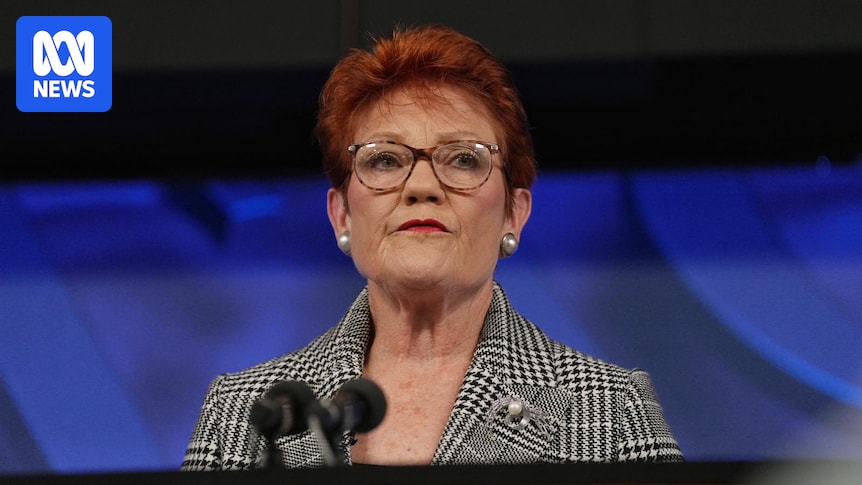
One Nation leader Pauline Hanson showed no such scruples a day later, when she claimed the Socceroos were her ideal vision of an Australian “monoculture”.
World Cup debutante Nestory Irankunda celebrates his World Cup goal. (Reuters: Agustin Marcarian)
Words still mean things
Last week, Hanson declared Australia was a multiracial society, but “cannot be a multicultural” one, and she warned high migration had caused the country to lose its identity.
After facing scrutiny for her comments, Hanson on Wednesday used a speech in the Senate to complain the media had taken her out of context and reported “rubbish”.
Rather than “ban foreign foods” or disband the Socceroos, Hanson insisted the team “in fact represent my vision of a monocultural Australia”.
These players from “different backgrounds and cultures and nations” who were “all wearing the green and gold and representing one nation under one flag and succeeding under the same set of rules”.
Hanson said she was all for “Greek salad … Italian pasta … Chinese stir fry [and] Indian curry” so long as everyone adhered to the same values and rules.
But unlike elements of the MAGA movement in the US, political debate in Australia has not yet descended into a post-truth world.
Words have meaning.
Monoculturalism is the idea of following a uniform set of norms and rules: food, clothing, religion, language and more.
It’s the multicultural society that gets to enjoy the very best of other cultures and celebrate football players who migrate from abroad.
You can’t have your monoculture and eat your banh mi, too.
“You simply can’t have your monoculture and eat your banh mi too,” writes Clare Armstrong. (ABC Radio National: Isabella Michie)
Taylor exposes himself to ridicule
Trying to co-opt the basic tenets of multiculturalism and rebrand them as an ideal “monoculture” is getting dangerously close to the right’s most-loathed pastime: virtue signalling.
Whether or not Hanson manages to convince the electorate of her worldview, voters would be forgiven for struggling to understand Taylor’s stance on the matter.
Perhaps conscious of not wanting to give his One Nation opponents a quote that could be construed as too pro-migration, Taylor avoided saying the word “multiculturalism” when asked several times on Tuesday.
That exposed him to ridicule from Labor, with Treasurer Jim Chalmers using Question Time to posit the idea that Taylor was trying to “out-One Nation, One Nation”.
Jim Chalmers used Question Time to posit the idea Angus Taylor was trying to “out-One Nation, One Nation”. (ABC News: Ian Cutmore)
In a second crack at the question on Wednesday, Taylor eventually confirmed he believed not in a monoculture, but in a “version of multiculturalism”.
None of his Coalition colleagues seemed to struggle as much with their answer on the issue.
Deputy Liberal leader Jane Hume said it most plainly, noting: “We are a multicultural society. Let’s face it, we already are.”
“I don’t give two hoots about your country of origin,” she said.
There is a clear tension within the Coalition about the best way to deal with the electoral threat of One Nation.
While Taylor has revealed he is open to working with One Nation on issues like opposing Labor’s tax changes, other Liberals clearly want nothing to do with the minor party.
That contrast is perhaps nowhere starker than in comments made by frontbencher Andrew Hastie, who used a partyroom meeting this week to tell colleagues: “I would rather get taken out in a box than bend the knee to One Nation.”
“I will never surrender to One Nation, and we will do them, and do them slowly,” he said.
The Coalition’s dilemma is not just whether to work with Hanson; it’s also whether to engage with the arguments she is putting at the centre of Australian politics.
Angus Taylor has said he supports a “version of multiculturalism” with stricter migration controls, but not a “monoculture” as demanded by One Nation. (ABC News: Ian Cutmore)
Millions of Australians tuned in
Barely a few months into the mammoth job of turning around the Liberals’ dire electoral fortunes, there are already whispers among some in the party that Taylor is not up to the task.
His obfuscation on multiculturalism has only strengthened that view.
Whoever leads the Coalition to the next election against Hanson might ponder how deeply ironic it is for the One Nation leader to use soccer as an example of Australian monoculturalism.
More than 4.7 million Australians tuned in to SBS (coincidentally, the multicultural-focused public broadcaster Hanson has vowed to cut) to watch the Socceroos’ thrilling 2-0 victory over Türkiye at the FIFA World Cup.
As noted during the last Women’s World Cup by University of Sydney’s senior lecturer of pedagogy and sport studies, Steve Georgakis, Australia’s relationship with the game most of the world knows as “football” tracked the nation’s transition from a “monocultural society to a multicultural” one.
For decades, the sport occupied a place on the margins of Australian life, sustained largely by migrant communities who brought their passion for the game with them.
Today, the Socceroos are one of Australia’s most popular national sporting brands and one of its most visible expressions of cultural diversity.
This makes the team a curious exhibit for a politician arguing Australia has lost something by becoming multicultural.
Loading

 By
By