
You really needed to search for it. Every mainstream account of Volkswagen slashing another 50,000 jobs in Germany made no mention of the elephant in the room: the Nord Stream wreckage at the bottom of the Baltic Sea and Germany’s loss of cheap and reliable Russian gas.
That’s unsurprising. Aside from a new report popping up here and there about how a few Ukrainian actors did the deed and how they’re avoiding prosecution, the seismic event has mostly been memory holed. It really is fascinating; respected economists can ramble on for hundreds of pages about European competitiveness and ignore Russian energy completely.
But back to Germany where the zeitenwende is turning faster everyday.
Volkswagen’s bombshell comes amid three other major developments: on the heels of Germany blaming Russia for the ludicrous Leipzig airport drone “attack” and coordinated hyperventilating across the European halls of power.
It was also impeccably timed ahead of yesterday’s vote in Saxony-Anhalt, which saw the Alternative for Germany dominate, as it vies with Russia for pole position in the political class’ panicked consciousness.
And it comes before what could shape up as a winter to remember—and not in a good way.
Let’s start with the economics before turning to the political fallout.
Blaming China, Ignoring the Elephant in the Room
Most anything the political class in Berlin finds unwelcome these days is pinned on Russia; in the case of Volkswagen, however, the blame is assigned to Beijing.
And sure there’s something to be said about Chinese industrial subsidies. Just as there is about the US-led West bringing China into the World Trade Organization, relocating a lot of dirty industry there, and reaping the profits for two decades before throwing a fit that Beijing had moved too far up the value chain.
Thing is, in the case of Volkswagen, it doesn’t really apply—not unless the Chinese aren’t supposed to sell their cars in their own country.
I say that because Volkswagen still does okay sales-wise on its home turf. What’s really changed is its sales in China have plummeted as Chinese brands made enormous gains.
For years, VW’s China profits were helping to prop up the rest of its expensive cost structure in Europe. Not anymore.
Now VW is looking ahead and fearing competition from Chinese EVs is coming.
But it’s a mistake to see VW’s job cuts as the direct result of Chinese EVs today. pic.twitter.com/pzmsNaZYZQ
— Kyle Chan (@kyleichan) September 4, 2026
As Chan puts it, “VW’s China profits were helping to prop up the rest of its expensive cost structure in Europe. Not anymore.”
Now there might have been a lot of mismanagement at VW but a major part of that cost structure in Europe in recent years has been the rise in energy costs brought on by Project Ukraine.
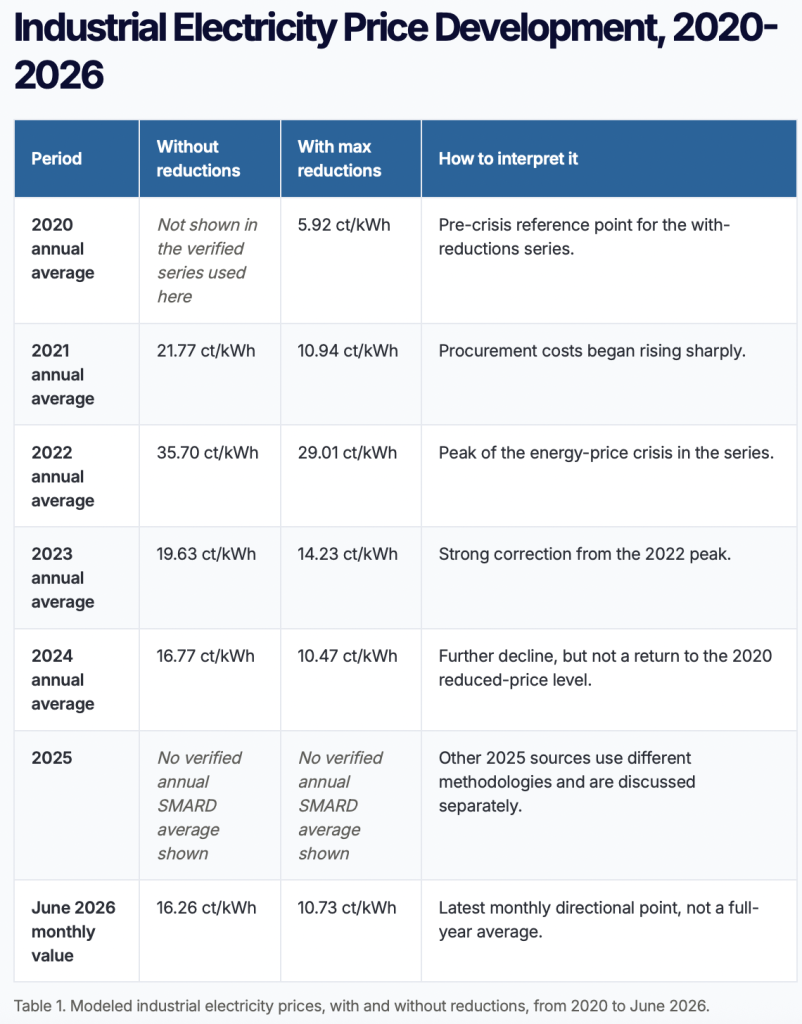
Here’s a snapshot of industrial electricity prices:

Even with prices coming down from 2022 peaks two key problems remain. One, is the cost in relation to other industrial competitors.

And second is pricing instability. For example, as we’ll show here in a moment, there is a chance that industrial activity is forced to pause this winter in Germany so that people don’t freeze.
Important to note about VW plans is that they continue a long-term trend of German industry relocating to low wage Eastern Europe:
This is not the end of Volkswagen’s European production, but rather its relocation from the more expensive core to the cheaper east. The Czech Republic, Slovakia, Poland and eastern Germany are gaining the work that the traditional West German centers are losing. The German concern is thus itself implementing the internal European labor cost arbitrage that it has used for decades to supplement production at home. This time, the supplement is becoming a substitute. Volkswagen remains European, but its production geography is becoming less and less German.
Mercedes-Benz is currently threatening a similar move, telling workers they must accept pay cuts, reduced holiday bonuses, and a longer work week or the company will shutter a factory and invest more in Eastern Europe.
Winter Shortages?
Due to Hormuz-fiasco-inflated LNG prices, Germany is way behind on filling its gas storage for the winter. That means a cold winter could shut down industrial activity in the country.
The picture is bleak across Europe, but Germany with the largest storage capacity in the bloc makes an outsize contribution to the overall shortfall:

Euronews with the lay of the land:
High prices mean it is not currently profitable for companies to buy and store large quantities of gas. Normally, suppliers buy cheaper gas in the summer, store it and sell it at higher prices in the winter.
The war in Iran has driven up global market prices, making storage less commercially attractive. On Friday, the benchmark European gas price, the Dutch TTF front-month contract, was trading at around €69 per megawatt-hour, up from about €29 at the beginning of the year.
German energy group and major gas trader Uniper confirmed to Euronews Business that market conditions were holding back injections.
“Storage spreads have improved recently, but they have not improved to an extent that would make additional storage injections economically viable.”
Are market conditions expected to improve? Not with the US-Israel blowing up wedding parties in Iran, hitting ships in the Strait of Hormuz, and QatarEnergy extending its force majeure notice into late autumn.
If Germany is stuck buying LNG to cover shortfalls this winter there is a decent chance that industrial electricity prices will rise to the level it’s no longer profitable for industry to stay online. That would also mean more inflation, less disposable income, and more job losses. Germany might escape the worst case scenario thanks to an El Nino-assisted warmer-than-average winter. At this point they’re banking on it. According to Rystad Energy, given current reserves the EU needs this winter to be two degrees warmer than the average in order to maintain normal energy supply throughout the winter.
This El Nino is also unprecedented in strength and its effects unpredictable. Europe could see above-average warmth across the whole of winter but with some brutal cold stretches mixed in and above-average to record precipitation.
Praying for an extreme above-average-termperature winter makes for business uncertainty and causes more to look for the exits.
It’s always worth a reminder that American LNG companies are making a killing off this arrangement, and that none of this would be an issue for Germany if Nord Stream was still online.
Perfect Storm for AfD
Unsurprisingly, Alternative for Germany (AfD) is capitalizing off the carnage in the German economy.
Chancellor Friedrich Merz from the Christian Democratic Union (CDU) promised to reform the economy and revitalize the country’s industrial base when he took power in 2025. He has overseen “reforms” by cutting social spending and passing anti-labor policies. It hasn’t helped the country’s industry which continues to hemorrhage jobs. At the same time, he has continued to shovel money into the bottomless pit known as Project Ukraine. Merz is now the least popular chancellor on record, surpassing the hapless Olaf Scholz who came before him. ANd just like the debate within Scholz’s party at the time, Merz’s conservatives are discussing a so-called Kanzlertausch, or chancellor swap.
It’s difficult to see what that would accomplish aside from buying a few months of grace.
The CDU is essentially running the same program followed by the preceding government led by the once-labor-friendly Social Democrats, which are now in coalition with Merz’s CDU. The last government also featured the pro-war Greens and the Free Democratic Party. They have all delivered more of the same disaster, so voters are looking to other options.
Now, as the press hyperventilates over the possibility of the “far right” forming a state government for the first time since WWII, they continually ignore just how crazy the political center—represented by all the above parties—has gone.
Enter the AfD.
The party won in a landslide yesterday in Saxony-Anhalt, coming away with 43.8% of the vote, according to preliminary official results, making it far and away the largest party. From DW:
- Alternative for Germany (AfD) — 43.8%, 39 seats
- Christian Democratic Union (CDU) — 17.2%, 15 seats
- Social Democratic Party (SPD) — 9.3%, 8 seats
- Green Party — 8.9%, 8 seats
- Left Party — 8.6%, 8 seats
- Sahra Wagenknecht Alliance (BSW) — 5.3%, 5 seats
Merz’s CDU plummeted nearly 20 points from 2021 when it got 37.1 percent. Despite the AfD’s domination, it’s unclear if it will be able to form a government as the political establishment has a “firewall” around the party — the promise not to govern with the “far right.”
The Sahra Wagenknecht Alliance might be the exception. The party has some overlap with the AfD in areas like talking with Russia and immigration control, but they differ substantially on economic policy where the AfD is plutocrat friendly and the BSW is pro-labor.
A CDU-led coalition of all the non-AfD parties looks doubtful as Merz’s party also has a pledge not to work with the Left Party. While that might be overcome, it’s almost impossible to see any cooperation with BSW and the others. New elections are a possibility, which is already being welcomed by the AfD, which believes it would score an even higher result.
Elsewhere, the AfD is also gaining strength rapidly in Berlin and Mecklenburg-Vorpommern — both holding elections this month.
Again, unsurprising. You really couldn’t have set it up better for the AfD.
It’s affordability, stupid.
89% of voters for the AfD in Saxony-Anhalt say they are worried that prices rise so much that they can’t pay their bills.
In fact, food prices are up 34.7% since 2021. Wages are lacking far behind & only rose 14.8%.
We need Anti-fascist Economics. pic.twitter.com/5dNXERsFl6
— Isabella M Weber (@IsabellaMWeber) September 6, 2026
The party bills itself as nationalist. It is NATO- and eurosceptic and wants to wrestle more control of German foreign policy away from this institutions. It also assigns a decent amount of blame for Germany’s current woes to the surge in immigration to Germany in recent years and the country’s energy policies. It is a pro plutocrat party that tries to appeal to disenchanted workers by blaming immigration, and does so successfully due to how previous governments embraced record numbers of arrivals with little thought to housing, schools, and culture. Meanwhile those same governments helped wreck the nation’s energy supply and economy.
Despite any misgivings about the party, it’s hard to argue it is perhaps Germany’s best chance to get off the collision course with Russia that the political establishment has embarked on for years now.
One wonders should the party continue its rise—which has only been aided by all the threats to ban it and the “firewall”—how far it would get in rebuilding ties with Russia.
Are they prepared to take on the whole of the EU political class, the spooks, media, to get past the countless manufactured controversies and potential false flags? Would they be prepared to swallow German pride if Russia makes them earn it? Are they prepared to defend energy infrastructure from Ukrainians, Americans, and others?
Or would they take the easier route and play ball with the Atlanticists and potentially, like the “right wing fascist Russia-loving” Giorgia Meloni and the Brothers of Italy, try to settle in for a comfortable extended stay in office?
It’s worth noting that the AfD has pursued stronger Atlanticist ties, albeit with MAGA actors. World’s richest man Elon Musk is already out with his congratulations for the party.
To my eye, the greatest danger for Germany is not that the AfD comes to power and pursues a nationalist path; that at least would provide a chance of peace with Russia. No, the nightmare scenario is that a toxic faux-nationalism fuses with Atlanticism at a particularly precarious and panicked moment in Europe and Germany in particular.
I have a difficult time shaking the feeling that from the perspective of Cold War warriors sitting in Langley, this is all coming up roses. A nationalist party presiding over a collapsing German economy that is increasingly dependent on the US. This is also a Germany closely aligned with Nazis in Ukraine that might soon be looking for a new home. The AfD also has the stated goal of ramping up militarization, albeit with more German control and less NATO. That sounds like a situation the CIA could exploit in their sleep.
Seeing as the far right is ascendant in Germany, reminder that Epstein, Bannon, & the aging Mossadist & Nazi Hunter Rafi Eitan all worked to prop up & normalize the AfD in 2018-19, as I show in “Jeffrey Epstein’s War & the PedoFash International”. Bannon even reported back to… https://t.co/1am2tZRSCM pic.twitter.com/erZaYEgWiQ
— ParaPower Mapping (@KlonnyPin_Gosch) September 6, 2026



 By
By