

That’s EJ Antoni, Chief Economist of Heritage, writing three days ago in the Washington Times:
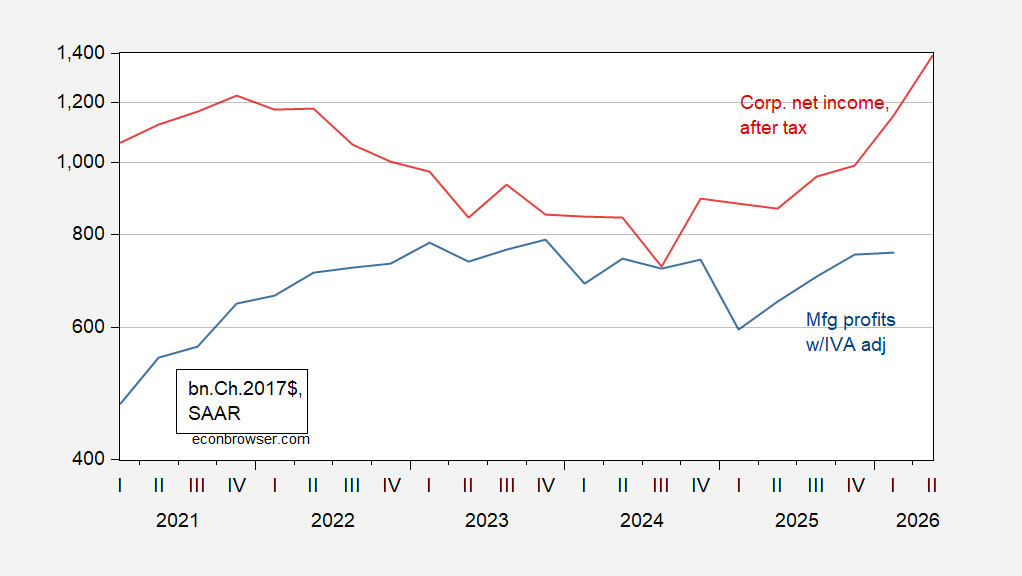
Dr. Antoni is writing about corporate net income after tax. That has definitely soared. Of course, looking at manufacturing profits with inventory valuation adjustments, things look a little differently.
Figure 1: Manufacturing profits with inventory valuation adjustment fm BEA (blue), and corporate net income after tax fm Census (red), both in billions 2017$ SAAR. Deflation using PCE deflator. Source: BEA, Census, and author’s calculations.
Indeed, corporate profits after-tax have surged, particularly in Q2. However, it’s not clear to me that profits with valuation adjustments, before taxes (so registering the actual health and momentum of the sector) have changed so much. After all, just because you can expense some equipment at 100% — so increasing after-tax income — doesn’t mean underlying productivity is higher.
It’s also important to note that Q2 includes IEEPA tariff refunds…
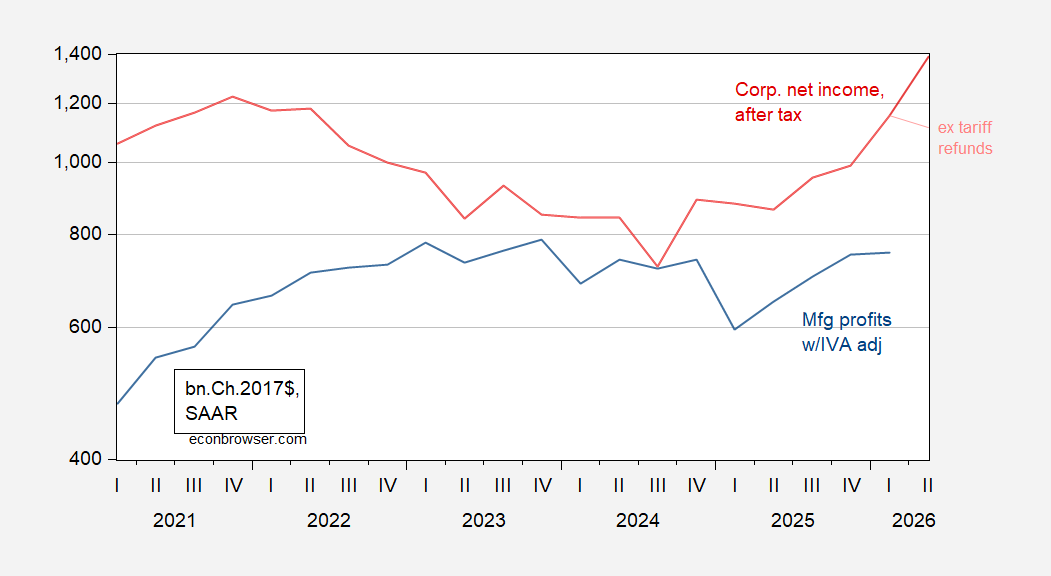
Figure 2: Manufacturing profits with inventory valuation adjustment fm BEA (blue), corporate net income after tax fm Census (red), corporate net income ex-total tax refunds from May and June, all in billions 2017$ SAAR. Deflation using PCE deflator. Source: BEA, Census, and author’s calculations.
On the other hand, I agree that ending the US-Iran war would boost the manufacturing sector, by reducing energy costs, relaxing supply chain constraints, and reducing policy uncertainty.

 By
By