
This is Naked Capitalism fundraising week. 861 donors have already invested in our efforts to combat corruption and predatory conduct, particularly in the financial realm. Please join us and participate via our donation page, which shows how to give via check, credit card, debit card, PayPal. Clover, or Wise. Read about why we’re doing this fundraiser, what we’ve accomplished in the last year,, and our current goal, funding bonuses for our terrific writers.
It has been disturbing to see my YouTube search field full of videos hyperventilating about a dollar collapse and de-dollarization. We have pointed out that the dollar is high by historical standards, to the degree that it is posing a problem for a lot of countries (start with Indonesia, India, and of course, Japan).
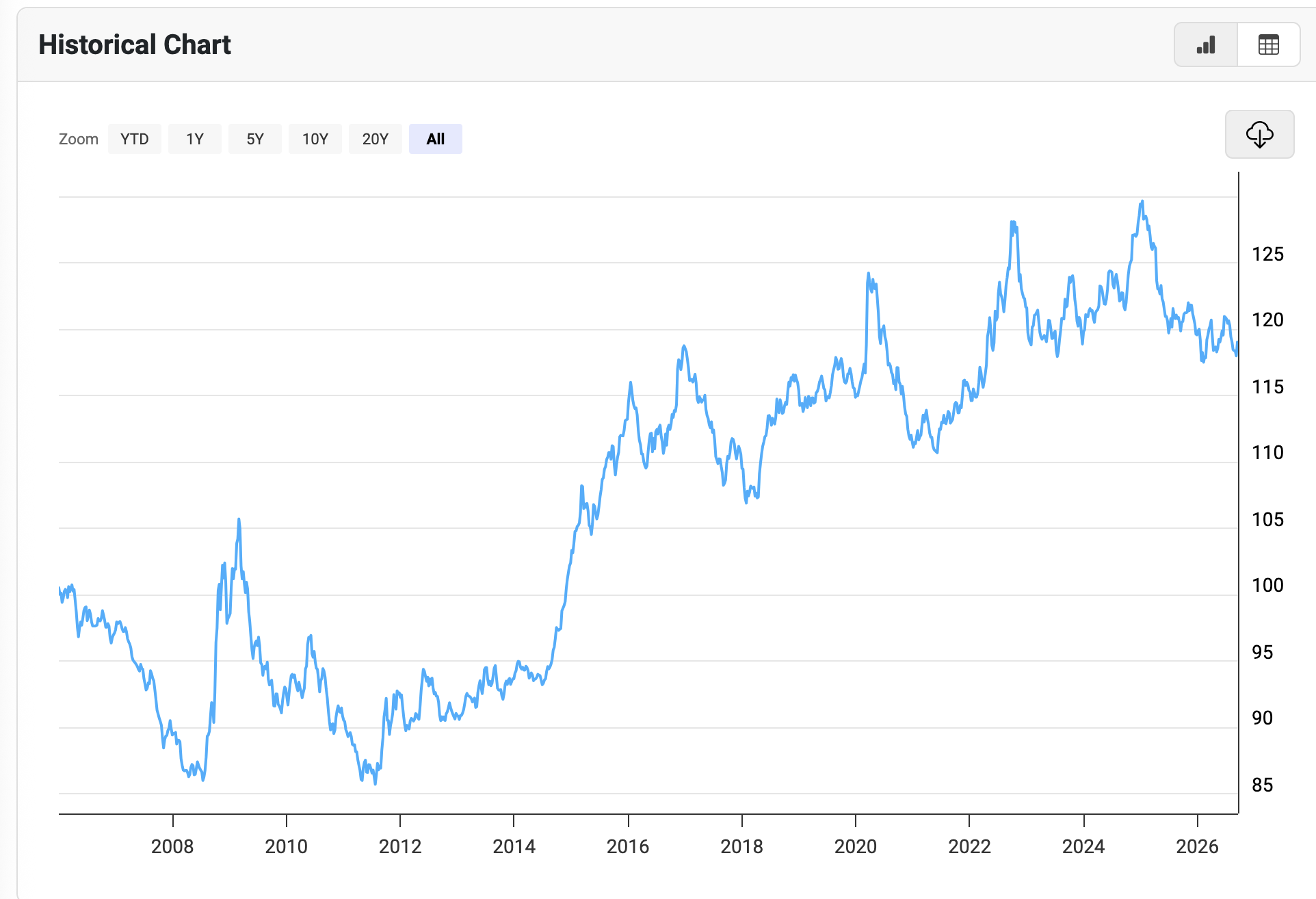
Even with the horribly destructive Trump in charge engaging in investor-rattling behaviors like his Liberation Day tariffs, the dollar has been strong. From Macrotrends:

If you look further back to pick up when the US represented a much larger share of global GDP than it does not, it level is still well within historical norms.
As we said at the start of the month:
As we have pointed out, many anti-globalists allow their distaste for US hegemony to color their readings of the current standing and prospects for the dollar. We have repeatedly stressed that well under 5% are for trade. The rest are financial flows. The big push to find alternative payment mechanisms is for trade, to prevent the US from using sanctions to choke cross-border commerce, as it has tried to do with only partial success with Iran. But getting more international goods payments to take place outside the dollar is not going to have much impact on the use of the dollar.
It is therefore extremely frustrating to see YouTubers, particularly ones who ought to know better, blather on about how the dollar is collapsing. The greenback was meaningfully lower in the dot-bomb ere and even more so in the years after the crisis. Yet no one was carrying on about a dollar crisis then.
That does not mean the role of dollar will not decline. But as Jomo confirms, its sell-by date is later than many want to believe. For instance, even though President Xi has said he wants the renminbi to become the reserve currency, he is not willing to take the necessary steps, starting with running regular trade deficits to get the renminbi widely held overseas, and ending capital controls.

A new report by capital flow maven Brad Stester (via reader Norbert H who sent along a Michael Shedlock1 article), De-reservification, Not De-dollarization, presents data that shows that the current position of the greenback is even stronger than we had suggested.
Stetser, then a former Treasury staffer, worked with Noriel Roubini for a few years around the time of the crisis. Roubini was early to make very detailed explanations (in the form of long lists with numbers) as to why the financial wheels were coming off in a big way. Setser would publish his own analysis of the monthly Treasury International Capital report, where he would often suggest rough adjustments, like for the fact that Treasury purchase listed as coming from London would include a big chunk of Chinese purchases.
Setser has been pointing out for some time that it is misleading to look at central bank holdings of dollars in isolation. I recall him mentioning many years ago that dollar sales by the Saudi central bank, SAMA, were occurring at the same time that the Saudi sovereign wealth fund was buying.
This image from Setser’s article eviscerates the claim that the Chinese are dumping dollars:

Widening the picture to include all of East Asia does not change the overall story much:

And the explanation, again from Setser’s article, is similar to the preview we gave with SAMA versus the Saudi sovereign wealth fund: even as central banks have been lightening up on dollars in their official reserves, other hefty financial players have been buying. From Setser:
The IMF’s data on the currency composition of foreign exchange (FX) reserves is scrutinized carefully for any signs that the world is shifting way from the dollar.
Yet it doesn’t really matter that much if the dollar’s share of reserves has shifted from 56.5 percent to 57 percent. The ink-to-impact ratio of the quarterly reporting on the latest COFER data is all off.
Neither the stock of global reserves nor the stock of dollar reserves has changed much in the last ten years.
The action is elsewhere.
China’s state banks (per the Bank of International Settlements) have almost as many foreign assets as the central bank (PBOC).
Government Pension Investment Fund (GPIF) has almost as many foreign assets ($986 billion) as the government has FX reserves ($1.1 trillion at the end of August). Japan’s FX reserves are on the books of the Ministry of Finance and the GPIF is overseen by the Ministry of Health, Welfare and Labor—so these are almost all assets of the Government of Japan or the broader public sector, not its central bank.
Korea’s National Pension Service has more foreign assets than the Bank of Korea has FX reserves.
A different dynamic is in play in Taiwan, as the government doesn’t run a big retirement fund. But in a world where the hedge ratio of the life insurers has been (and still is) used as a policy tool, the shift in Taiwan’s foreign asset accumulation away from the Central Bank of China (CBC) and over to institutions whose activities in the foreign currency market it directly influences broadly fits into the same theme. So too does the PBOC’s use of the “macroprudential adjustment factor” effectively adjust banks’ net foreign assets in much the same way that CBC regulations adjust lifer hedge ratios.
In the last year, the lifers’ hedge ratios—and their direct hedges with the central bank—have been one of the key tools the CBC has used to manage the Taiwan dollar (and guard the lifers’ solvency).
Asia’s big surplus economies are in a sense just catching up with the world’s oil exporters. Norway put its oil surplus into a sovereign wealth fund from the start. Kuwait, Qatar, and Abu Dhabi (the most oil-rich emirate) all also have large sovereign funds. And the world’s biggest oil exporter has joined them: The Public Investment Fund has almost as many foreign assets as the Saudi Central Bank (SAMA).*
What’s more, the available evidence suggests that the dollar share of these pools is in line with or higher than the dollar share of global FX reserves (it depends on the institution and jurisdiction)
In other words, by looking at the (easily available) data on the world’s static holdings of formal FX reserve assets, scholars and analysts miss most of the growth in the world’s sovereign and quasi-sovereign foreign assets.
Consider China.
>No serious analyst now disputes that China’s state banks—including the policy banks (the China Development Bank, China Exim)—hold several trillion in foreign assets.
China reports $3.3 trillion in gross foreign assets to the BIS (the net position, counting foreign bank claims on the entire Chinese economy not just the banks, is $2.5 trillion). That maps to the BOP data, which shows almost $4 trillion in gross outflows through the banking system (technically, the sum of gross outflows in “other” plus the $500 billion in foreign currency bonds held by the state commercial banks)

There’s more detail in the original article, but the data and analysis above more than makes the case.
As Michael Shedlock summed up in his recap:
So no, China is not dumping dollars. Nor is any other country.
_____
1 Shedlock was also very active during the heyday of the econoblogosphere, and provided a good deal of useful analysis and commentary on the crisis train wreck and its aftermath.


 By
By