


In 2022, as Russian forces advanced into Ukraine, the Starlink satellite communication system became an indispensable wartime asset. Thousands of Starlink terminals restored communications after conventional networks were disrupted, allowing military units, emergency responders, hospitals, and civilians to remain connected under extraordinarily difficult conditions. The speed and effectiveness of Starlink’s deployment represented a remarkable engineering achievement. Built to provide global broadband internet, the constellation demonstrated an unprecedented ability to deliver resilient communications where terrestrial infrastructure had failed. In doing so, it altered expectations about what commercial space systems could accomplish during a major international crisis.
Yet Starlink’s success also revealed a challenge that its designers had not originally set out to solve. As the system became integrated into military operations, decisions about network access, geographic coverage, and permitted uses increasingly carried strategic and political consequences. Engineering choices were becoming governance decisions. The story of Starlink is therefore more than a case study in technological innovation. It illustrates how frontier technologies can rapidly migrate from commercial infrastructure to strategic military resources, confronting their creators with responsibilities that extend well beyond engineering.
Starlink satellite – one of thousands in low Earth orbit.
Engineering Triumph
When SpaceX began deploying the Starlink constellation in 2019, its objective was straightforward: provide high-speed broadband Internet on a global scale. Traditional satellite Internet had long suffered from high latency, limited bandwidth, and expensive user equipment. By placing thousands of small satellites into low Earth orbit and connecting them with laser data links in a continuously developing network architecture, Starlink transformed satellite communications from a specialized service into a global utility.
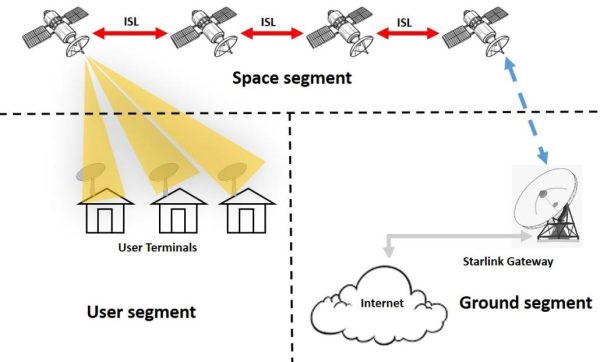
Starlink achieves high-peed global Internet communication by connecting satellites with laser data links (ISL)
The engineering challenge was immense. Rather than relying on a handful of large geostationary satellites positioned 35,786 kilometers above Earth, Starlink employs thousands of satellites orbiting at approximately 550 kilometers. The dramatically lower altitude reduces signal latency to levels approaching those of terrestrial broadband while permitting continuous global coverage through a constantly shifting orbital constellation. Sophisticated phased-array antennas automatically track multiple satellites as they pass overhead, handing communications from one spacecraft to the next with little interruption to the user. Laser transmission between satellites enables swift routing of traffic to a satellite near a ground station, where a radio link connects the data stream to the terrestrial Internet network.
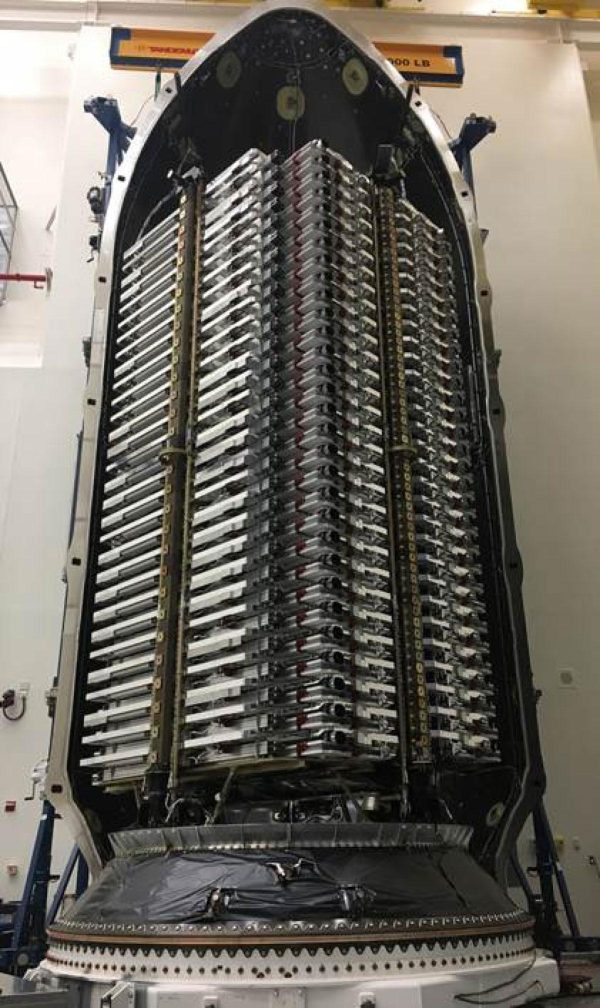
Starlink satellites stacked for launch aboard a Falcon 9 rocket. Launching 60 satellites at a time allowed SpaceX to build the constellation with unprecedented speed.
The scale and speed of the undertaking are remarkable. SpaceX has become not merely a launch provider but the operator of the largest satellite constellation ever constructed. Continuous launches, rapid satellite iteration, reusable Falcon 9 rockets, and increasingly automated manufacturing transformed what had traditionally been viewed as bespoke aerospace engineering into a highly scalable industrial process. The constellation continues to evolve through frequent hardware and software upgrades, allowing capabilities to improve without waiting for decade-long satellite replacement cycles.
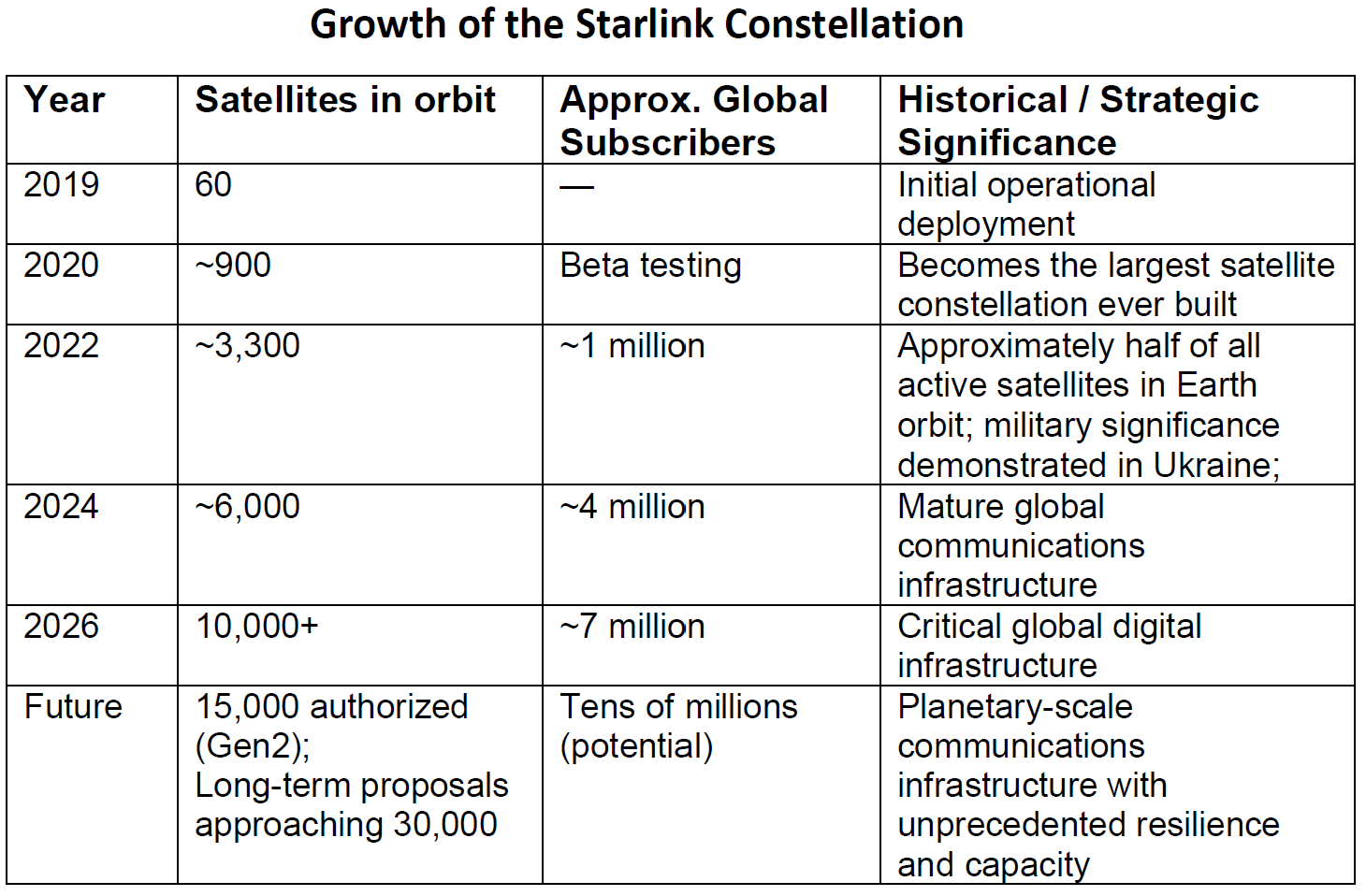
Equally significant was the system’s architecture. Starlink was designed with resilience rather than centralized infrastructure as a guiding principle. Instead of depending upon vulnerable terrestrial communication networks, users require only a terminal with an unobstructed view of the sky. The constellation’s distributed design provides multiple communication paths, allowing the network to continue functioning even when individual satellites, ground stations, or terrestrial infrastructure become unavailable. The result is a communications system whose reliability derives from redundancy and scale rather than from a small number of critical nodes.
These characteristics represented a remarkable engineering achievement independent of any military application. Low latency, global reach, rapid deployment, software-defined networking, and distributed resilience made Starlink one of the most capable communication systems ever developed. Like many transformative technologies, however, the very attributes that made it commercially successful also made it strategically valuable. The transition from engineering success to geopolitical significance would occur with extraordinary speed.
Starlink in the Kill Chain
When Starlink terminals first arrived in Ukraine, their primary purpose was restoring communications disrupted by the Russian invasion. The deployment was widely viewed as a humanitarian response to the destruction of civilian infrastructure. Hospitals, emergency responders, government agencies, journalists, and civilians all benefited from a communications system that could be established within minutes and operated independently of damaged terrestrial networks.
The humanitarian mission, however, represented only the first stage of Starlink’s wartime evolution. In modern military doctrine, the kill chain encompasses the sequence through which intelligence is collected, decisions are made, forces are coordinated, and military effects are delivered. Communications link every stage of that process. A resilient communications network therefore becomes more than supporting infrastructure—it becomes an operational component of combat capability.
The distinction between civilian and military use proved far less durable than anticipated. Modern armed forces depend upon secure, low-latency communications for command and control, intelligence dissemination, logistics, battlefield coordination, and, increasingly, the operation of unmanned systems. The same engineering characteristics that made Starlink invaluable for disaster recovery—mobility, resilience, low latency, and ease of deployment—also made it exceptionally well suited to network-centric warfare. The transition required no redesign of the technology; only a change in operational context.
Starlink’s role extends well beyond providing Internet connectivity to frontline troops. It provides the high-bandwidth, low-latency communications needed to control unmanned systems operating beyond conventional radio line-of-sight. Ukrainian maritime drones, long-range strike drones, and other unmanned systems use Starlink links to receive operator commands, transmit real-time video, and navigate over extended distances. In effect, Starlink became part of the command-and-control infrastructure that guides weapons to their targets, integrating a commercial communications network directly into the modern kill chain.

Starlink antenna on military drone
Because this capability proved so effective, it immediately became the focus of electronic warfare. Russian forces have repeatedly attempted to disrupt Starlink connectivity through dedicated electronic warfare systems designed to interfere with satellite communications. The continuing contest between satellite networking and electronic countermeasures illustrates that Starlink is no longer merely a commercial broadband service—it has become contested military infrastructure.
As Ukrainian forces integrated Starlink into increasingly sophisticated military operations, SpaceX and Elon Musk confronted decisions that had never appeared in the system’s engineering requirements. Requests for expanded capabilities were followed by requests for restrictions. Should service be available in contested territories? Should offensive operations receive the same support as defensive communications? Could a privately owned communications network become an integral component of a nation’s military capability?
The progression was gradual rather than abrupt. What began as humanitarian assistance evolved into increasingly complex decisions concerning acceptable military uses. Reports emerged that certain offensive applications would not be supported, particularly where Starlink might facilitate attacks beyond previously intended operational boundaries. Geographic restrictions, software controls, and later whitelisting policies became mechanisms through which technical configuration expressed policy choices. Access control was no longer simply a network management function; it had become an instrument of governance. The engineering problems had largely been solved. The remaining questions were no longer technical but political: Who should decide where the system could operate, who could use it, and for what purposes? Those are questions of governance, not engineering.
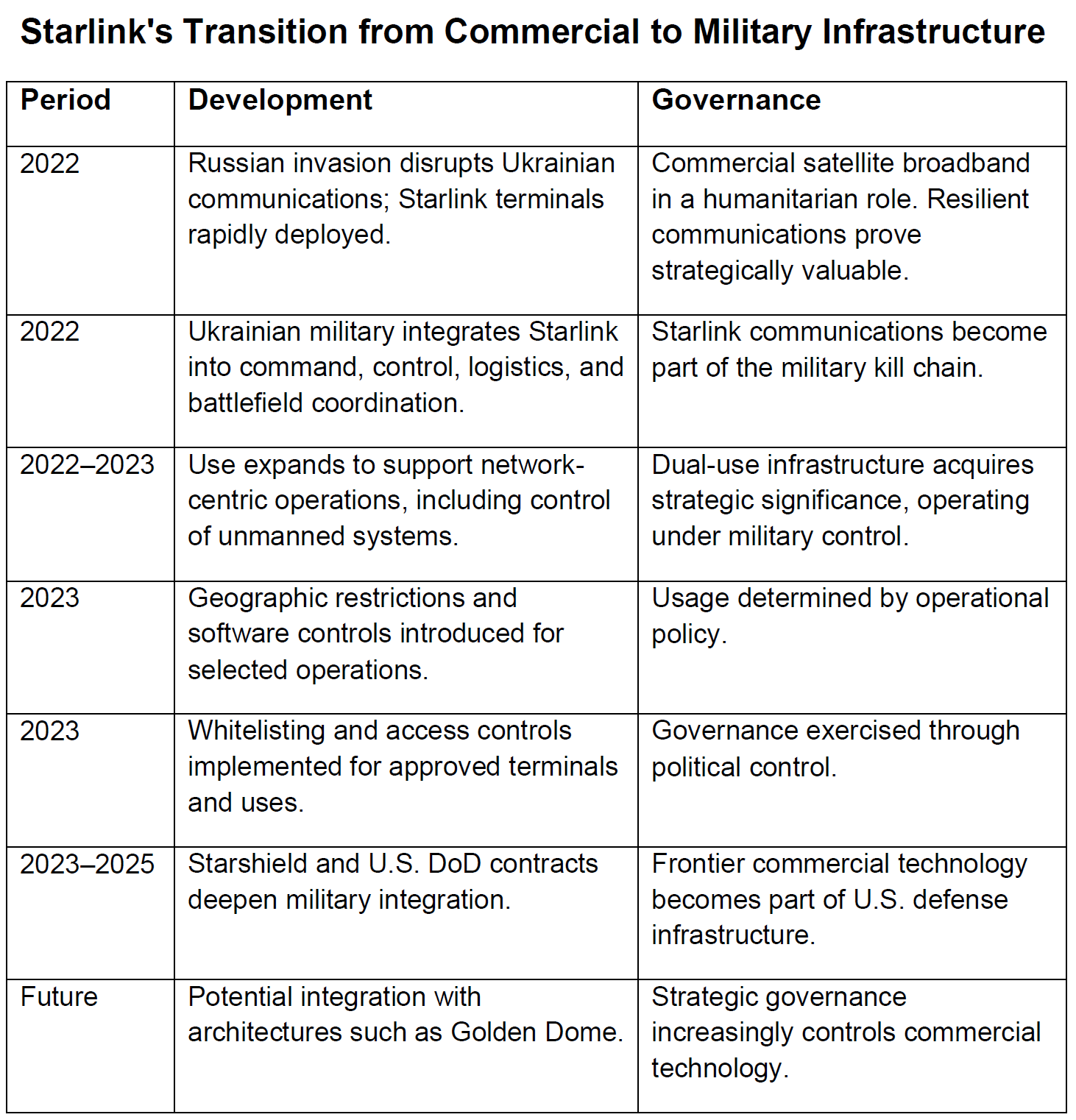
The Technology Governance Challenge
The progression from commercial communications platform to military infrastructure exposed a challenge extending well beyond Starlink’s role in the war in Ukraine. It demonstrated how rapidly frontier technologies can migrate into strategic roles for which neither their designers nor their operators were originally prepared. What began as an engineering achievement became an exercise in governance.
Engineering and governance are fundamentally different disciplines because they optimize for different objectives. Engineering seeks to maximize performance, reliability, efficiency, and resilience within well-defined technical requirements. Success is measured by whether a system performs as intended. Governance addresses a different class of questions: who should control powerful technologies, how they should be employed, and how competing political, military, legal, and ethical interests should be balanced when no purely technical solution exists.
The Starlink experience illustrates how engineering success can unexpectedly create governance responsibilities. Once the constellation became embedded within the military kill chain, decisions concerning software configuration, geographic availability, user authorization, and operational restrictions acquired consequences extending far beyond network performance. Geographic restrictions, whitelisting policies, and access controls ceased to be merely technical features; they became instruments through which technical administration expressed public policy. The network’s architecture had not changed, but its institutional role had.
None of these decisions could be answered through engineering alone. Engineers can determine whether a communications link is reliable or whether a software feature is technically feasible. They cannot determine the appropriate balance between humanitarian assistance and military utility, resolve questions concerning escalation or proportionality, or establish the political legitimacy of operational restrictions. Those judgments belong to governance because they require the reconciliation of competing societal values rather than competing technical constraints.
The pressures of strategic military competition make this challenge even more difficult. In an arms race, incentives favor the rapid adoption of militarily valuable technologies rather than prolonged deliberation over their institutional consequences. States that move first may establish decisive operational advantages, encouraging competitors to accelerate deployment despite unresolved governance questions. The result is a recurring pattern in which governance lags innovation rather than guiding it. Frontier technologies therefore become embedded within military and political institutions before societies have fully considered the broader implications of their use.
This helps explain why the Starlink experience represents more than an isolated wartime adaptation. SpaceX engineered one of the world’s most capable communications networks, yet increasingly found itself making decisions traditionally associated with governments. Engineering organizations are becoming producers of capabilities whose geopolitical consequences extend far beyond their original design objectives. The challenge does not arise because engineering has failed, but because engineering has succeeded so rapidly that governance institutions struggle to keep pace.
Starlink therefore illustrates an emerging characteristic of frontier technologies. As systems become more capable, more autonomous, and more deeply integrated into critical infrastructure, the boundary separating engineering from governance becomes increasingly difficult to manage. Artificial intelligence, autonomous weapons, biotechnology, cyber infrastructure, and other rapidly advancing technologies are likely to follow similar trajectories, migrating from commercial innovation to strategic military usage with surprising speed.
The central question is therefore no longer simply whether a technology works. It is who determines the conditions under which its capabilities may be exercised, according to what principles, and under whose authority. Building transformative technologies remains an engineering challenge. Governing their use has become an institutional challenge of equal importance.
The Next Frontier
The military impact of Starlink extends beyond the Ukraine war. The conflict demonstrated the strategic value of globally distributed commercial space infrastructure and accelerated its incorporation into national defense planning. What began as a commercial broadband constellation is now influencing the design of future military communications and missile defense architectures.
One manifestation of this transition is Starshield, SpaceX’s defense-oriented satellite business. While drawing upon the engineering foundations established by Starlink, Starshield is designed specifically for government and national security applications. The distinction is profound. The migration from commercial communications platform to defense infrastructure is no longer an unintended consequence of wartime necessity; it has become an explicit institutional objective.
The same trajectory can be seen in proposals for large-scale missile defense architectures such as Golden Dome. Whatever form such systems ultimately take, they are expected to rely upon extensive commercial capabilities in launch services, satellite constellations, secure communications, sensing, and data processing. The boundary between commercial innovation and national security infrastructure is becoming increasingly porous. None of this should be viewed as a criticism of engineering innovation. On the contrary, the extraordinary capabilities demonstrated by Starlink explain why governments increasingly seek to incorporate commercial technologies into strategic systems. The challenge lies in the political governance domain.
Conclusion
The story of Starlink is not ultimately about satellite communications, Elon Musk, or the war in Ukraine. It is about the increasingly rapid migration of frontier technologies from commercial innovation into strategic infrastructure. What began as an ambitious effort to provide global broadband connectivity became, within a remarkably short period, an indispensable component of modern warfare and, in turn, a matter of international governance.
Nothing in this progression reflected an engineering failure. On the contrary, it was the success of Starlink’s engineering that made its strategic adoption almost inevitable. The constellation performed precisely as designed. What changed was the environment into which that capability was deployed. Engineering requirements gave way to geopolitical realities, and technical decisions acquired military and diplomatic consequences.
The Starlink experience foreshadows a broader transition already unfolding across many technological domains. Artificial intelligence, autonomous systems, biotechnology, cyber infrastructure, and other frontier technologies are likely to follow similar trajectories as their capabilities become integrated into critical national and international institutions. Their creators may increasingly discover that engineering success brings governance responsibilities extending far beyond the original scope of their work.
Starlink’s two faces are not contradictory. They are successive stages in the life of a transformative technology. The first face is engineering innovation. The second is governance. Engineering enterprises have become extraordinarily effective at expanding technological possibility. Governance institutions have not evolved at the same pace. Premature or improvised military adoption of transformative technologies may produce serious consequences that existing governance institutions are poorly equipped to manage. As frontier technologies become increasingly embedded within military, economic, and political systems, closing that institutional gap may become one of the defining challenges of the twenty-first century.



 By
By