
The mile world record had been stuck at four minutes, 1.4 seconds for nine years when England’s Roger Bannister stepped onto the track at Oxford in May, 1954.
Near the same university where he earned his medical degree, Bannister operated with surgical precision to reach his ultimate goal of becoming the first man to dip under four minutes for the mile.
But, as is so often the case, once a barrier is broken, it reminds others they too can do what just yesterday seemed impossible.
And, sure enough, 45 days later Australian John Landy went around the Turku track in Finland four times in 3:58 flat.
It set the stage for the so-called Miracle Mile at the 1954 British Empire and Commonwealth Games.
Roger Bannister (329) in action against John Landy. (Getty Images: Mark Kauffman/Sports Illustrated)
It was a moment when the sporting world’s eyes were firmly locked on Vancouver, regardless of any connection to the Commonwealth, to watch the best middle distance runners to that point in history face off.
Eight runners made it to the final, but all eyes were on just two as Bannister, who set his sub-four-minute mark of 3:59.8 on a home track with friends pacing for him, would face Landy in the purest competition settings.
The Australian took the lead after one lap and led for the next kilometre and change, going out hard in an attempt to use his superior stamina, as Bannister called it, to negate the Englishman’s famous final burst.
Roger Bannister breaks the tape in the one-mile final in Vancouver. (Getty Images)
Having felt Bannister on his heels and seen his shadow sticking firm under him for the entire race, Landy took one look over his left shoulder about 100 metres out on the final bend, and in that moment Bannister burst past unsighted on the right and flew home to victory.
Both runners finished under four minutes, marking another piece of history.
An exhausted Bannister after the race. (Getty Images: Fox Photos)
A 60-year sabbatical
Despite that glorious event, and a race of almost exactly 1,600 metres seeming to make sense on the world-standard 400m track, the mile was only run at three more Commonwealth Games before swapping it out for the 1,500m after 1966.
New Australian record holder Cameron Myers said it can become prestigious once again.
“I think it’s a way we can attract more people into the sport,” he said.
“Americans still love it, so I think it’s just something that regular people can resonate a little bit more with.”
Cameron Myers is supremely confident in his mile. (AP: Alastair Grant)
At the time of its last Commonwealth outing in Kingston, the Caribbean nations were yet to become the sprint powerhouses we now know them to be, so the mile had been considered the blue-riband event at the Games.
And it returns 60 years later, with Glasgow hoping to host another historic night tonight.
“It’s obviously a very prestigious part of the Commonwealth Games and its history, so it’s really exciting that it’s come back in this year and allowed us to attack it,” said Abbey Caldwell, one of three Australian competitors in the women’s final.
Abbey Caldwell is part of Australia’s stacked middle-distance stocks. (ABC News: Che Chorley)
Caldwell will run alongside Jessica Hull and Claudia Hollingsworth from 6:45am (AEST), and she believes they have a genuine chance of a podium sweep.
“There’s always the pressure of you want to go and achieve those medals, and you want to be the first Australians to do that,” she said.
“But we’re also in a very fortunate position to have three very strong Australians going into this, so it’s a really nice opportunity for us to go take those history books and cement them as Australians.”
Jess Hull (second from right) leads an elite pack of Australian middle distance runners. (ABC News: Che Chorley)
Whether they win them or not, the men (from 5:55am) will get the honour of running for the first Commonwealth Games mile medals in six decades.
And in that race lies a chance for Australia to reverse the misery of Bannister’s late pass in 1954.
Young Aussie wants to spoil the party
Including Bannister’s first trip under the milestone mark, the mile record was broken 19 times in 44 years, when the great Moroccan Hicham El Guerrouj ran 3:43.13 in 1999.
His record stood for 27 years, which the astute among you may recognise as bringing us up to the here and now.
Well, two weeks ago, to be exact.
Josh Kerr played up to the crowd as he qualified for the final. (Supplied)
Just before the start of the Glasgow Games, Scottish 1,500m world champion Josh Kerr ran 3:42.66.
Just two weeks earlier at prestigious Prefontaine Classic, 20-year-old Myers broke Ollie Hoare’s Australian record, running 3:46.06, setting up a tantalising shootout on the mile’s return.
“Kerr’s going to want to make a move at some point, and he’s shown he’s the fittest in the field,” Myers said.
“I think he’ll want to make a move and I’m not going to let him go.”
Landy described the Miracle Mile as “like a title fight”, and just like a battle for a belt, styles make fights.
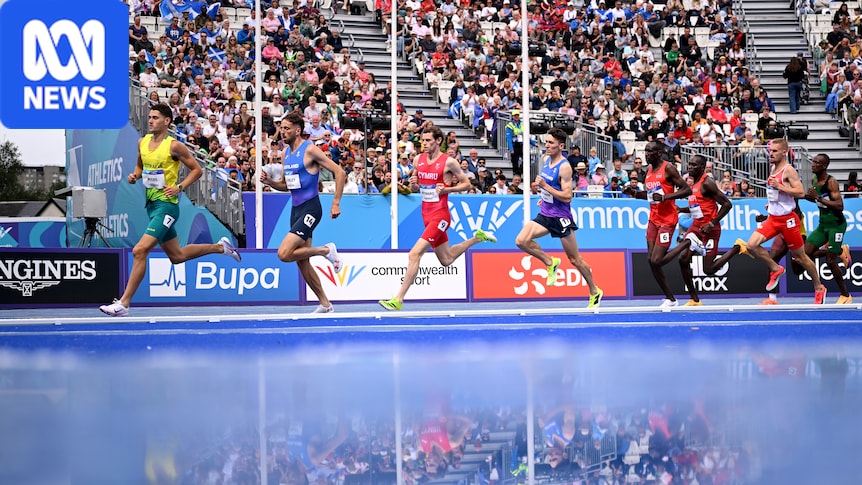
We saw a preview in their separate heats, where both won but Myers was five seconds faster than Kerr.
Myers jumped to the front of his pack and led the whole way home with clinical efficiency, while Kerr sat in the pack until the last lap before ambling to the front and revving up the crowd with 150 metres to go.
Josh Kerr fired up the Glasgow crowd as he coasted into the final. (ABC News: Che Chorley)
The Scotstoun Stadium crowd will be baying for Kerr and 2022 world champion in the 1,500m Jake Wightman, but young buck Myers is out to prove himself in an elite field.
“I’m a competitor, I don’t want to lose,” he said.
“I’m not going there to come second, so I’ll have a crack at him the best I can and if I blow up trying, so be it.
“Everyone’s cheering for the Scots, and I’m sure they want to go 1-2, so I’m trying to spoil that.”
The mile start line sits 9.34 metres behind the start/finish line. (ABC News: Che Chorley)
Myers will also be running alongside teammates, with reigning 1,500m Commonwealth champion Ollie Hoare and 24-year-old Adam Spencer making it through.
The final night of the athletics program on the penultimate day of the Games feels like the perfect time for a clash between the hosts and the runaway medal tally toppers.
If the Aussies can ruin the party, they would have done what Landy couldn’t 72 years ago.
And Myers is well aware of the opportunity in front of him.
“Hopefully I can reverse the roles.”

 By
By