
This is Naked Capitalism fundraising week. 792 donors have already invested in our efforts to combat corruption and predatory conduct, particularly in the financial realm. Please join us and participate via our donation page, which shows how to give via check, credit card, debit card, PayPal. Clover, or Wise. Read about why we’re doing this fundraiser, what we’ve accomplished in the last year,, and our current goal, continuing expanded daily Links
***
Germany’s Chief of Defence, General Carsten Breuer, kicked off a recent summit in Prague with a quote: ‘Wars are not won with speculations. Wars are won with soldiers.’
Who said that? Carl von Clauswitz? Erich von Manstein? No, it was Captain America in the 2011 superhero film.
It’s tempting to describe that choice as fitting considering the derealized state inhabited by most of those in power in Europe. Regular readers of this site are familiar with the issues facing Europe in its great rearmament more spending doesn’t equal more power, overpriced and ineffective hardware, outdated doctrine, an insufficient—and declining—industrial base, lack of military research capacity, overreliance on the US, military logistics, troop readiness, and Captain America is struggling with the same military production issues and won’t be coming to save them.
What’s so bizarre about the daily hysteria in Europe over drones and Russian “hybrid warfare,” and the apparent desire to provoke Moscow is that despite all the years of talk of rearmament, the EU still has not overcome basic upstream supply chain hurdles.
As the International Institute for Strategic Studies (IISS) Prague Defence Summit held Sept. 16-18 demonstrates, the continent’s political, military and industry people are keenly aware of their shortcomings in war readiness.
They are still racing—or talking about racing—to catch up. And they’re still making big plans. Just today comes news they’re discussing “Nato-style joint responses to Russian hybrid attacks.”
Yet the recent IISS gathering revealed yet again that only has the EU not overcome basic supply chain issues, but they have no functional plan to do so.
We’ll get to that in a moment but should first note that IISS, which is based in London, is like all the defense think tanks, funded by the usual suspects: Airbus, Lockheed Martin Corporation, BAE Systems, Raytheon, Boeing Company, Rolls-Royce, and Middle East Gulf oil money.
And so among the parade of experts, military men, and politicians who are trotted out to opine on military hardware and destruction it’s sometimes hard to distinguish between who are the die hard Russophobes desperate for war and who are simply grifters and the neoliberal ideologues who see this as an opportunity to finish the tearing down of European welfare states in the name of rearmament. There’s likely a lot of overlap as a guiding light of American Cold War ideology, which continues today and is now ever present in the vassal states of Europe, is that class warfare at home and funneling all of social capital toward wonder weapons paves the way to victory.
The European elite have embraced this philosophy—even if there are key differences between then and now, and here (the EU) vs there (the US).
Apologies for the long introduction, but I oftentimes need to try to put all this tragic craziness into context for my own sanity. Now let’s dig into the IISS report from its summit and its telling omissions that the EU still has no answers.
Defence-Production Demand, Increases and Challenges
The IISS summit report notes yet another example of the EU’s plans to overcome its industrial shortfalls:
As part of its European Defence Industry Programme, the EU in July 2026 also proposed five ‘European Defence Projects of Common Interest’ to advance joint procurement across the following priority areas: UAV and counter-UAV systems, maritime and seabed defence, space capabilities, air and missile defence, and strengthening security along the eastern flank.10 However, at present the initiatives remain very much in the proposal stage.
That is fitting. The bloc continues to make loads of plans and spend even more money. Yet despite endless contracts, the struggle continues to produce 155 millimetre ammunition, ground-based air and missile defence, unmanned aerial vehicles, and other war products.
Why is that? The reasons remain the same, as noted in the IISS summit report:
Supply-chain bottlenecks are another problem, particularly in energetics and rocket motors, where efforts are under way to establish alternative sources within Europe. Lastly, there is a shortage of skilled labour, particularly among early- and mid-career personnel.
…export restrictions imposed by China negatively affected European civil-sector and defence companies.10 European governments and companies are increasingly concerned with the extent of China’s dominance in the extraction and refining of CRMs important to defence and other sectors of the economy, although Europe lags behind the US in addressing the problem.
They were concerned two years ago, so it seems we’ve progressed to the “increasingly concerned” stage today. And tomorrow is probably more likely to bring the let’s-go-to-war-and-hope-for-the-best stage rather than acceptance.
Another complication has been the apparent reluctance of some suppliers outside Europe to approve the export of finished defence products or subsystems ultimately destined for Ukraine or NATO members near Russia.
Okay. So they can’t build them themselves and can’t buy them. That sounds bad, but we’re only roughly five years to a decade (some would differ on the start date) into the full-blown war-with-Russia hysteria, so let’s give them time.
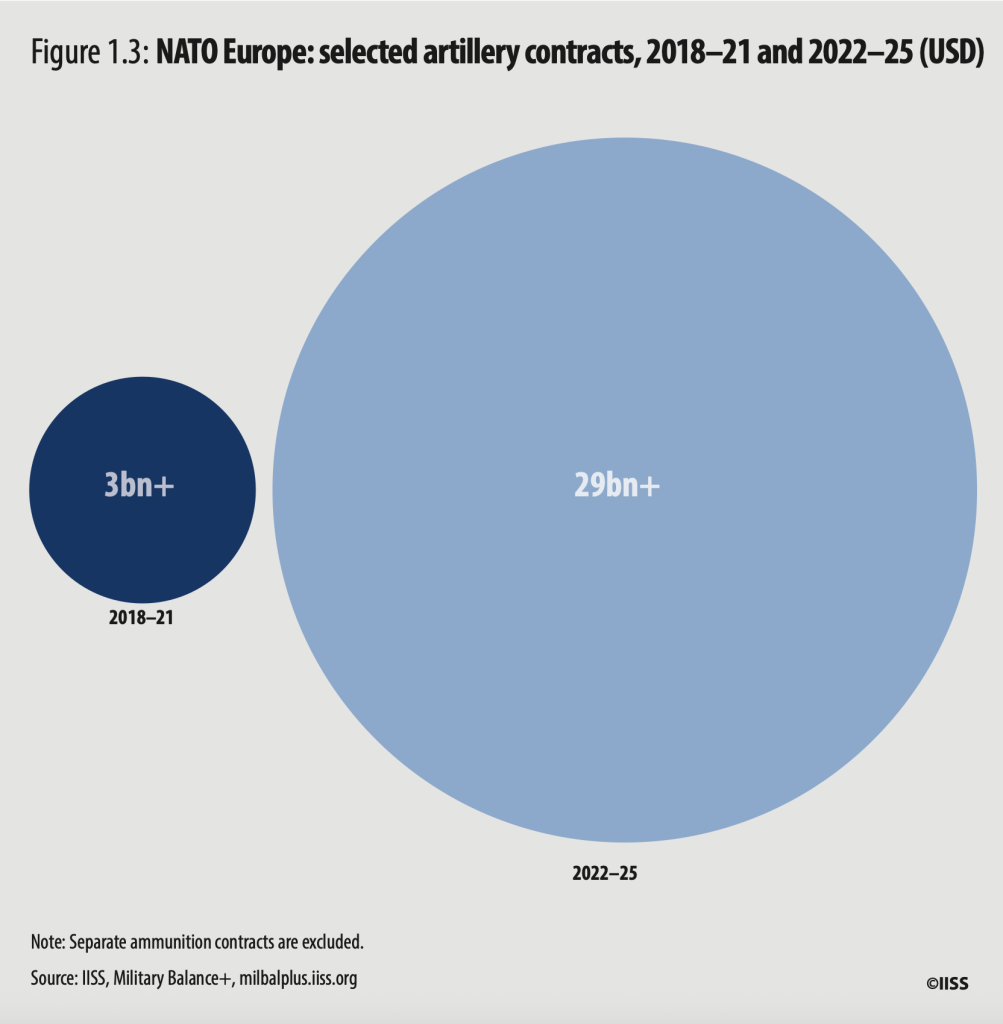
The IISS Summit championed European shell production as a success story since EU countries are spending a lot of money:

Small circle becomes big circle success story.
Yet production struggles remain:
155 mm production collective production capacity now likely exceeds 1.6m rounds per year and could reach 3.5m by the end of the decade if current production rates and expansion plans are maintained.
For some context, Ukraine fires about two million shells per year. Russia is already producing three million artillery shells per year. And Europe is nowhere close to catching up. Why?
…development of alternative propellants and explosives to remove the need for nitrocellulose and nitroglycerine, the supply of which represents a major bottleneck and a significant dependency on China and other suppliers.
Are there solutions? Yes, they agreed at the IISS Summit:
…a flurry of M&A, new and expanded production, and technical innovation has taken place across the continent….previously civilian-focused businesses can be utilised for the defence sector.
They note Rheinmetall’s acquisition of Hagedorn-NC, a manufacturer of nitrocellulose for civilian purposes as a major achievement.
One of the most important efforts – and a rare example of multinational cooperation in this sector – is the agreement between Denmark, Finland, Norway and Sweden in 2025 to further cooperate on ammunition production, through Nammo, and establish a resilient capability that can supply forces stationed in Finland and elsewhere.
But Nammo CEO Morten Brandtzeg said just last week that the company’s plants are operating at full capacity just to try to hold the crumbling lines in Ukraine. According to Brandtzeg, European militaries are unable to rebuild their reserves of 155mm shells because everything Nammo produces is currently being sent to Ukraine.
Nammo is increasing its capacity to produce 155mm ammunition with a new plant expected to begin production next year, but Brandtzeg said the facility’s capacity would be enough for only seven days of fighting in Ukraine, according to Voennoye Obozreniye.
That is, according to the wise leaders gathered at the IISS summit, “one of the most important efforts” Europe is undertaking to ready itself for a conflict with Russia.
Are there other important efforts?
IISS mentions that perhaps by 2030, there could be at least four TNT producers in NATO Europe (as opposed to the lone one in Poland now). In the meantime, China and Russia are the leading TNT producers in the world, and they ain’t sending it West. Even if Europe gets more TNT plants up and running, they’re already way behind and in case of war with Russia, how well defended might those plants be?
‘AI Will Save Us’
Despite the above-mentioned issues and more, IISS declares that major strides are being made on the AI front:
United Kingdom-based industrial-technology start-up Isembard and Germany’s defence ‘scale up’ Helsing are looking to boost resilience and manufacturing capacity through a combination of distributed production facilities, the use of advanced computer numerical control (cnc) machinery, and optimising processes – including the use of artificial intelligence (ai). Isembard is pitching its Masonos software as a means of integrating the management of scheduling, supply chains, manufacturing, quality control and deliveries, with agentic ai used to automate and continuously adapt processes…Its manufacturing processes are intended to leverage commercially available materials and manufacturing techniques
Ah, so it’s not Russia using washing machine components? The problem with looking to AI to be the savior is that no matter how much it’s leaned on, it can’t create its own supply chain and magically make real things like batteries and fiber optic cables appear out of thin air. And for now the EU remains almost entirely dependent on China for these products.
If You’re Championing AI as the Solution, You Haven’t Got a Solution
Alas, despite years of talk, here’s where the EU is:
Along with achieving coordinated procurement, tackling the critical dependencies that persist in the defence supply chain remains vital.
Yeah someone should really get on that—preferably before the missiles start flying.
Russian Foreign Minister Sergey Lavrov warned of the danger that active talk among European politicians about war with Russia could become a “self-fulfilling prophecy.” pic.twitter.com/yp0iPyCsAQ
— Victor vicktop55 commentary (@vick55top) September 27, 2026
Europe, while it might fancy replaying the American Cold War narrative of exhausting the USSR through an arms race, finds itself on the losing end of the financial race, as well. As IISS admits:
Sharply increasing defence spending, and thus the amount and scale of major procurement contracts, has not been possible in countries in a difficult fiscal position, such as France and the UK…extra spending in many European countries has been paid for by borrowing. Concern that the pace of defence-spending growth may slow in a few years as repayments begin might be limiting investments in the sector.
Yes, and are there other concerns aside from just “defence-spending growth”, such as collapsing social systems?
One item these think tanks like IISS never deal with at their summits is the political fallout. Here too Europe is just as likely to lose as it is on the military production front, as the elites turn on one another or maybe, finally Europeans begin to understand how much the Russia threat is emanating from inside the house.
Richard Youngs, a professor of International and European Politics at the University of Warwick argues that more societal input is needed as the EU moves toward “whole-of-society security”:
Concerns are rising in several European countries about the need to embed and constrain future German military power within a more deeply integrated EU. Calls for a “European army” are resurfacing, most recently by the Spanish government – but still without political precision.
Defence spending is growing not just through national governments, but EU-level instruments that entail deeper collective security. Many European governments are pushing towards Nordic-style, whole-of-society security in which military and civilian resources mobilise in unison. The EU’s Preparedness Union Strategy, introduced in 2025, is aimed at this too.
Such considerations show that a securitised Europe must be underpinned by continent-wide political debate and channels of accountablity. As citizens are asked to mobilise around full-spectrum defence, they need a greater say in security policies. They need a voice in the trade-offs that higher defence spending will require, and how to manage issues such as Germany’s incipient military predominance.
However, the process of rearmament is currently being carried out in a way that reinforces the opaque, crisis-mode features of EU decision-making that have nourished illiberal populist parties. Europe will struggle to legitimise its security turn without rivitalising its collective political system in ways that provide stronger and more active societal input.
Societal input? Please. Project Ukraine has only grown more unpopular despite round the clock propaganda. Parties opposed to it are squashed while the EU and national governments crack down on all forms of dissent.
The people’s input has been rejected.



 By
By