
Adiba Ganji knew that her life wouldn’t be the same if she stayed in Afghanistan.
“It was a Friday afternoon. We heard that the Taliban are coming,” she told the ABC.
On August 15, 2021, the Taliban captured Kabul as the last remaining United States troops withdrew from America’s longest war.
Two years earlier, the then-14-year-old had been selected to play for Afghanistan’s national soccer team.
Cultural norms meant it was already difficult for women to play sport in the country.
But under Taliban control Adiba knew women would not even be free to work or study, let alone compete in sport.
She knew she could not stay in Afghanistan.
“I was counting the airplanes in the sky and I wanted to be in them, I wanted to just go,” Adiba said, recounting watching hundreds of humanitarian flights leave Kabul’s international airport.
A soldier stands on the tarmac at Kabul International Aiport when thousands were evacuated. (Supplied: Adiba Ganji)
But freedom meant leaving her family.
The 16-year-old packed her bag with a bottle of water, two pieces of bread, her passport and national ID.
Describing the memory through tears, Adiba recalled the moment she told her mother she was leaving for the airport.
“It still reminds me of how I left my country,” she said.
“How I left the place where I grew up, my childhood, my family.“
According to the Department of Foreign Affairs and Trade, Australia’s military evacuated 4,100 people on 32 flights from Kabul between August 18 and 26, 2021.
Adiba and her older brother were two of those passengers, leaving their parents and four siblings behind in Kabul.
Refugees lining up for an Australian evacuation plane during the fall of Kabul, taken by Adiba Ganji on her phone. (Supplied: Adiba Ganji)
After weeks of waiting, travelling, and not knowing where they were going, the pair arrived in Melbourne.
“When we told our family that we are in Australia, they could not believe us,” Adiba said.
Adiba started to learn English, worked at a cafe in Melbourne’s CBD and moved into a house in Dandenong, in Melbourne’s south-east, with her brother.
She eventually joined nearly 30 of her teammates who also fled Afghanistan playing soccer for Melbourne Victory’s Afghan Women’s Team.
Adiba Ganji has been playing for Melbourne Victory’s Afghan Women’s team since arriving in Australia in 2021. (Takeover Melbourne: Marc Eiden)
Building a new life in Australia
Adiba missed her family and was determined to get the rest of her family to Melbourne.
With the help of Victoria Legal Aid, a statutory authority that provides free legal assistance to financially disadvantaged people, Adiba was able to support her sister Arya, two younger brothers and mother to reach Australia.
Adiba and her brother were reunited in Melbourne with her mother and siblings in 2024. (Supplied: Adiba Ganji)
The two sisters said they were overjoyed when they reunited in 2024 after three years apart.
“I’m really happy here with my family. And I really appreciate my sister, she helped us a lot,” Arya said.
Arya, now 18 years old, is attending high school, something that would have been impossible in Afghanistan.
Arya and Adiba didn’t know if they would ever see each other again after being separated in 2021. (ABC News: Danielle Bonica)
Adiba and Arya live with their siblings and mother who feared she would never see her daughter again.
“She’s a really beautiful mum, and she’s here now,” Adiba said.
Their father and older sister are currently in limbo in Pakistan where the government there has been deporting Afghan citizens without valid documentation back to the Taliban.
But Adiba is hopeful they’ll be able to join the rest of the family in Melbourne soon.
Arya and Adiba speak with their father and sister who left Afghanistan and now live in Pakistan. (ABC News: Danniele Bonica)
Barriers in citizenship applications
Five years after Adiba fled Afghanistan another milestone is within reach: Australian citizenship.
Victoria Legal Aid project coordinator Gaetano Romano said there’s a general perception that legal advice isn’t required when applying for Australian citizenship.
“The reality for many applicants is it’s very difficult to produce the circumstances of their previous life before they arrived in Australia,” he said.
Gaetano Romano said freely available legal services are under-utilised in citizenship applications. (ABC News: Danielle Bonica)
Senior lawyer Yoko Kamanda agreed, saying a lack of identity documents, information being recorded incorrectly and the citizenship test itself can be barriers for refugee applicants.
“Most of our clients don’t even have a passport,”
she said.
Through a little-known citizenship provision, Arya would soon become an Australian citizen before her older sister.
For children 15 years and younger applications are usually made alongside one or more parent, while migrants over 18 years of age are required to complete an individual application, typically after residing in Australia for four years.
Victoria Legal Aid senior lawyer Yoko Kamanda supports young people in applying for Australian citizenship. (ABC News: Danielle Bonica)
Ms Kamanda said provisions in the citizenship application process allow people aged between 16 and 17 the opportunity to apply for citizenship individually without meeting some requirements of over-18 applicants — such as completing the citizenship test and meeting the residency requirement.
“There is a misunderstanding in the community that everybody has to wait for four years,” she said.
“But it actually only applies to adults, not for children, but it’s not well-known.”
Since 2023, Victoria Legal Aid has supported just under 1,000 migrants under the age of 25 in applying for Australian citizenship.
Ms Kamanda said many young migrants simply do not realise they may be eligible to apply before reaching adulthood.
“We’ve met so many clients who missed their opportunity to apply for citizenship before they turned 18,” she said.
Yoko Kamanda supported Adiba and Arya in applying for Australian citizenship. (ABC News: Danielle Bonica)
The agency assisted Adiba and Arya in applying for their citizenship, and because Arya was 17 at the time she received her citizenship before her older sister.
“I was surprised, happy, really excited,”
Arya said.
“It makes me feel jealous. She’s only been here two years, I’ve been here more than that and she gets citizenship,” Adiba chuckled.
Arya was successful in obtaining Australian citizenship in 2026 at the age of 17. (Supplied: Adiba Ganji)
Arya said being an Australian citizen meant safety, education and opportunities for her family.
“I want to become part of the community and being a citizen will help me build my future here with better opportunities to work, personal growth, and most importantly continue my education,” she said.
Meanwhile, Adiba’s application has been approved. She’s now waiting patiently for her citizenship ceremony later this year.
Adiba is looking forward to receiving her Australian citizenship at a ceremony later in 2026. (ABC News: Danielle Bonica)
Looking to a new future
The Ganji sisters are excited to start a new chapter as Australian citizens.
“I’ve been practising my Aussie accent,” Adiba laughed.
Arya said she would like to become a doctor, to serve her fellow Australians and make a positive difference in their lives.
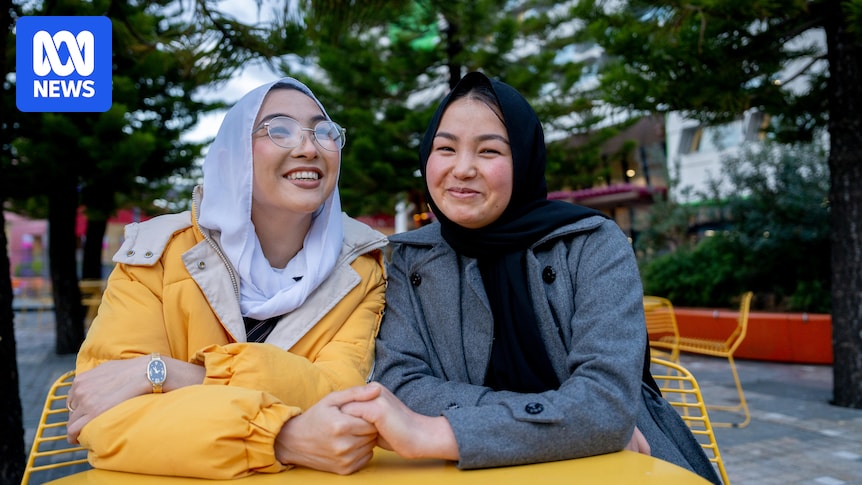
After a challenging journey, Arya and Adiba and looking forward to their next chapter in life as Australian citizens. (ABC News: Danielle Bonica)
For Adiba, soccer was put on pause while she supported her family during the visa application process, but she says she’ll be back on the pitch very soon.
She hopes to start her own hospitality business in Melbourne and use her new Australian passport to travel overseas.
For now, the 21-year-old has turned her attention to supporting her father and older sister to leave Pakistan.
“Every day I’m still dreaming. The day I go to the airport, after six years, I will maybe cry all day from happiness,” Adiba said.
“I can’t wait.”

 By
By