
POTUS Trump seems to have TACO’d again, delaying any renewed attacks on Iran until after the US midterm elections while Ansar Allah hit Saudi airports and closed in on the key Yemeni highland city of Taiz as Islah forces pulled out, and explosions rang loudly in the Strait of Hormuz.
TACO Thursday With a Side of Maybe Not In San Antonio
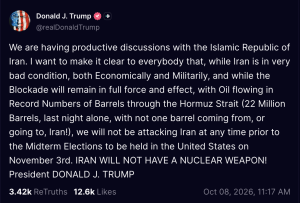
Trump Truth’d Thursday’s TACO:

Key points:
- “We are having productive discussions with the Islamic Republic of Iran,”
- “22 Million Barrels, last night alone, with not one barrel coming from, or going to, Iran!”
- “We will not be attacking Iran at any time prior to the Midterm Elections to be held in the United States on November 3rd.”
This contradicts what Trump said in San Antonio, Texas, on Wednesday: “I think the deal isn’t really something that I want to do, but they’re willing to offer us anything to stop.”
Cynics will ask if Trump’s decision was influenced by the rapidly increasing price of oil futures, per the NYT:

Seymour Hersh does some epic water-carrying in his latest post:
I have been reliably told by American and Israeli sources that things are quietly happening in secret talks between Washington and Tehran as the economy in Iran continues to plummet and the only way forward for Iran’s leadership is to obtain a settlement focused on its nuclear program.
…
The Iranian regime, the American acknowledged, is now facing a collapse of institutions, including the IRGC. Many Iranian citizens are out of work, hungry, and financially desperate. He believes the population could soon be on the verge of open revolt that would not, as in earlier demonstrations, be subject to murderous retaliation from IRGC members because many in the rank and file are unpaid and demoralized. He noted that just this past weekend there were demonstrations throughout Iran, including in Tehran, by retirees and workers who, according to published reports, were protesting rising poverty and unpaid retirement funds. There was no intervention by the IRGC, although executions of dissidents are still being authorized by the Iranian judiciary.
Iran’s Tasnim has the Iranian perspective (note that they transliterate MB Ghalibaf’s name with a different spelling than we’re used to):
Iranian Parliament Speaker Mohammad Baqer Qalibaf warned that the enemy has shifted its focus toward fomenting insecurity and violent acts inside Iran after failing to harm the country through military action.
Referring to the large-scale US-Israeli military aggression against Iran during the 40-day imposed war, Qalibaf said the Americans have realized that military action could not inflict damage on Iran, adding that this has created a deterrent effect.
“For this reason, they have concentrated serious and fundamental pressure against Iran on economic issues and disrupting security inside the country,” he said.
Qalibaf stressed that the enemy’s planning is focused on violent actions inside Iran, saying this strategy indicates that strengthening economic resilience and ensuring domestic security should be the country’s top priorities.
It’s not clear that IDF Chief of Staff Eyal Zamir got the TACO news per this Friday’s Jerusalem Post report:
IDF Chief of Staff Eyal Zamir was briefed on American military preparation for a return to fighting against Iran in the upcoming weeks, a senior American official told N12 News.
According to the sources, Zamir warned that a return to war within the next three weeks could cause the Israeli election, scheduled for October 27, to be postponed. This comes after an assessment that renewal of large-scale US attacks on Iran could lead to the Islamic Republic launching missiles at Israel, N12 added.
Before we get to the latest kinetic confrontation, the Congressional Research Service (Al Jazeera attributes it to the Congressional Budget Office) released a report saying that 81 US aircraft have been damaged or destroyed since February, via The Cradle:
Drones bore the brunt, with 45 MQ-9 Reapers – accounting for one-fourth of the US’s entire fleet – and three MQ-1s brought down during operations, while an MQ-4C Triton crashed in a flight mishap.
Twelve F-15E Strike Eagles were hit. Three fell to friendly fire over Kuwait, one was shot down over Iran, and eight suffered light damage in an Iranian missile strike on Jordan’s Muwaffaq Salti Air Base before returning to service.
Iranian ground fire also damaged an F-35A, and two A-10 attack jets were destroyed or badly damaged.
Seven KC-135 refueling tankers were affected, including one that crashed in Iraq, killing six crew members, and five damaged on the ground during an Iranian missile and drone attack on Prince Sultan Air Base in Saudi Arabia.
An E-3 Sentry was struck at the same base while parked on an unprotected taxiway, and two MC-130J special operations aircraft were deliberately destroyed after becoming stranded in Iran during the rescue of a downed F-15E crew.
Ansar Allah Blasts Saudi Airports
The AP reports that “several explosions were heard in Saudi Arabia’s capital on Thursday, including a large blast at Riyadh’s international airport,” resulting in the cancellation of hundreds of flights in and out of Riyadh.
They noted that Ansar Allah “claimed responsibility for the new attack on Riyadh’s King Khalid International Airport, saying the ballistic missile caused damage but giving no evidence.”
The AP also cited a statement by a “spokesperson for the Saudi-led coalition fighting the Houthis” one Maj. Gen. Turki al-Malki, claiming they intercepted and destroyed two ballistic missiles launched toward Riyadh, along with a ballistic missile fired toward Khamis Mushait, in the southwest near the Yemen border.
Saudi news outlet Al Yaum also claimed that a nursery and a clinic intercepted an Ansar Allah missile.
Reuters reported that a plane was damaged and caught fire after “intercepting” a missile.
MoloMonitor posted a picture of the plane:
Photo shows the aircraft destroyed by Ansarallah ballistic missile attacks on King Khalid International Airport in Riyadh, Saudi Arabia.
Meanwhile, Lufthansa and Air India have suspended flights to the Saudi Capital until further notice. https://t.co/kWzaDPR0Pv
— MoloMonitor 🇮🇹 (@MoloWarMonitor) October 8, 2026
Ansar Allah also warned, “all experts, engineers, workers, and employees at Saudi oil facilities against being present in locations that constitute targets for its forces—whether previously targeted or otherwise—so as not to endanger their lives.”
Dawn.com reported on the latest statements from Turkiye and Pakistan about their potential involvement:
…while both Ankara and Islamabad have pledged support for Riyadh, Turkish and Pakistani officials offered contrasting interpretations on Thursday regarding whether the pact is strictly limited to territorial defence, or permits direct military involvement.
In Turkiye, Foreign Minister Hakan Fidan ruled out sending troops to confront the Houthis. “This is a defence agreement,” he said. “If one of the countries is attacked, you support its defence. This is not an offensive agreement.”
Turkiye “will not send its troops to another country’s territory to launch an attack,” he stressed.
Meanwhile in Pakistan, Defence Minister Khawaja Asif told ARY News on Thursday that no stipulation in the Makkah pact bars alliance members from getting “directly involved” if one member faced a threat.
“To defend one of the member countries, the remaining two would get involved as if they were defending themselves,” Mr Asif said, though he separately told Geo News that while Pakistan and Turkiye had a “presence in the theatre”, only Saudi troops were involved in combat operations.
Separately, the Ministry of Information on Thursday dismissed a New York Times report claiming Pakistan Air Force aircraft were being used against the Houthis as “fake and fabricated”, having earlier termed a Reuters report claiming the deployment of 30,000 to 40,000 Pakistani troops as “speculative”.
Ansar Allah Gets Closer to Taking Taiz
Meanwhile, in the conflict in Yemen, the Saudis launched 59 airstrikes and missiles across Yemen, hitting a passenger bus and killing two civilians.
Al Jazeera’s Hadeel al-Yamani in Taiz reported on fighting in al-Shamayatayn, al-Maafer and the southern and western countryside, saying that Ansar Allah is pushing into rural areas to open a supply route, because its lines toward al-Kadaha and al-Waziiya “are nearly cut off” and Saudi-aligned (what he calls “government”) forces are “within striking distance” of al-Waziiya and Kahboub.
He also reports that on the western front, Ansar Allah is advancing toward al-Dhabab, which overlooks the main Aden-Taiz road. Government forces expect “a dangerous escalation over the next 48 hours.”
Interestingly, the Qatari Al Jazeera didn’t report on the bigger development in the battle for Taiz: the Saudi-aligned Islah party withdrew from Taiz.
For their part, Al-Khabar Al-Yemeni is reporting that Islah’s factions, the de facto authority in Taiz, began evacuating their positions in the city under an agreement with Sanaa. Video shows the party’s fighters leaving toward Islah’s last camps at Tur al-Baha in Lahj. The deal lets the fighters leave with their personal weapons. It comes as Sanaa’s forces finished encircling the city from the west. Islah did not take part in the latest fighting in rural Taiz. It is unclear whether this is part of a comprehensive Ansar Allah–Islah agreement or an offer from Sanaa letting anyone who wants to leave choose their destination.
Ansar Allah released a video of fighting around Taiz:
Now let’s move north to the Persian Gulf.
Heavy Explosions in the Strait, Tanker Confirmed Hit Off Qatari Coast
Both Fars and IRIB (via Turkiye’s A News) reported on heavy explosions in the southern passage of the Strait of Hormuz presumably caused by tankers hitting mines.
Yesterday’s report of a tanker fire off Fujairah was confirmed by other sources.
That, together with the strike on a tanker north of Qatar had gCaptain writing about “a wider threat beyond Hormuz:”
The location of the strike is particularly concerning. While most recent attacks have been concentrated in or near the Strait of Hormuz, Wednesday’s incident occurred farther west in the Persian Gulf, raising questions about the risks facing tankers operating well beyond the contested waterway.
The attack comes amid a sharp escalation in violence against commercial shipping. At least 12 oil and gas tankers were attacked between September 28 and October 5, according to Reuters, making it the most intense week of tanker attacks since the war with Iran began in February.
Several recent incidents have involved vessels struck by unidentified projectiles while transiting Hormuz, including an October 5 attack that caused a fire in a tanker’s engine room.
Bloomberg reported, via gCaptain, that “Supertankers Racing to Middle East Worsen Global Ship Crunch” citing a Signal Ocean report that more than 40% of the world’s roughly 850 VLCCs (Very Large Crude Carriers) are in the Gulf or within a couple of days’ sail of it. Gulf-to-East Asia freight costs more than six times its pre-war level.
That’s all for today. Stay safe, y’all.
Follow and support my work at NatWilsonTurner.com


 By
By