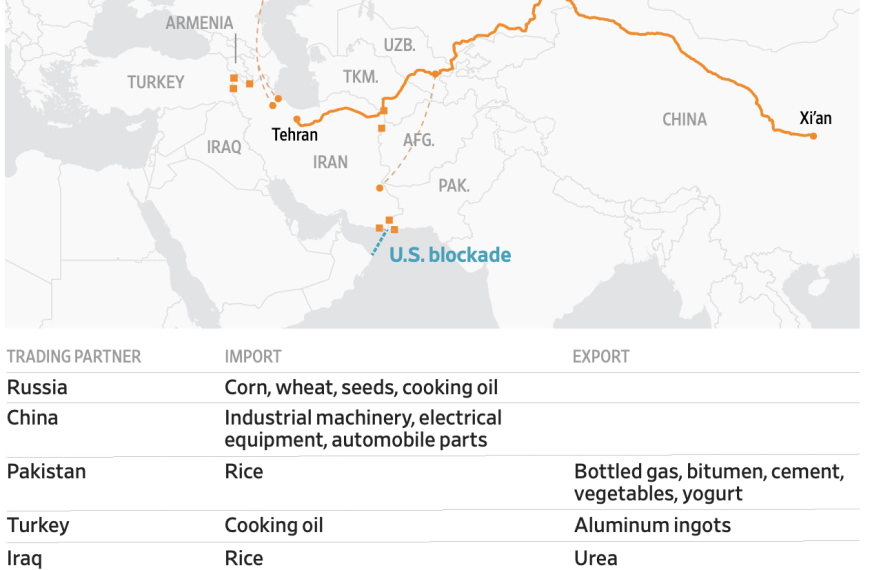


Most analysts have been predicting an energy crisis due to severe disruptions in energy-producing countries, infrastructure, and shipping. It’s difficult to foresee its scale, but it’s undoubtedly here. There are competing explanations as to why something that was predictable has come to pass.
Trump has recently blamed Ukraine for hitting Russian diesel infrastructure and escalating petrol prices. He’s not completely wrong. Russia has extended its export ban on diesel until the end of October, which has a direct impact on the global supply. However, he’s not right either; the war on Iran, which has shut down major oil and gas production in the Gulf and made shipping through the Strait of Hormuz—and now the Bab el-Mandeb too—almost impossible, is also undoubtedly to blame.
There are other structural reasons, such as surging electricity demand from AI and data infrastructure, aging grids in many parts of the U.S., and investments directed toward AI rather than consumer consumption. However, the trigger, if you will, has been the acceleration of oil, gas, and shipping disruptions by the Trump administration. The Biden administration started it with the war in Ukraine and the sabotage of Nord Stream (though we could probably trace this further back), but it has been the current U.S. government that has pressed ahead at full speed, starting with Venezuela. Why?
I think there are three main competing views, with many intermediate possibilities. The first is that the U.S. is doing it on purpose to capture energy markets, help restore dollar supremacy, and curb the rise of multipolarity. The second is that nations aiming for multipolarity—mainly Russia and Iran (with China’s support)—are driving an energy crisis to accelerate the collapse of U.S. power. The third proposes that this is part of a planned systemic transition, with different possibilities as to who is behind it and why.
Some of these hypotheses are not mutually exclusive, some share elements, and some views fall between two of them, but most of what I have read is some version of these three. I would add, however, a fourth possibility: that all of them are happening at the same time, amplified by the sheer stupidity and hubris of human beings, regardless of where they are.
Before delving into examples of these hypotheses, we must first discard the simplistic explanations of Western-controlled mass media: that the U.S. raid on Venezuela was conducted to rid the country of a drug trafficking ring; that the U.S. and Israeli attacks on Iran were meant to protect the world from Iran acquiring nuclear weapons; or that the Ukraine war was caused solely by Russian imperial ambitions. I think it’s self-evident that none of those were the primary drivers, even if aspects of them contain partial truths.
An example of the first proposition is Richard Medhurst’s article, How the US Pulled Off an Armed Robbery of the World’s Energy Supply and Created the Petrogas-Dollar, which Catherine Austin Fitts, of the Solari Report, expands on in an interview with Paul Buitink on his podcast. Interestingly, Catherine connects the first and third hypotheses.
In his article, Medhurst argues that the U.S., by leveraging its position as the world’s largest producer of oil, gas, and refined products, is abandoning the old “Petrodollar” framework—which relied on Middle Eastern stability—in favor of a “Petrogas-Dollar” or “LNG-Dollar.” Under this new paradigm, high global energy prices, market disruptions, and supply shocks directly benefit Wall Street and U.S. energy producers rather than harming them.
Medhurst contends that energy instability is an intentional strategy. High global energy prices no longer threaten the U.S. economy. As the world’s top producer and exporter of oil and LNG, high wartime energy prices directly enrich U.S. firms and drive global capital into the U.S. financial circuit.
Through a combination of physical destruction (Nord Stream, strikes on Ras Laffan), maritime blockades, and corporate expansion (Chevron), the U.S. is systematically eliminating its energy rivals—Russia, Qatar, and Iran—to turn Europe and Asia into captive, permanent buyers of expensive U.S. fuel. By physically interdicting and seizing energy shipments from China’s key suppliers (Venezuela, Russia, Iran), the U.S. aims to force Beijing into dependency on American energy, neutralizing multipolar initiatives like BRICS and the Belt and Road Initiative.
The Solari Report features a compelling global timeline of energy infrastructure and trade route disruptions, which adds validity to the thesis above. Catherine Austin Fitts adds an interesting systemic layer to this: a centralizing global financial elite (which she calls the “dollar syndicate”) is deliberately engineering economic instability to force a transition into a total digital control grid. By deliberately bottlenecking global energy, imposing trade restrictions, and engineering market disruptions, central planners are stripping capital and market share away from small businesses and the middle class to transfer wealth directly to mega-corporations and defense contractors.
As foreign nations and sovereign institutions dump U.S. Treasuries the U.S. financial elite intends to hook retail investors worldwide into the U.S. system via stablecoins, crypto rails, and tokenized financial assets to keep the empire funded. The end game of tokenizing trillions in stocks, bank deposits, and currencies is establishing transaction-level control over the population (taxation and enforcement without political representation) so citizens accept a shrinking economic footprint without revolting.
The caveat to this combined analysis is that it attributes too much planning and execution power to U.S. planners (in the case of Medhurst) or the “dollar syndicate” (in the case of Catherine), and it minimizes or ignores the agency of other actors, such as Russia, China, or Iran.
In the completely opposite camp, there’s an interesting theory quoted by Simplicius from Russian analyst Victor Leonov, which posits that Russia and Iran (presumably with support from China) are working to take down the Western monetary and economic order.
He posits that “Russia and Iran have agreed together to destroy the Western and American capitalist system, by creating an energy crisis through targeting energy facilities and transportation routes.” This results in higher fuel and energy prices, creating a cascading effect that raises inflation: “as a result, central banks are forced to raise interest rates in order to control inflation, which in turn slows and weakens the economy. In this way, production and factory activity gradually weaken, while the industrial sector faces a major threat.”
The result would be that “through this method, Russia and Iran are putting industry, economic growth, and the current world order at risk, to the point where factories may shut down and industry, in its current form, may no longer be able to continue. Since industry is the foundation stone of modern capitalism, step by step the current world order moves toward collapse as an energy crisis develops.”
I share Simplicius’ skepticism that coordinated cooperation is happening to “take down capitalism” for two reasons. First, both countries were happy to continue supplying energy to the West and keep capitalism afloat until the “capitalist order” turned on them. Second, it requires a level of centralized planning and execution at a macro level that I’m not convinced is easily achievable. As Simplicius says, it’s more probable that they are “reacting defensively to hurt their opponents at their most sensitive points.”
This is an extreme example of the “transition to multipolarity” thesis. Brian Berletic, who also argues for this transition, proposes that attacks on Gulf energy supply are conducted to deprive Asia—especially China—of energy in order to curb the rise of a multipolar world order. In this vein, Arnaud Bertrand has called the Iran war “The First Multipolar War.” Neither of them suggests that Russia and Iran are deliberately targeting energy infrastructure to accelerate the collapse of the Western order, but they do suggest a coordinated effort to move to a multipolar order, exemplified by BRICS.
I think the thesis of a shifting world order—and the energy crisis being part of it—has some merit. Perhaps not so much as a deliberate attempt against the “Western order,” but as a result of changing geopolitical realities and the insistence of the U.S. to continue exercising hegemony where it can no longer hold it.
I have previously made an analytical distinction between a “world order” and a “world system.” The world system, in this approach, consists of the systemic rails on which most nations—if not all of them—operate. The three essential ones (though others could be argued) are fiat-based financial systems, centralized state political control, and dependence on oil as the main energy source. The world order is the equilibrium (or lack thereof) that emerges from different factions controlling any or all of these rails in a given geographical zone, their interactions with factions in other areas, and the institutions set up to manage those dynamics.
Analyses by the likes of Simon Dixon, James Corbett, Simplicius to some extent, or Catherine Austin Fitts and the team at the Solari Report point to a change in the world system. They attribute the energy crisis and shifts in the world order to this systemic change.
Dixon focuses on, as he says, “following the money.” Rather than viewing global turbulence (wars, financial shocks, trade disputes) as random chaos, Dixon argues it is largely a scripted transition. The elites running the Financial Industrial Complex (FIC), Military Industrial Complex (MIC), and Technological Industrial Complex (TIC) are managing the wind-down of the unipolar U.S.-dollar ecosystem while transferring real capital and structural control into a multipolar architecture. The energy crisis, then, is a planned mechanism for a transition—not by the U.S. and its Western allies, but by those who control some of the rails (financial, state, oil, military)—toward a multipolar world order.
James Corbett, of the Corbett Report, who regularly describes himself as a “conspiracy realist,” is even more cynical regarding the transition from unipolarity to multipolarity. He argues that the multipolar world order is not the antidote to the globalist world order, but its next iteration toward a global technocracy. The division between globalists and sovereignists (unipolarity vs. multipolarity) is a dialectical illusion designed to capture both sides of the geopolitical divide. In his analysis, the energy crisis is a tool toward further monopolization of resources in the hands of fewer technocrats.
The struggle between “globalists” and “sovereignists”—which some analysts point to as another way of saying unipolarity versus multipolarity, the West versus the Global South, or NATO versus BRICS (though these two institutions are very different in scope, if comparably symbolic)—implies that two main ideological and power factions are competing to establish a world order. Depending on who you believe is ahead, the energy crisis was caused by one of these factions. This competition is either driven by a systemic change or is an illusion created by a systemic change to hide what is truly going on.
I understand how difficult it is to accept that the energy crisis—and much of the current global disorder—might have been caused by a series of mistaken or simply stupid strategic decisions. But it is entirely possible. I’m not implying that all of the above is not happening; I actually think most of it is happening at different levels of analysis. Two factors might explain why.
On the one hand, it’s impossible for anyone to have perfect information—by which I mean knowledge of all the variables affecting a decision, along with the ability to plan for every scenario and choose the optimal outcome. Analysts, including intelligence professionals, operate on probabilities and scenarios. On the other hand, among decision-makers—the powers-that-be, the elites, whether globalist or not—there seems to be a shared materialist worldview (in the sense that only matter counts). Even if they formally profess a different view, it does not meaningfully impact their actions.
As René Guénon writes in his book The Crisis of the Modern World: “Materialism stands for a complete mental outlook… This mental outlook is one that consists in more or less consciously putting material things and the preoccupations arising out of them in the first place, whether these preoccupations still make some show of being speculative or are purely practical; and it cannot be seriously disputed that this is, in fact, the mental outlook of the immense majority of our contemporaries.
These two reasons help explain why, once a course of action is set, inertia can lead to decisions that otherwise would seem like obvious strategic mistakes—or choices driven purely by hubris and ignorance.


 By
By