
STAT News is an essential news source for all things Biomedicine (i.e., Big Medicine plus Big Pharma), from the delivery of health care in the clinic to the basic research that is the foundation of clinical care, to the unremittingly garish politics of the moment that affect the entire structure of science in America. The STAT series on The Deadliest Drug, which I have followed for the past few months, is now complete. In it the authors ask, “Alcohol kills more Americans each year than all other drugs combined – Why does the U.S. ignore its most harmful substance abuse crisis?” And it is a crisis. Very few families have escaped damage caused by alcohol abuse, including my own. What follows is a selective summary of the series and an attempt to make sense of it all in a tentative conclusion. The eight parts of the series include (direct link/archive if needed):
According to the data analyzed throughout the series, alcohol kills 500 Americans every day, which is more than every infectious disease combined. Heavy alcohol consumption has been linked to cancer, heart disease, cognitive decline, developmental disorders, and gun violence. The costs have been reckoned at more than $240 billion annually, which is “more than every American’s medical debt combined.” As many as one in four Americans report binge drinking. The damage caused by alcohol exceeds that of “almost any other wealthy industrialized nation.” Consequently, all of this has led to a nation in denial:
Above all else, the alcohol issue demonstrates a kind of societal denial: Americans have bought into the idea that widespread harm and even death is a price we must pay in order for people to drink at all. The country has come to view the alcohol epidemic as an intractable inevitability rather than a preventable and entirely man-made public health crisis.
Or, we as a society we have dropped the ball on alcohol use. The argument is plausible, but it seems incomplete for reasons to be discussed in the conclusion.
One of the ways we have lost the plot is that during a doctor visit our physicians are often reluctant to bring up alcohol consumption with their patients. Perhaps, but over the past several years I have had reason to see a physician regularly after a very long and uneventful medical history. I am always asked about alcohol consumption, and illicit drug use. Data show that people who are asked about their alcohol use will answer the question, sometimes truthfully. However, the unwarranted assumption in this analysis is that the average American has regular visits with his or her physician.
In Part 3 we learn that one-third of Americans have a form of fatty liver disease and are facing a crisis:
The United States is hardly the only country where heavy and binge drinking is a problem. But Americans face a unique crisis: This country’s obesity and diabetes epidemics, combined with heavy alcohol use, are causing more people to get sick from a liver disease that, until recently, didn’t even have a name.
Metabolic dysfunction and alcohol-associated liver disease, or MetALD, is now a leading concern among doctors in the U.S. as more young people and women face serious illness and die from the condition. Doctors worry that many more Americans might be silently developing MetALD, at least in part because many people do not realize they are drinking too much.
This, of course, should be a surprise to nobody. Fatty liver disease has become remarkably common as our obesity epidemic has reached the critical stage. When people eat too much bad food – mostly ultra-processed food-like substances loaded with sugar and fat and mouthfeel additives – their livers will accumulate fat that is supposed to be stored in adipocytes (fat cells). This leads to severe liver disease. The series includes individual stories that illustrate problems associated with excess alcohol consumption. One young man drank two cans of Four Loko each day after work. One can of Four Loko may contain the alcohol of five cans of beer and double the amount of sugar in a typical soft drink. This can lead only to bad outcomes, such as 310 pounds on the 5-foot-5 frame of Stephen Silva-Brave, who has since recovered and become a mentor to others in similar crisis. He is a survivor and a hero.
In Part 4 the series is very good on how Americans have lost the plot on treatment of alcohol addiction. Twelve-step programs such as Alcoholics Anonymous (AA) work for many people, including the current Secretary of Health and Human Services who has said he attends as many as eight AA meetings a week. Good for him; he is about forty years into recovery. AA is not for everyone, however, as illustrated by the case of Jillian. She found AA to be too spiritual and God-centric. This is not uncommon. Another problem with AA can be the “abstinence or nothing” approach to alcohol. If the goal is to reduce alcohol use, this can be counterproductive for those who do not respond to the twelve steps.
This leads us to pharmaceutical treatment of alcohol use disorders. A reasonable goal for many of these patients is to lessen their consumption of alcohol. Drugs like naltrexone have been shown to lessen cravings in those who drink too much and allow them to gradually reduce alcohol intake. But as one might expect, the use of such drugs is not encouraged in the U.S. and naturally “many insurers balk at paying for them.” Antabuse (disulfiram) has been used since the 1950s. It is a cruel drug that inhibits acetaldehyde dehydrogenase, thereby leading to buildup of acetaldehyde after drinking. This makes the patient very ill. Unsurprisingly, Europeans are much more enlightened on the pharmaceutical approach to treatment of alcohol use disorder, largely because they have functional health care systems.
Part 5 covers the increased use of alcohol by women who are pregnant or might become pregnant. As many as one-in-eight women drink during pregnancy and perhaps as many as one-in-twenty school-age children may have a disorder caused by prenatal alcohol exposure. What was previously called fetal alcohol syndrome (FAS) is now subsumed under FASD (fetal alcohol spectrum disorders). The first public health advisory on alcohol and pregnancy was issued in 1977, and labels appeared on cans and bottles in 1989. [1] The reasons for the recent increase in alcohol consumption during pregnancy are not clear, but a reprise of the “You’ve come a long way, baby!” advertising strategy is undoubtedly part of the explanation. It is seldom noted that this “long way” has led to a marked increase in lung cancer among women.
There has also been academic support for “light to moderate” alcohol consumption during pregnancy, especially in the work of the economist Emily Oster, whose most recent work has advocated treating a family including children as a business firm. [2] Regarding alcohol and pregnancy, Oster has argued that there is “scant evidence showing low levels of alcohol use are harmful…and then…interprets a lack of clear science on low-to-moderate alcohol use as permission for (pregnant) women to engage in some drinking.” This argument may be reasonable in the abstract, but it is of a piece with those of science-adjacent economists or economics-adjacent non-disinterested “scientists” who are Merchants of Doubt. The precautionary principle states otherwise, and the likelihood that moderate drinking during pregnancy is safe is nil, because each mother, drinking habit, and baby is different, and there is no way to parse these factors in advance, including “moderate.”
Part 6 takes up the current administration’s views and actions on alcohol. President Trump is a famous teetotaler because of what alcohol addiction did to his brother Frank. This is not uncommon among families so affected. But it was surprising when the current Administrator of the Centers for Medicare and Medicaid Services remarked that:
Alcohol is a social lubricant that brings people together. There’s probably nothing healthier than having a good time with good friends in a safe way.
This is true as far as it goes, depending on social and economic context. Apparently the recommendation for moderate drinking as two drinks a day and one for women will remain in place. Personally, I have always thought this was ridiculous. Two martinis every day seems immoderate to me. And to be fair to the former Surgeon General designee, Casey Means-MD, she wrote in her book Good Energy (discussed here), “Understand that alcohol is (or can be) a highly addictive and toxic substance that is normalized due to industry-influenced marketing and policy.” At some level the government remains divided against itself on alcohol policy, but the priorities of the current administration will prevail eventually.
Which brings us to Part 7 that tells the obvious truth that the alcohol industry is very active behind the scenes to get what it wants. The global alcohol business is valued at more than one trillion dollars. This produces a lot of votes in our post-Citizens United world:
Companies, distributors, and trade groups accomplish their goals the way most other special interests do: by pouring time and copious amounts of money into politics. The industry spent $12 million on campaigns in the past three years alone. Much of the cash has been concentrated in congressional races, including battleground districts, with the industry throwing money at both sides of the aisle
…
While other nations have passed measures to crack down on alcohol-related problems — restricting hours of sale and advertising, or raising drink prices, for example — lawmakers and regulators in the U.S. have allied themselves with the industry. Wine, beer, and liquor caucuses are common on Capitol Hill. “We are on your team,” Mary Ryan, administrator of the Alcohol and Tobacco Tax and Trade Bureau, told craft brewers at a gathering in Washington last fall.
Totally unsurprising. As is the fact that the American Cancer Society (ACS) and Mothers Against Drunk Driving (MADD) have taken money from adjuncts of the special interests they ostensibly oppose. [3] In the meantime the alcohol industry blazes new advertising trails on TikTok. These are likely to be very effective, but someone will have to tell me about them.
Finally, the series ends with twelve very good recommendations. The five most important seem to be:
- Screen early and often for problematic alcohol consumption.
- Overhaul payment system for interventions directed at alcohol dependency.
- Require more doctor training, especially in the primary care specialties of Internal Medicine, Family Medicine, Pediatrics, Obstetrics & Gynecology, and Psychiatry
- Refocus messaging to encourage many people to drink less instead of trying (and largely failing) to get a few people to stop cold turkey
- Tighten marketing rules, beginning with no equivalent of “Joe Camel” for alcoholic beverages. These commercials during televises sports events are wearisome. Getting wasted is not fun and it can be dangerous. [4]
Overall, this series is very good at explaining the nuts and bolts of the problems of alcohol abuse in the United States. It is a grim picture with a few developing bright spots. But several important things were also left out. To reconsider a few points made above:
- Alcohol costs the United States more than $240 billion a year, more than the total medical debt in the United States. The authors of this series never seem to get around to pointing out that medical debt should not exist in the first place, that it exists only because we have such a dysfunctional system for delivering health care promptly and humanely to all who need it.
- It is recommended that doctors discuss alcohol consumption with their patients. This assumes that the average American has a regular primary care physician with whom they can talk. Once again, this is an unwarranted assumption. The primary care physician of an unconscionable number of Americans is the Emergency Room doctor they finally see because they had no other choice. The ER doc is not going to be the physician who talks with the patient about his or her drinking habits, because he or she will probably not ever see the patient again unless the patient is an ER “frequent flyer” with no other alternative but the Emergency Room.
- While it is undoubtedly true that “reimbursement” might be refused when a doctor treats a patient with naltrexone, this is taken to be a simple statement of fact instead of an absurd characteristic of a health care system. And besides, reimbursement is an odd euphemism to describe legitimate payment for medical care.
- One thing that Dr. Oz did get right is that low to moderate alcohol consumption can be part of a convivial social atmosphere. And it undoubtedly is in his milieu. But his world is not the world of Americans who are inexorably falling behind as the Neoliberal Dispensation tightens its grip.
What this entire series leaves out is any discussion of the foundations of this American pathology. Thus, there is no mention of Deaths of Despair and their causes. As Anne Case and Angus Deaton have shown conclusively, deaths of despair are very real in the United States, while they are not so common in other similar countries, yet. [5] People drink alcohol in these countries, too – Italy, France, Spain, Germany, Greece, United Kingdom, Australia, most of which also have a strong food culture – and are not beset with the same pathologies to the same extent as the United States.
Why is this? The short answer is social democracy in one form or another. Not that any of these countries is perfect, but the tenuousness of health care, right livelihood, retirement, education, childcare, elder care, and time for living a good life are not (or were not) the constant and inescapable stressors they are for the majority in the United States under the Neoliberalism. This is not a hard concept, but it is largely ignored in American politics of the Uniparty. [6]
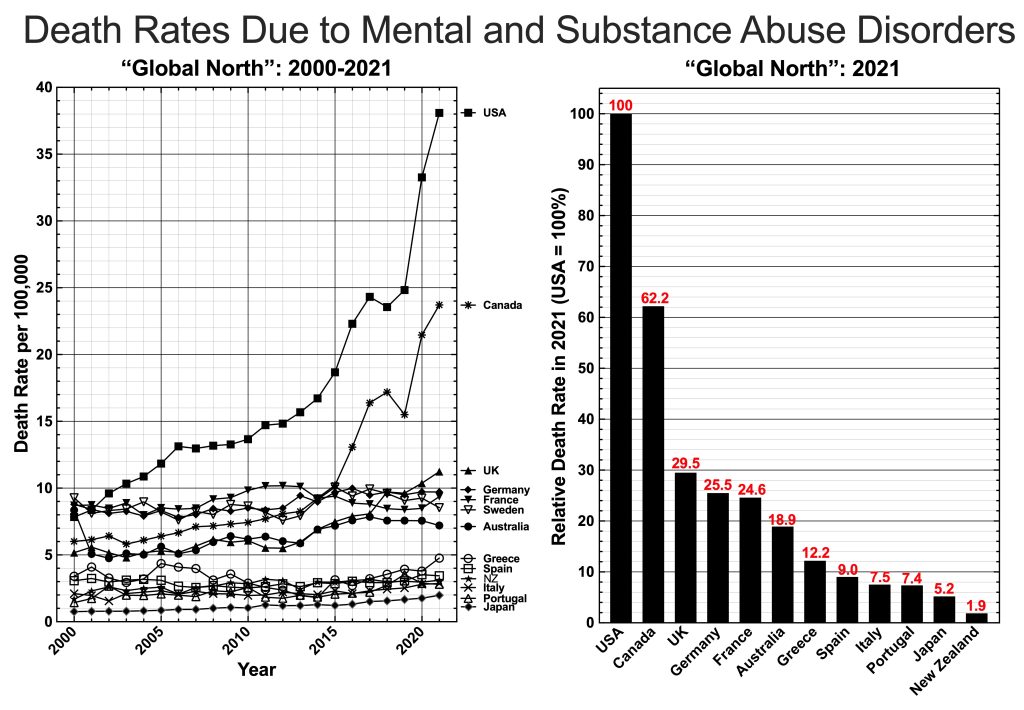
So, are there data that show the United States is different? Yes. The relevant literature is large and somewhat beyond my ken, so I asked a simple question: How does the United States compare with other similar countries? Our World in Data has a provisional answer, which I have illustrated below (these data are from the World Health Organization).

This figure compares Death Rates Due to Mental and Substance Abuse Disorders (22 years from 2000 to 2021) between the United States and other similar countries, none of which proscribe alcohol. Deaths attributed to alcohol abuse only are not exactly the same, but the comparison here seems to be between “peaches and nectarines” instead of “apples and oranges.” The United States has become the clear outlier between 2000 and 2021 (left panel), with Canada a close second. Perhaps we are contagious.
It seems likely the upward trend has continued over the past five years, with or without the pandemic. The right panel shows that if the death rate in the U.S. is set to 100% in 2021, Greece, Spain, Italy, Portugal, Japan, and New Zealand are the places to live, with the UK, Germany, France, and Australia in the next tier. For example, if an American were to pick Italy as a favorite destination, s/he would be, on average, 13-fold less likely to die of a mental health or substance abuse disorder. Granted, this is a view of the problem from 30,000 feet. Nevertheless, although I have spent only two continuous weeks in Italy, thirteen years ago, that sounds about right. As far as I remember, wine was a staple during my sojourn, with the “house red” being better than the expensive wine we have here (although the basic Antinori Tuscan is very good).
While this series on the dangers of alcohol is very thorough, a reasonable conclusion is that alcohol, damaging as it is for all but the willfully blind to see, should be considered a symptom, or proximal cause, rather than a final cause of this American pathology. It follows that addressing the manifest harms of alcohol in American society will require a much deeper transformation of society and political economy than new rules, however much they are needed, on the marketing, promotion, and sale of alcoholic beverages.
This problem must be solved comprehensively, and obliquely, from the bottom up rather than haphazardly from the top down.
Notes
[1] “According to the Surgeon General, women should not drink alcoholic beverages during pregnancy because of the risk of birth defects.” This is the precautionary principle in action, even if it not a particularly powerful statement.
[2] Critiques of Professor Oster are here and here; they are as expected from The Nation and The New York Review of Books. Business Insider on Professor Oster is here. Long reads but they explain Professor Oster’s approach to life through the veil of conventional economics very well.
[3] The essential work that MADD on the issue of driving while impaired is sometimes dismissed as unimportant. Nothing could be further from the truth. When I was young drunk driving was very nearly a sport among a certain cohort, something to be laughed away. Until it wasn’t. The United States was late to get serious about drunk driving. That there is no longer the chance to “Drive this car straight home and do not get in it again until you are sober!” Drive drunk, get caught, go straight to jail. And have your car insurance cancelled.
[4] It is often said that the most famous “last words” spoken in the American South are, “Hey, y’all! Hold my beer and watch this!”
[5] Various Deaths of Despair links are at the Princeton University website of Professor Sir Angus Deaton. The book Deaths of Despair and the Future of Capitalsim by Anne Case and Angus Deaton is good, although one might disagree with their explicitly stated “belief” that the solution to American deaths of despair lies within capitalism itself. Alas, it seems more likely that Lambert’s Laws of Neoliberalism are more likely to prevail: (1) Because markets, (2) Go die.
[6] The “little” book, Were You Born on the Wrong Continent?: How the European Model Can Help You Get a Life, by the labor lawyer Thomas Geoghegan, is good if you can find it in a used bookstore. Geoghegan is too breezy for some readers and the book has doubt it has passed its sell-by date, but that is due to social, political, and cultural stupidity rather than any natural laws of history (which do not exist).



 By
By