
The shifting pack ice, numbing temperatures, and powerful currents of the Antarctic’s Weddell Sea led Ernest Shackleton’s to describe it as the “worst portion of the worst sea in the world”. It made good on its reputation in 1915 when it sank Shackleton’s ship, Endurance, and those same conditions helped preserve it for more than a century.
Discovered in 2022, Endurance is now becoming more accessible, however due to climate change.
Those same climate forces making Shackleton’s ship easier to reach are also driving competition over shipping lanes and underwater minerals and fossil fuels. Indeed, many view global warming not as a threat, but as an opportunity.
The Heritage Foundation, the crazy capitalist think tank responsible for Project 2025, argued in that screed that the NOAA’s work was “harmful to US prosperity.”
And so away we go with Shackleton’s Endurance acting as a North Star. As the geopolitical wars rage over mineral and fossil fuel hot spots, and contests over shipping lanes and land corridors intensify, the world boils, ensuring that no one will emerge victorious aside from Mother Nature.
A Vicious Spiral
Let’s start near the opposite pole from Shackleton’s resting place where the competition over the Arctic heats up as the water literally does so.
The journey from eastern China to England, which normally takes 40 days via the Suez Canal, more than 50 days around the Cape of Good Hope, and a complicated and expensive China-Europe rail route, can be cut in half by an accommodating Arctic route.
As The Economist announces, “the Arctic will become more connected to the global economy.” That’s one way of putting it.
Snow reflects 85 percent of the sunlight that hits it, exposed water only 7 percent. So as the Arctic melts, it speeds up the process for the remaining ice. The Arctic has been warming four times faster than anywhere else on the planet since 1979, according to multiple scientific studies. That means, according to a recent study in Communications Earth & Environment, that all ice-going vessels would only be unable to navigate this route in the spring come 2065, and that the route would be navigable year-round by 2100. Hooray!
What often goes unmentioned in these pieces hyperventilating over how arctic shipping routes will transform the global economy is what exactly that means for the climate.
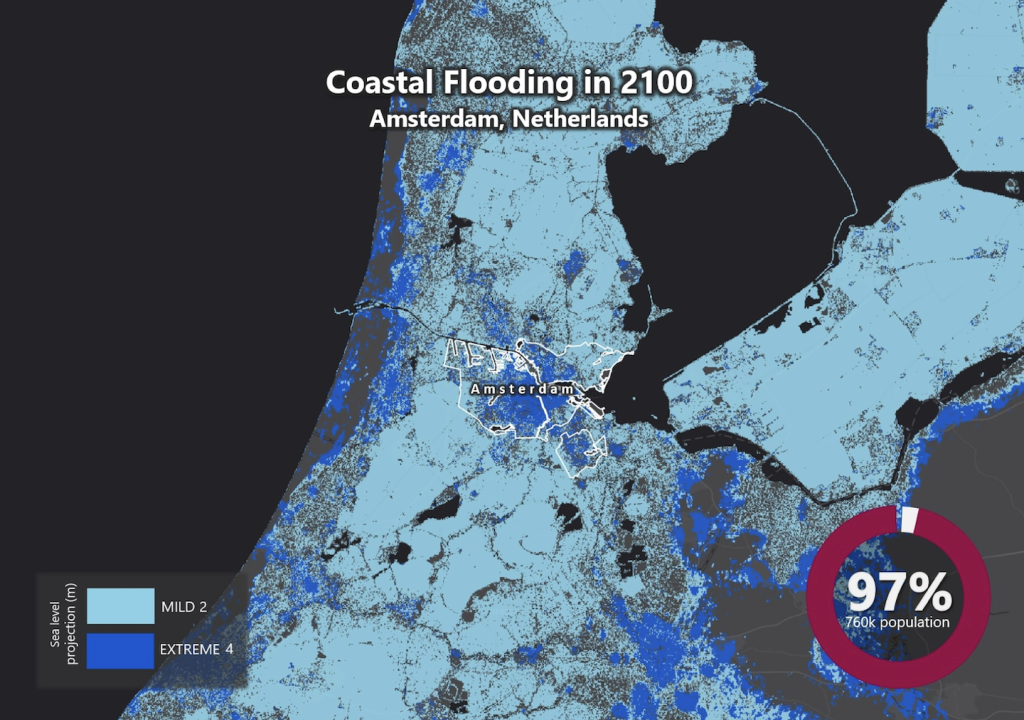
And that’s not a pretty picture. Put simply, there won’t be much of a global economy left. Here are what some cities will look like as vessels breeze through the Arctic:


If we want to really connect the Arctic to the economy, there’s always the ice-free future to consider.


I imagine many/most of us look at those maps and recoil in horror. Project 2025 authors, capitalism’s most crazed supporters, and others cheerleading the expedited shipping through the Arctic see dollar signs.
Needless to say, it’s not just sea level rise, but the breakdown of ocean circulation systems and weather patterns, bringing more severe weather, global food production collapse, and an inescapable doom loop.
The Arctic’s increasing connection to the global economy is already helping to speed up the breakdown. From France24:
It’s a vicious cycle. As sea ice melts and opens new routes for maritime traffic in the Arctic, the environmental fallout caused by vessels burning fossil fuels adds to global warming, which in turn melts more sea ice.
A perfect example of this is black carbon. It’s a sooty material emitted from gas and diesel engines that aren’t completely combusted. Not only does black carbon pollute the air with particulate matter, but because of its ability to absorb light as heat, it contributes to climate change by warming the air.
When black carbon is deposited on ice in the Arctic, it takes away its ability to reflect heat.
“The black colour deposited on the white ice means the ice then absorbs more sunlight, leading to more melting,” explained Sammie Buzzard, a polar scientist at the Centre for Polar Observation and Modelling at Northumbria University.
***
Elsewhere, similar geoeconomic battles are playing out over transit corridors that are likely to be rendered useless—or at least not worth the investment— by climate change.
The Caspian Sea is currently a focal point of the Middle Corridor, to which the Trump Route for International peace and Prosperity aspires to link up to. The geopolitical contest over Central Asian minerals, control over the Caucasus, and energy flows from the Caspian region are seeing tensions rise and increase the risk of conflict.
Meanwhile the Caspian Sea is dying. From SciTech Daily:
Water levels in the Caspian Sea, the largest landlocked body of water in the world, are steadily falling as rising temperatures cause more evaporation than inflow. Even if global warming is kept below 2°C, scientists estimate the sea could drop by 5 to 10 meters. If temperatures rise further, the decline could reach up to 21 meters by the end of the century.
In the northern Caspian, the findings show that some settlements, ports, and industrial facilities could end up being stranded tens or even hundreds of kilometers from new shorelines. The exposed dry seabed is likely to release dust containing industrial contaminants and salt, posing serious threats to human health, as previously occurred with the drying of the Aral Sea.
The findings also predict a concerning trajectory for industry, with critical ports in all bordering countries being impacted. Baku (Azerbaijan), Anzali (Iran), and Aktau (Kazakhstan) are expected to experience increases in distance to shore of 1 km or more, while Turkmenbashi (Turkmenistan), and Lagan (Russia; planned future site), could see increases of 16 km and 115 km respectively…
Some cities around the Caspian use desalination (removing salt and minerals from saltwater) for freshwater supplies, and water level declines are already impacting desalination operations at Aktau in Kazakhstan.
Loss of water from the Caspian could also affect the regional climate, leading to reduced rainfall and drier conditions across central Asia with indirect impacts on agriculture.
Further east where the “Great Game” is once again playing out, water is increasingly hard to come by, and it won’t be long before Mackinder’s Heartland Theory needs a Mad Max-style update. From IOP Science:
The year 2025, designated by the United Nations as the ‘International Year of Glaciers’ Preservation’, ironically became the most negative glacier mass-balance year on record in Central Asia. In situobservations reveal exceptionally strong and spatially coherent ice losses across the region, although not all individual glaciers experienced record losses. Regional simulations with the Global Glacier Evolution Model support these findings, indicating that 64% of glaciers larger than 1 km2(∼4000 glaciers) reached their most negative annual mass balance within the study period. Within a single year, glaciers in Central Asia lost an estimated 30 ± 6 km3 of ice (26 ± 9 Gt), corresponding to ∼2% of their present-day total mass. Mass loss was strongest in the western Tien Shan and western Pamir (−2% to −4%) and more moderate in the eastern Tien Shan and eastern Pamir (−1% to −1.5%). Climate reanalysis attributes the extreme 2025 losses to persistently above-average spring and summer temperatures, an unusually early onset of the melt season, and reduced snowfall frequency during late spring and summer. Together, these conditions enhanced melt-amplifying feedbacks by accelerating snow loss, leading to earlier exposure of low-albedo ice surfaces. The 2025 losses mark an alarming milestone for Central Asian glaciers and may become the new normal in the future.
To add a little more perspective, approximately 81 percent of Central Asia’s population depends on water originating in the Tien Shan and Pamir. And as supplies dwindle it increases the chances of internal destabilization and external conflict, which equals instability across food systems, energy markets, and regional trade.
The Panama Canal
This choke point is at the heart of the US and China struggle for control over global shipping infrastructure. Under pressure from Washington, Panama “retook control” of the Pacific Ocean port of Balboa and the Atlantic Ocean port of Cristobal after a court annulled a contract that had allowed a subsidiary of Hong Kong-based CK Hutchison Holdings to operate both since 1997. Beijing has retaliated by detaining Panama-flagged vessels, and Chinese shipping giant Cosco, which owns one of the world’s largest fleets of tankers, suspended operations at the two busiest Panama Canal ports.
This fight is playing out following a Blackrock consortium’s attempt—with an assist from Washington—to buy up dozens of ports from CK Hutchison. Beijing has nixed the deal over concerns that the new ownership could, under direction from Washington, raise prices on or refuse Chinese ships or allow the US to militarize the ports and use them to enact a maritime blockade of China.

Whoever ultimately controls the Panama ports might not have much to celebrate.
The Panama Canal Authority is already reducing maximum navigable drafts in anticipation of the coming El Nino weather pattern.
Under “normal” water level conditions, the Canal can handle 34 to 38 daily transits, but that had be cut by about 30 percent in 2023-24 due to the last El Nino when October 2023 saw the least amount of rainfall in recorded history.
This upcoming El Nino is expected to be much worse.
***
From where I sit, the fault for this race toward our own destruction lies almost exclusively in Washington and the transnational oligarchs it serves. Other countries have shown themselves willing to cooperate and compromise, but if China, for example, emerges as the new hegemon, would it chart an effective degrowth course on climate change or would it too seek growth at all costs?
Many apply the Thucydides Trap to US-China positions to help explain US elite determination for us all to suffer these pyrrhic contests, but perhaps that term is being applied to the wrong fight.
When Herman Wouk, the novelist and World War II veteran, popularized the Thucydides Trap in 1980 to describe the Cold War, he said this:
How do we break out of this Thucydidean trap, which now threatens to strangle, if not to destroy, our world?
To my ear, that sounds just as much about the climate catastrophe unfolding as the threat of nuclear war. Cursed are we to confront both under a system that deems both acceptable risks (if not welcomed outcomes) in the quest to squeeze every last cent out of the planet and its inhabitants.


 By
By