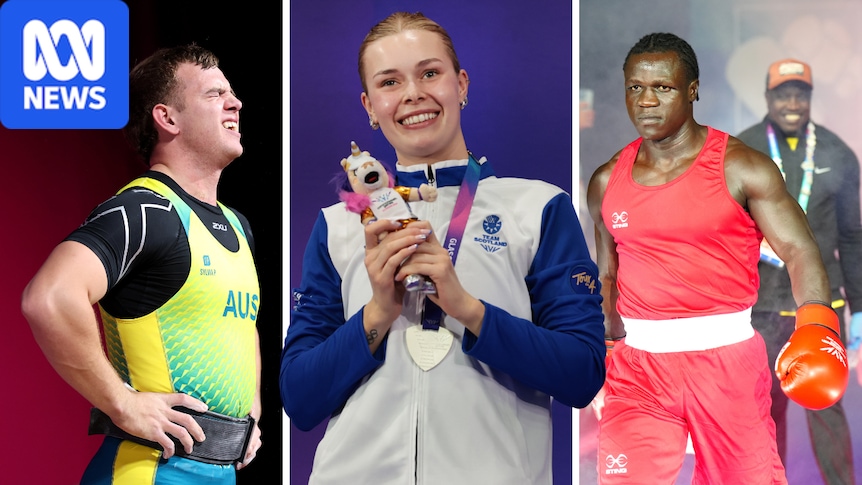
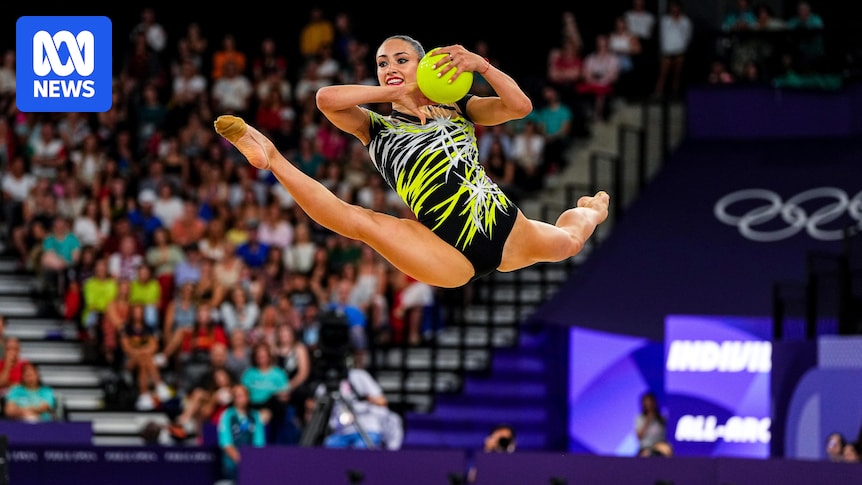

Alexandra Kiroi-Bogatyreva spent years sacrificing her health for a shot at making the Olympics.
“I was so driven that injuries didn’t stop me,” the 24-year-old told ABC Sport.
“I really wanted to achieve my goals, show the world what I’m capable of and give back to my family.”
The rhythmic gymnast competed in the 2024 Paris Olympics and medalled at the 2018 and 2022 Commonwealth Games.
She retired at 22 years old, noting that most athletes typically leave the sport between 17 and 21.
“The sport demands significant physical commitment, as well as considerable psychological resilience,” she said.
Kiroi-Bogatyreva trained up to 10 hours a day, six days a week, but it was often without the proper nutrition.
“It’s very hard for a gymnast [being an] aesthetic sport, to be told you should eat more carbs when you’re raised in the culture of being thin is better,” Kiroi-Bogatyreva said.
It meant her body wasn’t functioning the way it should have been.
Kiroi-Bogatyreva didn’t get her first period until she was 19. At that age, most women have had theirs for about seven years.
Doctors told Kiroi-Bogatyreva that her body didn’t have enough energy to have a period. (Getty Images: Alex Pantling)
After that, it would only come once a year, when she had a two-week break from gymnastics.
“No one really questioned why, or if it’s okay for that to be happening,” she said.
It wasn’t until years later that doctors explained what was going on.
“I was [told] ‘you’re malnourished, you are over trained and your body just doesn’t have the energy to even have a period,” she said.
“Before that, I never really linked it with my food intake or how many hours I trained at the gym.”
It’s this normalisation of menstrual dysfunction that athletes like Kiroi-Bogatyreva want to see changed.
They also want more knowledge about how to approach the menstrual cycle, and to raise awareness about the serious consequences if overlooked.
Kiroi-Bogatyreva wants coaches to have more awareness of women’s health. (ABC Sport: Patrick Stone)
Missing periods seen as sign of ‘fitness’
Getting your period late, or being irregular, isn’t unusual among elite athletes.
In partnership with Deakin University, ABC Sport surveyed 152 women and gender diverse athletes across 47 sports.
Seventy-five per cent of respondents said they experienced menstrual irregularities as an athlete.
The same number said menstrual cycles weren’t taken into consideration when developing their training programs.
Professional ironwoman Harriet Brown said she didn’t remember anyone asking about her menstrual cycle over the course of her 15-year career.
“Back then it was seen as you are really fit if you didn’t have your period,” the 35-year-old told ABC Sport.
Harriet Brown says when she was competing, not having your period was seen as a good thing. (Getty Images: Chris Hyde)
And Kiroi-Bogatyreva was led to believe just that.
“It was just well-known that if you’re an athlete you get your period later,” she said.
“There was just so much lack of education that we are really starting to realise can be really helpful,” Brown said.
“These are the topics that I think would have made a really big difference to so many female athletes, including myself.”
Several athletes told us that their menstrual irregularities and symptoms were dismissed or ignored by coaching staff.
One survey respondent wrote:
“I was told to go to training anyway, when my chronic illness (PMOS, formerly PCOS) left me bedridden for a few days during my period each month, to ‘practice what it would be like if it happened in competition’. No opportunity for reasonable adjustments. There was never a question of whether I could train, or care for whether I should.”
Another said:
“There is no consideration of support for athletes on their period, how to manage pain or recovery. There’s also no acknowledgement or tailoring of training. Sometimes my pain is so bad I can barely walk yet I push through a training session, how is this helpful?”
Pill use could be masking health problems
To help with managing the menstrual cycle, some athletes are put on the contraceptive pill, including many survey respondents.
Although using the pill can help some people, it can also hide more serious issues.
“It can be pretty impactful as an athlete because what it can be masking is RED-S [relative energy deficiency] in sport,” Brown, who is also an exercise physiologist, said.
RED-S happens when you use up more calories than you take in. You might feel tired, miss periods, or get colds or infections.
You’re more likely to get hurt because your body will take longer to recover after exercise, and down the track there’s a risk of fertility problems, bone weakness and osteoporosis.
“The body starts to slow down, down-regulate some systems and one of those systems that potentially starts to go is the menstrual cycle, or hormones, and so an athlete will no longer have a period,” Brown said.
Brown now focuses on giving female athletes the information she wishes she had while competing. (Getty Images: Chris Hyde)
Brown didn’t get her first period until 16. She doesn’t know exactly why but cites RED-S as a potential factor.
She went on the pill for about nine years while competing and struggled with knowing how much she needed to fuel.
“I was significantly under-eating because I had no idea how much an athlete training 15 times a week needed to eat,” Brown said.
“I have no idea if I had a healthy period throughout my career or not.
“When I went off [the pill], I had a much better understanding around nutrition, I was fuelling enough, so I did get a healthy period after that.”
Lack of menstrual management can have long-term health impacts
Ignoring menstrual irregularities can have serious long-term health implications.
Ro Nogueira is an anatomist at Bond University and an exercise physiologist, and said hormones, particularly oestrogen, played a crucial role in bone health.
Ro Nogueira is an assistant professor in the Faculty of Health Sciences and Medicine at Bond University. (Supplied: Bond University)
“You have to consider that low energy availability highly influences bone health,” she said.
“If you’re not supplying your body with enough nutrients, that’s when hormonal levels will be at risk.
“As a result, the bone mineral density of athletes will be reduced, and they will be much more prone to become osteoporotic in the future.”
Kiroi-Bogatyreva suffered multiple bone fractures throughout her career.
“I’ve had major competitions where I competed with stress fractures in both feet at the same time,” she said.
“I broke a finger the day before a competition. Three months later it was still sore and I went to get an X-ray, and it was like, ‘Oh, it’s broken’.
“The whole time I was training with a broken finger. I just ignored any pain I had.”
Kiroi-Bogatyreva is now coaching the next generation of rhythmic gymnasts. (ABC Sport: Patrick Stone)
Fertility can also be an issue. If you don’t have a healthy menstrual cycle, you may not be ovulating and therefore are unable to conceive.
Brown retired from racing two years ago and had a baby late last year.
Although falling pregnant wasn’t the only reason she decided to stop racing, it was a contributing factor.
“I knew it would be really difficult to fall pregnant whilst I was training 15, 16 times a week,” Brown said.
“My body was not in a great state for facilitating carrying a baby with the energy output that I was having.”
Harriet Brown had baby Olive in December after retiring from professional sport. (Instagram: @zizisun)
Clubs, athletes trying to bridge the education gap
Eighty-five cent of the ABC and Deakin University survey respondents don’t think there’s enough education about women’s health for athletes, coaches and support staff.
Although that’s a big number, changes have been made across some sporting codes in recent years.
AFLW teams like the GWS Giants have been working with a sports exercise and pelvic health physiotherapist. The Western Bulldogs and Super League teams have tailored training around the menstrual cycle, and some Super Netball players are being offered free fertility checks.
Other codes like NRLW, rugby, soccer and tennis have also opted into women’s health education, while the Australian Insititue of Sport’s Female Performance and Health Initiative has information online.
Brown and fellow ironwoman Lizzie Welborn have created an educational platform called KaMana, where they speak about menstrual health, body image, nutrition and performance mindset to athletes, coaches and support staff from community level to elite.
Loading Instagram content
“[It’s] all of the education we wish we had when we were younger athletes,” Brown said.
“Talking about these things can be so empowering, and not just help athletes at the elite level but also help with participation in sport.”
Participation is a key concern when it comes to adolescent girls, with drop-out linked to the menstrual cycle.
Brown and Welborn speak to athletes about menstrual health, body image, nutrition and performance mindset. (Getty Images: Chris Hyde)
Michaela Hardy used to swim at a national level and had issues navigating her period in the pool.
“In the middle of a session, I was on my period, I was cramping, I was quite exhausted and tired,” Hardy told ABC Sport.
“My coach stopped me, told me to hop out of the pool and said that I wasn’t training hard enough.
“That was the moment I realised there’s no safe way for me to say, ‘Hey, I’m on my period, this is where I’m at’.”
She doesn’t want others to face the same challenges she did, so she’s created an app aiming for change where athletes can log their cycle, symptoms, mood and energy levels, then choose exactly what information is shared with their coach.
Michaela Hardy created an app where athletes can share information about their cycle, symptoms, mood and energy levels. (Supplied: Bond University)
The goal is to support cycle-aware training, reduce injury risk, and remove the stigma around periods in sport.
“What I’d love my coaches to have known, was just knowing about the four phases [of the menstrual cycle] and how they can best train their athletes around that,” Hardy said.
Hardy hopes her app will also help keep girls in sport during their teenage years.
“My long-term vision is that every female athlete within Australia is empowered to communicate with their coach where they’re at in their menstrual cycle, and doesn’t feel their menstrual cycle is taboo, but actually can help performance and overall wellbeing,” she said.
Brown believes coaches have a big part to play in helping women feel comfortable to speak up about their menstrual cycles.
“It’s high-performance sport, it’s physiology, it shouldn’t just be a taboo topic anymore,” she said.
As a coach now herself, Kiroi-Bogatyreva wants to be there for her students, on and off the mat.
“Throughout my career, I experienced both exceptional coaching and situations that taught me what I would do differently,” she said.
“Those experiences have shaped the coach I strive to be: someone who supports athletes holistically, develops them both as individuals and performers, and provides a consistent, trusted presence throughout their journey.
“I spent 10 hours a day with [my] coach, and same with these gymnasts we coach now.
“So, I think if coaches start being more aware of the issues around food and overtraining, they can implement strategies to stop it, [and] I think the culture will shift.”
This story is part of the ABC Elite Athletes in Australian Women’s Sport Survey.

 By
By