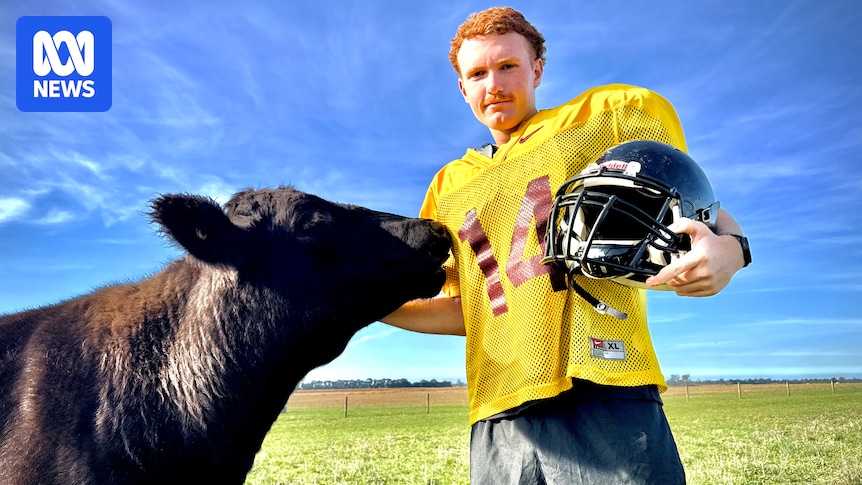

While most footy-mad teenagers dream of an AFL career, Mack Brown is instead eyeing the education and pay day on offer in a different type of football.
Like many young men his age Brown, 19, once lived for local footy.
But he’s traded in his Sherrin for a white-banded American “pigskin”, joining the growing number of Australian footballers eyeing America’s college football system.
The teenager can comfortably kick 50 metres, longer than an average NFL punt, and a taste of gridiron during his final year of school was all it took to convince him to make the switch.
Mack Brown says he can easily clear a 50-metre kick. (ABC News: Madeleine Stuchbery)
“I went to a few [American football] training sessions during year 12 and fell in love with it and committed full-time after that,” he said.
Brown now trains with fellow hopeful punters six times a week.
When he’s not there, he’s helping his dad run a beef farm in the country Victorian town of Clyde, about an hour’s drive south-east of Melbourne.
Brown said he hoped to land a college scholarship after a recent trip to California with NFL coaching group Prokick Australia, where he kicked in front of US college coaches.
“To finally get over there and just experience America and get on a field and kick in front of coaches … it was full circle,” Brown said.
Mack Brown has researched every university that offers agricultural studies. (ABC News: Madeleine Stuchbery)
Pathway to the pros
The Prokick Australia program has sent more than 400 athletes to the US to play college football since 2007, searching for Australian Rules footballers with booming kicks.
The program boasts 43 graduates in the NFL or CFL (Canadian Football League), including six NFL players in 2026.
College football was initially seen as a back-up for some of the AFL’s biggest kickers.
But punting is becoming the main event for a growing number of Australian Rules football-mad kids as young as 14 or 15.
Mack Brown always has a footy nearby. (ABC News: Madeleine Stuchbery)
“We’re getting younger and younger guys in who see this as a legitimate pathway at a younger age,” Prokick Australia director Nathan Chapman said.
Chapman was one of the first AFL retirees to try his hand at the NFL, signing with the Green Bay Packers.
He said the landscape had changed in recent years, with wages of up to $200,000 a year available to players at the college level, on top of their scholarship.
A first-year top-pick AFL player earns a base wage of $105,000.
“Our motto is to get them in so they can get a degree, and the NFL is cream on the top,” he said.
“They use their alumni connections and their degrees to come back and get to work. Sometimes that is in America.
“There’s plenty of guys who have stayed over.”
Game at ‘The G’ expected to inspire
Jack Bouwmeester signed as an undrafted free agent with the San Francisco 49ers last month after graduating from the University of Texas with a masters degree in 2025.
In his home town of Bendigo, he was playing football in the elite underage competition now known as the Coates Talent League, when his dad heard a radio ad for the US punters’ program.
Aged 19, he left a hot Melbourne summer in January 2019 and landed in Michigan during a polar vortex.
Jack Bouwmeester has finished college but has been signed as a free agent to the San Francisco 49ers. (Supplied: Jack Bouwmeester)
Seven years on, the 27-year-old hopes he’ll have his NFL debut on home turf, when the 49ers and Los Angeles Rams start their season at the MCG.
“You don’t really grow up dreaming of playing for the 49ers on the MCG, but it would be a pretty cool start to an NFL career to debut in Australia,”
Bouwmeester said.
“They can kind of ask an Aussie to do anything, and they can do it. They like guys that are athletic and can move around a little bit, run when they need to.”
Big kicks wanted
Brett Thorson was working as a dairy farmer when he became a top punter recruit in the US College system’s 2022 recruiting class, despite having never played the sport.
He’d missed out on being drafted to the AFL and at 20, felt like he wasn’t done with professional sport.
At the suggestion of a friend, he filled out an expression of interest form and ended up being picked to play for Georgia State University.
Brett Thorson, then a Georgia Bulldogs punter, before a college football game in 2022. (Getty Images via Icon Sportswire: Jeffrey Vest)
Hailing from Dumbalk, a tiny farming community in South Gippsland, playing gridiron in front of a sold-out stadium of 93,000 spectators each week was a lot to take in.
While he couldn’t find a suitor in this year’s NFL draft, the Minnesota Vikings picked him up as a free agent.
He now has a few months to prove his worth as the club trims its roster down to 53 players ahead of the start of the upcoming season.
But even if he doesn’t make it to the club’s final roster, he said he had made connections to help him land a good job once he retired.
“As an Australian, you have an upper hand for job opportunities after college because everyone’s interested in what you’re doing and how you got over here,” Thorson said.
“It’s so funny that me sucking at AFL potentially could work out better financially.“
Athlete work ethic sought after
Thorson said Australian draftees were given a set routine from the moment they began their college careers.
Classes are held from 8am until 2pm, and football training runs all afternoon and is followed by recovery.
Originally, scholarships were more about free degrees with costs covered.
Brett Thorson quickly became used to a 93,000-strong crowd. (Supplied: University of Georgia)
But in the past four years, players have received pay packets and have been encouraged to build their own brands and be around financial “boosters”.
“The top punters in college football now would probably make around $200,000 Australian on top of their scholarship,” Thorson said.
“I’ve heard of up to $300,000 for some punters, in Australian dollars.
“Then some base guys are making anywhere from $50,000 to $100,000 Australian, which is obviously good for a college kid because you get your scholarship, which pays for all the core stuff.”
Other positions, like quarterbacks, can be offered anywhere from about $1 million a year in college football, he said.
Choosin’ Texas
Jordy Sandy was 25 years old and working at the Maryvale Paper Mill in the Latrobe Valley in 2020 when he was signed by Texas Christian University.
“It’s not something I would have planned out but it’s pretty special … it completely changed my life,” Sandy said.
Jordy Sandy was 25 when he was drafted to the Texas Christian University football team. (Supplied: TCU Athletics)
“I left a job working in the paper mill and then came over to the US and all my friends were getting married and having kids and buying houses and I’m going to college as a 25-year-old.”
After finishing on the field, a company that specialises in finding jobs for former athletes got in touch online and found him a job managing orthopaedic equipment sales.
“A lot of athletes, especially, are recruited because I guess the qualities of a student athlete transfer pretty well into the real world,” Sandy said.
He’s still in the US, settled in Dallas and still working in orthopaedic sales.
Jordy Sandy now lives and works in the US after a great college football career. (Supplied: TCU Athletics)
“You have to be self-sufficient, be able to juggle commitments and work hard,” Sandy said.
“There’s just so much more opportunity here and that’s why I ended up deciding to stay.”


 By
By