
Yves here. As a student of the French Revolution in college, I am leery of comparing the current protests to that transformative process. It took nearly 100 years before France had a durable republic, with the Third Republic in 1871. The Revolution ushered in ten years of escalating violence, and ended not in democracy but the Empire under Napoleon. But that bloody first phase did shift how the French men saw themselves, as citizens rather than subjects.
If you take a broader view of what revolutions do, as in shatter political structures to allow new ones to rise, again the current protests do not yet seem sufficient to achieve that. Meaningful and durable change would require not just fundamental change in France but at the European Union level as well.
Nevertheless, this post gives a good feel for the state of play on the ground in France.
Dimitry Lascaris also has a lot of coverage on his Twitter account and on Reason2Resist. His opening tweet from his fresh coverage speaks volumes:
I’ve been in France for 10 days to cover the protests.
After having lived in France for 3 years in the 90s, I don’t recognize this country anymore.
France has become a police state.
In none of my three trips to Iran in the past 18 months did I see anything like this. https://t.co/q98uCpU4A9
— Dimitri Lascaris (@dimitrilascaris) November 3, 2026
By Tom Neuburger. Originally published at God’s Spies

I’m calling this a Quick Hits piece because the subject is incredibly broad and I don’t want to weigh in with a massive tome at this point. The real revolt encompasses the whole EU, including a crisis in Poland that’s both complex and fascinating. Our work at God’s Spies, our mission, essentially documents today’s Rule by the Rich and all the damage it has caused. This piece just touches on France, narrowed to the events starting October 17.
The New French Revolution
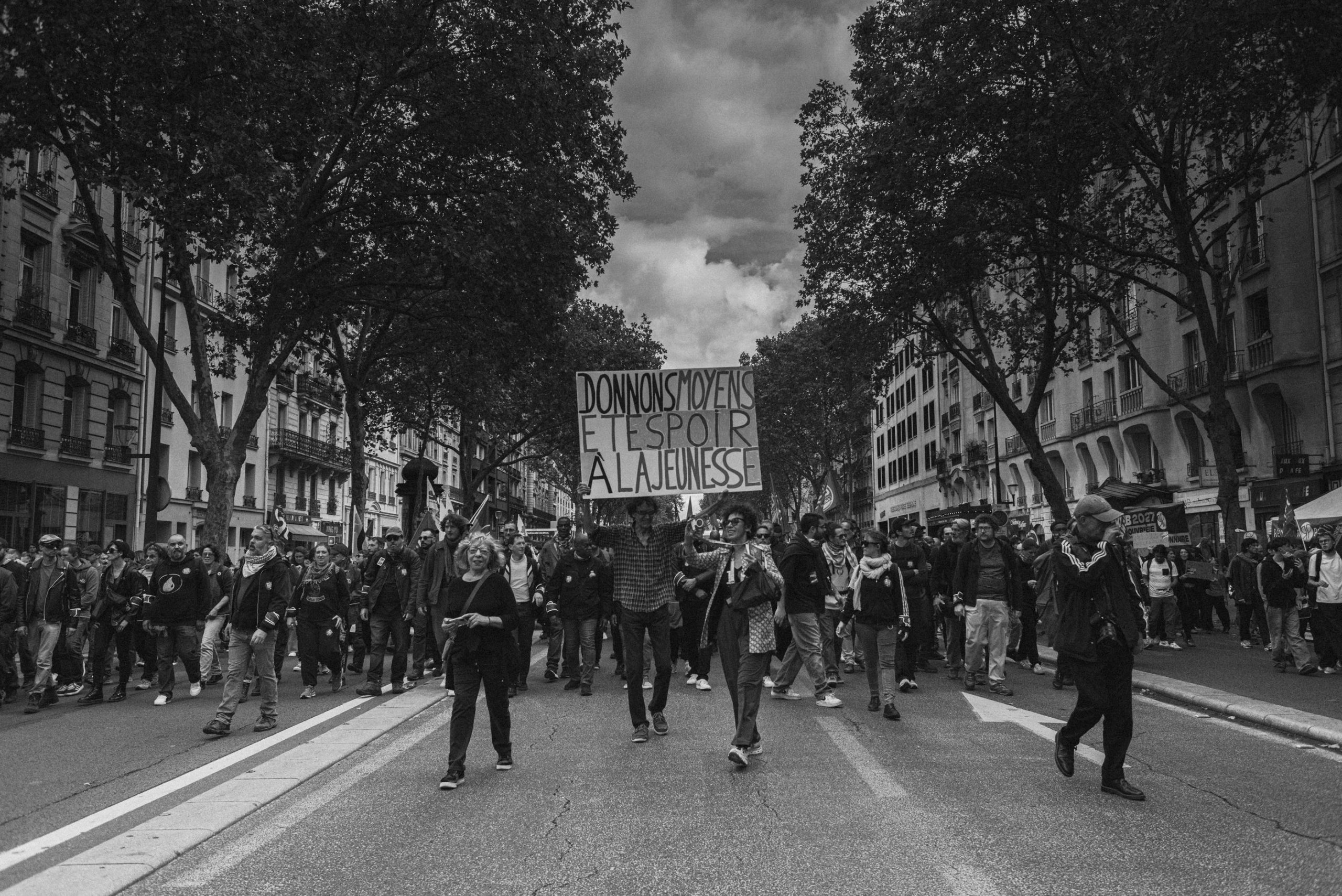
What’s said in the U.S. about France is not what’s happening in France. I happened to be in Paris on October 17, the first day of protest that made the American news, and was able to watch from the streets. I saw thousands of peaceful marchers (see the image above or this post), with many sidewalk non-participants singing along and less than a dozen or so black-clad violent people in the fringes around them. Anecdotal I know, but still.
In addition, I saw no one who personally feared the violent; all those attacks focused on property. That harm was great to be sure, but the only real personalharm was done by police.
Jon Stewart gets it right here — be sure to watch to the end. The runner is typical of the lack of personal concern.
Jean-Luc Szpakowski: What I Saw in France
For a more complete understanding of what’s happening in France, I offer this set of pieces from Jean-Luc Szpakowski, an American doctor who lives in California and spends time abroad. On October 17 and after, he went out in Paris to see what was happening. His reports are published at Substack in three parts:
• The French demonstrations of October 2026, Part 1 — The Lyceen (High School) Movement
• The French demonstrations of October 2026, Part 2 — October 17
• The French demonstrations of October 2026, Part 3 — October 24
Here are a few excepts from Part 1. His full report covers the small and the large alike. It’s well worth a read.
The chaos surrounding the demonstrations of the weekend of October 17-18 has left many appalled and confused. What transformed a story of peaceful demonstrations into a story of rampaging looters running amok? What follows is based on personal observations and a selection of social media and news outlets. Because of its length I am dividing it, like Gaul, into three parts.
The Lyceen Movement protests started in the French territory of Mayotte at the end of August, then spread to French Guiana and the Antilles before reaching the Parisian suburbs. Protests started September 17 at a single lycee, the Lycée Saint-Exupery in Créteil, a southeastern suburb of Paris, and quickly metastasized throughout France., involving alike poor districts and well off districts. On October first 1,027 lycées of the 3,700 across France were affectedby the movement’s actions, with blockades at 222 of them.
Many of the complaints are acknowledged as legitimate by all political parties. They include decaying infrastructure with dilapidated schools that are cold in the winter and hot in the summer, toilets not working, rodent infestation, large classes of 30-36 students, and long school days from 8AM to 6 PM. Most shocking “are the teacher absences…— for illness, parental leave, or various other reasons— for weeks and sometimes months at a time without replacements.” These involve especially mathematics classes. One figure from the French govt is that 7.5% of scheduled classes in 2024-25 had no teacher. Substitute teachers are in short supply largely due to low pay. All this has negative consequences for students and leaves them understandably poorly prepared during their exam year.
One source of the problem is money, always an issue under neoliberal rule. Jean-Luc:
The economist Thomas Piketty has posted a graph showing how funding per student dropped 20% between 2017 and 2025:

I won’t go into how the parcoursup replaced le bac (baccalauréat) and the damage it’s already done, but Jean-Luc does. Start with the section beginning “To add final injury…”.
About the Police
Police action in these events are a real problem. Jean-Luc again:
The student demonstrators have staged sit-ins and blockaded numerous schools, as well as roads in front of schools. In response the police have charged and dismantled some of them with numerous arrests. There are “reports that some officers had used rubber bullets (LBD) against the students, who are mostly aged between 15 and 18, and unverified videos on social media which appear to show officers beating students…”
and:
The police response … does not distinguish between peaceful demonstrators and those attacking them. This in turn leads to greater numbers protesting the violence against the innocent. At any rate the police response is viewed as uncalibrated. …
Beyond the number of arrests has been the violence and militarization of the state’s response to this movement by its youth. As one witness said, “ I will never forget witnessing CRS violently shove demonstrators (women) down metro stairs during the feminist march of 2021. Like these teenagers, protestors are regularly met with tear gas stun grenades— the very weapon responsible for blowing off a 15-year-old’s hand this week (and is not used by our EU neighbors in crowd control1). What’s more, accusations have circulated of plainclothes officers infiltrating student protests and provoking CRS aggression by launching projectiles.”
Here is one video of police during these events. Click here to watch; it’s nasty, brutish and short.

There are other videos of extreme police aggression, including some of police dressed as black bloc warriors throwing objects, then returning back to police lines. One of those videos is described below:
A video filmed in Metz on October 17, viewed more than 2.5 million times, shows four people dressed in black with faces covered, one of whom throws a projectile to the ground in a side alley before turning back. The small group is then escorted by a uniformed officer behind the police cordon.
Contacted by reporters, the Metz prosecutor confirmed that the individuals “are plainclothes police officers” who acted “within the framework of a public-order operation, under the direction of an officer in uniform.” David Touvet said their civilian attire and the throwing of the grenade were “governed by law” and that he had “not identified any difficulty in that regard.” The prosecutor’s office nonetheless conceded that “the absence of the ‘police’ armband may raise questions” and that “instructions on this point have been reiterated to the officers concerned by their superiors.”
That video is here. This is another. Appalling.
The Onion Gets It Right, Again
My final thought on the violence: This snarky Onion headline well catches our times.

Uniting the Protesters
One result of the police response is to unite the protesters. Jean-Luc:
One of the results of the police uncalibrated response to the students is that, as a NY Times reporter wrote, “I talked to a group of parents at the protest today who told me this is the first time they’ve started to attend their kids’ protests as shields and witnesses, to make sure their kids remain safe.” University students joined in when they saw the violence against junior high school and high school students.
Another commentator noted “What made the images from the square so striking was not just the scale of it, but the discipline within the anger. These are not mindless rioters, and the French demonstrators know it, which is why, amid the blocked roads and the burning barricades, they have consistently and deliberately made way for ambulances and fire engines.” Here is another video of demonstrators applauding firemen.
I continue to hold that the U.S. is one of the most heavily propagandized nations in the world, and certainly the most heavily propagandized Western nation (for just one example, see here and here).
What you may have been reading or seeing about Europe and France — isn’t about Europe or France. It’s about U.S. elites and their need to “keep order” at home.



 By