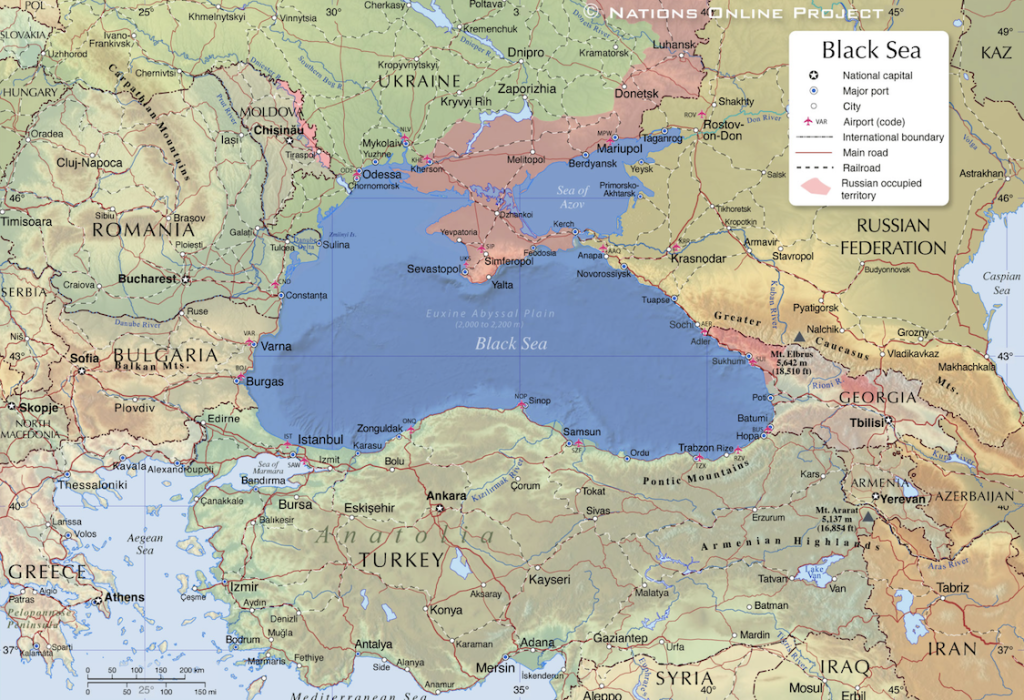

While much of the attention remains on the omnishambles in the Middle East waterways and the uniparty political theatrics in the US, the Black Sea has somewhat quietly become a no-go zone. Here’s Marine Insight on what’s now the world’s most dangerous waterway:
Attacks on merchant vessels in the Black Sea have risen considerably in the last two months, making the waterway the most dangerous to navigate, leaving behind the Persian Gulf and even the Strait of Hormuz, where the U.S-Iran war is ongoing. According to maritime security firm Ambrey and the International Maritime Organization, attacks on ships in the Black Sea are 6 times higher than those recorded in the Persian Gulf, where 24 seafarer deaths have been confirmed.
What does it mean for the fast-approaching global hunger crisis? Combined, Russia and Ukraine account for a little more than a quarter of global wheat exports, and the Black Sea fighting now has wheat futures on the Chicago Board of Trade at their highest level since 2023. They’ve shot up roughly 20 percent over the first nine months of this year.[1]
Traffic to NATO countries Romania and Bulgaria is now being affected as well. From gCaptain:
“The sinking of Contship Jet off Bulgaria last week has crystallized those concerns,” said Richard Meade, editor-in-chief of Lloyd’s List. “We understand that analysts are being approached over potential charter-party disputes, as some owners are essentially seeking to refuse orders to Romanian and Bulgarian ports. That suggests to me that the calculation is shifting from how much the risk costs to whether owners, charterers and crews are prepared to accept it at all.”
Why is that? Here’s Mark Sleboda:
And the transcript:
Russia has escalated their campaign on the Black Sea targeting not only ships moving directly in or out of the ports of Odessa, but they are now actively hunting down NATO shadow fleet ships, right. And by that I mean, we’ll use the western definition of that, right? Which is a cargo ship with a third-party flag or third-country flag of convenience, right? Some Pacific island of the sort that is being used by NATO to attempt to get military supplies into Ukraine through the Odessa ports simply because it’s very difficult to keep them supplied just by land, simply logistically it’s so much easier to move things on on water, and the trains you know from, shall we say, Poland to Ukraine are already you know kind of maxed out as far as deliveries.
They need to deliver ammunition, fuel, other things to the Kiev regime by ships, and Russia has been blockading that. But now Russia is no longer waiting for them to be creeping into the ports. They’re actually hunting them down off the coasts of Bulgaria and Romania, not literally in their territorial waters, but often in their exclusive economic zones. And that is a new development.
And they’ve even been using sea drones … to do this recently and we’ve seen some videos of that in action. And that is now leading not just to ships being hit but ships being sunk … off the coasts of Bulgaria and Romania. And NATO is flailing around at this point not quite sure what to do. And Russia’s getting some payback. You know, you want to detain our shadow fleet? Well, here’s an escalation. We’re going to sink NATO’s shadow fleet.
What’s to be done? Seeing as Western ruling class is determined the war continue until the last Ukrainian—and potentially longer with fresh meat for the grinder—we’re looking at two options.
One is that NATO gets warships into the Black Sea. likely to escort “commercial” ships to Ukraine, but despite years of pressure, Türkiye is still saying no to opening the Turkish Straits and that can of worms. “The US and France have been trying to expand their presence in the region for a long time, but Ankara opposes these plans and is guided by the Montreux Convention, which regulates the passage of warships through the Turkish straits,” the pro-Turkish-government Yeni Safak newspaper reported on Oct. 27.

After meeting with Zelensky last week, Erdogan is now trying to talk to Putin with some sort of Black Sea ceasefire at the top of the agenda. That would be option number two. No word on when that meeting might happen, but the Kremlin is repeatedly making clear it’s past the point of such temporary pacts that only give Ukraine a little time to repair and reload.
So what does Erdogan do?
Should he relent on passage through the Turkish Straits, the risks are considerable. Here’s The Duran:
Additional NATO warships operating in proximity to Russian forces would create new opportunities for confrontation. Türkiye would be asked to assume substantial political and strategic risks for an operation whose military benefits remain uncertain.
…The Black Sea presents the clearest illustration of this dilemma. Türkiye has compelling reasons to preserve its existing restrictions and avoid becoming directly involved in a naval confrontation with Russia. Pressuring Ankara to change course would risk extending the conflict into an area where the costs of miscalculation could be considerably greater than any immediate military advantage.
And the pressure on Erdogan to open the Turkish Straits is likely to rise with the diehard Project Ukraine faction of the uniparty back in command of both houses of Congress.
Are the Turks in on the Game or Are They a Target?
Although everyone is pointing the blame at Moscow —which certainly has the means and motivation—for the sinking of the ships near Romanian and Bulgarian waters there exists another possibility.
At least 26 Turkish ships have been struck in the past few months, including the two in the Bulgarian exclusive economic zone. As far as I know, the Russian side has not changed its stance that it was not behind the strikes in ships near Bulgaria and Romania.
NATO-Ukraine also has a motive to strike these ships—specifically Turkish vessles—as part of a pressure campaign to open the straits.
While Bulgaria and much of NATO treat Russian responsibility as a fait accompli, Erdogan said not so fast. From Turkiye Today:
“We cannot accept these attacks under any circumstances, regardless of who carries them out or what justification they may offer,” Turkish President Recep Tayyip Erdogan said Saturday after meeting Ukrainian President Volodymyr Zelenskyy in Istanbul.
It wouldn’t be surprising if there’s a notion in CIA-Ukraine to hit Turkish ships until Ankara relents on its adherence to the Montreux Convention.
At the same time, Turkish-Russian economic ties are declining rapidly. Part of the reason is the chaos in the Black Sea. The other reason is the concerted effort in Türkiye —under pressure from the West— to do so.
Russia is Türkiye’s second largest supplier of goods after China, but in August and September trade volumes plummeted by 41% and 79%, respectively. Türkiye is (partially) moving away from Russian gas, and the Russian diesel ban also played a role.
Türkiye’s exports to Russia, small compared to the imports, have been hammered by merchant shipping difficulties and the challenges of payments due to US secondary sanctions threats.
In December, Türkiye signed off on an extension of its gas-import contracts with Russia, but it was only for a single year, less than the long-term deal Moscow was hoping for.
Turkish Energy and Natural Resources Minister Alparslan Bayraktar raised eyebrows last week when he said Ankara would continue to seek alternatives to Russian gas because it is the expensive option. From Turkiye Today:
Speaking at a press roundtable in Istanbul, Bayraktar said, “The reason we are buying less gas from Russia and more gas from the U.S. has a very simple answer: not politics, but price. Russia is extremely expensive.”
The minister explained that prohibitive costs are accelerating Türkiye’s pivot toward a more diversified supply network.
“On the energy demand side, because gas is extremely expensive, you are basically forcing people to find alternatives—either alternative gas channels, cheaper gas, competitive gas, or alternative fuel,” he noted.
That really flies in the face of all available data. Even the archnemesis Greeks admit it’s cheaper to buy (Russian) gas from Türkiye than the US LNG. As Greek Energy Press notes:
LNG imports at the Revythoussa facility have remained subdued over the past few months as gas importers have shown a clear preference for more competitively priced Russian pipeline gas being rebranded as Turkish pipeline gas – to avoid sanctions imposed on Russia – and entering the Greek market via the country’s Sidirokastro gas entry point on the Greek-Bulgarian border.
Bayraktar’s comments are likely part of an effort to get the Russians to come down on price, and Turkiye has reason to believe it has more leverage as it’s been pursuing Western-preferred options for some time now.
- In May, Ankara signed a fifteen-year deal with Azerbaijan for 33 billion cubic meters (bcm) of natural gas.
- According to the Centre for Eastern Studies, US LNG imports to Türkiye reached 9.19 bcm in 2025, which covered nearly 16 percent of Türkiye’s total import market.
- New contracts with major suppliers like the Swiss energy firm Mercuria and the US-based Cheniere Energy are delivering 1.2 bcm and 4 bcm annually, respectively. Next year, a ten-year agreement with ExxonMobil comes online, bringing another 3.5 bcm.
Yet, Türkiye still has a long way to go if it wants to replace the 40% of natural gas imports it receives from Russia, especially with industrial expansion, and rising power generation. Ankara is trying to boost domestic and overseas production (in partnership with Exxon Mobil) to meet 30% of the country’s needs.
Türkiye is also engaged in a standoff over Mediterranean Sea gas fields.
Back to the economic relationship with Moscow, another foundational piece of those ties is undergoing difficulties: the Russian-built Akkuyu nuclear plant, which is also getting tied up in the gas geopolitics. From Intellinews:
A gas deal may be vital for the Akkuyu nuclear plant as well. The commissioning of the first of four planned 1.2-gigawatt reactors has been set back two years by the German government’s refusal to approve the sale of Siemens Energy equipment to Rosatom. Even if the first unit comes on stream, using alternative Chinese parts, further progress faces financing problems.
Erdogan and Russian counterpart Vladimir Putin reaffirmed their commitment to nuclear energy collaboration during the Shanghai Cooperation Organization (SCO) summit in Bishkek in September. However, no Turkish entity, public or private, has yet agreed to buy a stake in the Akkuyu plant, nor has there been any breakthrough regarding the re-routing of payments for Russian gas to fund further investment.
We see again how Türkiye’s geographic positioning lends itself to the type of deal making that the Erdogan clan running Türkiye is always open to: ones that enrich and empower it. Will Russia come down on gas prices or is there a deal out there that NATO could offer that would see warships sailing through the Turkish Straits?
What exactly NATO would gain from such a deal is questionable. Perhaps it should be careful what it wishes for. Should the US, France, UK, and others try to further militarize the Black Sea, what does it do if a warship gets hit? Furthermore, Russia currently ignores NATO air assets over the sea despite the fact they help NATO-Ukraine target Russian assets. What happens if the Putin government removes those restrictions in response to the Straits being opened? As usual this is more blind escalation without thinking through the consequences, but at this point why should we expect anything else?
Notes
[1] Russia is reportedly exploring using other routes for grain, but there are limitations.
Russian #wheat exports have been gradually recovering as shipments through the Baltic Sea rise.
August: 2.1 mmt
October: 2.9 mmt
But this may be close to the peak for now – and it’s still roughly 50% below normal.
What is limiting further growth?
Free note:
https://t.co/8NVpQMBkid
#Russia #blacksea #oatt #sizovreport
— Andrey Sizov (@sizov_andre) November 5, 2026
And from Traders Union:
As reported by Reuters, Murmansk Commercial Seaport and Demetra Holding say the first shipment of 3,400 metric tons of grain from key agricultural regions is being loaded onto a vessel. The move marks Russia’s first use of the Arctic World War II shipping route for grain exports as attacks on ports and vessels continue to disrupt Black Sea trade.
Murmansk, nearly 2,000 km north of Moscow near the border with Norway, can be approached through neutral waters. The port says it is opening an alternative route to foreign markets for Russian farmers at a time when traditional export corridors face restrictions.
According to shipping data and a market source, around 28,000 metric tons of wheat are due to be loaded onto a vessel bound for Morocco’s Casablanca port. Russia has also been subsidising rail transport from fertile southern regions to redirect cargo toward other seaborne outlets.


 By