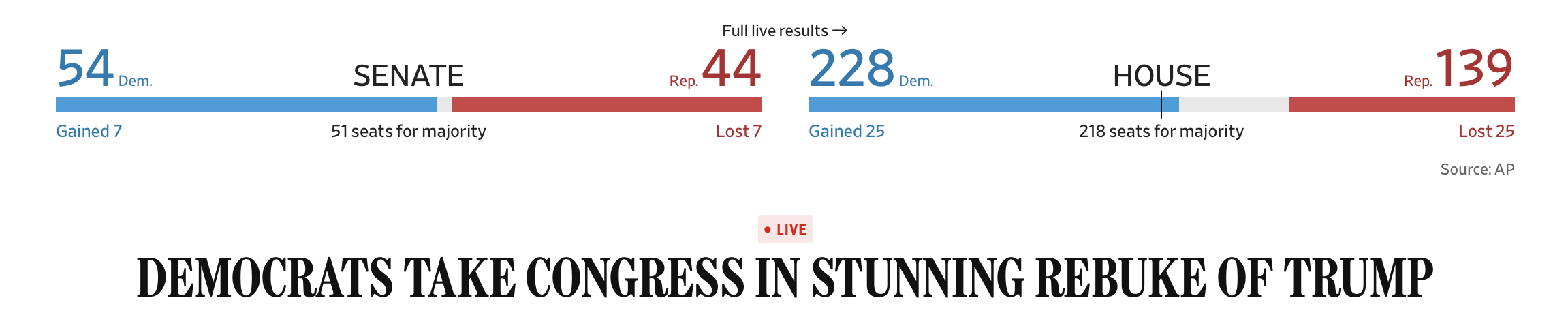

This post will be a quasi open thread since election results are still coming in. But major outlets are already sticking a fork in Trump. From the Wall Street Journal’s landing page:

55 in the Senate is the number to watch. Robert Barnes has argue that that is the threshold for removal of Trump in an impeachment, that enough Republicans would join so as to forcibly oust Hair Furore.
A few more big banners:

And Bloomberg:

The Texas result is significant not just in showing the severity of Trump repudiation, but also, as Nat pointed out last evening, the loss of Texas assures the Democrats the Presidency in 2028. It’s too early to tell whether progressives outperformed, with gas prices, tariffs, and high food prices big motivators for the high turnout.
Trump is, true to form, refusing to accept his loss, or more accurately, that the voter revulsion diminishes his power:

But it’s not that simple. Richard Nixon resigned after the US had had an epic wave of protests. There were natterings about the need to heal after Vietnam had created real fractures and elites pearl-clutched over the way the US had become ungovernable (muscular unions preserving real wages during stagflation were another cause of capitalist whinges). So there was a desire among many in the leadership class then to restore “normalcy”, as in circle the wagons to improve stability.
With Trump-the-volatility generator still very much insisting he holds the reins, disruption will have to get worse, as Trump’s freedom of action will need to be curtailed, for things to get better. The in-your-face Trump refusal to change course meaningfully, if that posture holds, is a frontal challenge to Dems to Do Something. Will they? Mr. Market seems to think they won’t do much. After an initial wobble, stocks and bonds rose even though the dollar retreated. At a first pass, this looks like the expectation is gridlock rather than Constitution-and-stability challenging political warfare.
Some of that depends whether the lame duck Congress will operate true to historical form and push through pet projects of the outgoing regime. but the Trump losses are so severe that this sort of thing might not occur. Trump can no longer protect allies, save pardoning them. He was never good about honoring money or favor promises. Exiting Congresscritters may have some interest in their future meal tickets, as in not burning bridges with the shifting political establishment.
Nat flagged an early test in his live blog last night:
This is the key post-election fight that could determine the Senate leadership election. Should Democrats block funding for the war on December 11? Chris Van Hollen says yes, block it.
— Ryan Grim (@ryangrim) November 3, 2026
Another is whether Massie’s impeachment of Hegseth gets traction. Hegseth is loathed and the bloodying of Trump could change some calculations:
Reporter:
Will you reintroduce articles of impeachment against SecDef Hegseth when Congress returns to DC?
Me:
If he’s still SecDef.
— Thomas Massie (@RepThomasMassie) October 26, 2026
Another sign of how much authority Trump can retain authority is how many key staffers leave the sinking ship or are pushed out by Trump in a scapegoating rage. It’s hard to see the upside in joining a tarnished Administration, so if there is a lot of post-election turnover, Trump may have a lot of internally promoted “acting” heads in charge. I have zero insight into how the various departments in the Executive branch operate, but in my part of the world, a common bureaucratic stonewalling method is to do the least important 40% of an initiative, slowly. Remember how Trump tried to order an exit from Afghanistan in the last month of his first term and was ignored.
Trump can also expect a big fall in media water-carrying for him. Readers may recall that I have often commented how Bloomberg in particular has give the most Trump-favoring spin possible in its Iran war headlines, such as grasping on to any thin claims that peace pow-wows are underway. Bloomberg may still carry on as before but the press generally will show a lot less deference.
However, Foreign Affairs warns Trump can still break a lot of china. From The Dangers of a Lame-Duck Trump:
Trump’s lame-duck period will not be like those of his predecessors, however. He has already gone through what was widely considered at the time to be a lame-duck phase, between November 2020 and January 2021. He used it to contest the election outcome despite clear evidence that Joe Biden had won. Trump is the first president in the past 100 years to have served two nonconsecutive terms, and therefore the only American leader in living memory to have a second lame-duck period—this time lasting more than two years.
With Democrats soon to be in control of the House and the Senate, the threat of impeachment or investigations into the Trump family’s business dealings will likely make the president feel cornered and angry. And that’s what makes the remainder of Trump’s term so dangerous. A boxed-in Trump, with no obvious constructive foreign policy outlet to channel his energy, may well lash out internationally. And Congress, even if controlled by Democrats, will have little power over his day-to-day management of foreign policy.
There are plenty of ways Trump could act out: issuing fresh threats against Canada, launching new attacks on U.S. alliances, or colluding with Russia or China at the expense of Ukraine or Taiwan. But to turn those threats into policy would require serious effort, such as repositioning U.S. troops or painstakingly negotiating with other great powers.
The two places where Trump can inflict the most damage are Iran and Cuba. According to The New York Times, the Trump administration and Israel have drawn up plans for fresh strikes on Iran as soon as the midterms are over. A last-ditch effort to compel Tehran to surrender is unlikely to work and would put at risk the global economy and the security and stability of Persian Gulf allies. Trump might also try to force regime change in Cuba. Military action against both adversaries would only require Trump to give his say-so. With no election on the horizon, all that constrains the president abroad is the sense of his own legacy.
We do have the looming threat of violent action against Iran, including of a nuclear strike. An excellent Black Mountain Analysis piece, When Stealth Meets the Bomb: Inside the US-Israel Nuclear Strike Scenario on Iran’s Deep Bunkers, describes how the nuclear B61 bomb, which ground penetrates before it detonates, really could do massive damage to Pickaxe Mountain, as well as contaminate a lot of the area:

The article also describes at length (even giving a detailed time sequence) of how the US and Israel would get the needed strike force into Iran, as well as the measures Iran can be expected to take to try to thwart the attack. IMHO blowing up a lot of the planes before they take off would seem more effective than anything the article describes, but no one in Iran asked my opinion.
However, Scott Ritter, who tends to be excitable, has said a nuclear attack is na ga happen. He points out Trump has been told no before and will be told no again. But Trump still has plenty of means to destroy the world economy as we know it by attacking Iran’s energy infrastructure.
And the Iran is not taking any cheer from the Trump kneecapping:
A message attributed to Iran’s Supreme Leader Mojtaba Khamenei said on Wednesday that changes in US election results would not alter Washington’s hostility toward Tehran, after Republicans suffered setbacks in the midterm elections.
“If anyone still hopes for a change in behavior or a shift between political parties and factions in the system of domination, they are gravely mistaken,” the message said.
The statement was published on Khamenei’s official website to mark November 4, Iran’s annual anti-US commemoration.
Khamenei has not appeared publicly or been heard speaking since the war began on February 28. No video or audio accompanied the written message.
The message also warned against making concessions to Washington, arguing that the United States sought Iran’s “unconditional surrender” and that compromising would encourage further demands and military attacks.
https://t.co/KzMOmgL7VQ
— Iran International English (@IranIntl_En) November 4, 2026
Trita Parsi shares their reservations:
As much as the Iran war is the key reason Trump and the GOP were crushed tonight, it is important to recognize that the pressure for war is now likely to increase.
This does not mean that Trump will restart the war. But the balance of pressure for and against war will likely favor escalation.
Trump was under a degree of pressure to strike a deal before the midterms, hoping to soften the blow in the polls. But now that the midterms are over, that pressure will dissipate somewhat. Gas prices are still high, but the political cost has already been paid. There won’t be another point on the political calendar for some time when that cost can be exacted again.
But two other factors will intensify.
Read full analysis: https://t.co/izlM9bKqPj
— Trita Parsi (@tparsi) November 4, 2026
Again there will be a great deal of post-election prognostication, as well as some initial signals of how much steel the normally cowardly Dems will show. Another key test of whether they will make a better show of being responsive to what voters want is on the data center front, where 29 out of 30 ballot resolutions calling for data center moratoriums passed. Will there be serious efforts to curb the environmentally-destructive, electricity-cost-goosing buildout? Keep in mind that that they could get lucky, that Mr. Market may settle the matter for them before they decide where to position themselves on the pure headfake versus somewhat serious spectrum.
Now to some of the many good hot takes:
From Axios in Voters deliver “AI earthquake,” rebuking tech and billionaires:
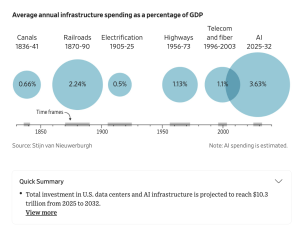
Voters showed deep distrust of the AI race Tuesday, approving dozens of data center moratoriums and electing a raft of candidates who favor slowing a $10 trillion buildout, including in Texas — the epicenter of the boom.
Why it matters: In an election that hinged on an affordability crisis for many Americans, voters made it clear they view Silicon Valley’s AI ambitions not as a technological miracle, but as a resource-draining threat to their wallets and communities.
From Politico’s European morning newsletter:
FAFO: The result is nothing short of a catastrophe for Trump, who had urged voters to pretend he was on the ballot. The result can thus be seen as a referendum on his premiership — and the message from America was crystal clear. This was a GOP defeat of historic proportions, with Dems winning Senate races in states they haven’t won in decades, even Kansas.
These election results mean that corporate America is in a LOT of trouble. The old model of hiring a Dem lobbyist when the Dems win or an R lobbyist when the Rs win, and then doing business as usual, is over. Corporate profits are at record highs, and the labor share of the economy is at record lows. That’s going to reverse.
Dozens of data center ballot initiatives passed, as did limits on electric utility lobbying, and a flood of young populist left-wing candidates will now be taking office in red and blue states. Americans are angry at corruption and corporate greed. A Democrat won a South Carolina Senate seat on a campaign to break apart the awful health care system we have.
We are going to see a bunch of fumbling around for awhile as the new candidates figure out how to govern, but after that, it’ll be a reversal of the neoliberal era. Get ready for actual public utility regulation in a lot of different sectors, as well as stronger rules against monopolies, corruption, price gouging, excessive CEO pay, and financial extraction.
Pour one out for CNBC and Jim Cramer.
— Matt Stoller (@matthewstoller) November 4, 2026
This contentious interchange between the NY Times and @GinaHinojosaTX was truly amazing. Hinojosa offered one of the best explanations of populism I’ve ever seen. Her comments were a total rejection of Corporate Dems’ neoliberal formula. Her Texas victory is a game changer. https://t.co/M2ye9fiPSk
— David Sirota (@davidsirota) November 4, 2026
🇺🇸Abdul El-Sayed trolling JD Vance after the victory:
“JD, habibi, there is this delicious irony in the fact that you’re constitutionally obligated to swear me in January.” https://t.co/sxH1Ps0eaV
— Megatron (@Megatron_ron) November 4, 2026
🇺🇸 Trump handpicked Republican candidates in 4 of the country’s biggest Senate races. All 4 LOST.
South Carolina: Trump backed Darline Graham, sister of the late Lindsey Graham, in a state he won by 18 points. Democrat Annie Andrews took the seat, the first Democratic Senate win there since 1998.
North Carolina: his pick Michael Whatley got routed by former Gov. Roy Cooper.
Texas: Trump pushed Ken Paxton over Sen. John Cornyn in the primary. Democrat James Talarico cruised to the party’s first Texas Senate win since 1988.
Michigan: Mike Rogers lost to Abdul El-Sayed, who’ll be the first Muslim in the Senate.
Even some Republicans are pointing the finger at Trump, saying his picks cost the party seats it should have won easily.
Trump’s own take: “I wasn’t on the Ballot and if I was, we would have won IN A LANDSLIDE!”
Before the vote, he told everyone to pretend he was on the ballot. Now that the results are in, suddenly he wasn’t…
Source: Reuters / Writer: Julie
— Mario Nawfal (@MarioNawfal) November 4, 2026
More good hot takes, please! Share them in comments!


 By