

Yves here. Jospeh Busby calls out the considerable hypocrisies in how nuclear weapons states approach nonproliferation, such as changing nuclear doctrines and their attempts to de-sensitize the public to the use of tactical nuclear weapons.
Kevin Kirk, in his must-read Armageddon Now! Israel’s Nuclear Weapons Program, discussed Israel’s nuclear weapons development in depth. That included describing how France, Great Britain, and South Africa, provided Israel with know-how and critical inputs.
This article also provides an important background for assessing the US-Saudi nuclear deal, which seems to be back on track. An initial reaction from Trita Parsi in Trump’s Saudi nuclear agreement may prolong the Iran war:
A final deal between the United States and Iran is slipping further out of reach….
But even if these obstacles were resolved, profound differences over the nuclear issue would remain. And those differences have now grown dramatically more severe because of Trump’s nuclear agreement with Saudi Arabia. The details of the deal were just made public, and Kelsey Davenport at the Arms Control Association has published an excellent FAQ addressing its most important aspects.
The bottom line is: Trump is granting Saudi Arabia access to the same uranium-enrichment technology the United States has sought to deny Iran for more than three decades, while imposing a far weaker inspection regime on Saudi nuclear activities. In effect, Washington is providing Riyadh a pathway to the bomb while insisting that Iran have no enrichment capability whatsoever—the infamous zero-enrichment objective….
Again, the comparison with Iran is revealing. When Iran expanded its enrichment to 20 percent in 2010 to produce fuel for the Tehran Research Reactor—which, ironically, the United States had given Iran in the late 1960s as part of the Atoms for Peace program—Washington pointed to the move as further evidence of Iran’s alleged nuclear weapons ambitions.
State Department spokesperson Philip Crowley said on February 11, 2010, that Iran’s decision to begin enriching to 20 percent “further solidifies … our impression and that of the international community that Iran’s nuclear intentions are anything but peaceful.” …
Now, Trump wants Congress to approve a deal with Saudi Arabia that gives the kingdom access to precisely that technology—but with far fewer inspections—while bombing Iran to prevent it from having any enrichment at all.
Admittedly, at least one US president was seriously trying to prevent more states from acquiring nuclear weapons:
🇺🇸🇮🇱 Fmr CIA Officer John Kiriakou:
“There are 10,000 documents [related to the Kennedy assassination] that are never going to be released [by Trump].
Because every single one of them points directly at Israel.
[JFK] was actively trying to disrupt the Israelis from acquiring… pic.twitter.com/4bUwxCzi7p
— Mario Nawfal (@MarioNawfal) March 25, 2026
By Joseph Busby, the founder and director of Reality-Based Analysis Group (RBAG), an independent geopolitical analysis firm based in Vienna, Austria. RBAG is affiliated with the Association for the Promotion of International Development and Stability (APIDS, apids.at). Subscribe at rbag.at. Originally published at the Reality-Based Analysis Group website
I. The Lies that Frame the Narrative
For the past few years you have been asked to believe a narrative about nuclear nonproliferation which is not true. That’s not to say that those spreading the lies are aware that they are not speaking the truth; often they are simply repeating, or reporting, what they have been told, what they believe to be true. The most common claim is that Ukraine gave up its nuclear weapons in exchange for territorial security guarantees and after February 2022 the West is now obligated to defend “Ukrainian” territory. The second claim is that South Africa gave up its nuclear weapons and weapons program voluntarily in order to be welcomed back into collegial relations with the rest of the world. Neither story is true. Both are designed to reinforce the importance of the Western security umbrella, but from different angles.
Since the outbreak of open hostilities between Russia and Ukraine in February 2022, a mythical take on the 1994 Budapest Memorandum has been used by Ukraine and its supporters to demand military and other support. At the time of the collapse of the Soviet Union, approximately 1,900 strategic nuclear warheads were located in what had suddenly become sovereign Ukrainian territory. The Budapest Memorandum, signed by the Russian Federation, Ukraine, the United States, and the United Kingdom, arranged for the return of those warheads in exchange for political assurances regarding Ukraine’s territorial integrity. The Memorandum is not and never was a binding treaty and at most it demanded political “assurances” (and in the Russian and Ukrainian version “guarantees”), not arms and armies. More critical, however, is the fact that the warheads were not Ukrainian and were never under Ukrainian command and control. Despite robust efforts to gain access to the launch codes and other authorities which would allow for use of the weapons, the Ukrainians never succeeded and the warheads were unusable. The weapons were Soviet and the launch authority and all of its complexities lay in the Russian Federation. While some scholars have argued that it may have been feasible for Ukraine to eventually hack into the system, the reality is that they tried and failed and then made a deal. Only after Ukrainian failure did they accept the Budapest Memorandum, returning to Russia what was never Ukrainian. A state does not exchange a functioning deterrent for a non-binding agreement, but it will give up custody of someone else’s weapons for one. Returning a weapon you cannot use is not the myth of sacrifice Ukraine and its supporters present. Thus, the Budapest Memorandum proves a different story: political assurances from great powers are nonbinding. Ukraine’s borders continue to shrink and there is nothing assured or guaranteed by the West regarding their return to pre-war boundaries.
The false version of the story, however, works very well for its purposes. For Ukraine it converts its sacrifice, the return of the nuclear weapons, into a debt owed to it by the West. After all, if Ukraine voluntarily gave up its weapons of mass destruction based on a promise that it would be protected from invasion, and then Russia broke the promise by invading, the West must follow through with support, both military and financial. For advocates of Ukrainian membership in NATO, the argument is extended further: if the obligations of the Budapest Memorandum can be ignored, then Ukraine must be admitted into NATO by treaty so that Article 5 can apply and make legal and official what the Memorandum failed to do. For those who advocate aggression against Russia, the story makes Western military and financial assistance in Ukraine’s fight a moral obligation and a debt to be repaid.
However, as Ukraine never controlled the weapons at all, the Budapest Memorandum was never a trade, it was a Russian promise of forbearance and a Western promise of assurance, both broken decades later. The false story is a simplistic tale which attempts to use the Budapest Memorandum to make a moral argument in lieu of NATO’s Article 5 requirement to defend a partner. Given that Ukraine is not a member of NATO, Russia did not need to fear a NATO response. The lie about Ukrainian nonproliferation is designed as an end-around in order to make a Western military response a moral requirement.
South African unilateral nuclear disarmament is often presented as a “feel good story” in which a rogue state saw reason, ended its program, along with its apartheid governance, and was welcomed into the community of nations. The timing and trajectory are correct, but the reasons behind the decision show a different moral to the story. As South African whites-only rule was drawing to a close in 1989, President F.W. de Klerk ordered the dismantling of its nuclear program, which at that time consisted of six completed nuclear weapons with a seventh under construction. In February 1990, the ban against the African National Congress (ANC) was lifted. The weapons and program were gone by 1991, although the official announcement of this was not public until March 1993, during negotiations regarding the official transfer of power to the ANC.
The official story was that the weapons were no longer needed given the end of the Cold War, the withdrawal of Cuban forces from Angola, and a long-delayed peace settlement ending South Africa’s conflict in Namibia. All of those details are true; however, the decision to disarm was not from external persuasion or events, it was from the uniquely South African transition from the apartheid era to majority black rule. The Afrikaner government never intended to hand a functioning nuclear arsenal to its former adversaries; they disarmed for the same racist reasons which underpinned their regime: they were not going to usher the ANC into the world’s smallest club, the nuclear powers.
This second misleading myth reinforces a completely different narrative. It tells the story of the only example of a nuclear armed state disarming out of conviction, the only case in which institutional norms, pressure, and inducement produced nuclear disarmament, and thus is the institutional justification for the pressures since applied to Iraq, Libya, Iran, and North Korea. The entire system of sanctions, inspections, and the carrot of admission into respectable company, are all based on the South African example. A true account of South Africa’s motives eliminates the one example and demonstrates that the track record of persuaded disarmament has no successes whatsoever.
Both anecdotes serve the greater narrative which is that a nation should accept the Western security umbrella, its nuclear shield, rather than its own. Unilateral disarmament brings a nation under that umbrella. Disarmament without that protection invites invasion. Should a nation try to create its own nuclear deterrent, it will be punished, sanctioned, and even attacked, as demonstrated in the public justification for the US and Israeli attacks on Iran in 2025 and 2026.
Once both anecdotes are correctly interpreted a very different message is revealed: the sole example of a state surrendering functioning nuclear weapons under its control was when the ruling regime would lose control of them anyway. Critically, no state on Earth is in this position. There is no government for which abandonment of a functioning nuclear deterrent is preferable to the “guarantees” and “assurances” of someone else’s security umbrella.
II. An Eroding Deterrence
Credible nuclear deterrence is often thought to be ironclad (the example of North Korea springs immediately to mind), and from the early days of the Cold War, no state with nuclear weapons was invaded and none were overthrown. Deterrence worked. That is, until the end of 2022. In December 2022 the conflict in Ukraine took a significant and unprecedented escalation with a strike against the Engels strategic bomber base, deep inside Russia. This is one third of Russia’s “nuclear triad”: the air, land, and sea-based strategic nuclear deterrent. It would prove to be anything but an isolated incident.
It was followed by the May 2024 attacks on Russian over-the-horizon radar installations at Armavir and Orsk. These are critical components of Russia’s early warning system designed to provide Moscow early warning of incoming American (or other) missile launches and to provide Russian leadership time to consider the launching of a counterstrike. Elimination of those installations reduces the time available to assess the situation and increases the likelihood of a false-positive and thus a mistaken second-strike. These radars are not used in any way in the Ukraine war. Blinding them was a massive escalation and risk, for Moscow had published in 2020 the conditions in which a nuclear retaliation would be justified, and destroying these radars was among them. Then came Operation Spiderweb, the audacious 1 June 2025 attack on multiple Russian airfields across the country. Ukraine publicly took credit for the operation in which specially modified trucks simultaneously released hordes of drones which targeted and destroyed a number of Tu-95 strategic bombers. While the degree of success is hotly debated, it is indisputable that Ukraine, with clear Western assistance, carried out an attack against Russia’s nuclear bombers, taking advantage of Russian compliance with their New START treaty obligations to house them in open air. Ten months earlier, Ukrainian forces, with significant assistance from their Western military sponsors, invaded sovereign Russian territory in Kursk, an action unthinkable during the Cold War. None of these attacks touched Russia’s land-based or submarine-based nuclear capabilities and Russia’s second-strike capabilities were barely impacted. In none of these examples was Ukraine or its partners deterred by Russian possession of the world’s greatest nuclear arsenal. Why not?
The answer is uncomfortable and it carries the implication that nuclear weapons are more likely to be used than not. Russian deterrence failed, and these attacks have led to escalation, which many have argued was precisely the objective. Every attack above, as well as many more, was met with a firm and at times overwhelming conventional response, including new and innovative weapons systems such as the jet-powered Geran-4 drones (based on the original Iranian Shaheds) and the still somewhat mysterious Oreshnik. However, possession of the world’s greatest nuclear arsenal did not prevent these attacks and did not produce a nuclear response. This leads to the inescapable conclusion that a nuclear deterrent deters regime change operations but nothing more, and even here deterrence has failed. Strategic weapons have become too powerful and mutually assured destruction has set the stakes too high, thus if everyone knows that a country is unlikely to end life as we know it, the weapons fail to deter anything but the end of the world. Unless, of course, smaller, tactical nuclear weapons are brought into the equation and normalized for use. Which is exactly what is happening now.
III. A New Threshold
Moscow was the first to publicly address the problem that if strategic nuclear weapons deter only attempts to destroy the state, lower levels of deterrence required the threat of a weapon its adversaries not only feared, but feared would be used. The first step was to officially lower the threshold required for a nuclear response, published in November 2024. This was accompanied by a greater dispersal of nuclear weapons, including across Belarus, which had begun the year before. November 2024 also featured the operational debut of the new and unique Oreshnik weapon, fired first into the city of Dnipro (also known as Dnepr), demonstrating its extraordinary kinetic power even when used without any warhead at all. Considered unstoppable, the Oreshnik vividly demonstrated Russia’s ability to deliver a nuclear warhead which adversaries could not interdict.
States rarely move swiftly and the change was a long time coming. Publicly, it originated with Dr. Sergei Karaganov, professor and honorary chairman of Russia’s Council on Foreign and Defence Policy, and his June 2023 article “A Difficult but Necessary Decision.” In this Karaganov explained that the existential fear of nuclear weapons had dissipated since the end of the Cold War and that the decades following the dissolution of the Soviet Union had resulted in a steady strategic carelessness which, to Karaganov, proved that nuclear weapons were no longer deterring the behavior they were designed to deter. His reasoning was compelling but his conclusion was swiftly rejected, with President Putin publicly distancing himself, and thus the State, from Karaganov’s suggestion: in order to restore deterrence, Russia should lower its threshold for nuclear weapons usage and demonstrate clear willingness to use tactical nuclear weapons against European and NATO targets. The distance between President Putin’s 2023 public stance and Russia’s current policy has been shrinking steadily ever since Karaganov’s paper, in large part due to the abovementioned steady escalation of Ukrainian/NATO strikes against Russian territory and strategic targets.
In early August 2026, the United States moved publicly in the same direction. Remorselessly coinciding with the 81st anniversary of the US atomic attack on civilian Hiroshima, Elbridge Colby, the Pentagon’s “Under Secretary of War for Policy,” revealed a new potential strategy for nuclear weapons, shifting the emphasis to shorter-range, regional use rather than large-scale strategic launches. While refraining from using the word “tactical,” the logic was explained that deterrence required an adversary to believe that nuclear weapons could and would be used, which is not the case with the larger “strategic” arsenal and doctrine. Basically, if a country’s use of nuclear weapons ensures the destruction of that country’s cities, an adversary knows that they will not be used for anything other than a truly existential threat. Thus, strategic nuclear weapons (those which destroy a city) are not a deterrent in regional conflicts, however serious. Lower-yield weapons (tactical weapons) which can obliterate an airport, a military base, or a neighborhood, on the other hand, are very easy for an adversary to envisage being used. As such, tactical nuclear weapons are a threat an enemy can believe in and thus wish to avoid. Hence, their possible use renews the nuclear deterrent. It also makes their usage much more likely, irrespective of the human cost or the Law of War. Thirty years ago, in 1996, the International Court of Justice found that the threat or use of nuclear weapons was contrary to the Law of War, with one possible exception on which it declined to rule: the case of extreme self-defense in which “the very survival of a State would be at stake.” Tactical nuclear weapons, normalized for regional conflict, obviate this legal finding and undo at a stroke the legal limitations put in place since the Second World War.
China, the other nuclear-armed superpower, responded immediately, pointing out the obvious risk in both countries’ policy shifts. Lowering the yield of nuclear weapons and normalizing their use significantly lowers the threshold for their usage. Chinese commentators warned that there is no precedent for a nuclear exchange ending without further escalation and reminded the United States specifically that any use of nuclear weapons, however small, would trigger “catastrophic consequences.” They noted that lowering the nuclear threshold and normalizing the use of smaller yield nuclear weapons would “fuel a new arms race” and “undermine global nuclear stability, increase the risk of global nuclear conflict and threaten world peace and security.” Unfortunately, given the failure of the original nuclear deterrent, these Chinese warnings are better understood as predictions and a clear glimpse of what is to come. After all, it must always be understood that, in the West at least, decisions such as these come with a price tag and a profit margin, and a shift in doctrine emphasizing a new type of nuclear weapon is a tantalizing prospect for those whose business model is war.
IV. The Double Standard
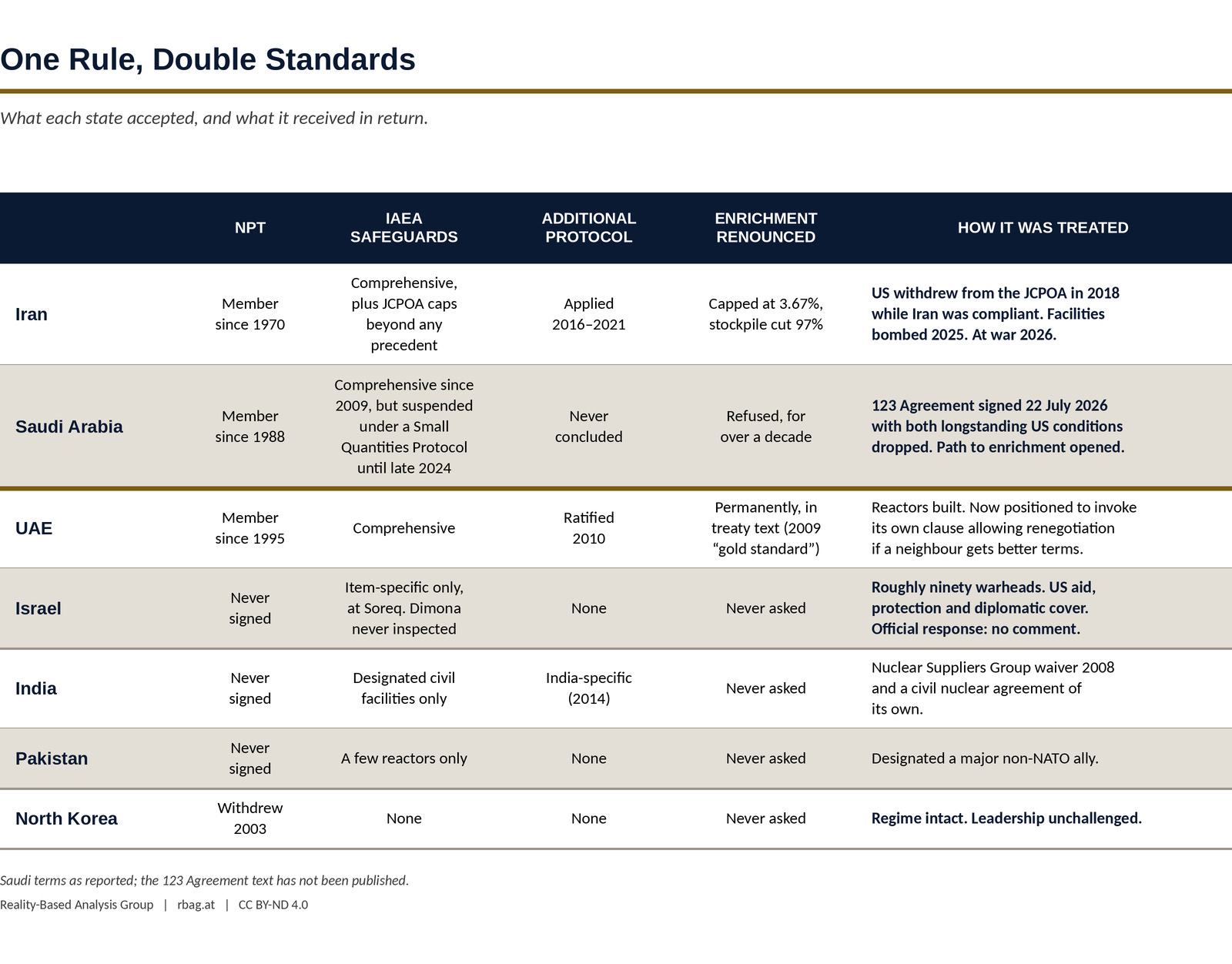
The third pillar upon which the Western nonproliferation myth is perched is the double standard. Here too the goal is coerced acceptance of the Western nuclear security umbrella. Vividly shown in the headlines, in the same month of July 2026, US President Trump simultaneously declared that Iran can “never” have a nuclear weapon yet offered the pathway for one to Saudi Arabia. Iran agreed in 2015 to the “Joint Comprehensive Plan of Action” (JCPOA), capped enrichment at 3.67 percent, reduced its stockpile of low-enriched uranium by 97 percent, dismantled two-thirds of its installed centrifuges, rendered the Fordow facility incapable of enriching uranium and the Arak reactor incapable of producing weapons-grade plutonium, and submitted to continuous IAEA monitoring. No state has ever agreed to such significant concessions and Iran remained in compliance with all of them until the same President Trump unilaterally withdrew from the agreement in 2018. He bombed the facilities eight years later in the conflict both nations are embroiled in now.
Saudi Arabia, on the other hand, joined the Non-Proliferation Treaty in 1988 but never renounced enrichment or reprocessing and resisted inspections entirely until 2024. Yet, on 22 July 2026, the United States and Saudi Arabia signed the “123 Agreement” specifically authorizing the transfer of nuclear material from the United States to Saudi Arabia. The previous conditions were dropped, and “inspections” are now being arranged by the two states themselves. Here we see that the state which accepted the most stringent and intrusive inspections regime in history was punished and bombed; the state which resisted for decades is being sold the component parts of a nuclear program.
And then there is Israel where the double standard ceases to be a matter of principle and becomes a matter of policy. Regarding Iranian possession of nuclear weapons, the United States hubristically declares “never!” whereas regarding Israeli possession, it squeaks “no comment.” Officials of the United States government routinely avoid comment or confirmation of Israel’s very tangible and well-known arsenal of approximately ninety nuclear warheads. Israel has never signed the Non-Proliferation Treaty, accepted inspections or safeguards, or even acknowledged the existence of a nuclear weapons program, let alone the weapons. Since the 1969 “understanding” reached between US President Nixon and Israeli Prime Minister Golda Meir, the United States stopped commenting.
This is the system. India and Pakistan built their nuclear weapons programs outside the NPT, and once armed, they were embraced. Israel built theirs and is protected. Saudi Arabia houses US bases, provides a foothold and profit-center, and it is welcomed into the club. Iran complied with the JCPOA and was declared a pariah state, vilified, and was bombed. With the Saudi example, other US allies are requesting the same provisions, South Korea foremost among them, but with the UAE, Turkey, and Egypt not far behind.

Thus, here too, the double standard has made nuclear weapons use more likely than before, as “friends” of the United States are being “allowed” the pathway to a nuclear program; indeed, they are being sold it. This, coupled with the visible example of American attempts to “punish” Iran after its compliance, inevitably leads to more proliferation, not less, and more weapons programs, more weapons, and more opportunities to use them.
V. Lessons Learned
Throughout all of this, the nations of the world watched, took note, and learned the pattern. In 2003, Libya surrendered its nascent nuclear program, which consisted mainly of centrifuges purchased from the A.Q. Khan network, and rather than ensuring support for his rule, Muammar Gaddafi was famously and publicly murdered in 2011 after his state was destroyed; it remains ruined to this day. Iraq had no nuclear program in 2003; it was invaded twice and its leader too executed on television. Iran signed the NPT, complied with the JCPOA, and has been attacked twice. North Korea, armed to the teeth, remains intact, its leadership unchallenged.
While these are similar patterns, they are not the same lesson. Libya in particular provides two very different takeaways to different audiences. The most obvious is the same as Ukraine’s Budapest Memorandum: paper assurances and guarantees are not defense alliances and are ignored at will for political convenience. The operation which ultimately deposed Gaddafi, however, supplies perhaps the greater and more dangerous one. That operation, ostensibly designed to protect civilians, was authorized by United Nations Security Council Resolution 1973, and passed in March 2011 only due to abstentions by China and Russia. Russia’s abstention became the defining moment in then-Russian President Dmitry Medvedev’s political career, initially portraying him as weak. However, far from damaging his career, Medvedev learned his lesson too, that the West was not to be trusted, and has transformed himself into the most hardened and steadfast hawk in President Putin’s inner circle. A brilliant man, bad cop to Putin’s good, this implacable opponent of the Western unipolar order was in large part made into who he now is due to the perfidy of Western exploitation of the international system.
Thus, the nations of the world note that the systems are applied unevenly, double standards are embraced without comment, and the mechanisms of power are used and abused according to the political desires of those with the nuclear arsenals to get their way. Smaller nations see the power, protection, and impunity of Israel, India, Pakistan, North Korea; the price paid by Libya and Iran; the deals made by Saudi Arabia and possibly South Korea; they see the same thing Medvedev saw, and they draw their own conclusions.
VI. The Wild Card
The doctrinal shifts, too, are not happening in a vacuum. They are happening while the legal architecture of nonproliferation and nuclear limits is being systematically dismantled. The New START treaty, the reason those Russian nuclear bombers were parked in open air and vulnerable to Ukrainian attack, expired on 5 February 2026. Russia unilaterally offered to abide by it for another year; after an initially positive informal response from President Trump, the agreement was allowed to quietly lapse with no action taken. There is no successor agreement currently under negotiation and for the first time in over a half century there is no agreed-upon limit or verification mechanism for any superpower’s most deadly weapons. Three months after the expiry of the New START treaty, in May 2026, the Eleventh Review Conference of the Non-Proliferation Treaty ended without agreement. The delegates were irreconcilably divided over the bombing of Iran.
Further, the smaller yield tactical weapons were never covered by New START to begin with. These have never been capped, never been counted, never been declared or inspected. Thus, the very category which now is publicly under consideration by both the United States and Russia for regional deployment and use, the one whose deterrent appeal is that it can and will be used, is a complete wild card. The nuclear weapons now being normalized for use have never been internationally controlled at all and the current political trajectory implies that they will not be.
VII. The Danger Zone
All of this has made the world a much more dangerous place. Nuclear threats have become almost routine since Ukrainian President Volodymyr Zelensky threatened to obtain nuclear weapons, mere days before, and possibly precipitating, Russia’s invasion of his country. Few believe that strategic nuclear weapons will be used in that conflict, regardless of provocation, which illustrates Karaganov’s dilemma and Colby’s suggestion perhaps better than anything else. The best example came in December 2025, when a swarm of 91 Ukrainian drones targeted President Putin’s residence at Dolgiye Borody on Lake Valdai, all of which were intercepted. Russia interpreted the attack as an attempted assassination, the regime decapitation the West has been shown to favor in Venezuela and Iran, and it qualified for the most radical of responses. Yet Russia’s response was not reciprocal, not nuclear, and left all of Ukraine’s leadership alive and well. Russian Foreign Minister Sergei Lavrov condemned the attack, Russian negotiators revised and hardened their positions, and conventional retaliation was dialed up a degree. No one feared a nuclear response and Russia’s vast nuclear deterrent did not deter the assassination attempt, if indeed that is what Ukraine attempted.
In the aftermath of the attack, rather than increase the deterrent, Russia hardened the target, blurring it on satellite imagery, covering parts of it with anti-drone netting, peppering it with Pantsir air-defense system towers. That is the anticipation of an attack and the preparation for defense, not deterrence.
It is the doctrinal shift, taking place simultaneously in both Russia and the United States, which is the new deterrence. It is the opening of the nuclear marketplace to Saudi Arabia which signals that nuclear programs are available for the right partners at the right price. It is the legal opening in which tactical low-yield nuclear weapons are unbounded and unrestricted. It is the exposure of the double standard and the shattering of the Western security umbrella revealed by the Iranian destruction of the US military bases throughout the Persian Gulf. This is the reality of nuclear proliferation at the dawn of the multipolar era. Expect more members of the nuclear club and soon, first in the Middle East and then swiftly elsewhere. Do not be surprised when normalized tactical nuclear weapons are used on the battlefield, perhaps as Karaganov’s warning, perhaps in lieu of US ground troops in Iran. And remember, the use of any weapon of war will be justified by those who use it or profit from it; tactical nuclear weapons will be no different.



 By
By