

Energy efficiency has become one of the most important topics in mobile networks. Operators need to support growing traffic, wider bandwidths, massive MIMO, better coverage and new services, while also reducing energy consumption, managing cost and meeting sustainability targets.
We have put together a five-part video series looking at Energy Efficiency Improvements in 3GPP Technologies, starting with LTE and then moving through 5G NR, 5G-Advanced Release 18 and 3GPP Release 19.
The aim of the series is to explain the topic in a structured way. Energy saving in mobile networks is not simply about switching equipment off. It requires careful coordination between radio design, traffic load, user experience, QoS, mobility, device behaviour, RAN hardware, network policies and service requirements.
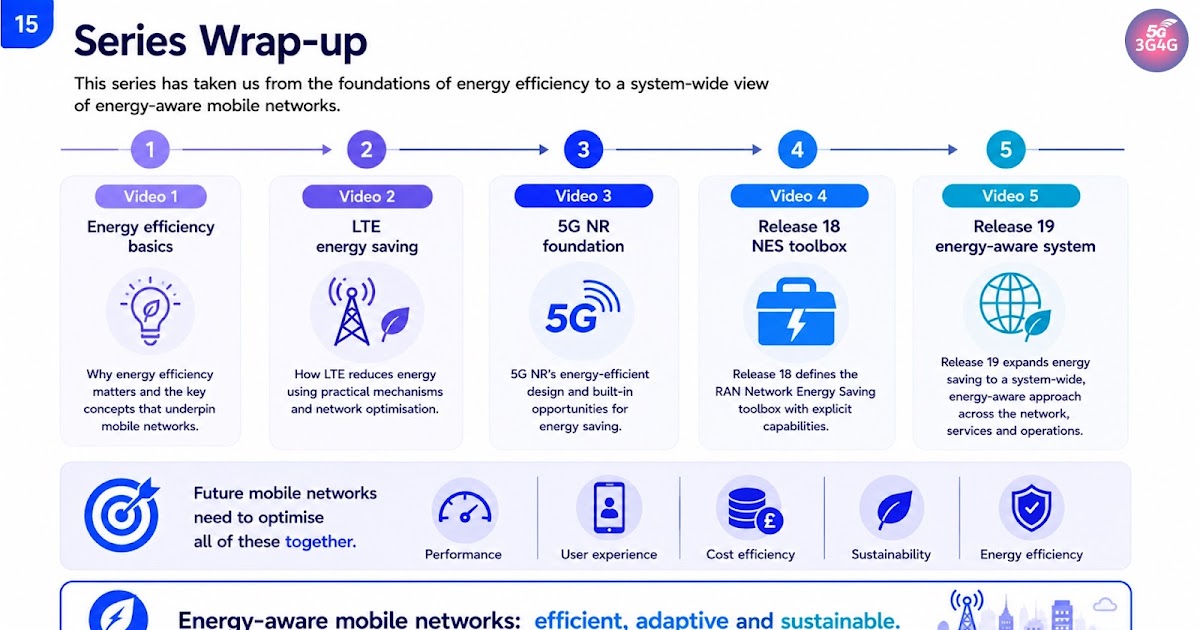
The five videos in the playlist are:
- Energy Efficiency in Mobile Networks: The Basics – This introductory video explains why energy efficiency matters, why the RAN gets most attention, how energy saving differs from energy efficiency, and why measurements and KPIs are essential before optimisation.
- How LTE Networks Save Energy – This video looks at LTE energy-saving mechanisms including dormant mode, carrier switch-off, secondary antenna deactivation, common channel power control, Cell DTX, compensation cells, and OAM or signalling-based control.
- Why 5G NR Is More Energy Efficient by Design – This part explains the energy-efficiency improvements built into 5G NR, including lean carrier design, sleep opportunities, Bandwidth Parts, carrier aggregation, UE DRX, massive MIMO, beamforming and radio hardware evolution.
- 5G-Advanced Release 18 Network Energy Saving – This video looks at Release 18 Network Energy Saving features such as SSB-less SCells, Cell DTX/DRX, CSI enhancements, antenna adaptation, PDSCH power adaptation, Conditional Handover for NES cells and legacy UE handling.
- 3GPP Release 19 Energy Efficiency and Energy Saving – The final video looks at Release 19 enhancements including on-demand SSB operation for SCells, on-demand SIB1 for idle/inactive UEs, SSB periodicity adaptation, PRACH and paging adaptation, LP-WUS/WUR, Energy Information Function, OAM, slicing, charging and energy efficiency as a service criterion.
The overall message from the series is that mobile network energy efficiency has evolved from relatively simple resource switch-off mechanisms towards more intelligent, adaptive and service-aware optimisation. LTE introduced many of the early practical ideas. 5G NR provided a more flexible and energy-efficient foundation. 5G-Advanced Release 18 made RAN Network Energy Saving more explicit, and Release 19 expands the topic towards on-demand signalling, UE wake-up efficiency and system-wide energy awareness.
The complete playlist is embedded below.
https://www.youtube.com/watch?v=videoseries
The main references used for this series include 3GPP article, 3GPP TR 21.919, 3GPP TR 38.864, 3GPP TR 38.869, NGMN material on 5G energy efficiency best practices, and technical material from Nokia Bell Labs on 5G-Advanced Network Energy Saving.
Related Posts:


 By
By