
[Yves here. Today we also have an important post by Rob Urie that starts with an important discussion of the Iran war, including discussion of fresh developments. So please read today’s update in conjunction with his article. I have to run out, so please return at 8:30 AM EDT or refresh this page then for a final version]
The media, and even commentators who should know better like Trita Parsi and Robert Pape, took up the CENTCOM/Trump framing that Iran’s strike on Jordan after refraining from attacks after the unilateral US “pause” as a “surprise” attack. FFS, a war is on. The US is engaging in an ongoing assault by imposing a blockade just beyond the Strait of Hormuz. That is an act of war.
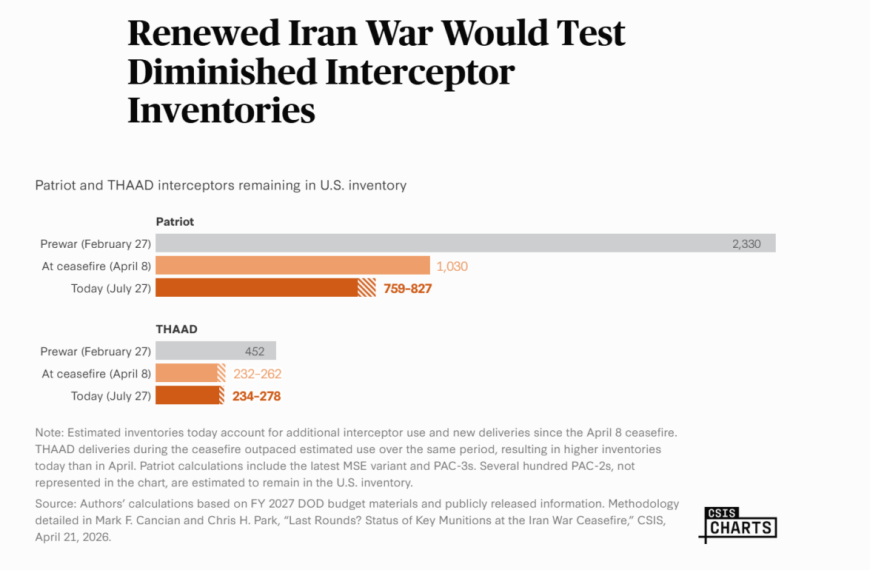
However, the Iran strike on Jordan is significant. It means Iran has abandoned its practice of attacking the US and its allies only in response to particular strikes, as opposed to continuing aggression and economic warfare. Iran is now out to displace Trump as the driver of events, and even more critically, of overall pacing and intensity. This is more than just getting inside the US OODA loop to gain tactical advantage. The US revealed, by refraining from the monster attack that Trump had threatened for last weekend, that the armed services were worried that the Iran conflict was depleting US precision weapons to the degree that continuing with the attacks, which were also admitted to be not very productive, could weaken US effectiveness in other theaters. Yes, the US still has ample supplies of less sophisticated arme. But generally speaking, using them puts servicememembers at more risk when the US has also demonstrated that it is casualty-averse.
As we will soon show below, Mohammed Marandi argues that Iran is now seeking to force US retreat by breaking its economy. But the US is one of the last in line in terms of downsides. India, most of Africa, Sri Lanka, and Indonesia are among the countries that will suffer great damage before the US will (admittedly, as with military fatalities, the US has limited pain tolerance).
Even though Marandi downplays this possibility, given what amounted to an intervention by top generals last weekend, it seems even more likely that the rupture will occur on the military front. Admittedly, there is the wild card, widely discussed in the Israeli media, of Israel and the US jointly attacking, as in the US gets a wee lease on force projection life.
Further evidence of US weakness comes via reports of the US dragging in NATO allies to try to parry Iran attacks:
German & French Fighter Jets (refueled by A400M) are operating over eastern Jordan, attempting to intercept projectiles targeting U.S. Bases. https://t.co/52hy8AnlPV pic.twitter.com/ZgPqnuBhEP
— MenchOsint (@MenchOsint) July 30, 2026
But even so, if Iran succeeds in deking the US into operating at a higher gear, the US will face the risk of dangerous depletion. Alternatively, it may fall into the trap of attempting a ground operation with US forces, as opposed to useful idiots like the Kurds. The Iranians eagerly hope the US will do so; independent Western experts are in close to universal agreement that it would be an epic fiasco.
At least on the energy front, the Trump team has signaled it is willing to go all in to try to beat Iran. We argued, and readers concurred, that the Department of Energy statement that the Strategic Petroleum Reserve could be drained to a level of 70 million barrels was tantamount to saying they were willing to collapse the salt caverns if need be.
But what happens if Trump grandiosity and need to dominate runs into resistance from the military? As Robert Barnes reported, Trump was talked down last weekend by being told in firmer, simple noun-verb sentences, that Bad Things would happen if he went ahead, plus the action was unlikely to hurt Iran much. What happens when Trump becomes immune to argument? I have said from before the time the war started that Trump was at risk of a soft military coup, of having orders (then the object of consideration was an unjustified declaration of martial law) defied. One possible version is a Trump version of the Saturday Night Massacre, of ordering Hegseth to fire generals who would not implement US-overall-interest-threatening attacks on Iran. Even if that did not generate a Constitutional crisis, as it did with Nixon. it could trigger a breakdown of authority in the armed services.
We’ll return to the strategic implications of Iran’s new posture but first, we’ll cover some kinetic updates.
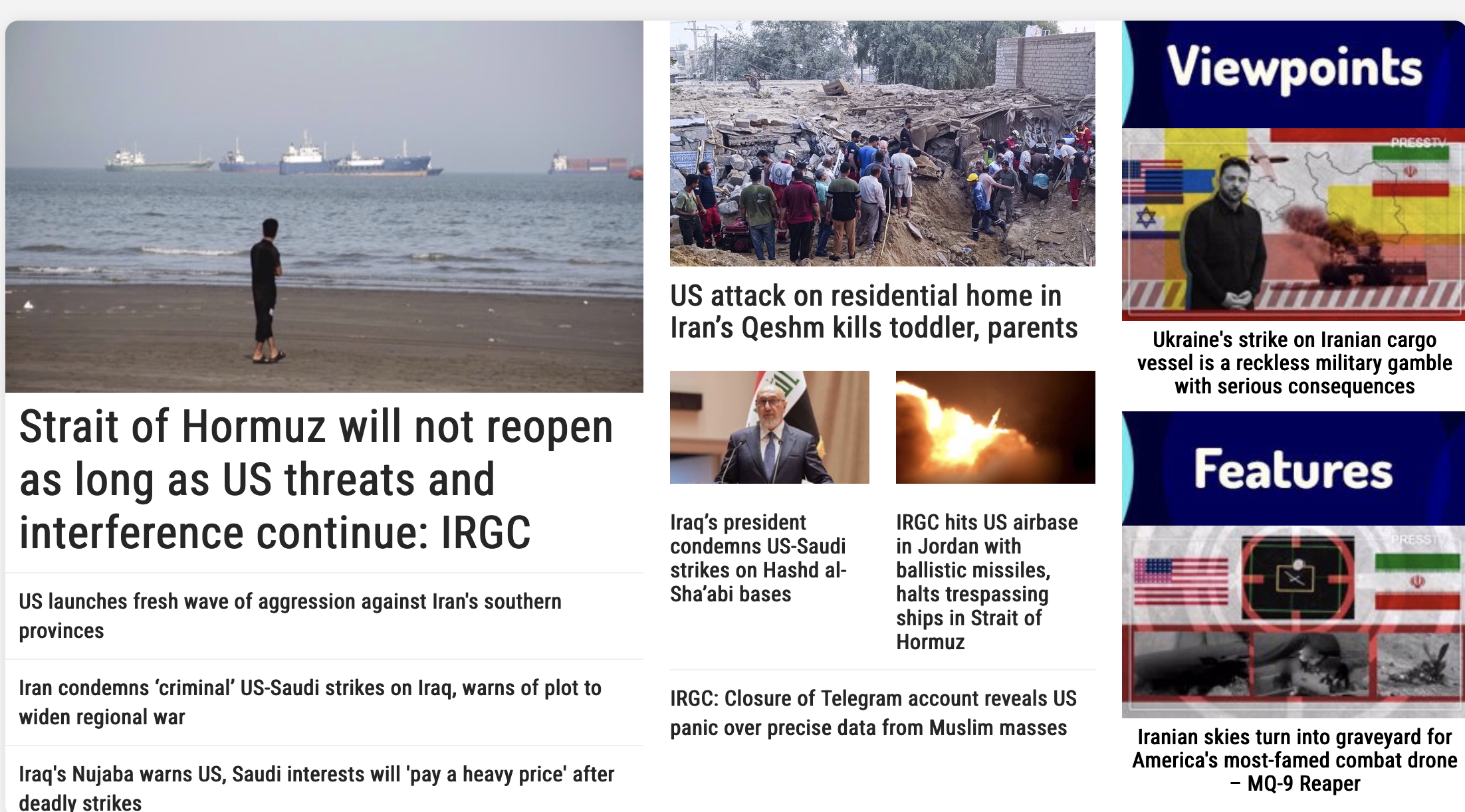
The PressTV landing page:

From US launches fresh wave of aggression against Iran; explosions reported across southern provinces:
In a post on X late Wednesday local time, CENTCOM claimed that American forces began the attacks at 8:00 p.m. ET (00:00 GMT Thursday), describing them as a so-called “powerful response” to what it labeled “attempted Iranian attacks” on US forces illegally stationed in the region the previous day.
Explosions were subsequently reported in several locations across southern Iran following the launch of the US attacks.
Three explosions were heard on Qeshm Island inside the city, Tasnim news agency reported. Explosions were also heard in Bushehr province, according to the IRIB state broadcaster.
If you click through and read the entire article, which includes images, it does not seem that the US hit anything of military importance. In other words, it looks like yet another punishment attack, which Robert Pape has warned will not succeed.
AlMayadeen also has an overview in US resumes aggression on Iran after five-day pause.
This action seems to fall well short of the punishment Trump promised to administer:
BREAKING: President Trump tells Fox News the U.S. will respond after surprise attacks on U.S. forces in Jordan:
“We’re going to beat the f***ing sh** out of them.”
“We’ll be hitting them hard.”
“They’re going to get a beating.” @TreyYingst pic.twitter.com/KgSXEmgt2p
— FOX & Friends (@foxandfriends) July 29, 2026
From Middle East Eye’s landing page:

From its live feed:
- A US strike on a residential house in Qeshm, located in Iran’s Hormozgan, killed three members of a family and injured two others, aged 7 and 9. Hormozgan official Ahmad Nafisi said that the family members killed included a father, mother and their two year-old child.
- The latest statement by the Islamic Revolutionary Guard Corps (IRGC) warned that countries who aid the US will face consequences. The IRGC also doubled down on Iran’s control over the Strait of Hormuz, saying that the strategic waterway will not be opened for as long as “US threats” continue.
- The chairman of the Joint Chiefs of Staff Dan Caine told US President Donald Trump that the situation regarding munitions stockpile could impact military operations in Iran, according to AP based on a US official source
- US President Donald Trump met with Saudi Arabia’s Defense Minister, Prince Khalid bin Salman, on Wednesday for urgent discussions following the two countries’ joint strikes on Iraq, Axios reported citing an American official.
- The Israeli army has intensified its attacks across the Gaza Strip, killing at least three – including a child – and wounding several others.
From Bloomberg’s landing page:

From US Strikes Iran Again as Conflict Widens Across Middle East:
- The US retaliated against Iranian strikes on American forces with a fresh wave of attacks, escalating a conflict that is spreading wider across the Middle East.
- The US hit dozens of targets in a two-hour operation aimed at degrading Tehran’s ability to threaten American forces, its Arab allies and commercial shipping in the region.
- Two liquefied-natural-gas vessels were hit by projectiles on Egypt’s Mediterranean coast and caught fire, with a security firm saying the vessels had been struck by drones.
…Two liquefied-natural-gas vessels were hit by projectiles on Egypt’s Mediterranean coast around the same time and caught fire. A security firm said the vessels had been struck by drones, but there was no claim of responsibility.
The discussion of the attack on LNG ships is cowardly. Importantly, Egypt did not assign blame. This smacks of being Israeli handiwork.
HFI Research begs to differ with the cheery headline take in the image above on Strait of Hormuz traffic:
Strait of Hormuz over the last 24 hours: same old shit.
In the past 7 days, Kpler estimated ~2 million b/d exited the Strait of Hormuz. A total of 15 tankers exited with 4 of them being related to Iran.
Based on the video from @MarineTraffic, you can see some tankers still… pic.twitter.com/TZO2Q6ZysQ
— HFI Research (@HFI_Research) July 29, 2026
Or at best, more Gulf States are knuckling under to Iran’s management:
The first Qatari LNG shipment in three weeks has successfully passed through the Strait of Hormuz along an Iranian-designated route with Tehran’s authorization, Fars news agency reported.
Three weeks ago, following a US violation of a memorandum of understanding, Tehran… pic.twitter.com/7ILma6zs0z
— Al Mayadeen English (@MayadeenEnglish) July 30, 2026
However, there are claims that the US hit at least near Iran refineries:
If this proves to be true, that the US struck directly on Iranian oil infrastructure tonight, the likely response from Iran before sunup, or possibly within 24 hours, is likely to be finding the same targets on our side.
Kuwait, Saudi Arabia, Bahrain, UAE, Qatar, all potential… https://t.co/kijs92BOvF
— Daniel Davis Deep Dive (@DanielLDavis1) July 30, 2026
Kuwait is still very much in the mix:
💢 Regional media reports and footage indicate that US missiles are being launched from Kuwait tonight.
Last week, Kuwait’s ambassador to the United States, Sheikha Al-Zain Al-Sabah, formally stated that Kuwait had not permitted its territory, airspace, or territorial waters to… https://t.co/Z8gtGMFG8G
— Drop Site (@DropSiteNews) July 30, 2026
There are also reports of new Iran retaliation on Jordan, but I have yet to see anything on live feeds or the big Iran official sites (Tasnim and PressTV):
🚨🇮🇷 BREAKING: Iran is firing back already, with ballistic missiles launching from Khomein and Tabriz reportedly aimed at U.S. forces in Jordan.
-Reports describe fresh ballistic missile launches from Khomein in Markazi province and from Tabriz in the northwest, with U.S. bases…
— Mario Nawfal (@MarioNawfal) July 30, 2026
Now to Iran’s shift in posture. We pointed out in January 2026, before this war began, while Supreme Leader Ali Khamenei was still alive, that Iran had changed its military doctrine to permit pre-emptive strikes. From that post:
From Tasmin News on January 6, translated by Resistance.org:
Statement of the Secretariat of the Defense Council of the Islamic Republic of Iran, January 6, 2026.
[….]
The Islamic Republic of Iran, relying on national cohesion, comprehensive deterrence capability, and full defensive readiness, once again affirms that the country’s security, independence, and territorial integrity constitute an inviolable red line. Any infringement upon national interests, interference in internal affairs, or action against Iran’s stability will be met with a proportionate, targeted, and decisive response.
Within the framework of legitimate self-defense, the Islamic Republic of Iran does not limit itself to responding after an action has occurred and considers objective indications of threat as part of the security equation.
So Iran has not changed its doctrine but has changed its strategy. We cited earlier statements that Iran would not consider itself limited to engage in proportional response.
Keep in mind that Iran’s officials have given up on negotiations, even though they go through the motions. From Esfandyar Batmanghelidj on Twitter:
Iran’s latest ballistic missile attacks and the continued rejection of compromise solutions on the Strait of Hormuz might seem like indications that “hardline” thinking is dominating Iran’s national security strategy.
But my conversations with counterparts in Tehran suggest that something else is at play. Iranian decisionmaking is increasingly shaped by an intense pessimism about what diplomacy with the U.S. can achieve. Most senior figures, whether pragmatists or hardliners, simply do not believe a deal is possible. This pessimism has gotten worse since the MOU was signed.
Part of this is about the repeated experience of U.S. escalation during the course of negotiations, but the pessimism is no longer confined to the question of “does Trump want a deal?” Increasingly the belief is that “Trump can’t do a deal, even if he thinks he wants one.”
Policymakers in Tehran are looking at several things. At a technical level, the Trump administration was unable to execute even the most basic confidence building measures of the MOU. No assets were released and the oil waiver was never really operationalized. Iranian leaders are also looking to other contexts. Even in Venezuela, where the administration has complete political control and a full court press approach to economic reengagement, sanctions relief has floundered (eg. it took a whole month after the massive earthquake for FinCen to take proactive steps to try and provide banks comfort to support humanitarian transactions).
At a political level, the Iranians have seen the overblown reaction to the MOU from the full range of politicians in Washington. Democrats eager to score political points attacked provisions in the MOU that would be fundamental to *any* viable agreement with Iran. The Iranians are also watching the growing rift between the Rubio and Vance camps and are concluding that the administration is inherently dysfunctional. During the Biden years, the issue was whether the president could defend his deal from political rivals in Congress. Now, the rivals are within the cabinet itself.
At an individual level, there is also a growing sense that Trump is too erratic to stick by his own deals. Even Saudi Arabia, the country with perhaps the greatest influence in the White House after Israel, could not shield its own nuclear deal from Trump’s excessive demands.
This may be an unprecedented situation. The U.S. has started a war it does not know how to end. Meanwhile, the arguments for diplomacy in Tehran have been reduced to “this has a low chance of succeeding, but we have to still try.” That’s not a strong, positive case for diplomatic engagement and understandably the strategic thinking is tending towards the idea that U.S. dysfunction will continue to manifest in the form of economic pressure and kinetic action against Iran for a long time to come.
Shorter: a country that has designated incompetent Zionists real estate brokers as negotiators and keeps sending them when it is well known on the US side that they are not merely not trusted but also hated, is unserious.
With Daniel Davis, Professor Mohammed Marandi provided fine one-stop shopping in term of what the more aggressive military approach means. Marandi confirms some items we had flagged, such as the fact that Iraqi militias did not attack the Saudi facilities at Jazan and Abqaiq but the Saudis refuse to credit Ansar Allah because they can’t respond effectively to them.
Nevertheless, the strikes into Iraq did kill some IRGC personnell:
BREAKING: Iranian sources are now confirming that [at least] four people affiliated with Iran’s IRGC have been killed in a joint attack by the US and Saudi Arabia, reports Al Jazeera’s Tohid Asadi, from Tehran.
🔴 LIVE updates: https://t.co/xBiIBjGkzo pic.twitter.com/yXir4xhj6Y
— Al Jazeera English (@AJEnglish) July 29, 2026
Marandi also describes at length how the Gulf State monarchies are hopeless vassals of the US and that the most they can do is plead with the Trump Administration not to make particular attacks.
From a lightly edited machine transcript:
Marandi: I do think that the Iranians believe that the best way to bring an end to the war is to is for Trump to be defeated. And rather than this going on and on for many months and being drawn out, the Iranians would like to end this sooner. That’s why when the war began five months ago, over five months ago now, uh the Iranians wanted Trump to carry out a land offensive. And during those 40 days of fighting, I when I would speak to people who were pretty much well somewhat well informed about the situation, they were keen on a land offensive….
So right now the Iranians are thinking in my opinion that we don’t want the Americans to sit back and uh rearm themselves or bring in a few more missiles and then two weeks from now uh start it up again for a few days and then we want this to play out as as much as possible. And at at the moment since in my opinion the energy crisis is growing very fast even though they’re manipulating the price and the price is low but again you had another guest a few weeks ago who discussed this and I I think what he was saying I don’t remember his name but I think what he was saying more is is more or less valid. I think we’re approaching that turning point and after a certain period of time uh manipulation doesn’t work….
Especially since now the uh the Red Sea is closed to Saudi Arabia and the Yemenes are striking Saudi Arabian assets…
So that’s basically what the Iranians want to push him towards to recognize that if he keeps going then he’s going to the the global economy is going to go off a cliff….
Davis: Are there talks going on behind the scenes?
Marandi: No. The Iranians have zero interest in talking to Trump. They will not talk with him. They will not talk with the United States representatives.
[Add discussion of Trita Parsi and perhaps Robert Pape]
And in a further sign of desperation and weakness, despite the Saudis and the US failing to subdue Ansar Allah, the Saudis act as if a new college try against a now more powerful Yemeni resistance will somehow work. Magical thinking is not a strategy. From Antiwar in Saudi Arabia To Announce New Red Sea Coalition To Counter Yemen’s Ansar Allah
Saudi Arabia is seeking to form a new multinational coalition to pre-empt any effort by Yemen’s Ansar Allah, also known as the Houthis, to shut down the Bab el-Mandeb Strait, Al-Monitor reported on Wednesday.
Following Saudi airstrikes on Yemen’s Sanaa International Airport earlier this month, Ansar Allah has targeted oil infrastructure inside Saudi Arabia and has announced a maritime blockade on Saudi ports, attacking at least three tankers, a policy the group calls a “blockade for a blockade.”
While the new blockade has disrupted shipping in the region, Ansar Allah hasn’t announced a blanket ban on shipping through the strategic Bab el-Mandeb Strait, which connects the Red Sea and the Gulf of Aden. Some Chinese ships loaded with Saudi crude have also been able to pass through the strait, and Reuters reported that Beijing had cleared each passage with Sanaa.
But as the US-Iran war and conflict across the region are escalating again, the chances of the Bab el-Mandeb Strait being completely closed are rising. The Al-Monitor report, which cited two diplomatic sources and an unnamed US official, said that Riyadh has invited around 50 nations to join the Red Sea coalition, but that US support was seen as vital for the initiative to take off, and it was unclear at this point if Washington would participate…
Similar efforts to counter Ansar Allah attacks on shipping have failed in the past, including President Biden’s 2024 formation of a multinational coalition, dubbed Operation Prosperity Garden [Guardian].
President Trump also tried and failed to get Ansar Allah to end a blockade on Israeli shipping…
Ansar Allah also sustained a brutal seven-year war from 2015-2022, launched by a US-backed Saudi/UAE-led Gulf coalition. The goal was to oust the Houthis from Sanaa, which the group took control of in 2014, and reinstall the government of former Yemeni President Abd Rabbuh Mansour Hadi, who died in Riyadh earlier this year, but it failed, and the two sides agreed to a ceasefire in 2022, which held relatively well until the Saudi strikes on the Sanaa airport.
Note this article confirms that Ansar Allah has permitted only loaded Chinese vessels to depart; there is still no sign that even Chinese ships are being allowed to take new Saudi cargoes.



 By
By