
Two months ago, I tripped over a big old tree root while running and hurt my shoulder (I wrote about it here). The Urgent Care doc said that probably it was just a sprain and I should come back for an Xray and MRI only if the pain or mobility symptoms worsened in the next couple of days. I’m averse to medical tests, so that recommendation aligned with my own avoidant inclinations. Nothing worsened. So, I went about my life. As was possible. Given that I had severely restricted mobility and, yes, some pain, which I worked hard to minimize, going so far as to take fewer of the prescribed painkillers, to monitor my recovery, I told myself. Minimizing pain is an inherited trait. Discomfort was not to be acknowledged in my family.

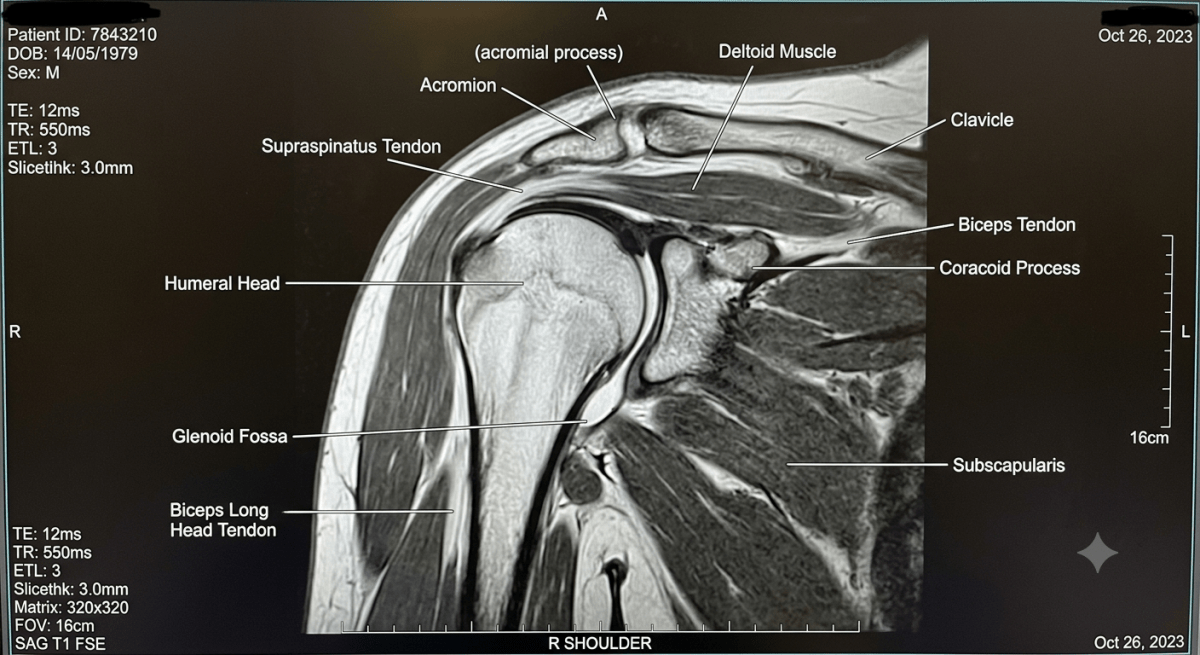
More than a month after my shoulder injury, I finally started physical therapy. Although I already felt miles better, the therapist said she wouldn’t treat me without an Xray and MRI. The results were shocking (not just to me, also the doctor and the physical therapist). I had multiple fractures and partial tears. You know that feeling when you have just had a close shave and then afterwards you are shaky, thinking about what might have been? That’s how I felt when I got the MRI results, oh — that’s why my shoulder hurt so fucking much. The results gave me retrospective permission to feel all the pain I’d been in. Even though it was mostly gone by then. I realized that I’d been very tuned into what provoked more pain. But I was less tuned to the level of daily pain.
I would like to move beyond my inherited relationship with pain. And yet, here’s what I’m wondering: did not naming the pain, nor seeking an accurate diagnosis, help me? My recovery has gone better than expected. I’m not back to doing handstands or pull-ups. Yet. Eight weeks out, almost everything else is back, with only minor tweaky discomfort. I can throw on a jacket or wrestle off a sports bra without a significant extra physical negotiation. Running. Cycling. Yoga. Oh, yes, I am using lighter weights at the gym. I’m not that insouciant.
In an easy version of this scenario, I tell myself, see, not knowing healed me, the mind is powerful, trust the body over the scan. The reality is that I have no control case. I don’t know what would have happened to this shoulder if I’d had the MRI on day three instead of day thirty-two. Maybe I’d have been sent to surgery, immobilized properly, protected from re-injury, and healed faster and cleaner. Maybe the delay allowed me to heal in blissful ignorance. I can’t know.
Here’s a possibility I’m considering: Not knowing how bad my injury was meant I didn’t guard the shoulder the way I might have if a radiologist had handed me a list of exactly what was fractured and torn. I kept using my shoulder, to the extent my body allowed, without the extra layer of fear that comes from a diagnosis. Pain research talks about fear-avoidance, catastrophizing, the way bracing against a movement can cost you more function than the injury itself does. Maybe less fear meant less guarding, and less guarding meant more range of motion stayed available while the tissue healed.
At the same time, I’m suspicious of my own desire for my not-knowing to have helped, because that’s the version where I’m tuned into and trusting my body. I like that story. And I’m going to hold it loosely.
What I’ve learned from this incident is not, don’t get a scan. In fact, I’ll be more likely to get an early scan next time. And I want to create more permissive space for my pain to be real, no matter if there’s a diagnosis or not. At the same time, I want to stay tuned to my body and keep dancing with my potential fear and the threshold of what’s still possible.
Related
Discover more from FIT IS A FEMINIST ISSUE
Subscribe to get the latest posts sent to your email.

Published by


 By
By