

[Today’s Iran war post launched before complete because reasons. Please return or refresh this page at 8:00 AM EDT for a final version]
Trump is doubling down on the Iran conflict despite the fact that the narrowing of war aims to merely re-opening the Strait of Hormuz is already an admission of failure. Even though Trump is the undisputed master of double-speak, it seems hard to fathom how he could reverse himself and abandon the war, particularly since the Iranians would make a point of humiliating him.
The press and markets are continuing to downplay the significance of the current escalation. Too many are depicting it as tit for tat, as in more of the same, when that is not accurate. Not only are the strikes and counter-strikes more severe, but the US is hitting targets deeper inside Iran, including uncomfortably close to the Bushehr nuclear plant. Iran has considerably expanded its targets to include Oman and Qatar and is now going after the UAE port of Fujairah to prevent its use as an export route.
Even more significant, in terms of another massive strategic miscalculation, is that, as we described yesterday, Iran defied the 11 year Saudi blockade of Yemen by flying a plane into and out of Sanaa. Iran tried a second run, among other things, to bring some mourners at the funerals of the Supreme Leader back. The plane eventually managed to land despite Saudi Arabia bombing the runway. Yemen has announced that it will close the Bab el-Mandeb strait. This has ramifications on commerce far beyond the impact on oil exports from the Gulf, as we will explain below. And it comes when Ukraine is successfully interfering with Russian shipping in the Sea of Azov. Even if, as Ukraine skeptics argue, the interference is not all that consequential to Russia and is being addressed, it has led to a halt of diesel exports and has the potential to seriously dent wheat exports when the world is set to enter a period of high prices and shortages due to the one-two of fertilizer and diesel price hikes plus a super El-Nino.
The only sort-of-sensible explanations so for for Trump’s conduct (ex that if push comes to shove, he will greenlight Israel using nukes) is that he believes he can bring Iran to heel with another three to four weeks of punishment and perhaps some economic privation.1 Robert Pape has described long form that punishment campaigns do not work. On top of that, we are going into this round of escalation in a weaker position from a weapons and oil supply vantage. Iran surely knows that, which is even more reason for them to continue to hang tough.
First to some overviews, starting with some immediate action and then the implications, particularly for oil and other critical materials.
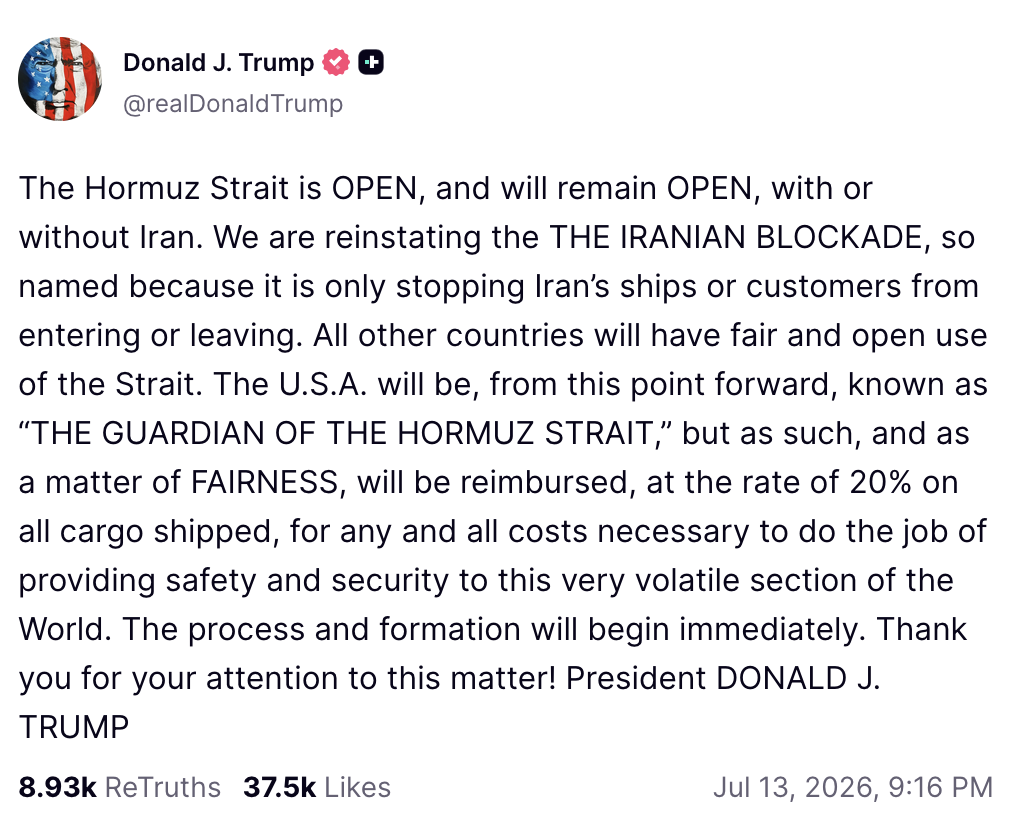
Trump’s blockade announcement:

A good talk at Bloomberg, Legality of US Plans for 20% Cargo Toll in Strait of Hormuz, cannot be embedded, but the transcript of the talk with Jennifer Parker, Adjunct Fellow at UNSW Canberra provides her good high level take. Importantly, she debunks the oft-repeated depiction of the latest exchanges as “tit-for-tat” as in similar to the action in recent weeks, when they are more severe. From Parker:
So I know this has been compared to the tit for tat that we saw during the ceasefire in April where one stride side would strike each other, and then there would be a response and we’d be in a lull. But I think the last week is something different.
We’re seeing this continued escalation since Monday last week. We’ve seen six ships struck in the Strait of Hormuz and the US reapplying that naval blockade. We are in a very different phase of this conflict…
And the US, unlike in April when Iran was attacking ships, have decided that they need to disincentivize Iran, and the way they’re going to do that is through punishment. So every time Iran attacks shipping, The US responds by attacking Iran. That is a different strategy. That is the deterrence by punishment strategy as opposed to the economic incentive strategy we saw in the Memorandum of Understanding.
Bloomberg for a change is signaling alarm in its headlines:

From US-Iran Truce Collapses as Attacks Worsen and Blockade Returns. Note that the oil price reaction says no one is taking Trump’s 20% fee scheme seriously, plus the US does not even remotely have the apparatus to implement it (although the US could just play pirate and seize vessels and cargoes). Nevertheless:
Other states, including major Gulf Arab oil and LNG exporters and Asian importers, may balk at having to pay a 20% fee. That would add roughly $32 million to the cost of sailing the largest tankers, which can hold 2 million barrels, through Hormuz at today’s prices.
The White House did not provide other details on Trump’s proposal, including how fees would be administered or whether the proposal had been communicated to US allies in the region such as Saudi Arabia, Qatar and the UAE.
More than 10 people involved in shipping markets, including a handful whose ships have passed through Hormuz in recent weeks, said they were blindsided by Trump’s announcement of fees on cargoes crossing the waterway. They said it was too early to know what the plan might look like in practice and how it would shape their decisions about transit.
Not surprisingly, Iran jumped on Trump legitimating the idea of charing for supervision of Gulf transits:
POTUS is absolutely right. Whoever provides secure and safe passage of commercial vessels through the Strait of Hormuz should be compensated for this service.
Iran has always been the GUARDIAN of the Strait and will remain so FOREVER.
20% is of course too much. We will be fair
— Seyed Abbas Araghchi (@araghchi) July 13, 2026
And the shipping industry is up in arms:
Trump’s Hormuz toll plan could backfire, global shipping industry warns — here’s why https://t.co/ICj8OQdvhi
— CNBC (@CNBC) July 14, 2026
More from the Iran side on kinetic action, via The Cradle on Twitter:
Iran’s Islamic Revolutionary Guard Corps (IRGC) issued three more statements on the morning of 14 July detailing retaliatory operations following overnight US attacks on Iranian military sites and coastal facilities. The statements announced strikes against maritime targets near the Strait of Hormuz and US military assets in Bahrain, while warning that cooperation with US military activities in the region could further delay the reopening of the strategic waterway and deepen the global energy crisis.
■ The first statement (Announcement 6 since Monday morning) said two violating supertankers were struck and disabled after ignoring repeated warnings from the Strait of Hormuz Security Control Center. The vessels had switched off their navigation systems and attempted to transit through a mined route with US encouragement, endangering maritime navigation.
■ In the second statement (Announcement 7) the IRGC said it launched the second wave of Operation Nasr-2 against the US Naval Support Activity in Juffair, Bahrain (Fifth Fleet). The operation reportedly targeted several weapons support warehouses, a satellite communications center, and accommodation facilities housing US personnel, describing the strikes as an initial response to fresh US air attacks on southern Iran.
■ In its third statement (Announcement 8) the IRGC announced further missile and drone strikes against the US Fifth Fleet in Bahrain, claiming to have set fuel storage facilities ablaze and destroyed Patriot radar systems, the fleet’s air-control radar, an early warning C-RAM radar system, and a command and monitoring center for unmanned guided boats.
The IRGC stressed that retaliatory operations remain ongoing.
And from Middle East Eye’s live feed:

The feed includes fresh accounts of Iran attacks on tankers on the Oman side of the Strait of Hormuz:
Another vessel attacked near Oman, UKMTO says
An oil tanker was targeted by a missile while transiting the southern route of the Strait of Hormuz near Limah, Oman, the UK Maritime Trade Operations agency said, adding that the vessel was struck about 13 nautical miles east of the Omani town.
The incident follows a separate attack reported a day earlier near Qalhat, where UKMTO said a tanker was hit by an unknown projectile on the starboard-side engine room.
UKMTO WARNING 087-26 – ATTACK
Click here to view the full warning ⤵️ https://t.co/K9ry6dSGTe#MaritimeSecurity #MarSec pic.twitter.com/KyMMsk7AqZ
— UKMTO Operations Centre (@UK_MTO) July 14, 2026
And:
The US Central Command has released footage after saying its forces completed a new wave of strikes against Iran on Tuesday pic.twitter.com/OmtxFkuwH9
— Middle East Eye (@MiddleEastEye) July 14, 2026
Aljazeera’s live feed, which is updated the most frequently, includes some new hopium:

- The UAE says two of its national tankers were hit by Iranian cruise missiles, as India summons Iran’s deputy ambassador after an Indian crew member was killed and several others were wounded in the attacks.
- The US has carried out more strikes on Iran, with Iranian media reporting explosions on Kish and Qeshm islands, as well as Bushehr and Bandar Abbas.
Key entries in the last hour:
More explosions reported in southern Iran
Four locations in Bushehr – in southwestern Iran and home to nuclear facilities – have been hit by US missiles, Iran’s official news agency IRNA reports.
Iranian state television earlier reported at least five blasts were heard near the southern city of Bandar Abbas.
‘Complex talks have begun to shape a lasting framework’ for Hormuz: Omani FM
In an opinion article published in the French daily Le Monde, Badr bin Hamad Al Busaidi, Oman’s foreign minister, writes that his country bears “a particular responsibility” because its territorial waters border the strategically important Strait of Hormuz.
“Complex talks have begun to shape a lasting framework guaranteeing freedom of navigation in the Strait of Hormuz,” he wrote in Le Monde on Sunday.
The top diplomat added: “It is incumbent upon Oman to work with Iran – the other coastal state – as well as with the entire international community, which depends on this maritime route, to develop a system that is realistic, sustainable, and compliant with international law, thus safeguarding freedom of navigation.”
If you believe the talks between Iran and Oman will get anywhere, I have a bridge to sell you. There could eventually be some sort of understanding between Iran and the Gulf states, but it will take time and some pain to get there.
This Janta Ka segment is worth a watch due to its, many worthwhile clips: Trump’s latest derangement of 20% fees in Hormuz and hallucination of a negotiating session with Iran that never happened, Rubio earlier contradicting Trump’s new position, Ansar Allah describing retaliatory strikes on Saudi Arabia and its plans to close Bab el-Mandeb strait, and more from Ro Khanna on Israel’s savagery towards Palestinians in West Bank:
The Janta Ka clip includes part of a statement from a Ansar Allah spokesman, in which he also warns against the use of Saudi airspace, as in it is on the menu.
Anadolu Agency’s update on shipping, Renewed US-Iran strikes bring Strait of Hormuz tanker traffic close to a halt, has the subhead, “Only 2 tankers complete crossings in past 24 hours, while 2 LPG carriers approach critical energy waterway.”
Now to a look at oil and energy markets. A quick overview of the state of play (not ploy):
📈 https://t.co/xQzuNfwW5a pic.twitter.com/oVfMJqFxWE
— MenchOsint (@MenchOsint) July 13, 2026
U.S. GASOLINE PRICES are escalating in response to low inventories and intensifying fighting in the Gulf and Russia. Front-month futures have risen to $137 per barrel from a low of $121 a month ago. Inflation-adjusted prices are already in the 58th percentile for all months since… pic.twitter.com/aPoHzLVvOP
— John Kemp (@JKempEnergy) July 14, 2026
Strikes across Iran, into Jordan, near Oman, and along the entire Hormuz corridor.
This is the instability actually moving the price.
Not a headline.A map with strikes on both sides spanning 5 countries.
Brent does not need a new catalyst to keep rising. It just needs this… pic.twitter.com/dV3NxzmG9W
— Jack Prandelli (@jackprandelli) July 14, 2026
Commodities maven Jeff Currie is again cheery as oil is now destined to move higher. He and Mario Nawfal discuss their mystification as to why the market reaction is chill given the givens. There are some sour notes from Currie; he labors under the misapprehension that Russia is closer to civil war than the US.
From Currie in a lightly-edited machine transcript:
The market doesn’t take any of this seriously, which I think is what’s being reflected in both the equity market as well as the oil market. But,for those of us who follow this, this is serious. This is not a there the ability to back out of this thing, I think, is going to be really difficult…I think you know because at this point the TACO options have all been exhausted and in this time it’s far more aggressive….
I think it was Paul Tudtor Jones who was just going talking about Elon Musk and calling it a French Revolution moment…
I think the the reality is these are all simmering issues that need to be addressed and are not being addressed and will continue to percolate and they hit commodities in a particular strong manner because when you’re delobbalizing, you have to build out new supply chains. You’re going to onshore stuff and bring it back home. You need energy security of your supply chains and then you need to spend a lot of money on defense.
All of that is lots of commodity spend, metals and energy and everything like that. And so on that then if we turn to the electrification and if you think about why do you want to electrify? You want to electrify because you want to bring it home, because everybody has their own sunshine. Everybody has their own wind and everybody can get nuclear because it’s small little you know you’re not having big long supply chain.
So it localizes every everything. And then you think about redistribution.
Why do you need the redistribution?
Globalization made these individuals very poor in some of these countries because of we’re basically capital in the United States and Europe did incredibly well. Labor did not.
And so by bringing it onshore and bringing it home, it brings back that whole point. They’re all really the same story. I want to delobalize because I want to protect my my workers. My workers were the ones that suffered from deglobalization. And this is what happened, you know, in in the the leadup to the Second World War. It was the same thing. The you instead of being the US, it was the UK. It’s the same story just being replayed again. And again, they’re all that they all boil down to the exact same thing. um you know bring it home, localize, protect my my manufacturing my workers. And by bringing it to my country I make them safe.
The effective closing of shipments out of Fujairah has not gotten the attention it warrants. From HFI Research on Twitter:
Two VLCCs get attacked using the Oman lane. Origin is from Fujairah.
Fujairah, as the ship-to-ship transit hub, is all but dead.
These tankers are sitting ducks. If Iran escalates into Fujairah, UAE will have to shut-in 3.5 million b/d of crude.
This is on par with closing Bab el-Mandeb.
And:
Fujairah, Fujairah, Fujairah.
Crude timespreads awaken because Fujairah is where GCC has been giving stupendous discounts on crude. pic.twitter.com/6s4NqhjQXS
— HFI Research (@HFI_Research) July 14, 2026
To the significance of the closure of the Bab El-Mandab, Brandon Weichert had turned to that topic in his Substack just after Ansar Allah started escalating by attacking a vessel:
🔴 The UK Maritime Trade Operations (UKMTO) says it has received a report of an incident approximately 50 miles south of Aden, Yemen.
Follow: https://t.co/7Dg3b41hTx pic.twitter.com/o76NSrSRYn
— PressTV Extra (@PresstvExtra) July 13, 2026
From Houthis Ready to Close the Strait of Bab el-Mandeb:
Located between Yemen and the Horn of Africa, the narrow Bab el-Mandeb serves as the southern entrance to the Red Sea and, ultimately, the Suez Canal. Any vessel traveling between Europe and Asia through Suez must first transit the vulnerable Bab el-Mandeb.
One chokepoint limits exports.
The other limits distribution.
And together they form a strategic trap unlike anything seen in modern economic history.
Closing Bab el-Mandeb Changes Everything.
If the Houthis start systematically attacking commercial shipping, as they had done throughout the Biden administration, and the Iranians seal the SoH, the effects would be immediate. Insurance premiums would explode.
That would, in turn, force shipping companies to suspend Red Sea transits.
Container carriers and energy companies would then divert vessels around the Cape of Good Hope—adding significant time (and, therefore, cost) onto the journey.
As time and costs to ship goods globally increase due to the closure of shorter routes through the Middle East and Africa, the price of everything rises as shippers and other producers pass on higher shipping and insurance premiums to their consumers.
One reason shipping costs would increase for ships relying on the Cape of Good Hope route is that it would add two weeks to most journeys that would otherwise use the Mideast routes. Beyond adding an inconvenient two-week transit time, the longer journey would increase fuel costs for ships using the Cape of Good Hope route.
The longer that this condition persisted—and it’d go on a while—the fewer voyages per year that shippers would make. That’d ensure that the global merchant fleet effectively shrank overnight because vessels spent far longer at sea. So, what appeared to be a shipping delay quickly devolves into a shortage of available ships.
That shortage drives freight rates higher, delays deliveries, and cascades through every major supply chain on Earth.
All this would likely lead to severe aggregate demand destruction. Just think back to what happened during the COVID-19 global lockdowns. We’d experience something similar, only likely worse, this time around as the Houthis worked with the Iranians to seal the Strait of Bab el-Mandeb and the Red Sea.
Weichert gives more color in a talk with Mario Nawfal:
From a lightly-edited machine transcript:
I think Somaliland is going to come into play over time. I think that they’re getting the center of gravity or not the center of gravity but I think another front, rather in the war is set to open up and it’s going to be in uh the the Gulf of Aden between Israeli, Turkish, UAE, US potentially forces stationed in or going to be stationed in Somaliland to try to stop the missile strikes coming out of Yemen from the Houthis. And I think that this is expanding. I don’t think the war is ending….
This is now a different kind of escalation. It’s more of a geopolitical one, but it’s an escalation nonetheless and the Iranians are driving it. This is not good….
If everybody’s worried about the price of everything going up right now, if the US military starts firing on ships, even if they are ships belonging to the shadow fleet, h it’s the the the real risk here is escalation, first of all, followed on by even greater price hikes because that’s just going to add volatility into the whole thing market.
So, I mean, there’s no winning on this one. He should not even be doing this. What he should be doing is deescalating. This isn’t worth it. Who cares? The the the issue is we’ve got to have a consistent flow of energy and agricultural goods. And by the way, the last 24 hours, another story that’s I’m looking at is what’s going on with these drone attacks in the Sea of Azov, which is Ukraine side.
What the Ukrainians are doing is they’re attacking Russia’s wheat production, their ability to move large numbers of wheat goods of wheat to the international market. And then if you add that with the ongoing agricultural shutdown because of the Strait of Hormuz, we are talking about global famine conditions happening in real time and we’re heading into it right now.
This is a very very precarious situation especially if the Houthis initiate their blockades of the Bab el-Mandeb and the Red Sea and by extension they will then have the ability,h because they’ll cut off the southern entryway they’ll have the ability to strangle the Suez Canal. So we’re talking about a total shutdown of a massive chunk of waterways that both energy and food stuffs has to use daily.
Done for today! See you tomorrow!
____
1 Per Axios on July 8 in With Iran ceasefire “over,” Trump shifts to battle for Hormuz. Note how the US believes Iran’s leadership is divided and the US can exploit that:
The White House is preparing for what could become a multi-day or even multi-week exchange of fire with Iran over the Strait of Hormuz.
- The length and severity of the new campaign hinge entirely on Tehran’s next moves, U.S. officials tell Axios.
Why it matters: A war that began with the goal of degrading Iran’s missile capabilities and destroying what remained of its nuclear program has evolved into an open-ended fight over the world’s most important energy chokepoint….
Between the lines: U.S. officials say the White House believes it has more room to escalate because hundreds of oil tankers have managed to leave the Gulf through the strait in recent weeks.
- That has eased concerns inside the administration that a renewed clash would immediately trigger a major oil price spike, the officials said.
Behind the scenes: A U.S. official claimed the current escalation stems from frustration among more radical elements inside Iran’s fractured leadership who believe the MOU has not delivered real benefits for Tehran.
- Iran saw its leverage in Hormuz slipping as hundreds of ships transited through the southern route close to the Omani coast, the official said.
- Despite U.S. sanctions waivers, Iran struggled to sell oil because financial institutions would not approve transactions and countries were reluctant to rely on temporary waivers.
- No Iranian frozen funds have been released because Iran has not yet taken nuclear steps required by the agreement.
- The framework agreement the U.S. brokered between Israel and Lebanon made the Lebanon portion of the MOU unnecessary, the official said.
What to watch: “Part of the Iranian leadership was not happy about all of those things,” the U.S. official said.
- “They started shooting and we decided it’s time to slap them back hard. It’s a process. We have patience. If we don’t feel we’re getting the deal we want, we are not going to do it.”


 By
By